
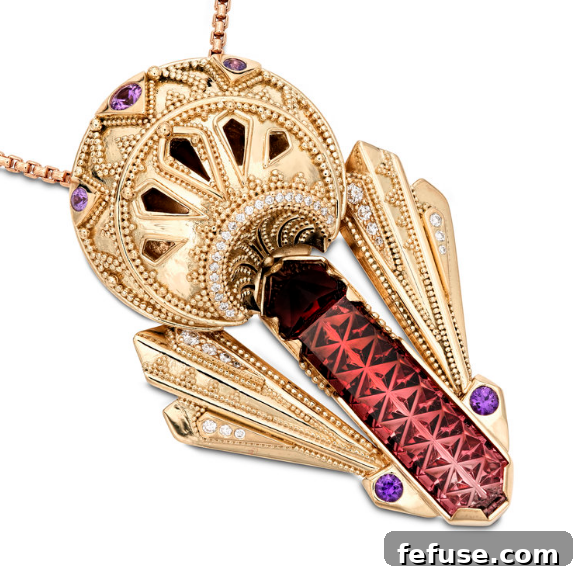
The world of fine jewelry design paused to celebrate unparalleled talent and innovation as Rio Grande proudly announced the winners of its 17th annual Saul Bell Design Award competition. This highly anticipated event culminated in a prestigious gala dinner held on May 21st during the esteemed Santa Fe Symposium in Albuquerque, New Mexico. For nearly two decades, the Saul Bell Design Award has served as a beacon, illuminating the most creative minds and skilled hands in the global jewelry community, fostering a spirit of artistic exploration and technical mastery.
Renowned for its rigorous judging process and the caliber of its entries, the Saul Bell Design Award continues to attract a diverse array of design professionals and aspiring artists from around the globe. This year’s competition once again showcased an extraordinary collection of works, pushing the boundaries of traditional and contemporary jewelry art. A distinguished panel comprising leading experts in design, art, and metallurgy meticulously evaluated entries across eight distinct competitive categories, ultimately selecting first- and second-place winners, alongside the coveted overall Best of Show recipient.
The competition is more than just an awards ceremony; it’s a vital platform that spotlights emerging trends, celebrates established masters, and inspires a new generation of jewelers. The breathtaking craftsmanship, innovative material use, and profound artistic vision displayed by this year’s winners and finalists underscore the vibrant and ever-evolving landscape of jewelry design. These awards not only recognize individual brilliance but also contribute significantly to the advancement and appreciation of jewelry as a legitimate art form.
For those eager to delve deeper into the captivating world of these award-winning creations, a comprehensive showcase of all winning designs and finalist pieces is available for viewing online. The official competition website, saulbellaward.com, offers an immersive experience, allowing enthusiasts and industry professionals alike to appreciate the intricate details and artistic narratives behind each masterful piece.
Celebrating the Pinnacle of Design: Best of Show and Category Victors
The culmination of months of meticulous work and passionate creativity, the 17th annual Saul Bell Design Award ceremony honored exceptional talent across various specialties. Here, we present the designers and their visionary pieces that earned the highest accolades, setting new benchmarks for excellence in jewelry design:
Best of Show: Valerie Jo Coulson’s “Firenze” Bracelet
The pinnacle of recognition, the Best of Show award, was bestowed upon Valerie Jo Coulson for her magnificent “Firenze” bracelet. This extraordinary piece captivated the judges with its unparalleled artistry, technical precision, and profound aesthetic impact. Coulson’s “Firenze” bracelet is a testament to the power of design to evoke emotion and tell a story, embodying a harmonious blend of classic elegance and contemporary flair. Its intricate details and masterful execution likely showcased innovative metalwork techniques, a sophisticated use of materials, and a design narrative that resonated deeply with the expert panel. This award not only celebrates Coulson’s individual genius but also highlights a benchmark of excellence that all aspiring jewelers can aspire to reach, confirming her status as a true visionary in the field.
Gold/Platinum Category Winners: Mastering Precious Metals
This esteemed category celebrates the masterful manipulation of the most coveted precious metals: gold and platinum. Designers in this segment demonstrate not only a deep understanding of these materials’ properties but also an ability to transform them into wearable art that combines opulence with innovative design.
- First Place: Sarah Williamson for “Unfurl Rebel Jewel”
Sarah Williamson’s “Unfurl Rebel Jewel” took home the top honor, a piece that likely challenged conventional notions of precious metal jewelry. The title suggests a dynamic, perhaps asymmetrical or deconstructed form, hinting at a design that unfurls with a rebellious spirit. This jewel would have showcased exceptional craftsmanship in working with gold or platinum, potentially incorporating complex hinges, fluid lines, or innovative settings that allowed the metal to express movement and defy traditional rigidity. Its beauty lies not just in its material value but in its daring conceptualization and flawless execution, making it a truly iconic piece for its category. - Second Place: Henry Spencer for “Sinuous Line”
Henry Spencer’s “Sinuous Line” earned second place, indicating a piece that probably emphasized fluid, organic forms. The “Sinuous Line” likely explored the elegant curves and unbroken flow achievable with gold or platinum, perhaps through masterful wirework, intricate chasing, or a seamless integration of components. This design would have celebrated the inherent beauty and malleability of these precious metals, demonstrating a refined aesthetic and a deep appreciation for sculptural form.
Silver/Argentium Silver Category Winners: The Versatility of Silver
The Silver/Argentium Silver category highlights the immense versatility and widespread appeal of silver, especially the tarnish-resistant Argentium variety. Designers here often explore bold forms, intricate textures, and innovative surface treatments, demonstrating how silver can be elevated into magnificent works of art.
- First Place: Arturo Sanfelix Garcia for “Passarola”
Arturo Sanfelix Garcia’s “Passarola” secured first place, suggesting a piece inspired by movement, flight, or perhaps architectural forms. “Passarola” could have been a breathtaking sculptural piece, possibly featuring an open framework, delicate filigree, or dynamic three-dimensional elements that showcased the brilliance and workability of silver. The design likely leveraged silver’s ability to hold fine detail and intricate textures, resulting in a piece that felt both grand and ethereal, capturing the imagination with its unique narrative. - Second Place: Matthieu Cheminee for “Stampclastic”
Matthieu Cheminee’s “Stampclastic” earned second place, a name that hints at an experimental approach to form and texture. This piece likely explored innovative surface manipulations, perhaps through stamping, chasing, or reticulation techniques, creating a unique tactile and visual experience. “Stampclastic” would have demonstrated a keen understanding of silver’s capacity for textural contrast and its ability to create compelling visual interest through unconventional means.
Metal Clay Category Winners: Unlocking New Creative Potentials
Metal clay has revolutionized jewelry making, offering artists an unprecedented ability to sculpt, carve, and mold metal with the ease of clay. This category celebrates the innovative ways designers harness this material to create intricate, organic, and often highly detailed pieces that would be challenging to achieve with traditional methods.
- First Place: Cindy Miller for “Cultivated Woodland”
Cindy Miller’s “Cultivated Woodland” was awarded first place, indicating a piece deeply inspired by nature and possibly miniature, intricate ecosystems. This design likely featured incredibly fine details, such as sculpted leaves, tiny creatures, or botanical elements, all rendered with precision using metal clay. “Cultivated Woodland” would have showcased the material’s ability to capture organic textures and forms, creating a wearable miniature world that celebrates the beauty of the natural environment with exceptional artistry. - Second Place: Liz Sabol for “Cheshire Cat”
Liz Sabol’s “Cheshire Cat” secured second place, a title that immediately brings to mind whimsicality and perhaps a touch of mystery. This piece likely demonstrated remarkable sculptural skill in metal clay, capturing the iconic grin or other characteristics of the famous literary character. The design would have stood out for its imaginative concept, playful execution, and the clever use of metal clay to bring such a fantastical creature to life in a wearable form.
Enamel Category Winners: The Art of Vitreous Beauty
The Enamel category celebrates the ancient art of fusing powdered glass onto metal, creating vibrant colors, translucent effects, and durable, captivating surfaces. Winning pieces in this category often display intricate pictorial scenes, complex color blending, or innovative textural applications of enamel.
- First Place: Sandra McEwen for “Fool’s Errand”
Sandra McEwen’s “Fool’s Errand” claimed the top spot, suggesting a narrative piece, possibly whimsical or allegorical. This design would have demonstrated extraordinary skill in enamel application, perhaps through champlevé, cloisonné, or plique-à-jour techniques, to create a vivid and compelling story on a metal canvas. The rich colors, meticulous detailing, and perhaps a subtle sense of humor or profound message within the enamel work would have distinguished this piece as a true masterpiece of the craft. - Second Place: Nicolette Absil for “Dried Flower Series: Chrysanthemum”
Nicolette Absil’s “Dried Flower Series: Chrysanthemum” earned second place, indicating an exquisite exploration of natural forms through enamel. This piece likely featured delicate and realistic renderings of flowers, utilizing the translucent or opaque qualities of enamel to capture the subtle nuances of dried botanicals. The artistry would have been in the sensitive depiction of form, texture, and color, showcasing enamel’s capacity for intricate naturalistic representation.
Hollowware/Art Objects Category Winners: Beyond Wearable Art
This category moves beyond personal adornment, focusing on larger-scale sculptural pieces, vessels, and decorative art objects crafted from metal. These works demonstrate not only jewelry-making skills but also an understanding of form, balance, and spatial relationships on a grander scale.
- First Place: Aleksandr Maryaskin for “Discovery of Eggcellence”
Aleksandr Maryaskin’s “Discovery of Eggcellence” won first place, a title that is both clever and indicative of an exceptional sculptural work, likely an egg-form art object. This piece would have showcased extraordinary hollowware techniques, potentially involving intricate fabrication, chasing, repoussé, or electroforming, to create a seamless and visually stunning form. The “Eggcellence” would have stood out for its impeccable finish, innovative design, and the symbolic depth often associated with egg motifs, pushing the boundaries of traditional metal art. - Second Place: Henry Spencer for “Nuthatch Box”
Henry Spencer’s “Nuthatch Box” earned second place, a charming title that suggests a functional yet highly artistic container. This piece would have demonstrated superb craftsmanship in creating a small box, possibly featuring intricate details related to the nuthatch bird, such as sculpted elements or engraved designs. The “Nuthatch Box” would have been celebrated for its exquisite form, precision engineering, and the thoughtful integration of aesthetic and functional elements.
Alternative Metals/Materials Category Winners: Pushing Boundaries
This forward-thinking category embraces innovation by featuring jewelry created from non-traditional metals and materials, such as titanium, steel, wood, plastics, fiber, and recycled components. It’s a testament to designers who dare to experiment and challenge conventional perceptions of what jewelry can be made from.
- First Place: Andy Cooperman for “Poison Ring No. 2”
Andy Cooperman’s “Poison Ring No. 2” secured first place, a captivating title that evokes historical intrigue and modern interpretation. This piece likely utilized an innovative combination of alternative metals or materials to create a statement ring with a hidden compartment, a classic “poison ring” re-imagined. Cooperman’s design would have impressed with its complex construction, bold aesthetic, and the clever integration of its functional aspect, demonstrating the versatility and artistic potential of non-traditional materials. - Second Place: Sophia Hu for “Turning”
Sophia Hu’s “Turning” earned second place, a name that suggests dynamic movement, transformation, or perhaps the use of turning techniques in its creation. This piece likely explored the unique properties of an alternative material, perhaps wood, resin, or industrial components, to create a compelling visual narrative. “Turning” would have been recognized for its inventive material choice, sophisticated design, and its ability to convey a sense of motion or evolution within a static form.
Emerging Jewelry Artist 22 Years of Age and Younger Category Winners: The Future of Design
This category is dedicated to nurturing the next generation of jewelry artists, recognizing the exceptional talent of young designers aged 22 and under. It highlights fresh perspectives, innovative techniques, and the burgeoning skills of those who represent the future of the industry.
- First Place: Jason Baide for “Flexibility”
Jason Baide’s “Flexibility” won first place, a piece that likely showcased ingenious construction allowing for movement or adaptability. This design would have demonstrated a sophisticated understanding of mechanics and form, possibly utilizing unique linkages or articulation in the metalwork to achieve its flexible nature. Baide’s win underscores his remarkable technical aptitude and creative vision at a young age, promising a bright future in the field. - Second Place: Yeonjung Hong for “Embrace”
Yeonjung Hong’s “Embrace” earned second place, a title that suggests a design focused on connection, comfort, or protective forms. This piece likely explored organic curves, interlocking elements, or a sensuous feel against the body, demonstrating a mature aesthetic and a thoughtful approach to wearable art. Hong’s “Embrace” would have been recognized for its emotive quality and refined execution.
Emerging Jewelry Artist 18 Years of Age and Younger Category Winners: Inspiring Young Minds
Further fostering burgeoning talent, this category specifically celebrates the extraordinary achievements of designers aged 18 and under. It provides a vital platform for these very young artists to gain recognition and encouragement early in their careers.
- First Place: Autumn Lee for “Rocket Askew”
Autumn Lee’s “Rocket Askew” took the top honor, a whimsical and imaginative title that implies a playful yet sophisticated design. This piece likely featured a dynamic, perhaps off-kilter rocket motif, showcasing creative fabrication and a unique artistic voice. Lee’s “Rocket Askew” would have impressed the judges with its originality, technical skill for her age, and charming storytelling through jewelry. - Second Place: Jordan Harrison for “Locked In”
Jordan Harrison’s “Locked In” earned second place, a title that suggests a design exploring containment, security, or perhaps an intricate mechanism. This piece would have demonstrated a clever approach to structure and form, potentially incorporating elements that appear to lock or secure components, showcasing impressive technical abilities and conceptual depth from a young designer.
Impact and Future of the Saul Bell Design Award
The Saul Bell Design Award not only bestows recognition but also serves as a crucial catalyst for careers. Winning or even being a finalist in such a prestigious competition can open doors to new opportunities, collaborations, and enhanced visibility within the highly competitive jewelry industry. It validates years of dedication, refinement, and artistic endeavor, providing designers with a powerful endorsement of their skills and creative vision.
Rio Grande’s continued commitment to hosting and championing this award reflects its unwavering dedication to promoting excellence and innovation in the craft. By providing this platform, Rio Grande encourages experimentation, pushes the boundaries of material science and design, and ultimately enriches the entire jewelry community. The Saul Bell Design Award remains a cornerstone event, inspiring countless hours of creative work and contributing to the global dialogue surrounding contemporary jewelry art.
As we look forward to future iterations of this remarkable competition, the 17th annual Saul Bell Design Award stands as a testament to the enduring power of human creativity and the timeless appeal of beautifully crafted jewelry. Congratulations once again to all the winners and finalists for their outstanding contributions to the world of design.
Original news source: jckonline.com