
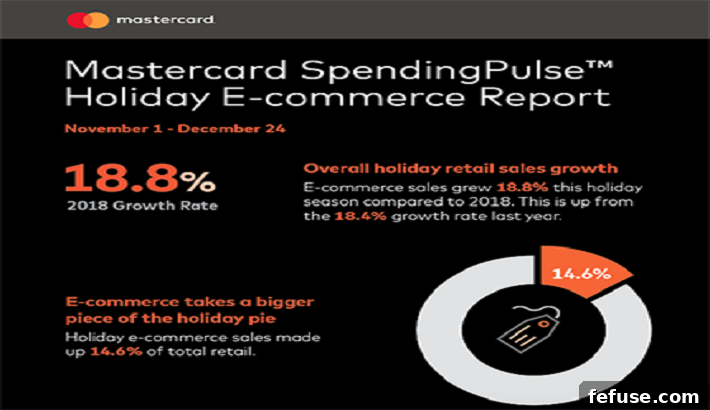
Holiday Retail Sales Soar: E-commerce Drives Record Growth in Festive Season
The holiday shopping season, a pivotal period for retailers globally, once again demonstrated robust performance, with fresh data from Mastercard SpendingPulse™ illuminating strong consumer engagement and a significant, accelerating shift towards digital channels. According to their comprehensive report, holiday retail sales experienced a healthy 3.4 percent increase (excluding auto sales) when compared to the previous year, 2018. This growth not only underscores the underlying resilience of the retail sector but also highlights the enduring tradition of festive gifting and spending that characterizes the year-end period. However, the most compelling revelation from this season’s analysis is the unprecedented surge in online sales, which climbed a remarkable 18.8 percent. This figure marks a new record high, fundamentally reshaping how consumers approach their holiday shopping and cementing the dominance of e-commerce.
Mastercard SpendingPulse™ serves as an invaluable source of market intelligence for the retail industry. It provides deep, actionable insights into overall retail spending trends across all major payment types, including cash, checks, and various credit and debit cards. This holistic data collection methodology ensures that its reports capture the full spectrum of consumer purchasing behavior, offering an accurate and reliable benchmark for retailers, financial analysts, and economists alike. For this particular analysis, the data encompasses the critical shopping period spanning from November 1 through December 24, effectively covering the entirety of the crucial Thanksgiving-to-Christmas retail rush.
The Digital Revolution: E-commerce Takes Center Stage During Holidays
The stellar 18.8 percent growth in online sales stands out as the unequivocal headline from this past holiday season. This figure represents far more than a mere statistical uptick; it signifies a profound acceleration of the digital transformation that has been sweeping through the retail industry for years. Consumers increasingly gravitated towards the internet for their holiday purchases, drawn by an array of compelling advantages. These include unparalleled convenience, access to a vast and diverse selection of products, highly competitive pricing, and increasingly personalized shopping experiences offered by sophisticated e-commerce platforms. From the comfort of their homes, shoppers could effortlessly browse extensive catalogs, compare prices in real-time, read comprehensive product reviews, and arrange for their chosen gifts to be delivered directly to their doorstep or conveniently picked up in-store, thereby seamlessly merging the physical and digital retail worlds.
Steve Sadove, a distinguished senior advisor for Mastercard and former CEO and Chairman of Saks Incorporated, eloquently captured the essence of this monumental shift. He noted, “E-commerce sales hit a record high this year with more people doing their holiday shopping online. Due to a later than usual Thanksgiving holiday, we saw retailers offering omnichannel sales earlier in the season, meeting consumers’ demand for the best deals across all channels and devices.” Sadove’s insightful comments illuminate several critical factors that influenced this year’s exceptional performance: the ever-growing consumer preference for online shopping and the proactive, strategic responses adopted by retailers to navigate a unique calendar anomaly.
The timing of Thanksgiving, falling later than usual, compressed the traditional, high-stakes shopping window between Black Friday and Christmas Eve. This shortened period typically intensifies competition among retailers, compelling them to innovate rapidly and adapt their strategies with agility. Rather than passively waiting for the Black Friday rush, many forward-thinking retailers proactively launched their omnichannel sales initiatives significantly earlier in the season. This strategic foresight allowed them to capture the attention of early bird shoppers and more effectively distribute the purchasing frenzy over a longer duration. Such an approach ensured that consumers had ample opportunity to discover and secure the best deals, irrespective of whether they preferred to shop in traditional brick-and-mortar stores, entirely online, or via mobile devices. This proactive and integrated strategy not only helped mitigate potential losses stemming from a truncated shopping season but also profoundly reinforced the undeniable necessity of a robust, cohesive, and deeply integrated omnichannel retail strategy for long-term success.
Key Findings and Sectoral Performance: A Detailed Look
The Mastercard SpendingPulse™ report offers a granular and invaluable examination of how various retail sectors performed during this particularly dynamic holiday period. While the overarching picture remained positive, particularly for the e-commerce segment, performance metrics varied considerably across different categories. This divergence highlights the diverse challenges, unique opportunities, and varying degrees of digital maturity within the intricate retail ecosystem.
Shining Bright: The Jewelry Sector’s Resilient Growth
One of the standout success stories of the season was undoubtedly the Jewelry sector, which recorded a healthy 1.8 percent growth in total retail sales. Even more impressively, online sales within this specific category surged by a remarkable 8.8 percent. This strong performance across both overall and online channels emphatically underscores the enduring appeal and cultural significance of jewelry as a cherished gift item, especially during the emotional and celebratory context of the holidays. The sector’s ability to not only grow but to thrive in a competitive market suggests several important underlying trends. Firstly, robust consumer confidence and a generally stable economic environment often correlate positively with discretionary luxury spending. Secondly, jewelry retailers have demonstrably increased their investments in sophisticated online presences, offering high-quality, detailed product photography, innovative virtual try-on experiences, and secure, transparent purchasing processes designed to build trust with online buyers for high-value items.
Furthermore, the report indicates that this positive growth trajectory for the jewelry sector actually commenced even before the official holiday shopping season began, providing a strong foundational momentum that propelled the sector powerfully through to its successful conclusion. This early burst suggests that discerning consumers were planning and executing significant purchases well in advance, perhaps capitalizing on early promotions or simply demonstrating a sustained, inherent appetite for fine goods. The strategic blend of traditional retail appeal, often associated with a luxury experience, combined with enhanced digital accessibility and convenience, unequivocally proved to be a winning formula for the jewelry industry during this period.
Department Stores: Navigating the Omnichannel Imperative Amidst Challenges
In stark contrast to the buoyant performance of the jewelry sector, traditional department stores faced a more challenging holiday season, with overall sales declining by 1.8 percent. This decline is not an isolated incident but rather continues a long-standing trend for many established department store chains, which have consistently struggled to adapt effectively to rapidly evolving consumer preferences and the relentless competitive pressure exerted by agile, pure-play online retailers. However, even amidst this downturn, there was a discernible silver lining: online sales for department stores collectively grew by a respectable 6.9 percent. This particular figure is critically important, as it unequivocally emphasizes the paramount importance of robust, fully integrated omnichannel offerings for these legacy retailers seeking to maintain relevance and market share.
The modest yet significant growth in online sales for department stores clearly indicates that while physical store foot traffic may be steadily waning, there remains a substantial segment of their loyal customer base actively willing and eager to engage with them digitally. For department stores, embracing omnichannel is no longer merely an option or a future aspiration; it has become an undeniable strategic imperative for their very survival and continued relevance in the modern retail landscape. A truly effective omnichannel strategy involves the seamless integration of physical stores, sophisticated e-commerce websites, intuitive mobile applications, and dynamic social media channels to deliver a cohesive, consistent, and supremely convenient shopping experience across all touchpoints. This might encompass a range of essential services such as ‘buy online, pick up in-store’ (BOPIS), streamlined in-store returns for online purchases, and highly personalized promotions delivered consistently across multiple digital and physical channels.
To effectively reverse the challenging trend of declining overall sales, department stores must decisively double down on these crucial omnichannel strategies. This necessitates substantial and continuous investment in advanced digital infrastructure, a relentless focus on enhancing their online user experience, proficient leveraging of data analytics to gain deep insights into customer behavior, and a bold reimagining of their physical stores. These stores must evolve beyond mere sales floors to become dynamic experience centers, inviting brand showrooms, and highly efficient convenient pickup points. The future viability and prosperity of department stores are inextricably linked to their ability to create compelling, multifaceted reasons for customers to engage with their brands, both in the digital sphere and within their physical locations, by consistently offering expertly curated selections, unique and memorable brand experiences, and unparalleled levels of convenience.
The Broader Landscape: Key Factors Driving Holiday Success
Beyond the performance of individual sectors, several overarching macroeconomic conditions and prevailing consumer behavior trends collectively contributed to the overall success of the 2019 holiday retail season. A generally strong job market coupled with relatively stable consumer confidence likely encouraged greater discretionary spending among households. Furthermore, retailers themselves played a critically pivotal role through the implementation of sophisticated strategies and the proactive adoption of cutting-edge technological innovations.
- Early Promotions and Deals: As insightfully highlighted by Steve Sadove, the earlier-than-usual rollout of enticing promotions and attractive deals proved highly effective. This strategy allowed retailers to capture consumer demand over a more extended period, thereby effectively mitigating the potential negative impact of the compressed Thanksgiving-Christmas shopping window.
- Seamless Online-to-Offline (O2O) Experience: The intensified emphasis on true omnichannel integration was not merely about having an online store; it was about meticulously crafting the customer journey to be effortless when transitioning between online browsing and in-store purchasing (or vice-versa). Innovative features such as BOPIS (Buy Online, Pick Up In-Store), convenient curbside pickup options, and easy, hassle-free returns emerged as significant differentiators for customer satisfaction and loyalty.
- Personalized Marketing and Engagement: By intelligently leveraging vast amounts of consumer data, retailers increasingly offered highly personalized product recommendations and targeted promotions. This bespoke approach significantly enhanced the relevance of their offerings to individual shoppers, fostering stronger engagement and driving conversion.
- Mobile Shopping Dominance: The pervasive proliferation of smartphones meant that a substantial and ever-growing portion of online shopping activity occurred on mobile devices. Consequently, having mobile-optimized websites and highly functional, intuitive retail applications became absolutely critical for achieving widespread success during the holiday season.
- Logistics and Fulfillment Innovation: Operating effectively behind the scenes, continuous advancements in logistics and supply chain management played a crucial role. This included the implementation of faster shipping options, more efficient warehouse operations, and sophisticated inventory management systems, all of which were instrumental in meeting the heightened and often instantaneous demands of online shoppers.
Implications for the Future of Retail: Navigating an Evolving Landscape
The 2019 holiday shopping season serves as a powerful and unambiguous harbinger for the future trajectory of the retail industry. The trends and shifts observed are far from fleeting anomalies; instead, they represent a significant acceleration of long-term, fundamental changes in both consumer behavior and technological capabilities. Retailers who aspire to not just survive but genuinely thrive in this rapidly evolving environment must keenly recognize, understand, and proactively adapt to these profound transformations.
Firstly, the relentless and inexorable march of e-commerce is set to continue its upward trajectory. Online channels will not only sustain their robust growth but will also become progressively more sophisticated and immersive. We can anticipate the increasing integration of cutting-edge technologies such as augmented reality (AR) for virtual product try-ons, advanced artificial intelligence (AI) for hyper-personalized recommendations, and intelligent virtual shopping assistants designed to create even more seamless, engaging, and personalized customer experiences. To remain competitive and relevant, retailers must consistently and strategically invest in the continuous development and enhancement of their digital platforms.
Secondly, the concept of “omnichannel” has definitively transcended its status as a mere industry buzzword; it has firmly solidified its position as an absolute foundational requirement for modern retail. The traditional distinction between online and offline shopping continues to blur into obscurity, with today’s savvy consumers expecting a consistently unified and utterly seamless experience across every single touchpoint, whether digital or physical. Future retail success will be unequivocally defined by how effectively brands can harmonize their physical store presence with their digital footprint, intelligently utilizing each channel to uniquely complement, reinforce, and enhance the overall customer journey.
Thirdly, the strategic application of data analytics will become even more central and indispensable to effective retail strategy. The ability to deeply understand nuanced customer preferences, accurately predict future demand fluctuations, optimally price products for maximum profitability, and personalize every customer interaction will increasingly rely on the intelligent, ethical, and efficient use of vast amounts of consumer data. Retailers who can effectively gather, meticulously analyze, and promptly act upon the actionable insights derived from their customer data will undoubtedly gain a significant and sustainable competitive advantage.
Finally, the role and physical form of the brick-and-mortar store are undergoing a profound metamorphosis. While some less adaptable or poorly performing physical locations may unfortunately close, others will strategically evolve into dynamic experiential hubs, immersive brand showcases, and highly efficient fulfillment centers for online orders. The fundamental purpose of a physical store in this burgeoning digital age is shifting from being purely transactional to becoming more relational, focusing intently on fostering deeper customer engagement, meticulously building brand loyalty, and delivering exceptional, personalized service.
Conclusion: A Dynamic and Digital Retail Landscape Beckons
The 2019 holiday retail season, as brightly illuminated by the detailed analysis from Mastercard SpendingPulse™, unequivocally stands as a resounding success for the broader industry, predominantly fueled by the extraordinary and undeniable growth of e-commerce. With overall retail sales climbing by a solid 3.4 percent and online sales surging by an impressive 18.8 percent, the message emanating from this period is crystal clear: the digital realm is no longer just an alternative; it is now an indispensable and central pillar of modern holiday shopping.
While specific sectors, such as the jewelry industry, demonstrated robust and thriving performance by adeptly leveraging both traditional in-store appeal and cutting-edge online channels, traditional department stores continued to face persistent challenges. Their experience profoundly underscores the critical and urgent need for comprehensive, sophisticated omnichannel integration across all facets of their operations. Retailers who proactively embraced early promotional strategies, invested significantly in creating seamless online-to-offline customer experiences, and consistently prioritized personalized consumer engagement were undoubtedly best positioned to capitalize fully on this exceptionally dynamic and competitive retail period.
Looking ahead, the profound trends and insightful lessons gleaned from this holiday season provide invaluable strategic guidance for the entire retail sector. The future undeniably belongs to agile and visionary retailers who possess the capacity to continuously innovate, prioritize a frictionless and engaging customer journey across every conceivable channel, and expertly harness the transformative power of technology to deliver unparalleled and memorable shopping experiences. The festive success of 2019 stands as a powerful and enduring testament to the ever-evolving nature of retail and the undeniable, ascendant power of the digitally empowered consumer.
News Source: diamondworld