
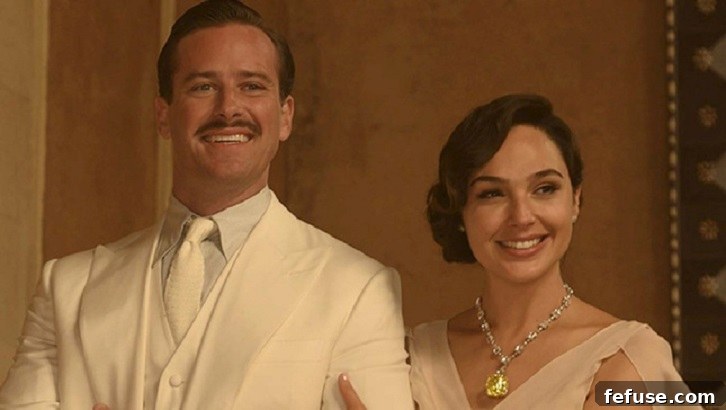
The cinematic world is abuzz with the news that the legendary Tiffany Diamond, an emblem of unparalleled luxury and a beacon of history, is set to grace the silver screen once more. In Kenneth Branagh’s highly anticipated adaptation of Agatha Christie’s classic murder mystery, Death on the Nile, the magnificent 128.54-carat yellow diamond will adorn none other than Israeli actress Gal Gadot, widely celebrated for her iconic role as Wonder Woman. This marks a new chapter in the illustrious journey of one of the world’s most famous gemstones, intertwining its radiant legacy with the thrilling intrigue of Christie’s masterful storytelling.
The decision to feature the Tiffany Diamond in such a prominent film underscores its status not just as a jewel of immense material value, but as a cultural icon. Its appearance in Death on the Nile will undoubtedly add an extra layer of opulent glamour and historical gravitas to a narrative already steeped in wealth, betrayal, and suspense. Fans of both cinema and fine jewelry are eagerly awaiting its dazzling debut alongside Gadot, whose character, Linnet Ridgeway Doyle, a wealthy heiress, makes the perfect canvas for such an extraordinary piece.
The Unrivaled Legacy of the Tiffany Diamond
The story of the Tiffany Diamond begins in 1877, deep within the famed Kimberley diamond mines of South Africa. Discovered as a rough stone weighing an astonishing 287.42 carats, its raw potential was immediately recognized. It was acquired by Charles Lewis Tiffany, the visionary founder of Tiffany & Co., for a sum of $18,000 – a significant investment at the time that would prove to be one of the most astute in gemological history. Tiffany’s ambition was not merely to possess a large diamond, but to transform it into a piece that would exemplify unparalleled beauty and craftsmanship, setting a new standard for luxury.
The arduous task of cutting and polishing this monumental gem was undertaken in Paris. Instead of prioritizing sheer size, the cutters, under Tiffany’s precise instruction, focused on enhancing the diamond’s inherent brilliance and extraordinary canary-yellow hue. This meticulous process resulted in a cushion-shape brilliant weighing 128.54 carats, distinguished by an unprecedented 82 facets – a remarkable 24 more than the traditional 58 facets found in most brilliant-cut diamonds. This innovative cutting technique maximizes the diamond’s fire and scintillation, allowing it to capture and reflect light in a breathtaking dance of color and luminosity. The result is a gem so vibrant and full of life that it seems to radiate its own internal light, making it truly one-of-a-kind. Experts today estimate its value to be well over $30 million, although its historical and cultural significance make it, in many ways, truly priceless.
A Star Among Stars: The Diamond’s Iconic Appearances
Long before its upcoming role in Death on the Nile, the Tiffany Diamond had already carved out an indelible niche in popular culture through a series of unforgettable appearances. Its most iconic moment arguably came in 1961, when it was famously worn by Audrey Hepburn in publicity photographs for the classic film Breakfast at Tiffany’s. Though Hepburn only wore the Jean Schlumberger-designed “Ribbon Rosette” necklace featuring the diamond for promotional shots rather than in the film itself, those images became synonymous with elegance, sophistication, and the aspirational allure of Tiffany & Co. The sight of Hepburn, with her timeless grace, adorned with the radiant yellow diamond, cemented its status as a symbol of cinematic glamour and an enduring fashion statement.
More recently, the Tiffany Diamond made headlines in 2019 when it was worn by global superstar Lady Gaga at the 91st Academy Awards. Gaga, who won an Oscar for Best Original Song for “Shallow” from the movie A Star Is Born, became only the third woman in history to publicly wear the diamond. Her choice to don the jewel on such a momentous occasion underscored its connection to artistic achievement and major cultural events. It was a powerful statement, linking contemporary artistry with a piece of history, captivating audiences worldwide and once again proving the diamond’s enduring relevance and magnetic appeal. These moments transcend mere jewelry display; they are cultural touchstones that elevate the diamond beyond its material worth, transforming it into a piece of living history.
Gal Gadot and the Intrigue of Death on the Nile
Now, Gal Gadot steps into this esteemed lineage, bringing the Tiffany Diamond into the lavish and dangerous world of Death on the Nile. Directed by and starring Kenneth Branagh as the iconic detective Hercule Poirot, the film promises a visually stunning and suspenseful journey through ancient Egypt. Gadot plays Linnet Ridgeway Doyle, a glamorous and wealthy heiress whose honeymoon cruise down the Nile quickly devolves into a murder mystery. Linnet’s character is defined by her immense fortune and luxurious lifestyle, making the Tiffany Diamond a perfectly fitting adornment for her on-screen persona.
The inclusion of such a globally recognized and valuable gem is not merely a stylistic choice; it deepens the film’s atmosphere of opulence and high stakes. In Agatha Christie’s narratives, wealth often serves as both a motivation for crime and a backdrop against which human frailties and dark desires are starkly revealed. The diamond’s presence will symbolize Linnet’s prosperity and, by extension, the envy and greed it might inspire among the passengers, thereby enriching the psychological depth of the murder mystery. The partnership between Tiffany & Co. and the film production amplifies the authenticity and grandeur of the cinematic experience, offering viewers a glimpse into a world of exquisite beauty and potential peril.
The Enduring Allure of Legendary Jewels in Cinema
The fascination with legendary jewels like the Tiffany Diamond transcends their monetary value. When these gems appear on screen, they become more than just props; they are extensions of character, symbols of status, and often, silent participants in the narrative. They embody dreams, desires, and sometimes, the darker aspects of human nature. For audiences, seeing such a magnificent piece of history in a contemporary or period film evokes a sense of wonder and connection to the past, reminding us of the enduring power of beauty and craftsmanship.
From a marketing perspective, these cinematic collaborations offer immense value. For Tiffany & Co., it’s an opportunity to showcase their most prized possession to a global audience, reinforcing the brand’s heritage, luxury appeal, and its deep connection to Hollywood glamour. For the film, it adds an unparalleled touch of authenticity and spectacle, drawing viewers into a world where every detail, down to the most dazzling gem, is meticulously crafted to enhance the storytelling. The Tiffany Diamond, with its unique history and undeniable splendor, serves as a powerful bridge between the worlds of high fashion, art, and entertainment.
As Death on the Nile prepares for its release, the anticipation surrounding Gal Gadot’s portrayal of Linnet Ridgeway Doyle, coupled with the dazzling presence of the Tiffany Diamond, creates a compelling draw. It’s a testament to the diamond’s timeless appeal and its remarkable ability to remain at the forefront of cultural consciousness, continually finding new ways to captivate and inspire. Its latest appearance is more than just a fleeting moment; it’s another shining chapter in the continuing saga of a true masterpiece, forever intertwining its brilliance with the magic of cinema and the enduring legacy of human artistry.