
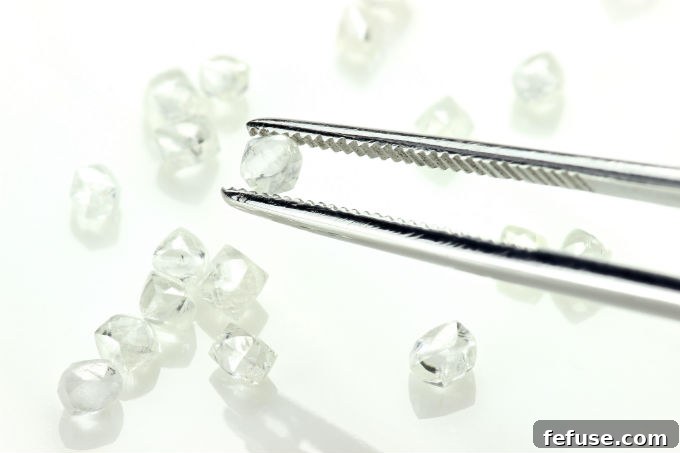
De Beers Group Reports Strong Rough Diamond Sales Amidst Positive Market Sentiment
The De Beers Group, a global leader in diamond mining and sales, has announced robust financial results for its 5th sales cycle of 2018, underscoring a period of solid market demand within the diamond industry. The company reported a total of US$575 million in rough diamond sales, a figure that not only highlights current market strength but also signals a positive trajectory for the sector. This impressive performance builds upon previous cycles, demonstrating consistent growth and resilience in the face of evolving global economic conditions.
The value of the latest rough diamond sales, which encompassed both global Sightholder allocations and auction sales, comfortably surpassed the US$554 million recorded in cycle 4 of 2018. Furthermore, it showed a significant year-on-year increase over the US$541 million achieved in cycle 5 of the previous year, 2017. These sequential and annual increases paint a clear picture of an invigorated market, where demand for high-quality rough diamonds remains strong across various segments, indicating robust health within the diamond supply chain from mining to retail.
Understanding De Beers’ Sales Cycles and Market Influence
De Beers operates on a system of ten sales cycles per year, known as ‘Sights,’ where a select group of authorized buyers, known as Sightholders, are invited to purchase rough diamonds directly. These Sights are critical junctures for the global diamond trade, setting benchmarks for pricing, supply, and demand. The reported figures for Cycle 5 2018 reflect the cumulative sales activity up to June 25, 2018, providing a crucial snapshot of the market’s pulse at the mid-year point. This structured approach allows De Beers to manage its vast supply effectively, ensuring market stability and responding strategically to global economic shifts and consumer trends in luxury goods.
The consolidated accounting basis used for quoting these sales values ensures a comprehensive and accurate view of the company’s rough diamond revenue streams. It’s important to note that these figures are reported before the capitalisation of pre-commercial production revenues at its Gahcho Kué mine. This accounting distinction helps to isolate the core rough diamond sales performance from revenue streams associated with the development phase of new mining projects. Such transparency provides investors and market analysts with a clearer picture of the operational health and profitability derived purely from De Beers’ established diamond production assets.
Auction sales, an integral and increasingly strategic component of De Beers’ overall sales strategy, contribute significantly to the total sales value reported for each cycle. For any given cycle, auction sales represent the aggregate of all transactions finalized between the conclusion of the preceding cycle and the end of the currently noted cycle. This dual sales mechanism, combining the traditional Sightholder allocations with dynamic auction sales, enables De Beers to optimize price discovery, maximize value extraction, and meet diverse market needs, catering to both long-term strategic partners and opportunistic buyers seeking specific parcels of rough diamonds.
Positive Midstream Sentiment Fuels Demand
Bruce Cleaver, CEO of the De Beers Group, articulated the underlying optimism driving these robust sales figures, stating, “Sentiment in the diamond industry’s midstream is positive following the JCK Las Vegas trade show at the start of the month, and we continued to see good demand for our rough diamonds across the product range.” This commentary provides invaluable insight into the current health and future prospects of the diamond supply chain, particularly emphasizing the ‘midstream’ segment, which is often considered the engine of the industry.
The midstream comprises the crucial segment of the diamond value chain that transforms raw rough diamonds into polished gems ready for retail. This includes expert cutters, polishers, and manufacturers who add significant value to the stones through meticulous craftsmanship. Positive sentiment among these players is a strong, forward-looking indicator of anticipated demand from downstream retailers and, ultimately, end consumers. When the midstream is confident about future sales, they are more willing to invest heavily in purchasing rough diamonds, knowing there’s a reliable market for their polished output. This confidence is often a direct reflection of broader economic health, consumer spending trends, and the perceived stability of the luxury goods market.
The JCK Las Vegas trade show, held annually at the beginning of June, serves as a pivotal and highly influential event for the global jewelry industry. As one of the largest and most significant jewelry exhibitions in North America, it convenes thousands of retailers, manufacturers, designers, and suppliers from around the world. The show is a crucial platform for networking, trend forecasting, and, most importantly, order placement. Positive feedback, strong attendance, and robust order books at JCK typically translate into increased demand for rough diamonds in subsequent sales cycles, as manufacturers replenish their inventories to fulfill new orders. Cleaver’s direct mention of JCK highlights its enduring role as a key barometer for industry health, reinforcing the intricate connection between retail activity and rough diamond sales.
Diverse Demand Across the Product Range and Market Stability
The CEO’s observation of “good demand for our rough diamonds across the product range” is particularly significant and speaks volumes about the current state of the market. De Beers mines and markets a vast array of rough diamonds, which vary considerably in size, quality, color, and clarity. Demand that spans across this entire product spectrum suggests a broad-based market recovery and a healthy, diversified appetite for diamonds, regardless of their specific characteristics. This indicates that midstream manufacturers are confident in their ability to sell both high-value, larger, exceptional stones and smaller, more accessible diamonds, thereby catering to a comprehensive and diverse consumer base that appreciates diamonds at various price points.
A balanced demand across the entire product range is absolutely crucial for the long-term stability and sustained growth of the diamond market. It helps prevent oversupply in specific categories and ensures that all types of rough diamonds, from the smallest melee to the largest single stones, can be efficiently absorbed by the midstream manufacturing sector. This diversification in demand helps mitigate risks associated with fluctuating consumer preferences for particular diamond types and supports a more resilient and stable pricing environment for De Beers’ extensive and varied production.
The Global Diamond Market: Factors and Future Outlook
The strong performance of De Beers in Cycle 5 2018 is indicative of a broader recovery and robust demand evident across the global diamond market. Several interconnected factors contribute to this positive trend. A stable and expanding global economy, particularly rising consumer confidence and disposable income in key luxury markets such as the United States, China, and India, plays a paramount role. Furthermore, the enduring cultural appeal and emotional significance of natural diamonds as symbols of love, commitment, and celebration continue to drive consumer desire. The luxury goods sector, within which diamonds are a cornerstone, often serves as an early indicator of economic health, with discretionary spending naturally increasing as economies strengthen and stabilize.
Looking ahead, the diamond industry continues to navigate a landscape shaped by evolving consumer preferences and an increasing emphasis on ethical sourcing and sustainability. De Beers, through its pioneering initiatives like the “Diamonds for Good” program and its leadership in developing cutting-edge traceability solutions, is actively addressing these critical issues. Today’s discerning consumers are increasingly seeking assurances that their diamonds are not only beautiful but also sourced responsibly, contributing positively to mining communities and minimizing environmental impact. This unwavering commitment to sustainability and ethical practices is not merely a moral imperative but also a significant driver of consumer trust, brand loyalty, and long-term market differentiation in the contemporary luxury market.
While the emergence and growing presence of lab-grown diamonds present a new dynamic within the broader jewelry sector, the market for natural diamonds continues to thrive, particularly in the premium and luxury segments where rarity, heritage, and intrinsic value are paramount. De Beers’ steadfast focus on natural diamonds, coupled with its sophisticated global marketing efforts designed to highlight their unique geological origins and enduring value, positions the company strategically to capitalize on sustained consumer demand for these precious geological wonders. The consistent growth demonstrated in rough diamond sales further solidifies the natural diamond industry’s robust foundation and optimistic future.
In conclusion, De Beers Group’s exceptional sales performance in its 5th cycle of 2018 stands as a powerful testament to the strong underlying demand and positive momentum pervading the global natural diamond market. Buoyed by unequivocally positive sentiment within the crucial midstream sector and a successful JCK Las Vegas trade show, the company is demonstrating consistent growth that outpaces previous periods. With sustained demand observed across its diverse product range and an unwavering commitment to responsible sourcing and ethical practices, De Beers is exceptionally well-positioned to continue its leading role in the natural diamond industry, contributing significantly to a vibrant and optimistic outlook for the remainder of the year and for many years to come.