
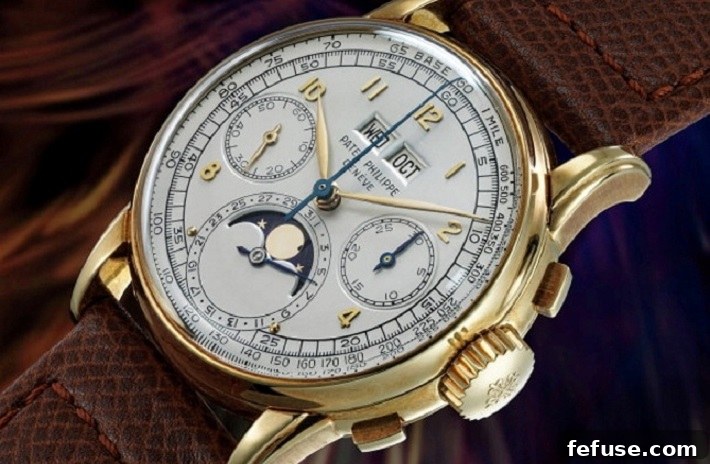
Luxury Watch Auction Market Faces Significant Correction in 2023 After Record-Breaking Year
The global luxury watch auction market experienced a notable slowdown in 2023, signaling a significant correction after the unprecedented boom observed in 2022. According to comprehensive data compiled by Switzerland-based Hammertrack, a leading monitor of the watch auction market, total sales across major auction houses saw a substantial 13 percent decline compared to the previous year’s record-setting performance. This downturn reflects a broader shift in collector and speculator behavior, who have demonstrably curbed their spending in response to evolving market dynamics and economic pressures.
Combined sales for the preeminent players in the auction world—Antiquorum, Bonhams, Christie’s, Phillips (in association with Bacs & Russo), Polyauction, and Sotheby’s—reached CHF 610 million, equivalent to approximately $691 million. This figure, while still substantial, starkly contrasts with the record highs of 2022, underscoring a period of recalibration for this specialized segment of the luxury market. The slowdown, as Hammertrack notes, was not entirely unanticipated, with preliminary indicators emerging as early as the final quarter of 2022, setting the stage for the full-year decline.
Unpacking the Causes: Why Did the Market Slow Down?
Several converging factors contributed to the cooling of the luxury watch auction market in 2023. Understanding these underlying drivers is crucial for grasping the current state and future trajectory of this high-value sector. The exuberance that characterized the post-pandemic market, fueled by ample disposable income and a surge in luxury goods interest, began to wane as global economic realities set in.
Economic Headwinds and Shifting Consumer Confidence
A primary catalyst for the reduced spending among collectors and speculators was the prevailing global economic uncertainty. Inflationary pressures across major economies, coupled with rising interest rates, diminished consumer purchasing power and heightened caution. The cost of living crisis in many regions meant that even affluent buyers became more discerning about discretionary luxury expenditures. The speculative fervor that drove prices to unprecedented heights in 2021 and 2022 began to subside as investors sought safer havens or adopted a more conservative approach to luxury asset acquisition. This created an environment where the appetite for immediate, high-volume transactions diminished, leading to fewer bids and more selective purchases.
From Speculation to True Collection: A Behavioral Shift
The market’s peak witnessed a significant influx of speculative buyers drawn by the rapid appreciation of certain luxury watch brands and models. Many saw these timepieces not just as objects of beauty or horological marvels, but as viable investment vehicles. However, as the market cooled and the prospect of quick, substantial returns diminished, these speculative buyers naturally receded. This left a market increasingly dominated by true connoisseurs and long-term collectors who prioritize provenance, rarity, and intrinsic value over short-term financial gains. While a return to core collecting values is healthy for the long-term stability of the market, it invariably leads to a reduction in overall transaction volume and velocity, as these buyers typically act with more deliberation.
The Supply Conundrum: Fewer Pieces, Greater Impact
Auction houses also grappled with a shrinking supply of desirable pieces entering the market. In a buoyant market, owners are often more inclined to consign rare and valuable watches, anticipating strong prices. Conversely, in a softening market, potential sellers may choose to hold onto their assets, awaiting more favorable conditions. This reduction in the availability of highly sought-after, investment-grade timepieces further constrained auction volumes. When fewer exceptional items are available, the total realized sales naturally decline, even if individual pieces still command respectable prices. The challenge for auctioneers becomes one of curation, ensuring that the limited supply still comprises items that will attract competitive bidding.
Competition from Other Luxury Segments
Another significant factor highlighted by market observers is the apparent shift in buyer interest towards other luxury auction markets, most notably jewelry. While luxury watches experienced a period of unparalleled spotlight, other categories within the broader luxury goods spectrum have demonstrated renewed attractiveness. Buyers with substantial disposable income, who might typically diversify their luxury investments, may have found jewelry, art, or other collectible assets to offer more compelling value propositions or greater perceived stability in the current economic climate. This re-allocation of luxury spending away from watches contributed to the overall reduction in auction house activity within the horological segment.
The Enduring Power of the Elite: “Millionaire Lots” Defy the Trend
Despite the overarching downturn, a fascinating resilience was observed within the ultra-high-end segment of the market, specifically for what are termed “millionaire lots” – timepieces selling for over CHF 1 million (approximately $1.13 million). This elite category demonstrated an ability to weather the storm more effectively than the broader market, showcasing a clear bifurcation in performance.
While the *number* of millionaire lots sold did decline, falling from 98 in 2022 to 58 in 2023, the *total value* realized from these sales actually increased slightly. The collective hammer price for these exceptional pieces rose to CHF 122.6 million, or approximately $138.9 million. This phenomenon suggests that demand for truly rare, historically significant, or uniquely desirable timepieces remains robust among the world’s most affluent collectors and institutional buyers.
Understanding the High-Value Segment’s Resilience
The resilience of millionaire lots can be attributed to several factors. These pieces often represent investment-grade assets, akin to fine art, whose value is less susceptible to short-term market fluctuations. Buyers in this stratospheric segment are typically less affected by broader economic downturns, possessing substantial wealth that allows them to pursue truly exceptional acquisitions irrespective of prevailing market sentiment. Furthermore, such watches often boast impeccable provenance, historical significance, or unique complications that render them irreplaceable, making them highly coveted irrespective of general market trends. Their scarcity creates an inelastic demand, where a limited pool of discerning buyers is consistently willing to pay a premium for unparalleled quality and exclusivity.
Navigating the Market: The Role of Auction Houses
The major auction houses—Antiquorum, Bonhams, Christie’s, Phillips (in association with Bacs & Russo), Polyauction, and Sotheby’s—play a pivotal role in shaping and reflecting the luxury watch market. Their strategies and offerings significantly influence collector behavior and market perceptions. In a challenging year like 2023, these houses undoubtedly faced pressure to adapt their approaches.
Successful adaptation often involves an even greater emphasis on curation, focusing on bringing only the most desirable and authentic pieces to market. Enhanced marketing efforts, global outreach to new potential buyers, and the development of compelling narratives around individual timepieces become paramount. The ability to identify and secure exceptional consignments, particularly those falling into the resilient millionaire lot category, remains a key differentiator for these established players. Their expertise in authentication, valuation, and presentation continues to be invaluable in maintaining collector trust and facilitating high-value transactions.
Historical Context: Market Cycles and Corrections
It is important to view the 2023 downturn within the broader historical context of the luxury goods market. These markets, including luxury watches, are inherently cyclical. Periods of rapid growth and appreciation are often followed by corrections or consolidations. The exceptional growth experienced in 2021 and 2022, fueled by unique post-pandemic circumstances and a surge in liquidity, was arguably unsustainable in the long term. A correction was, in many ways, an inevitable and healthy market adjustment. Such cycles have been observed historically, allowing for the market to re-establish equilibrium and for prices to align more closely with fundamental values rather than purely speculative forces. This adjustment period often clears out less serious buyers, leaving a more stable and focused collector base.
What Lies Ahead? Outlook for the Luxury Watch Auction Market
Looking beyond 2023, the luxury watch auction market is likely to continue its path of careful navigation. While a return to the frenetic pace of 2022 is unlikely in the immediate future, there are reasons for cautious optimism and a focus on qualitative rather than purely quantitative growth.
Focus on Quality, Provenance, and Rarity
The enduring strength of the millionaire lots segment signals a clear trend: the market’s appreciation for impeccable quality, undeniable provenance, and extreme rarity will only intensify. Collectors will increasingly prioritize pieces with unique historical significance, exceptional craftsmanship, and limited availability. Brands with strong heritage, innovative horological achievements, and a reputation for enduring value are likely to fare better. Auction houses will undoubtedly double down on securing these ‘holy grail’ pieces to maintain their market relevance and appeal to serious collectors.
Potential for Future Growth and New Collectors
Despite the recent slowdown, the underlying appeal of luxury watches as both functional art and collectible assets remains strong. The industry continues to innovate, attracting new generations of enthusiasts. As global economic conditions stabilize and potentially improve, coupled with the continued rise of wealth in emerging markets, the pool of potential high-end watch collectors could expand. Digital platforms and engaging content can also introduce new audiences to the fascinating world of horology, fostering future growth. Moreover, the transparency and authentication provided by established auction houses continue to offer a trusted avenue for acquiring significant timepieces.
Conclusion: A Period of Adjustment, Not Decline
In conclusion, the 2023 performance of the luxury watch auction market should be viewed not as a catastrophic decline, but rather as a necessary and healthy period of adjustment. After years of meteoric rises, a recalibration was inevitable. The market is maturing, shedding some of its speculative froth, and returning to a focus on intrinsic value, rarity, and genuine horological appreciation. While overall sales figures have retracted, the sustained strength at the very top end of the market indicates a robust foundation. For discerning collectors, this period may even present opportunities to acquire exceptional pieces at more considered valuations. As the market adapts to new economic realities and collector preferences, its long-term trajectory will likely be shaped by a renewed emphasis on quality, provenance, and the timeless allure of masterfully crafted timepieces.