
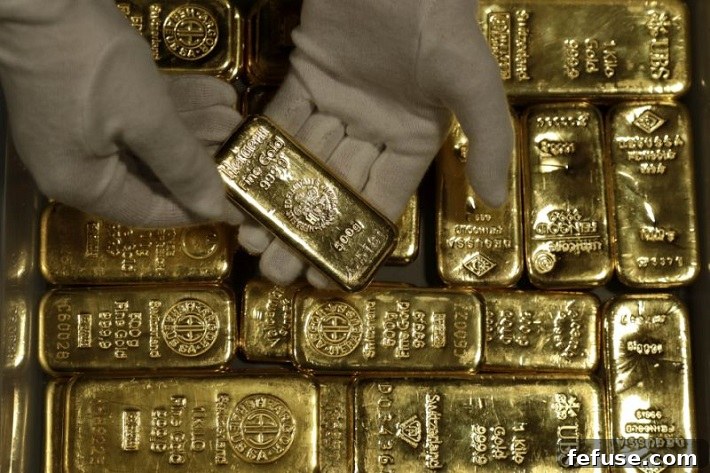
Gold: The Resilient Safe Haven Amidst Economic Uncertainty
In periods of heightened economic uncertainty and market volatility, investors often seek refuge in assets traditionally deemed “safe havens.” Among these, gold consistently shines, demonstrating its enduring appeal as a store of value. Over the past three months, the precious metal has experienced a significant upswing, climbing more than 4% as capital flows gravitate towards perceived safety. Market strategists and analysts widely anticipate this upward trajectory to continue, with gold prices poised to reach even greater heights in the coming year, solidifying its role in diversified investment portfolios.
The recent resurgence in gold’s allure is not an isolated event but a direct consequence of broader market dynamics. Across global markets, including commodities and equities, a palpable increase in volatility has taken hold. This instability, if it persists, is a critical driver pushing investors toward tangible assets like gold. Chris Louney, a respected commodities strategist at RBC Capital Markets, articulated this sentiment, noting that “Volatility has reemerged across markets generally — commodities, equities, etc. If that volatility persists, it will be key. It is going to push investors to perceived safe havens like gold.” This perspective underscores gold’s inherent value as a hedge against unpredictability.
Understanding Gold’s Role as a Safe Haven Asset
Gold’s reputation as a safe haven asset is deeply rooted in history and economic principles. Unlike fiat currencies, gold cannot be printed at will by central banks, giving it an intrinsic scarcity that tends to preserve its value, especially during times of inflation or currency devaluation. Investors turn to gold when traditional financial markets, such as stocks and bonds, become unstable or when geopolitical tensions escalate. Its tangibility offers a sense of security that purely digital or paper assets may lack. Historically, during periods of economic crisis, wars, or significant political upheaval, gold has often outperformed other asset classes, serving as a reliable store of wealth that transcends national borders and economic systems. This makes it a crucial component for portfolio diversification, offering a counter-cyclical hedge against broader market downturns.
Economic Headwinds Fueling Gold’s Ascent
The current climate is ripe for gold’s continued rise, characterized by a confluence of economic anxieties. Fears of a looming economic slowdown, exacerbated by protracted trade disputes between global economic powerhouses like the United States and China, have sent shockwaves through financial markets. The U.S. stock market, in particular, experienced a notable tumble since October, with all three major indices entering correction territory—meaning they fell more than 10% from their recent highs. This market apprehension directly translates into increased demand for gold as investors seek to protect their capital from potential losses.
John Reade, Chief Market Strategist at the World Gold Council, highlights the potential severity of such a slowdown: “If U.S. growth slows, due to a sugar rush from tax-cuts as well as trade wars, then investors may continue to seek gold. Meanwhile, a rapid economic slowdown could see gold flows match those seen during the 2008-2009 financial crisis.” This stark comparison to the global financial crisis of a decade ago underscores the depth of concern among market observers and the potential for gold to become an even more critical asset. The “sugar rush” analogy points to the temporary nature of economic boosts from tax cuts, implying that the underlying economic fundamentals might be weaker than perceived.
Adding to this bullish outlook for gold, Mikhail Sprogis, a respected precious metals analyst at Goldman Sachs, emphasized his firm’s conviction that safe-haven assets, including gold, are set to continue their upward trend in the coming year, irrespective of the actual pace of economic deceleration. Sprogis elaborated, “Our bullish outlook is driven by the expectation of a pick up in ‘fear’ related investment demand for gold as the U.S. economy slows down and late cycle concerns mount. Even though we as a bank think that this cycle has room to run, this doesn’t prevent people from becoming increasingly afraid.” This insight is particularly telling, suggesting that investor sentiment and fear, rather than just hard economic data, play a significant role in driving gold demand during late-stage economic cycles. These late-cycle concerns often include worries about peak growth, tightening monetary policy, and potential recessions.
The Federal Reserve’s Influence and Interest Rate Dynamics
Beyond broad economic fears, the actions and rhetoric of the Federal Reserve (the Fed) are paramount for gold investors. As the central bank prepares for its crucial two-day policy meeting, market participants are paying heightened attention. While a widely anticipated interest rate hike at the meeting’s conclusion is almost a certainty, the real focus will be on Federal Reserve Chairman Jerome Powell’s forward guidance regarding the trajectory of rate hikes for the upcoming year. The Fed’s monetary policy decisions directly impact the attractiveness of interest-bearing assets versus non-yielding assets like gold.
Mikhail Sprogis of Goldman Sachs offers a nuanced perspective on the relationship between interest rates and gold. Despite predicting a more aggressive rate hike schedule—three hikes next year compared to the consensus of one to two—Sprogis believes this will not impede gold’s appreciation. He explains, “Moreover, we would like to highlight that negative correlation between gold and 10-year real rates tends to reverse during late stages of the hiking cycle as higher rates themselves can lead to increased financial market volatility and growth slowdown concerns.” This suggests that while higher rates typically make gold less appealing by increasing the opportunity cost of holding a non-yielding asset, in the later stages of a tightening cycle, the very act of raising rates can introduce enough volatility and economic concern to drive investors back to gold.
Navigating Potential Headwinds: The Dollar’s Strength and ETF Flows
While many strategists foresee a bright future for gold, some prominent voices caution against an overly bullish outlook, citing potential headwinds that could dampen its rally. Harry Tchilinguirian, Global Head of Commodity Strategy at BNP Paribas, presents a contrasting view, particularly concerning the impact of central bank policies. He argues that “As the Fed continues to tighten monetary policy while other central banks remain on hold for now, the policy divergence may help to keep the dollar firm in the short term, which is negative for gold.” A stronger U.S. dollar makes gold, which is priced in dollars, more expensive for international buyers holding other currencies, thereby reducing demand.
Tchilinguirian further points out a critical indicator that, in his view, does not yet support a sustained long-term rally for gold: the absence of significant inflows into physically-backed exchange-traded funds (ETFs). These ETFs are often seen as a proxy for broader investor sentiment and long-term commitment to gold. “As such we continue to maintain a negative bias on gold in the short term, even as the yellow metal’s price has had some support recently from weakness in equity markets,” Tchilinguirian stated. A lack of substantial investment in gold ETFs suggests that while short-term market volatility might offer temporary support, a strong conviction for a sustained gold bull run among institutional investors might still be nascent.
The Enduring Impact of a Strong Dollar on Gold Prices
The strength of the U.S. dollar (DX=F) remains a formidable challenge for gold’s performance in the coming year. As Sprogis reiterates, “The gold market continues to be hurt by a strengthening dollar. A strong dollar affects gold by reducing dollar purchasing power of world ex-U.S.” The inverse correlation between the price of gold and the U.S. dollar is a fundamental tenet of commodity markets. When the dollar’s value appreciates, it makes dollar-denominated assets, including gold, more expensive for buyers using other currencies. Conversely, when the dollar weakens, gold becomes more affordable, often leading to increased demand. Investors frequently turn to alternative investments like gold when the dollar’s value declines, seeking to preserve wealth in a more stable asset. Therefore, any sustained strengthening of the dollar could apply downward pressure on gold prices, acting as a crucial counterbalance to other bullish factors.
Gold Price Forecasts and Investment Outlook for 2019
Despite the legitimate concerns surrounding a strong dollar and the nuances of investment flows, the prevailing sentiment among many leading analysts remains largely optimistic for gold in 2019. Both Mikhail Sprogis of Goldman Sachs and Chris Louney of RBC Capital Markets believe that gold has considerable upside potential. Goldman Sachs has set a robust price target of $1,350 per ounce for gold by the end of 2019, reflecting their confidence in its sustained rally. Similarly, RBC Capital Markets has issued an average 2019 forecast of $1,338 per ounce, indicating a strong consensus for appreciation from current levels. As of a recent trading session, gold settled at $1,251.80, suggesting that these forecasts represent a meaningful increase.
These projections underscore gold’s critical role in investor strategies during times of economic transition. Whether driven by heightened market fear, concerns over global economic deceleration, or specific monetary policy decisions, gold’s status as a premier safe haven asset continues to attract significant attention. For investors seeking to diversify their portfolios and hedge against potential financial turbulence, gold presents a compelling opportunity. As the economic landscape continues to evolve, the yellow metal is poised to remain a cornerstone of prudent investment planning, offering stability and growth potential in an uncertain world.
NewsSource: Yahoo Finance