
Safeguarding the Purity: GJEPC’s Unified Front Against Undisclosed Synthetic Diamond Mixing
The global diamond industry stands at a critical juncture, navigating the delicate balance between innovation and tradition. As technology advances, the presence of synthetic diamonds in the market has grown, bringing with it the imperative to maintain transparency and trust. In response to this evolving landscape, the Gem & Jewellery Export Promotion Council (GJEPC), a leading authority in the Indian gem and jewellery sector, has issued a powerful call to action. The Council urges all stakeholders across the diamond value chain to adopt a meticulously coordinated approach aimed at eradicating the undisclosed mixing of synthetic diamonds with their natural counterparts. This proactive stance is not merely about market regulation; it is fundamentally about upholding the principles of fair trade and, most importantly, fortifying consumer confidence in the enduring value and inherent beauty of natural diamonds.
Forging Collaboration: A Multi-Stakeholder Approach to Technological Advancement
At the heart of GJEPC’s visionary strategy lies a groundbreaking proposal: the establishment of a robust multi-stakeholder body. This collaborative entity is envisioned as a nexus for concerted efforts in technology development and intensive Research & Development (R&D). The primary objective is to accelerate the creation of highly effective segregation technology capable of accurately differentiating between natural and synthetic diamonds. Such advancements are crucial for both large-scale operations and smaller businesses. A significant aspect of this initiative focuses on ensuring the widespread deployment of detection equipment at economically reasonable prices, thereby making essential tools accessible to a broader spectrum of industry players. Furthermore, the Council champions the concept of shared facilities, which would enable smaller enterprises to access sophisticated and often costly detection technologies without bearing the full financial burden of individual ownership. This democratisation of technology is vital for a truly transparent and equitable market.
Beyond equipment, the GJEPC proposes the formation of a structured platform designed to manage these ambitious efforts. This platform will evolve into a common ground for scientists, researchers, and technical experts to converge, sharing invaluable knowledge, exchanging innovative ideas, and fostering collaborative breakthroughs. By pooling intellectual capital and resources, the industry can collectively accelerate the development of cutting-edge solutions necessary to stay ahead of potential challenges and ensure the integrity of diamond identification processes.
Global Advocacy: India’s Leadership on the World Stage
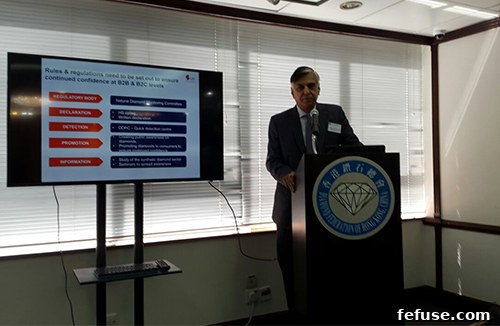
The commitment of the GJEPC to this cause has been prominently showcased through the recent international engagements of its Chairman, Praveenshankar Pandya. During a high-profile visit by an Indian delegation to key markets in Hong Kong and China, Mr. Pandya delivered a series of impactful presentations, amplifying India’s proactive stance on diamond integrity. These visits underscored India’s leadership in advocating for global standards and practices that protect the natural diamond industry.
As previously highlighted in industry reports, the GJEPC Chairman was a pivotal speaker at the International Industry Forum in Shenzhen, a bustling hub for technological innovation and trade. His participation in a critical round table discussion focused specifically on the challenges and opportunities presented by synthetic diamonds. Following this, Mr. Pandya continued his dialogue on this vital subject during a visit to the National Gemstone Testing Center (NGTC) in China, a renowned institution for gemological research and certification. Further demonstrating India’s unwavering commitment, he presented similar detailed insights and proposals to the Diamond Federation of Hong Kong, China (DFHK), engaging with leading stakeholders in one of the world’s most significant diamond trading centers. These engagements served to galvanize international support and foster a shared understanding of the collective responsibility required to tackle this issue effectively.
Strengthening Domestic Defenses: The Role of the NDMC
During his impactful presentations, Mr. Pandya meticulously detailed the robust activities and innovative initiatives undertaken by the Indian diamond industry. These efforts operate under the comprehensive oversight of the Natural Diamond Monitoring Committee (NDMC), an influential body established several years ago in close coordination with other prominent Indian trade associations. The NDMC stands as a testament to the Indian industry’s commitment to self-regulation and vigilance.
He elaborated on how the NDMC has been instrumental in organizing and conducting numerous seminars and awareness programs across various industry segments. These educational outreach efforts are designed to inform and sensitize manufacturers, retailers, gemologists, and other stakeholders about the risks associated with undisclosed mixing and the importance of accurate disclosure. Furthermore, the NDMC has played a crucial role in establishing advanced testing and detection centres in India’s primary diamond trading and manufacturing hubs: Mumbai and Surat. These state-of-the-art facilities provide essential services for identifying and differentiating diamonds, acting as a critical safeguard against fraudulent practices and ensuring that both trade members and consumers can verify the authenticity of their diamonds with absolute confidence.
Pioneering Global Traceability: The HS Code Initiative
A significant stride towards enhanced traceability and transparency, as championed by Mr. Pandya, is the Indian government’s recent acceptance and implementation of the industry’s proposal for a separate Harmonized System (HS) Code specifically for synthetic diamonds. This is a monumental achievement, as an HS Code is a globally standardized numbering system used by customs authorities worldwide to classify products. The introduction of a distinct code for synthetic diamonds will dramatically simplify their identification, tracking, and regulation throughout international trade channels. This measure is expected to curb illicit mixing at the import/export stage, providing unprecedented clarity and accountability.
Building on this domestic success, Mr. Pandya highlighted the GJEPC’s strategic intent to approach authorities in other pivotal global centres. Key markets such as Singapore, Malaysia, the USA, and the UAE are being encouraged to adopt similar measures, thereby fostering a consistent international regulatory environment. The ultimate vision extends even further: the GJEPC plans to formally request the World Customs Organization (WCO), the intergovernmental body responsible for maintaining the HS classification system, to create a new, universally recognized code for synthetic diamonds worldwide. A global standard will ensure seamless traceability, eliminate ambiguities in nomenclature, and provide a unified framework for customs agencies across all nations, thereby creating an impregnable wall against undisclosed mixing on a global scale.
Enforcing Ethics: Key Action Proposals for Industry Integrity
To further solidify the industry’s commitment to ethical practices and transparency, the GJEPC has put forth several critical action proposals aimed at rigorous enforcement and fostering a culture of accountability:
- Immediate and Stringent Action Against Errant Players: This proposal advocates for robust and swift punitive measures against any individual or company found to be engaged in the undisclosed mixing of natural and synthetic diamonds. Such actions would include, but not be limited to, the imposition of substantial fines, immediate expulsion from relevant trade bodies, and the proactive sharing of information about these non-compliant entities across the industry. The intent is to establish a strong deterrent, signalling that fraudulent practices will not be tolerated and will carry severe consequences for those who threaten the integrity of the diamond market. This commitment to self-policing ensures consumer trust remains paramount.
- A Coordinated and Consistent Communications Strategy: The GJEPC emphasizes the vital importance of developing a unified and pervasive communications strategy. This strategy is designed to ensure complete alignment among all industry bodies, from manufacturers and traders to retailers and gemological laboratories. The objective is to deliver consistent, clear, and unambiguous messaging to all stakeholders, including the end consumer. By fostering widespread awareness about the differences between natural and synthetic diamonds, the importance of full disclosure, and the industry’s efforts to maintain transparency, this strategy aims to educate and empower consumers while building collective confidence.
- Setting Up of Independent Grievance Redressal Bodies: To further solidify trust and provide avenues for dispute resolution, the Council proposes the establishment of dedicated grievance redressal bodies. These independent mechanisms would be tasked with enforcing industry values, mediating conflicts, and ensuring absolute transparency in all transactions. Such bodies would serve as crucial pillars for upholding ethical standards, providing a fair and impartial platform for addressing concerns, and reinforcing the integrity of the natural diamond supply chain.
Proactive Research and Technological Solutions
In a testament to its forward-thinking approach, the Council also revealed that it had commissioned an updated and comprehensive study on the synthetic diamond industry. This crucial research, being meticulously conducted by the renowned firm Bonas & Co, is anticipated to be completed within the next year. The findings from this study will provide invaluable insights into the global landscape of synthetic diamond production, market penetration, technological trends, and potential challenges. Such data is indispensable for informed decision-making, strategic planning, and the continuous adaptation of industry policies to effectively navigate the evolving market dynamics.
Furthermore, the GJEPC highlighted significant progress already made in the realm of detection technology. It proudly noted that the Gemmological Institute of India (GII) has successfully developed the “Quick Check” machine. This innovative device is celebrated for being both affordable and remarkably easy to operate, making sophisticated diamond verification accessible to a wider range of businesses, including smaller retailers and independent gemologists. The availability of such practical tools is a game-changer, enabling rapid and reliable screening for undisclosed synthetics at various points in the supply chain. Moreover, the Council confirmed that the Indian industry has not merely theorized about action but has already taken concrete steps in three documented cases of undisclosed mixing, demonstrating a firm resolve to address and rectify fraudulent practices swiftly and decisively.
A Future Built on Trust and Transparency
The multi-pronged strategy spearheaded by the GJEPC reflects a profound commitment to protecting the intrinsic value and esteemed reputation of natural diamonds. By fostering technological innovation, advocating for robust regulatory frameworks, and enforcing stringent ethical standards, the industry is building an ecosystem where transparency is paramount and consumer confidence is unshakeable. These concerted efforts by the GJEPC, in collaboration with its partners globally, are ensuring that the natural diamond industry continues to shine brightly, built on foundations of integrity, authenticity, and trust for generations to come. The future of natural diamonds relies on this collective vigilance and unwavering dedication to purity and ethical trade practices.