
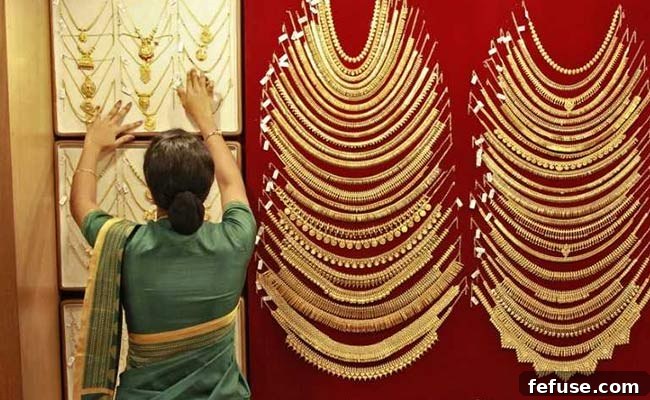
The Indian gold jewelry market, a sector deeply intertwined with the nation’s cultural fabric and economic pulse, faced significant headwinds in 2018. A credit rating agency had projected a 2-4 percent weakening in gold jewelry demand during that year, primarily attributing this slowdown to two critical factors: escalating gold prices and a notable tightening of credit availability. While these immediate challenges presented a cautious outlook, the broader perspective for the medium to long-term painted a much more optimistic picture. Experts widely anticipated a robust return to gold volume growth, buoyed by the enduring strength of rural demand, the consistent rhythm of India’s wedding seasons, and the steady upward trajectory of rising disposable incomes across the country.
Beyond the immediate pressure of higher gold prices, a confluence of other factors contributed to the cautious sentiment prevalent in the gold market. Chief among these was the intensified scrutiny and constant monitoring of the sector, particularly concerning the provision of loans to companies operating within this vital industry. This heightened vigilance was not arbitrary; it stemmed from a series of events that profoundly shook the financial sector and redefined lending practices for jewelers.
The turning point came earlier in 2018, initiated by the widely publicized case involving prominent jeweler Nirav Modi. Modi was charged in a massive fraud case filed by Punjab National Bank, allegedly amounting to a staggering Rs. 12,000 crore and even more. This incident sent shockwaves throughout the banking and financial communities, creating an atmosphere of extreme caution and leading to a fundamental reassessment of risk within the jewelry sector. The sheer scale of the alleged fraud underscored systemic vulnerabilities and prompted an immediate and drastic response from lenders across the board.
In the aftermath of the Nirav Modi scandal, financial institutions and lenders adopted a markedly more conservative approach towards the jewelry sector. This translated into a significant increase in due diligence processes, with banks and other credit providers implementing more stringent checks on both creditworthiness and inventory quality. The previous lending norms, which might have been more lenient, were replaced by rigorous assessments designed to mitigate future risks and safeguard financial assets. This newfound caution, while necessary for financial stability, posed immediate operational challenges for many jewelers.
The consequence of this curtailed access to formal funding was palpable across the industry. Jewelers, particularly those in the unorganized sector who traditionally rely heavily on informal credit or easier bank loans, began to face considerable difficulties in financing their day-to-day operations and managing their working capital. The flow of funds essential for purchasing raw materials, stocking inventory, and covering operational expenses became significantly constrained, threatening the viability of smaller players and forcing others to seek alternative, often more expensive, funding avenues.
K. Srikumar, Vice President of ICRA, a reputable credit rating agency, succinctly articulated this challenge: “We expect the tightened credit availability to affect the working capital position of jewellery retailers, especially the unorganized ones.” This statement highlighted the disproportionate impact on the unorganized segment, which lacks the robust financial structures and diversified funding sources of larger, organized players. The ability to maintain sufficient working capital is crucial for any retail business, and its disruption can lead to stock shortages, missed sales opportunities, and even business closures.
However, despite these immediate pressures, the ICRA statement consistently projected an underlying resilience for the Indian gold market. The expectation was that the situation would progressively improve over the medium to long-term, driven by the sector’s inherent strengths and the unique dynamics of the Indian consumer base. This optimistic outlook provided a much-needed counter-narrative to the short-term anxieties, emphasizing the foundational demand that underpins the industry’s longevity.
Expanding on this positive forecast, ICRA further elaborated, stating, “Over the medium to long-term, the industry revenues are likely to settle at 7-8 percent growth led by socio-economic and cultural factors that are unique to the Indian market.” This projection underscores a belief in the market’s intrinsic capacity for growth, driven not just by economic indicators but by deeply ingrained cultural practices and social values. These unique factors provide a stable bedrock for gold demand, distinguishing India from many other global markets.
**Navigating the Immediate Headwinds: A Closer Look at 2018’s Challenges**
The increase in gold prices served as a primary deterrent for many consumers in 2018. Gold, while a traditional investment and adornment, is also sensitive to price fluctuations. Higher prices mean less gold can be purchased for the same budget, directly impacting demand for jewelry, particularly discretionary purchases. This sensitivity is particularly pronounced in price-conscious markets like India, where consumers often defer purchases in anticipation of price corrections. Furthermore, the global economic climate, geopolitical tensions, and currency movements all play a role in determining international gold prices, which directly influence domestic rates. When global uncertainties drive investors to safe-haven assets like gold, prices tend to rise, potentially pricing out some jewelry buyers.
The tightening of credit availability, as previously noted, was the second major hurdle. The withdrawal or reduction of easy credit meant that jewelers faced an uphill battle in maintaining inventory levels, investing in new designs, or even expanding their operations. This disproportionately affected smaller, independent jewelers who might not have established relationships with multiple banks or access to diverse financial instruments. The consequence was a slowdown in the entire supply chain, from manufacturing to retail, as businesses struggled to secure the necessary funds to keep operations running smoothly. This created a ripple effect, impacting not just jewelers but also artisans, suppliers, and ancillary businesses reliant on the jewelry trade.
**The Catalyst for Caution: The Nirav Modi Scandal and its Far-Reaching Impact**
The Nirav Modi fraud case was more than just an isolated incident; it became a watershed moment for the Indian banking sector and the jewelry industry. The alleged fraudulent issuance of Letters of Undertaking (LoUs) by bank officials, ostensibly to facilitate import financing for Modi’s firms, exposed significant gaps in internal controls and risk management within a major public sector bank. The sheer magnitude of the fraud, involving billions of rupees, necessitated a systemic response. Regulators and banks immediately tightened their lending norms, not just for the jewelry sector but broadly across industries perceived to have higher risk profiles. For jewelers, this meant that financial institutions, wary of similar future incidents, dramatically increased their scrutiny of balance sheets, inventory valuation, and overall business practices. Banks began demanding more collateral, stricter repayment schedules, and comprehensive audits, making it considerably harder for even legitimate businesses to secure credit.
This increased due diligence, while a necessary step towards financial prudence, placed an enormous burden on jewelers. Many found themselves spending significant time and resources compiling extensive documentation, undergoing rigorous audits, and navigating complex bureaucratic processes to demonstrate their creditworthiness. The focus shifted from merely assessing a business’s growth potential to meticulously vetting its financial health and transparency. For unorganized jewelers, who often operate with less formal accounting practices and limited collateral, this new regime presented an almost insurmountable obstacle, severely impacting their working capital positions and hindering their ability to sustain operations or capitalize on market opportunities.
**Resilience and Recovery: The Pillars of Long-Term Gold Demand**
Despite the short-term turbulence, the long-term outlook for India’s gold jewelry market remains robust, anchored by several deeply embedded socio-economic and cultural factors. One of the most significant drivers is the **unwavering strength of rural demand**. In rural India, gold is not merely an ornament; it is a critical investment, a store of wealth, and a form of financial security. During times of agricultural prosperity, fueled by good monsoons and high crop yields, rural incomes often translate directly into increased gold purchases. This segment of the population views gold as a tangible asset, a hedge against inflation, and a readily convertible form of capital for emergencies or future investments. Unlike urban consumers who might have access to a wider range of financial instruments, gold remains a preferred and trusted asset in rural areas, making its demand less susceptible to transient economic fluctuations.
The **enduring power of wedding seasons** also acts as a consistent and powerful demand generator. Weddings in India are elaborate affairs, and gold jewelry plays an indispensable role. It is a symbol of prosperity, status, and tradition, forming an essential part of a bride’s trousseau and a significant portion of family gifts. Regardless of gold prices, families prioritize gold purchases for weddings, often planning and saving for years. The sheer volume of weddings across the vast Indian subcontinent ensures a continuous baseline demand for gold, providing a resilient buffer against market volatility. This cultural imperative ensures that even during challenging economic periods, wedding-related gold purchases largely remain intact, offering stability to the industry.
Finally, **rising disposable incomes** across India contribute significantly to the long-term growth narrative. As India’s economy continues to expand, a growing middle class and increasing urbanization lead to higher discretionary spending. Gold jewelry, often considered a luxury good, benefits directly from this economic progression. Consumers with more disposable income are not only able to purchase more gold but also opt for higher-value, intricately designed pieces. This trend is further fueled by aspirational buying, where consumers view gold as a status symbol and an expression of personal style and prosperity. The expansion of organized retail and the availability of diverse designs also cater to this evolving consumer base, driving both volume and value growth.
**Uniquely Indian: The Socio-Economic and Cultural Bedrock of Gold Demand**
The intrinsic value placed on gold in India transcends mere economic utility. It is deeply ingrained in the nation’s socio-cultural fabric. Gold serves as a **powerful investment and store of value**, often seen as a hedge against inflation and economic uncertainty. For generations, families have accumulated gold as a form of savings, easily convertible into cash during times of need. This historical role as a financial asset gives gold a unique standing, distinct from mere decorative items.
Moreover, gold plays a central role in numerous **cultural celebrations and religious ceremonies**. Festivals like Diwali, Akshaya Tritiya, and Dhanteras are considered auspicious days to purchase gold, believed to bring prosperity and good fortune. Gifting gold is a traditional practice during these occasions, as well as during births, anniversaries, and other milestones. This consistent demand, driven by cyclical cultural events, provides a steady flow of business for jewelers throughout the year. Gold is also often passed down as **inheritance**, becoming a cherished family heirloom that connects generations, reinforcing its emotional and cultural significance.
**Industry Dynamics and Future Trends**
The Indian jewelry market is characterized by a significant divide between the **organized and unorganized sectors**. The unorganized sector, comprising numerous small, independent jewelers, constitutes a substantial portion of the market, particularly in rural and semi-urban areas. While flexible and deeply integrated into local communities, this segment is often more vulnerable to credit tightening and lacks the economies of scale and sophisticated marketing strategies of organized players. The organized sector, consisting of large retail chains and branded jewelers, has been growing steadily, driven by increasing consumer preference for transparency, trust, and standardized quality. This sector is better equipped to adapt to regulatory changes and navigate financial challenges, often having stronger banking relationships and diversified funding sources.
Looking ahead, **transparency and regulation** will continue to shape the industry. The government’s efforts to formalize the economy, introduce measures like GST, and enhance consumer protection (e.g., mandatory hallmarking) are pushing the industry towards greater accountability. While initially challenging, these reforms are expected to benefit the organized sector and foster greater trust among consumers in the long run. Additionally, **technological adoption** is playing an increasingly vital role. E-commerce platforms, virtual try-ons, and advanced design technologies are changing how consumers interact with and purchase jewelry. This digital transformation is opening up new avenues for growth and allowing jewelers to reach a wider audience, catering to evolving consumer preferences and shopping habits.
**Expert Insights and Forward Projections**
Reiterating ICRA’s forward-looking statements, the expectation of 7-8 percent growth in industry revenues over the medium to long-term is a testament to the fundamental strength and resilience of the Indian gold market. This growth is not merely a reflection of economic recovery but a deep-seated demand fueled by India’s unique socio-economic and cultural landscape. The propensity for gold ownership, whether for investment, celebration, or as a symbol of prosperity, remains ingrained in the Indian psyche. While global gold prices and domestic credit conditions will always play a role, these intrinsic demand drivers ensure that the Indian gold jewelry market will continue to be a vibrant and dynamic sector for years to come.
**Conclusion: A Golden Future, Despite Transient Challenges**
In summary, while 2018 presented the Indian gold jewelry market with tangible challenges stemming from elevated gold prices and a significantly tightened credit environment – largely triggered by high-profile financial irregularities – these headwinds are ultimately viewed as transient. The market’s inherent resilience, deeply rooted in India’s unique cultural reverence for gold, robust rural demand, the perpetual significance of wedding seasons, and the steady rise in disposable incomes, positions it for substantial growth in the medium to long-term. The industry is evolving, adapting to greater transparency and embracing technological advancements, which will further solidify its foundations. Despite the short-term anxieties, the intrinsic value and cultural importance of gold in India assure a luminous and prosperous future for its jewelry market, projected to achieve steady revenue growth driven by its unique, unwavering demand drivers.