
De Beers’ Lightbox: A Paradigm Shift in the Diamond Market Through the Lens of Disruptive Innovation
In the dynamic world of luxury goods, few industries are as steeped in tradition and mystique as the diamond market. For centuries, mined diamonds have held an unparalleled status as symbols of eternal love, commitment, and exclusivity. However, recent years have witnessed the emergence of a formidable challenger: lab-grown diamonds. Among these, De Beers’ Lightbox brand stands out, not merely as another competitor, but as a fascinating case study in Clayton Christensen’s theory of disruptive innovation. This theory, which posits that simpler, more affordable, and often initially inferior products can fundamentally reshape established markets, offers a compelling framework for understanding Lightbox’s unique position and potential impact.
Understanding Disruptive Innovation in the Diamond Industry
Clayton Christensen, a renowned Harvard Business School professor, introduced the concept of disruptive innovation to explain how seemingly insignificant newcomers can eventually overturn dominant players. He argued that established companies often focus on improving products for their most demanding (and profitable) customers, inadvertently creating an opening at the lower end of the market. Here, new entrants introduce “disruptive” products that are typically cheaper, simpler, and initially offer lower performance or appeal compared to the incumbent’s offerings. Initially, these established firms tend to scoff at these newcomers, dismissing them as inferior and irrelevant to their core business. Yet, over time, these disruptive products improve, become more sophisticated, and eventually meet the needs of a broader market, often at a significantly lower cost, thereby eroding the market share of the incumbents.
The Natural Diamond Industry’s Initial Reaction to Lab-Growns
This dynamic perfectly mirrors the early interactions between the natural diamond industry and the nascent lab-grown diamond sector. For years, the traditional industry largely dismissed lab-grown diamonds. The narrative was clear: they weren’t “real” in the same spiritual or emotional sense, they lacked the rarity and intrinsic value of earth-mined stones, and thus, they were unworthy of life’s most significant occasions like engagements and anniversaries. The focus remained squarely on promoting natural diamonds as unique, finite treasures, distinct from their man-made counterparts, often emphasizing their geological origins and the arduous journey from mine to market.
The Lab-Grown Industry’s Response to Lightbox
Intriguingly, the same pattern of dismissal is now evident within the lab-grown diamond sector itself, directed towards Lightbox. When De Beers, a historical titan of the natural diamond industry, launched Lightbox, it introduced a product line of lab-grown diamonds with a strikingly different value proposition. Established lab-grown diamond companies, many of whom have diligently worked to mimic the traditional diamond market’s structures, reacted with skepticism and criticism. They argued that Lightbox was not targeting the bridal market, which constitutes the bulk of their own sales and represents the pinnacle of diamond consumption. Furthermore, Lightbox diamonds are sold without conventional grading reports (like those from GIA or IGI), leading to questions about their quality and transparency in a market that has increasingly relied on standardized certification. Critics also pointed out that Lightbox initially focused on total carat weight (t.w.) pieces rather than true single-stone carats. While Lightbox has clarified its intention to offer true 1-carat white diamonds for $800 each (even though it anticipates other colors will be more popular), these initial critiques highlight a common defensive posture against a perceived “lower-tier” offering.
Lightbox’s Revolutionary Approach to Diamond Sales
Beyond the product itself, one of the most compelling and disruptive aspects of Lightbox lies in its radical simplification of the diamond buying experience. For decades, the process of purchasing a diamond has been characterized by two significant barriers: a complicated nomenclature and often opaque, complex pricing structures. These factors, while sometimes frustrating for consumers, have arguably contributed to the industry’s success by creating a perceived need for expert guidance, thus elevating the role of jewelers and specialized consultants.
The Traditional Diamond Buying Journey: Complexity and Expertise
In the traditional diamond market, both for natural and most lab-grown stones, the purchase journey typically involves delving into the intricacies of the “4Cs”: Cut, Color, Clarity, and Carat Weight. Consumers are encouraged to understand the nuances between a VVS1 and a SI2 clarity, or an E color versus a G color, and how these factors, along with cut quality, dramatically influence price. This often necessitates consulting grading reports from reputable laboratories, which provide a detailed blueprint of each stone’s characteristics. The pricing, consequently, is far from straightforward. It’s a complex algorithm influenced by global market demand, the stone’s specific 4Cs, its origin, and the vendor’s margins, often leaving consumers feeling overwhelmed and dependent on expert advice to navigate what can feel like a labyrinthine process. This established paradigm ensures that jewelers and experts remain indispensable guides, adding to the perceived value and exclusivity of the purchase.
Lightbox’s Radical Simplification: Transparency and Accessibility
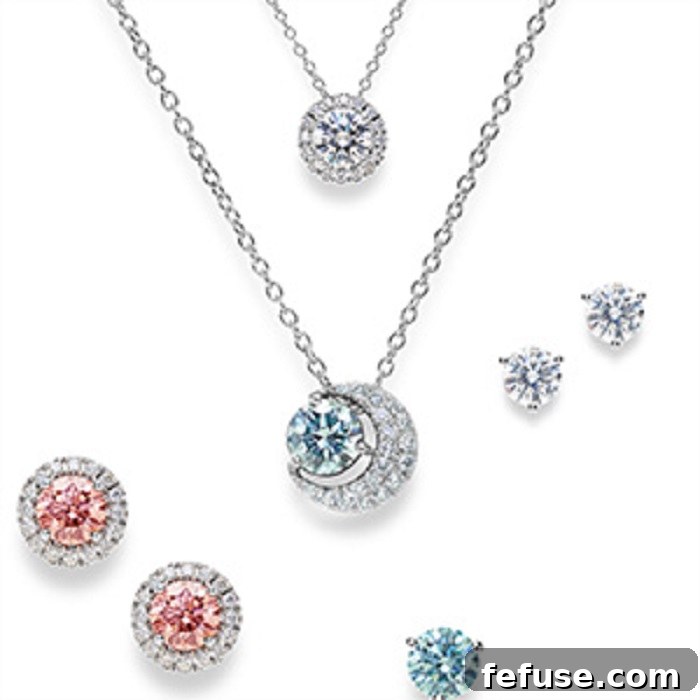
Lightbox deliberately dismantles much of this complexity. Its core proposition is strikingly simple: transparent, fixed pricing ($800 per carat, $400 for a half-carat, $200 for a quarter-carat, regardless of most other quality factors). De Beers justifies this approach by stating that lab-grown diamonds are mass-produced and, unlike unique natural stones, do not warrant the same individual attention or complex grading. Whether or not one fully agrees with this rationale, the practical outcome is an unprecedented simplification of the buying experience. With Lightbox, there are no intricate letter-and-number grading systems to decipher. Consumers are not expected to spend hours poring over color grades, clarity inclusions, or cut proportions. The choice is distilled to selecting a piece, then a color (typically three choices: white, pink, or blue), a carat weight (also limited options), and a mounting style (usually two simple options). This streamlined process transforms diamond purchasing from an intimidating, research-heavy endeavor into a remarkably painless and accessible transaction.
Embracing the Fashion Formula
In a sense, Lightbox’s model harks back to an age-old piece of advice often given by experienced jewelers to overwhelmed customers: “Don’t get fixated on the grades; focus on how the piece looks and how it makes you feel.” This is essentially the classic fashion retail formula: if an item possesses the right style, is aesthetically pleasing, and is priced attractively, it will sell. This strategy has long been applied to the sale of diamond fashion jewelry – a category that Lightbox now directly threatens with its accessible pricing and simplified purchasing. However, applying this “fashion formula” to single-carat diamond solitaires, traditionally products of significant emotional and financial investment, is an unusual and audacious move, signaling a profound shift in market approach.
Market Dynamics, Challenges, and Consumer Reception
While Lightbox presents a compelling vision of a simplified diamond market, its success is by no means guaranteed. It faces several significant challenges related to market dynamics, consumer expectations, and its ambitious goal of creating an entirely new market segment rather than merely capturing existing demand.
Targeting a New Market: Fashion and Self-Purchase
One of Lightbox’s most explicit strategies is its focus on the fashion and self-purchase jewelry market, distinct from the traditional bridal segment. This is a critical distinction because the bridal market, with its deep-seated emotional associations and higher price points, still accounts for the majority of sales for both natural and most lab-grown diamonds. By deliberately sidestepping bridal, Lightbox avoids direct competition with established players in their most lucrative segment. Instead, it aims to cultivate a new category where diamonds are viewed as accessible accessories, impulse buys, or gifts for lighter occasions. The challenge, however, is immense: creating a wholly new market segment is far more difficult than entering and disrupting an existing one. It requires significant consumer education and a shift in perception about diamonds’ role in everyday life.
Millennials and Price Sensitivity
Lightbox’s success heavily relies on its appeal to modern consumers, particularly millennials, who often prioritize transparency, value, and ethical sourcing. For many in this demographic, traditional luxury price points for jewelry can be prohibitive. While Lightbox’s $800-per-carat pricing is revolutionary for diamonds, even a $350 piece of jewelry, let alone a $1,000 piece, can still represent a substantial discretionary expense for many millennials. Anecdotal evidence suggests that Lightbox’s prices may even decrease further over time, which would further enhance its accessibility. However, capturing this market requires not just attractive pricing but also aligning with their broader values and purchasing habits.
The Value of Learning and Engagement
It’s also important to acknowledge that not all consumers desire extreme simplification. For some, part of the joy and engagement of purchasing a significant item, especially one with technical aspects, lies in the learning process itself. Consider the watch industry: mastering the intricacies of movements, complications, and craftsmanship is, for many enthusiasts, a significant part of the fun and passion. Similarly, some diamond buyers genuinely enjoy understanding the nuances of the 4Cs, comparing grades, and feeling like an informed connoisseur. Lightbox’s model, by stripping away this complexity, might alienate a segment of consumers who appreciate the intellectual and educational aspects of their purchase.
Innovation and the Future of the Lab-Grown Diamond Industry
The lab-grown diamond business is, by all accounts, a nascent industry, still in its infancy compared to the centuries-old natural diamond trade. For a long time, the prevailing assumption was that this new industry would simply mirror the template of its traditional predecessor, adopting its grading standards, pricing models, and marketing narratives. So far, this has largely been the case, with many lab-grown companies striving to achieve parity or even superiority to natural diamonds across the 4Cs and using similar certification processes. However, there’s no inherent rule or natural law stipulating that this must remain the standard. The very newness of the lab-grown sector presents an unparalleled opportunity for innovative thinking and radical redesign.
Redesigning the Diamond Trade from Scratch
Imagine a hypothetical scenario: if one were tasked with designing the diamond trade from the ground up, with the paramount goal of maximizing consumer-friendliness, how might things be different? It’s highly probable that the existing labyrinthine grading systems, with their often subtle distinctions and technical jargon, would be simplified. Similarly, the opaque and fluctuating pricing structures that necessitate expert guidance might be replaced by a more transparent, predictable model. The focus would shift from esoteric technical specifications to tangible aesthetics and straightforward value propositions. In this hypothetical, consumer-centric redesign, one might very well arrive at a model remarkably similar to Lightbox.
Lightbox as a Blueprint for the Future
Therefore, while it is still too early to definitively ascertain whether consumers will fully embrace Lightbox’s simplified model or whether the brand will achieve widespread market penetration, its significance as an industry experiment cannot be overstated. Lightbox represents a bold departure from established norms, challenging both the natural diamond industry and its lab-grown counterparts to reconsider their approaches to pricing, grading, and the overall consumer experience. It pushes the boundaries of how diamonds, whether mined or grown, can be perceived and purchased, potentially paving the way for a more accessible and democratized luxury market. This initiative from De Beers, a company historically synonymous with natural diamonds, underscores the profound disruptive forces at play and signals a potential future where diamonds, once solely symbols of ultimate luxury, can also become mainstream fashion statements.
Conclusion: Redefining Diamond Consumption
De Beers’ Lightbox project embodies a fascinating application of disruptive innovation in a deeply traditional industry. By intentionally offering a simplified product at a transparent, accessible price point, Lightbox is not just selling lab-grown diamonds; it is attempting to redefine the very act of diamond purchasing. It challenges the long-held beliefs about scarcity, value, and the necessity of expert guidance, proposing a future where diamonds can be bought for joy, fashion, and self-expression, without the usual complexities. Whether Lightbox ultimately becomes a dominant force or remains a niche player, its bold strategy has undeniably injected a fresh wave of innovative thinking into the diamond market, prompting a crucial conversation about consumer experience, value proposition, and the evolving landscape of luxury.
News Source: Jckonline.com