
The Future of Wearable Health: Unveiling the Revolutionary Smart Earring
In an era where personal health monitoring has become increasingly prevalent, the quest for more accurate, comfortable, and discreet wearable technologies continues to drive innovation. Traditional smartwatches and fitness trackers, while powerful, often face challenges related to accuracy, bulkiness, and aesthetic appeal. Stepping into this dynamic landscape is a groundbreaking invention from the University of Washington: a smart earring designed to monitor earlobe temperature with unprecedented precision. This elegant device heralds a new chapter in personal health analytics, promising to revolutionize how we track our well-being, from daily stress levels to critical reproductive health cycles, all while blending seamlessly with personal style.
Beyond the Wrist: Why the Earlobe is the New Frontier for Health Monitoring
The development of this smart earring challenges conventional wisdom about ideal biometric sensing locations. While wrists and hands have long been the go-to spots for wearable devices, research spearheaded by the University of Washington team reveals a significant advantage to monitoring temperature from the earlobe. The earlobe offers a unique anatomical position that provides a more stable and accurate reading of core body temperature compared to extremities like the wrist, which can be easily influenced by external factors such as ambient air temperature or physical activity in a less consistent manner. This enhanced accuracy is crucial for deriving meaningful health insights and represents a critical leap forward in non-invasive personal health tracking.
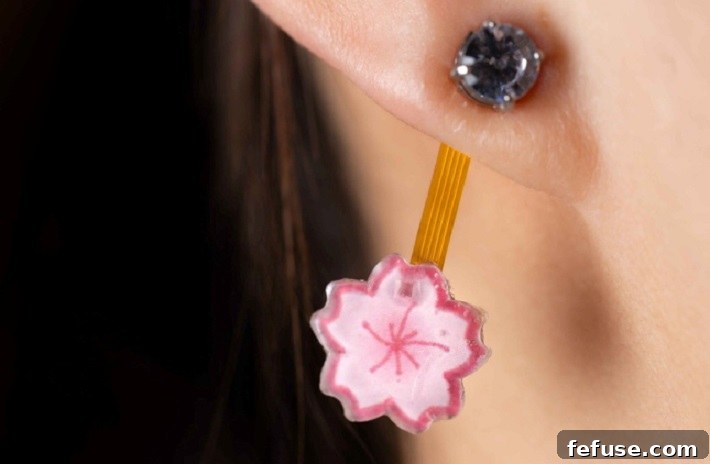
The ingenuity of the smart earring’s design lies not only in its chosen placement but also in its sophisticated approach to environmental compensation. The prototype, remarkably compact and lightweight, integrates two distinct temperature sensors. One sensor is strategically attached to the wearer’s earlobe, directly measuring skin temperature. The second sensor, positioned approximately an inch below, dangles freely to estimate the ambient room temperature. This dual-sensor configuration allows the device to intelligently differentiate between the wearer’s actual earlobe temperature and the surrounding environmental heat, ensuring that the collected data is robust, reliable, and free from misleading external influences. This meticulous attention to detail underscores the scientific rigor behind its development and its potential to deliver truly actionable health data.
A Closer Look at the Technology: Precision in a Miniature Package
Despite its diminutive size – comparable to that of a small paperclip – the smart earring is a marvel of miniaturized engineering. It houses a sophisticated array of components, each meticulously chosen for performance and efficiency. At its core are intricate circuits that manage data processing and power distribution. A low-power Bluetooth chip enables seamless, wireless communication with a paired smartphone or other compatible devices, allowing users to access their health data in real-time. Powering this advanced system is a high-efficiency battery, designed to deliver an impressive 28-day lifespan on a single charge. This extended battery life significantly surpasses many existing wearable devices, reducing the hassle of frequent recharging and ensuring continuous data collection, which is vital for long-term health pattern analysis. An integrated antenna completes the package, ensuring stable and reliable data transmission.
The choice of materials and construction further highlights the device’s thoughtful engineering. The components are carefully enclosed to withstand daily wear, yet remain lightweight enough to be comfortable for extended periods. This balance of durability, performance, and comfort is critical for a device intended for continuous wear. The entire assembly is designed to be as unobtrusive as possible, moving away from the bulky designs that often deter users from consistent engagement with wearable technology. This focus on user experience, combined with cutting-edge sensing capabilities, positions the smart earring as a frontrunner in the next generation of personal health devices.
Beyond Temperature: Unlocking Diverse Health Applications
While the primary function of the smart earring is highly accurate earlobe temperature monitoring, its potential applications extend far beyond simple temperature readings. The consistent and precise thermal data it collects can serve as a powerful proxy for a wide range of physiological states and bodily functions. Researchers envision its development to include monitoring subtle changes that indicate signs of stress, for instance. Elevated stress levels can manifest in slight shifts in body temperature, and the earring’s sensitivity could detect these nuances, offering users timely alerts and encouraging mindfulness or relaxation techniques.
Furthermore, its utility in tracking eating and exercise patterns is promising. Metabolic processes involved in digestion and physical exertion can induce minor temperature fluctuations. By correlating these thermal signatures with user-logged activities, the earring could provide deeper insights into caloric expenditure, post-meal thermogenesis, and recovery states. One of its most significant potential applications lies in women’s health: highly accurate ovulation tracking. Basal Body Temperature (BBT) monitoring is a well-established method for fertility tracking, and the earlobe’s consistent temperature readings could offer a more reliable and convenient alternative to traditional oral thermometers, automating a process that currently requires manual effort and precise timing. This could empower individuals seeking to understand their reproductive cycles with greater ease and accuracy, whether for family planning or general health awareness.
The possibilities continue to expand. The earring’s continuous temperature monitoring could also be invaluable for early detection of fevers, providing proactive health alerts. For individuals managing chronic conditions, subtle temperature shifts might indicate inflammatory responses or changes in medication efficacy. In sleep analysis, body temperature naturally dips and rises, and the earring could contribute to a more comprehensive understanding of sleep cycles and quality. The device could potentially track circadian rhythms, offering insights into sleep-wake patterns and aiding in the management of conditions like jet lag or shift work challenges. Ultimately, this versatile platform has the potential to become a cornerstone in preventative health, offering a continuous stream of biometric data that empowers users to take a more proactive role in managing their own well-being.
Fashion Meets Function: Personalization Without Compromise
One of the most compelling aspects of the smart earring is its seamless integration of advanced technology with personal style. Co-lead author Qiuyue (Shirley) Xue, a doctoral student who developed the earring, articulated the core motivation: “I wear a smartwatch to track my personal health, but I’ve found that a lot of people think smartwatches are unfashionable or bulky and uncomfortable.” This observation highlights a critical gap in the wearable tech market – the compromise between functionality and aesthetics. The smart earring directly addresses this issue by offering a device that is not only technologically superior but also customizable and fashionable.
The design allows for significant personalization without impacting its accuracy or performance. Users can choose to adorn the earring with various fashion designs made of resin, perhaps in the shape of a flower or other intricate patterns. Alternatively, it can be customized with gemstones, allowing it to seamlessly blend with existing jewelry collections. This level of aesthetic flexibility means that individuals no longer have to sacrifice their personal style for the sake of health monitoring. The device transforms from a purely functional gadget into a stylish accessory that happens to also collect vital health data. This dual appeal is crucial for broader adoption, particularly among demographics who value both health insights and personal expression, making wearable technology truly accessible and desirable for a wider audience.
The Innovation Journey: From Concept to Prototype
The journey from an innovative concept to a functional prototype is a testament to the dedication and ingenuity of the research team at the University of Washington. Shirley Xue’s personal experience with smartwatches fueled the initial spark, prompting her and her colleagues to explore alternative, more comfortable, and discreet body locations for biometric sensing. The decision to focus on the earlobe was a pivotal moment in the development process. As Xue explained, “I also like to wear earrings, so we started thinking about what unique things we can get from the earlobe. We found that sensing the skin temperature on the lobe, instead of a hand or wrist, was much more accurate.” This insight laid the foundation for the earring’s core advantage: superior thermal sensing accuracy.
The subsequent engineering challenge involved miniaturizing the necessary circuitry, sensors, battery, and communication components into a form factor suitable for an earring. This required innovative solutions for power management to achieve the remarkable 28-day battery life and clever design for the dual-sensor system to isolate skin temperature from ambient temperature effectively. The team’s interdisciplinary approach, combining expertise in electrical engineering, computer science, and human-computer interaction, was crucial in overcoming these hurdles. Their success in developing a functional prototype that is both technologically advanced and aesthetically pleasing represents a significant milestone in wearable technology research, paving the way for future advancements in non-invasive, continuous health monitoring.
The Impact on Personal Health and the Wearable Market
The introduction of the smart earring has profound implications for both personal health management and the wearable technology market. For individuals, it offers a discreet, comfortable, and highly accurate tool for continuous health monitoring, empowering them with detailed insights into their body’s responses to daily activities, stress, and physiological cycles. This continuous stream of data can facilitate proactive health decisions, aid in the early detection of potential issues, and promote a greater sense of bodily awareness. Its ease of use and long battery life encourage consistent engagement, which is key to deriving meaningful long-term health patterns.
In the broader wearable market, the smart earring introduces a new category of devices that addresses the limitations of existing options. By prioritizing both accuracy and aesthetics, it appeals to a demographic that might have previously shunned smartwatches due to their size or perceived lack of style. It demonstrates that advanced health monitoring does not have to come at the expense of comfort or fashion. This innovative approach could inspire other manufacturers to explore more diverse form factors and sensing locations, fostering a new wave of creativity and user-centric design in the health tech sector. As research continues and the device moves closer to commercialization, the smart earring from the University of Washington stands poised to redefine our expectations of personal health technology, making sophisticated biometric monitoring an accessible, elegant, and integral part of everyday life.