
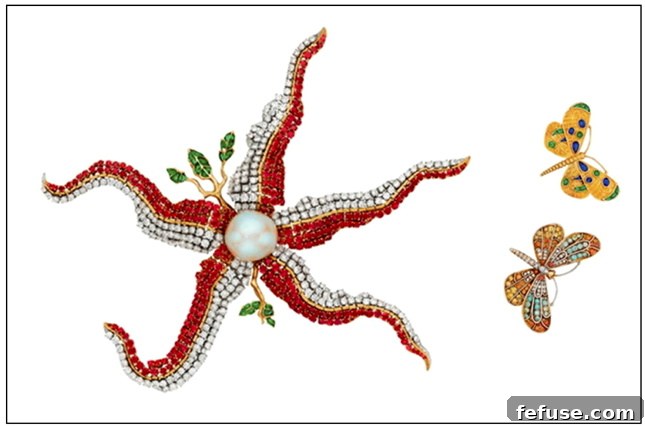
Salvador Dali’s “Etoile de Mer” Brooch: A Surrealist Masterpiece Bridging Art, Opulence, and Modern Pop Culture
The world of fine art and high jewelry often intersects with fascinating stories, but few tales are as vibrant and multi-layered as that of Salvador Dali’s “Etoile de Mer” (Starfish) brooch. This extraordinary piece of jewelry, a testament to the Spanish surrealist’s boundless imagination, recently commanded an impressive $982,000 at a Christie’s New York auction. More than just a sum, this figure marked a significant milestone, becoming the highest price ever paid at auction for a piece of jewelry created by the iconic artist. Crafted from cultured pearls, diamonds, rubies, and emeralds, the brooch is not merely a sparkling accessory; it is a wearable sculpture, imbued with the eccentric spirit of its creator and a rich history stretching back to one of America’s most intriguing socialites.
The Auction Phenomenon: A Record-Breaking Sale
The sale of the “Etoile de Mer” brooch captivated collectors and art enthusiasts alike. While it sold just shy of its pre-sale estimate, which ranged from $1 million to $1.5 million, its final price solidified its place in art history. The $982,000 hammer price underscored the enduring allure and investment value of Salvador Dali’s unique contributions to the jewelry world. This record-setting sale highlights the growing appreciation for his three-dimensional works, which are often overshadowed by his more famous paintings and sculptures. For a piece of jewelry to achieve such a price, particularly one outside the traditional mainstream of historical royal or ultra-rare gemstones, speaks volumes about the artistic merit and provenance it carries.
Christie’s, a venerable institution in the auction world, successfully presented the piece as not merely a collection of precious stones but as an integral part of Dali’s surrealist oeuvre. The meticulously detailed description and historical context provided by the auction house undoubtedly contributed to the intense bidding, emphasizing the brooch’s significance as both a jewel and a sculptural work of art. The record broken by the “Etoile de Mer” brooch serves as a powerful reminder of Dali’s multifaceted genius and his profound impact across various artistic disciplines.
Dali’s Vision: The Surrealist Jeweler
Salvador Dali (1904-1989) was not content to confine his artistic expression to canvas alone. His foray into jewelry design was a natural extension of his surrealist philosophy, allowing him to explore themes of transformation, dreams, and the subconscious in a tangible, wearable form. For Dali, jewels were not just decorative objects; they were “miniature sculptures,” each with its own narrative and symbolic depth. He once famously declared, “My aim is to show the absolute indivisibility of art and jewelry.” He viewed gemstones as living entities, capable of expressing emotion and conveying profound ideas, much like the figures in his paintings.
Dali’s approach to jewelry was revolutionary. He rejected conventional notions of design, instead favoring organic forms, fantastical creatures, and symbolic motifs that echoed his painted masterpieces. He often incorporated unexpected elements and challenged the traditional settings of precious stones, transforming them into dynamic, kinetic pieces that seemed to pulsate with life. The “Etoile de Mer” perfectly embodies this philosophy, reimagining a simple starfish into an object of otherworldly beauty, adorned with a constellation of precious gems that twinkle like starlight on the ocean floor.
A Masterful Collaboration: Dali and Carlos Alemany
The creation of Dali’s extraordinary jewels was often a collaborative process, primarily with the skilled jeweler Carlos Alemany. Alemany was not merely a craftsman but an artist in his own right, uniquely capable of translating Dali’s often complex and abstract visions into precious metals and stones. Their partnership, which began in the mid-20th century, was crucial in bringing Dali’s sculptural jewelry to life. Alemany possessed the technical mastery and an understanding of the surrealist aesthetic necessary to execute Dali’s intricate designs, ensuring that each piece retained the artist’s distinctive touch and provocative spirit.
For the “Etoile de Mer,” designed in 1949, Alemany’s expertise would have been indispensable in meticulously setting the cultured pearl, diamonds, rubies, and emeralds to form the distinct shape of the starfish. The brooch’s complexity was further enhanced by two attachable butterfly enhancements, crafted with additional diamonds, sapphires, and emeralds. These detachable elements exemplify Dali’s fascination with metamorphosis and transformation, allowing the wearer to alter the piece and imbue it with different meanings. This innovative feature showcases not only Dali’s creativity but also Alemany’s exceptional skill in fabricating such adaptable and exquisite components.
The Legendary Owner: Rebekah Harkness, A Life of Grandeur and Rebellion
Beyond its artistic provenance, the “Etoile de Mer” brooch carries a captivating personal history, having once belonged to Rebekah Harkness (1915-1982). A quintessential American heiress and socialite, Harkness was known for her immense wealth, extravagant lifestyle, and often tempestuous personality. Born into the prominent Standard Oil family, she inherited vast fortunes, which she used to indulge her passions for art, ballet, and lavish entertaining. Her life was a whirlwind of opulence, marked by grand parties, numerous marriages, and a penchant for pushing societal boundaries.
Harkness was a significant patron of the arts, particularly dedicated to the world of ballet. In the 1960s, she founded her own dance company, the Harkness Ballet, and established the Harkness House for Ballet Arts. Her commitment to fostering new talent and pushing the boundaries of classical dance was unwavering, even amidst financial challenges and artistic differences. It was through her deep engagement with the arts that she crossed paths with Salvador Dali, commissioning him to paint backdrops for her ballet productions. This artistic connection undoubtedly led to the creation of the “Etoile de Mer,” a bespoke piece designed specifically for her by the surrealist master.
The Rhode Island Mansion and Its Echoes in Pop Culture
Rebekah Harkness’s life was as colorful as the jewels she collected. Her Rhode Island mansion, a sprawling estate in New England, USA, became legendary for the notoriously loud and elaborate parties she hosted. These gatherings, often filled with artists, celebrities, and socialites, frequently infuriated her more staid neighbors, cementing her reputation as an eccentric and unapologetically flamboyant figure. The mansion itself became a symbol of her larger-than-life persona, a place where art, wealth, and scandal intertwined.
Decades after her death, Harkness’s story found a new audience through an unexpected medium: the music of global pop superstar Taylor Swift. In 2020, Swift released her album “folklore,” which included the song “The Last Great American Dynasty.” This track directly references Harkness’s life, chronicling her wild reputation, her “mad” mansion, and her infamous antics, such as reportedly cleaning her pool with champagne or filling a birdcage with expensive Scotch. Swift, who herself paid $17 million for the very Rhode Island mansion that Harkness once owned, found a profound connection with the historical figure. The song not only immortalized Harkness in modern pop culture but also sparked renewed public interest in her fascinating life and the legacy of the “Holiday House,” as the estate is known.
The acquisition of the brooch by Harkness underscores her sophisticated taste and her daring spirit. To commission a piece from Dali, an artist known for challenging conventions, speaks to her own unconventional nature and her appreciation for art that was both beautiful and thought-provoking. The “Etoile de Mer” was not just a piece of jewelry for Harkness; it was an extension of her artistic patronage and her unique identity.
The Enduring Appeal of Surrealist Jewelry
The record-breaking sale of the “Etoile de Mer” brooch underscores the enduring and growing appeal of surrealist jewelry, particularly pieces designed by Salvador Dali. These aren’t merely accessories; they are miniature works of art that capture the imagination and challenge perception. Dali’s jewels represent a unique intersection of fine art, craftsmanship, and fantastical storytelling. Each piece is a journey into the subconscious, inviting the wearer and observer to look beyond the glittering stones and appreciate the deeper artistic narrative.
Collectors are increasingly drawn to works that offer a story, a connection to a significant artist, and a distinctive aesthetic that stands apart from mass-produced luxury items. Dali’s jewelry fulfills all these criteria, offering rarity, artistic genius, and a fascinating provenance. As the art market continues to value uniqueness and historical context, pieces like the “Etoile de Mer” are likely to see their value and desirability continue to soar, cementing their place as treasures that transcend time and trends.
Conclusion: A Starfish That Continues to Shine
The “Etoile de Mer” brooch by Salvador Dali is far more than a dazzling collection of precious gems. It is a masterpiece of surrealist design, a tangible link to the eccentric world of Rebekah Harkness, and a fascinating thread woven into the fabric of modern pop culture by Taylor Swift. Its journey from Dali’s visionary mind, through Alemany’s skilled hands, onto the glamorous life of a socialite, and finally to a record-setting auction, speaks to the enduring power of art to connect disparate worlds and capture the human imagination across generations.
This starfish brooch, with its shimmering cultured pearl and constellation of diamonds, rubies, and emeralds, continues to shine not just with its inherent brilliance but with the luminescence of its incredible story. It stands as a vibrant testament to Salvador Dali’s unparalleled artistic versatility, Rebekah Harkness’s audacious spirit, and the timeless allure of objects that carry within them layers of history, artistry, and unforgettable narratives.