
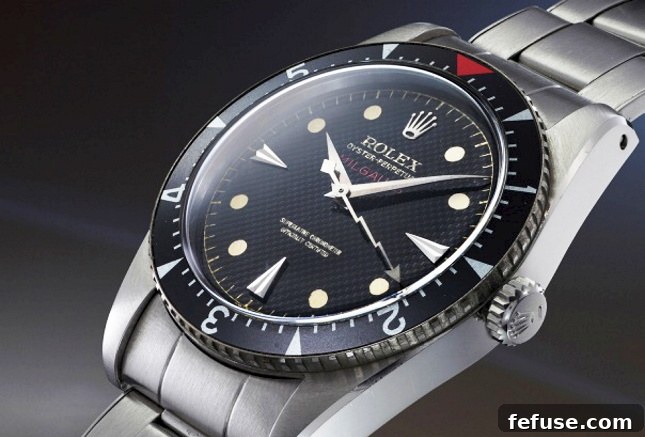
Rolex Milgauss: A Record-Breaking Acquisition and a Legacy of Scientific Precision
In a move that sent ripples throughout the horological world, luxury watchmaker Rolex reportedly paid an astonishing $2.5 million at auction to acquire one of its own historic timepieces. This monumental sum marked a record for the brand purchasing one of its watches, underscoring the enduring value and rich heritage embedded in its most iconic creations. The watch in question was a meticulously preserved 1958 Milgauss steel sports watch, a testament to Rolex’s pioneering spirit and its deep connection to scientific advancement.
The highly anticipated auction at Phillips Geneva saw the vintage Milgauss shatter pre-sale estimates, which had ranged from $556,000 to $1,110,000. Its final price more than doubled the highest estimate, reflecting intense bidding and the extraordinary condition of the watch. While the buyer’s identity was not officially confirmed by Phillips, industry reports, notably from Bloomberg, suggested that the winning bid was placed on behalf of Rolex itself, likely destined for the brand’s prestigious archives. This strategic acquisition is more than just a purchase; it’s an investment in Rolex’s legacy, a reclamation of a significant piece of its history, and a powerful statement about the brand’s commitment to preserving its authentic narrative.
The Genesis of an Icon: Engineering for the Electromagnetic Age
The Rolex Milgauss is no ordinary watch. Its very conception was born out of a specific and demanding need: to provide accurate timekeeping for scientists and engineers working in environments permeated by high levels of electromagnetism. In the mid-20th century, as technological advancements accelerated, scientific research facilities began to pose unprecedented challenges for traditional mechanical watches. Magnetic fields, ubiquitous in laboratories, power plants, and research centers, could severely disrupt the delicate balance springs and escapements of timepieces, leading to significant inaccuracies or even complete malfunction.
One of the most prominent institutions facing this challenge was the Conseil Européen pour la Recherche Nucléaire (CERN), the European Organization for Nuclear Research, located in Geneva, Switzerland. Home to groundbreaking particle physics experiments, CERN’s labs were veritable crucibles of electromagnetic activity. Scientists there required a watch that could withstand these harsh conditions without compromising precision. Rolex rose to this challenge, leveraging its engineering prowess to develop a groundbreaking solution: the Milgauss.
Introduced in 1956, the Milgauss was engineered with a unique feature designed specifically to combat magnetic interference: an internal soft iron cage. This innovative shield, known as a Faraday cage, enveloped the movement, protecting it from magnetic fields. The name “Milgauss” itself is a direct nod to its exceptional capability. Derived from the French “mille gauss,” meaning “a thousand gauss,” it signified the watch’s ability to withstand exposure to 1,000 gausses – a unit of magnetic flux density. This remarkable resistance earned it the memorable nickname, “the mad scientist’s watch,” a playful yet accurate moniker that captured its specialized purpose and innovative spirit.
The Allure of the Vintage Milgauss: Rarity, Condition, and Distinctive Features
What made this particular 1958 Milgauss so coveted and capable of fetching such a high price? Phillips, the auction house, provided an eloquent description that highlighted its extraordinary attributes: “The probably best preserved and to our knowledge complete amagnetic stainless steel wristwatch with honeycomb dial, ‘lightning’ hand, bracelet, chronometer certificate, guarantee, hang tag and presentation box.” This detailed account reveals several key factors contributing to its record-breaking value.
Firstly, its condition was described as “mint,” implying minimal wear and tear over its more than six decades of existence. For vintage collectors, originality and preservation are paramount. Finding a watch from 1958 in such an untouched state is incredibly rare. Secondly, its completeness played a crucial role. The presence of its original accessories – the bracelet, chronometer certificate, guarantee, hang tag, and even the presentation box – adds immense value. These accompanying items provide irrefutable provenance and confirm the watch’s authenticity, making it a dream acquisition for serious collectors and a historical treasure for Rolex.
Beyond its pristine condition and completeness, the aesthetic elements of the 1958 Milgauss (likely reference 6541 or a very early 1019) contribute significantly to its iconic status. The “honeycomb dial” refers to a distinct textured pattern that adds visual depth and uniqueness. But perhaps the most recognizable and beloved feature is the “lightning bolt” second hand. This vibrant, zig-zagging hand is an immediate identifier of the Milgauss, a whimsical yet functional design choice that symbolizes electricity and the very magnetic forces the watch was designed to defy. These specific details, combined with the watch’s historical significance, elevate it from a mere timekeeping device to a piece of art and engineering history.
Rolex’s Strategic Move: Preserving Heritage and Influencing the Market
The decision by Rolex to buy back one of its own watches, especially at a record-setting price, is a powerful statement. While not explicitly confirmed, the widely accepted rationale is for the watch to be housed in Rolex’s private archive or museum. For a brand synonymous with heritage and enduring quality, possessing such a pristine and historically significant example of its own innovation is invaluable. It allows Rolex to control its narrative, showcase its technological advancements, and provide tangible proof of its commitment to excellence from its earliest days.
Moreover, such an acquisition subtly influences the vintage watch market. When the brand itself participates in high-profile auctions, it reaffirms the intrinsic value of its historical pieces. It can also set a benchmark, potentially elevating the perception and future prices of similar vintage Milgauss models. This move is a testament to Rolex’s understanding that its past is just as critical to its identity as its present and future innovations. By securing this Milgauss, Rolex reinforces its position not just as a leading watch manufacturer, but as a custodian of horological history.
The Enduring Legacy of the Milgauss in Rolex’s Pantheon
The Milgauss, while perhaps not as widely recognized as the Submariner or Daytona, holds a special place within the Rolex professional watch lineage. Its reintroduction in 2007, after a long hiatus, with the distinctive green sapphire crystal (GV model) and the modernized lightning bolt hand, showcased Rolex’s continued dedication to its specialized tool watches. The modern Milgauss (reference 116400GV) pays homage to its vintage predecessors while incorporating contemporary advancements, demonstrating that the spirit of scientific precision and resistance to magnetic fields remains a core tenet of the collection.
The record-breaking sale of the 1958 Milgauss at Phillips Geneva is more than just a transaction; it’s a narrative of innovation, rarity, and enduring value. It highlights the incredible appreciation for vintage Rolex watches among collectors and historians alike. The watch, designed for the “mad scientists” pushing the boundaries of human knowledge, has now cemented its place in horological history, not just for its technological prowess, but also for the staggering sum it commanded. This event underscores Rolex’s unique position in the luxury market, where its past achievements are celebrated, preserved, and continue to inspire awe and demand.
In conclusion, the $2.5 million acquisition of the 1958 Milgauss represents a landmark moment for Rolex and the vintage watch market. It celebrates a watch born out of necessity, engineered for a specific scientific purpose, and now recognized as a timeless icon. The meticulous preservation, unique features like the honeycomb dial and lightning bolt hand, and its undeniable historical context – particularly its association with CERN – converge to make this Milgauss an irreplaceable artifact. Rolex’s decision to bring this piece back into its fold is a powerful reaffirmation of its commitment to its own illustrious history, ensuring that the legacy of the “mad scientist’s watch” continues to resonate for generations to come, symbolizing a perfect blend of scientific ingenuity and unparalleled craftsmanship.