
Navigating PMLA Compliance: Essential Clarifications for India’s Gems & Jewellery Sector
The landscape of financial regulations is constantly evolving, and for an industry as vital and intricate as India’s Gems & Jewellery (G&J) sector, understanding these changes is paramount. Amidst recent notifications that caused considerable debate and apprehension, critical clarifications emerged from the government, aiming to provide much-needed guidance. These clarifications were meticulously discussed during the IIJS Virtual 2.0 on January 9, featuring a crucial dialogue between Rohan Shah, an eminent legal expert, and Colin Shah, Chairman of the GJEPC.
This session was instrumental in dissecting the implications of the Prevention of Money Laundering Act (PMLA) notifications, specifically for businesses dealing in precious metals, stones, and finished jewellery. The clarifications sought to address widespread confusion and establish a clearer path for compliance, distinguishing between the initial perceived obligations and the actual requirements.
Rohan Shah: A Pillar of Expertise for the Industry
At the heart of this crucial discussion was Rohan Shah, whose profound understanding of legal and regulatory frameworks makes him an invaluable resource for the G&J sector. Shah’s extensive experience includes working with the Council and various trade bodies in diverse capacities, establishing him as a preeminent authority on such complex topics. His expertise is further underscored by his appointment by the Ministry of Commerce and Industry as India’s representative and Governor on the Board of Economic Research Institute for ASEAN and East Asia.
Recognized for his contributions, Rohan Shah was awarded the prestigious Indian Tax Lawyer Of The Year at The Legal Era Awards of 2019. Over the years, he has been a consistent and staunch supporter of the GJEPC, offering invaluable guidance on intricate legal issues that directly impact the industry’s operational framework and future growth. His participation in the IIJS Virtual 2.0 discussion provided the G&J community with authoritative insights, helping to dispel myths and clarify the true scope of their compliance responsibilities under the PMLA.
Demystifying PMLA: Addressing Initial Industry Apprehensions
Prior to the clarifications issued on January 8, a significant wave of concern swept across the G&J industry. The initial understanding of the notifications led many to believe that the entire sector had been designated as a ‘reporting entity’ under PMLA. This perception fueled fears that every business, regardless of size or transaction volume, dealing in precious metals, precious stones, or jewellery, would be subject to stringent and pervasive compliance obligations. The industry was grappling with the possibility of having to maintain Know Your Customer (KYC) records for virtually every transaction exceeding Rs 50,000, coupled with the daunting prospect of filing monthly returns and diligently reporting all suspicious transactions to regulatory authorities.
Such an interpretation would have imposed an immense administrative burden on businesses, from small family-run establishments to large corporations, potentially stifling trade and adding layers of complexity to daily operations. The prospect of meticulous record-keeping, extensive data submission, and heightened scrutiny for even relatively modest transactions created considerable anxiety and uncertainty regarding the viability and future conduct of business within the sector.
The Pivotal January 8th Clarifications: A Breath of Relief
The clarifications released on January 8 served as a significant reprieve and a much-needed course correction for the G&J industry. Rohan Shah elaborated on these pivotal updates, emphasizing that the widespread initial fears were largely based on a misinterpretation of the actual regulatory intent. The core message delivered was unequivocally clear: there are no *new* compliance requirements that the industry needs to fulfill under PMLA, beyond what was already in place, unless specific conditions are met.
The critical distinction drawn by the clarifications revolves around cash transactions. Businesses are only required to undertake additional PMLA compliance measures in relation to cash transactions that exceed a specific monetary threshold. This crucial point alleviated the industry’s concern that every single transaction, irrespective of payment method or value, would trigger PMLA reporting obligations. The government’s intention was not to cast a wide net of enhanced scrutiny over the entire industry for all transactions, but rather to focus on high-value cash dealings that inherently carry a higher risk profile for money laundering activities.
Key Distinction: Focus on Cash Transactions Exceeding Rs 10 Lakhs
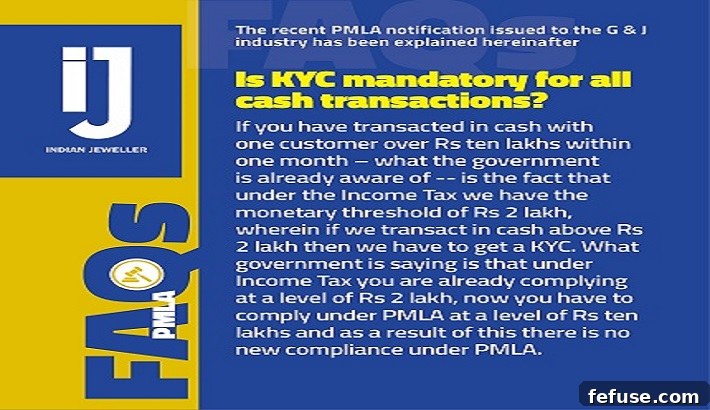
The primary revelation from the January 8th clarifications was the establishment of a clear threshold: PMLA compliance is specifically triggered only in the case of cash transactions with a single customer exceeding Rs 10 Lakhs within one month. This clarification drastically narrowed the scope of immediate concern for most routine transactions. It explicitly stated that if a business engages in a cash transaction above this ten-lakh rupee limit with a particular customer, then, and only then, do the enhanced PMLA compliance requirements apply.
Furthermore, Rohan Shah highlighted the interplay between PMLA and existing Income Tax regulations. He explained that under the Income Tax Act, a monetary threshold of Rs 2 Lakhs already exists for cash transactions, where KYC is mandatory. The government’s stance is that businesses already complying with KYC norms for cash transactions above Rs 2 Lakhs under Income Tax regulations will now simply extend a similar, though distinct, compliance effort for cash transactions above Rs 10 Lakhs under PMLA. This implies that for many entities, the procedural framework for compliance might already be partially established, reducing the perceived novelty and burden of the PMLA requirements.
Navigating the Nuances: Unresolved Questions and Future Directives
While the January 8th clarifications provided significant clarity, certain aspects remain open-ended and require further governmental elucidation. These lingering ambiguities present potential challenges for businesses striving for full compliance and necessitate a vigilant approach from the industry.
- Connected Transactions: A major point of contention and uncertainty revolves around the interpretation of “connected transactions.” The question remains whether multiple smaller cash transactions with a single customer, which cumulatively total up to Rs 10 Lakhs within a specified period (e.g., one month), need to be examined closely and reported under PMLA. This has not yet been definitively clarified. The implication here is critical: if a customer makes several purchases, each individually below Rs 10 Lakhs, but together they exceed the threshold, is the business expected to track and report this cumulative sum? Without clear guidance, businesses face the dilemma of how to implement their internal monitoring systems effectively. Misinterpretation could either lead to over-reporting or, more critically, non-compliance if such cumulative transactions are overlooked.
- Defining “Customer”: Another area requiring precise definition is “who constitutes a customer” for the purpose of these regulations. Is the ‘customer’ solely the individual physically purchasing the item from the establishment? Or does it extend to include individuals who are income tax payers, potentially linking to broader financial identities? The complexity arises because not all buyers may be income tax payers, especially in a diverse market. This distinction is vital for accurate identity verification and reporting, as it dictates the scope of KYC procedures and the information required from the buyer.
These ambiguities highlight the need for ongoing dialogue between the government and industry stakeholders to ensure practical and implementable compliance frameworks. The Central Board of Indirect Taxes and Customs (CBIC) is keenly aware of these issues and acknowledges that further clarifications are necessary to ensure smooth implementation across the board. Businesses are advised to stay updated with any forthcoming guidelines from CBIC.
It is also crucial for the industry to understand the enforcement mechanism. Non-compliance with PMLA regulations is a serious matter and can invite action from the Enforcement Directorate (ED). This underscores the critical importance for all G&J businesses to not only understand the rules but also to establish robust internal processes to ensure strict adherence, thereby mitigating severe legal and financial repercussions.
Mandatory Compliance for High-Value Cash Transactions
For those specific instances where a cash transaction with a single customer exceeds Rs 10 Lakhs, the PMLA regulations mandate strict compliance procedures. Businesses engaged in such transactions are required to perform a comprehensive Know Your Customer (KYC) process for the buyer.
The necessary documents for KYC verification typically include:
- Buyer’s Aadhar card
- Buyer’s PAN (Permanent Account Number) card
- Any other equivalent government-issued document proving the identity of your buyer.
Beyond KYC, there are specific reporting obligations and timelines:
- Transaction Reporting: Details regarding the nature of the transaction must be reported by the 15th of the following month. This requires businesses to maintain meticulous records of all high-value cash transactions, including transaction dates, values, and customer details, and submit them to the relevant authorities within the stipulated timeframe.
- Suspicious Transaction Reporting: In cases where a transaction, regardless of its value, appears suspicious or raises red flags indicative of potential money laundering or illicit financial activities, a separate and expedited reporting mechanism comes into play. Businesses are required to file a Suspicious Transaction Report (STR) within seven working days of becoming aware of the suspicious nature of the transaction. This highlights the ongoing responsibility of businesses to exercise due diligence and professional judgment in identifying and reporting unusual financial behaviors.
Adherence to these deadlines and accurate reporting are not merely procedural formalities but critical components of the national effort to combat money laundering and terrorist financing. Businesses must develop internal protocols and training programs to ensure their staff are well-versed in identifying, documenting, and reporting such transactions effectively.
Strategic Implications for the Gems & Jewellery Sector
The clarifications, while alleviating some initial fears, underscore the G&J industry’s ongoing responsibility in the broader fight against financial crimes. For businesses, this means it is no longer sufficient to merely react to notifications; a proactive approach to compliance is essential. This entails developing and implementing robust internal compliance frameworks that are tailored to the specific nature of their operations.
Key strategic implications include:
- Strengthening Internal Controls: Businesses must review and enhance their internal control systems to accurately track cash transactions, identify cumulative dealings with single customers, and ensure timely KYC collection.
- Employee Training: Regular training for employees on PMLA regulations, KYC procedures, and the identification of suspicious transactions is crucial. A well-informed team is the first line of defense against non-compliance.
- Leveraging Technology: Implementing suitable software or digital tools can significantly aid in managing customer data, tracking transactions, and generating reports, thereby streamlining the compliance process.
- Seeking Professional Advice: Given the complexities and evolving nature of these regulations, consulting with legal and financial experts specializing in PMLA and AML (Anti-Money Laundering) compliance is highly recommended.
- Fostering a Culture of Transparency: Beyond mere compliance, the industry can benefit from fostering a culture of transparency and ethical conduct, which not only meets regulatory requirements but also enhances consumer trust and international standing.
By embracing these strategic measures, the Indian Gems & Jewellery sector can effectively navigate the regulatory landscape, mitigate risks, and continue to thrive as a globally respected industry.
Conclusion: Adapting to Evolving Financial Regulations
The PMLA clarifications, particularly those concerning cash transactions over Rs 10 Lakhs, represent a significant development for India’s Gems & Jewellery industry. While they brought relief by dispelling the notion of universal reporting for all transactions, they also reinforced the necessity for heightened vigilance and structured compliance for high-value cash dealings. Rohan Shah’s insights at the IIJS Virtual 2.0 provided invaluable guidance, helping the industry differentiate between widespread apprehension and actual regulatory requirements.
As the government, through bodies like CBIC, continues to refine and clarify these regulations, it is imperative for all G&J businesses to remain informed, adapt their operational practices, and invest in robust compliance mechanisms. Proactive engagement with these evolving financial regulations is not just a legal obligation but a strategic imperative for safeguarding the integrity, reputation, and sustainable growth of India’s vibrant Gems & Jewellery sector in the global market.