PMLA Compliance Unpacked: Essential Clarifications for India’s Gems & Jewellery Sector
A deep dive into the recent government notifications impacting G&J businesses, featuring insights from Rohan Shah at IIJS Virtual 2.0.
Understanding the Evolving Regulatory Landscape for Gems & Jewellery
The Indian Gems and Jewellery (G&J) industry, a cornerstone of the nation’s economy and a significant contributor to global trade, often finds itself navigating a complex web of financial regulations. Recent government notifications, particularly those concerning the Prevention of Money Laundering Act (PMLA), have spurred significant discussion and, at times, confusion within the sector. To address these critical matters and provide much-needed clarity, an insightful session was held during the IIJS Virtual 2.0 on January 9th, featuring industry stalwarts Rohan Shah and Colin Shah, Chairman of the Gem & Jewellery Export Promotion Council (GJEPC).
Rohan Shah, a distinguished expert in the field of legal and regulatory affairs, brought his extensive experience to the forefront. Having served the Council and various trade bodies in diverse capacities, Shah possesses an unparalleled understanding of the legal intricacies that govern the industry. His expertise is further underscored by his appointment by the Ministry of Commerce and Industry as India’s representative and Governor on the Board of the Economic Research Institute for ASEAN and East Asia. Recognized for his contributions, including being awarded the Indian Tax Lawyer Of The Year at The Legal Era Awards of 2019, Rohan Shah has been a steadfast ally and crucial advisor to GJEPC on pivotal law-related issues over the years. His participation was instrumental in demystifying the recent PMLA clarifications, providing a beacon of guidance for G&J businesses.
Navigating the Initial Confusion: What the January 8th Clarifications Mean
Prior to the official clarifications issued on January 8th, the G&J industry was grappling with considerable uncertainty and widespread apprehension. Initial interpretations of the notification led many within the sector to believe that the entire industry, regardless of the nature of their dealings – be it in precious metals, precious stones, or finished jewellery – had been designated as a ‘reporting entity.’ This perception generated significant concern, as it implied a stringent new regime requiring Know Your Customer (KYC) compliance for every transaction exceeding a mere Rs 50,000. Furthermore, businesses anticipated the cumbersome responsibility of filing monthly returns and proactively reporting any suspicious transactions to the authorities, thereby adding a substantial administrative and compliance burden across the board.
Rohan Shah meticulously broke down these concerns, offering a sigh of relief to many. He emphatically stated that the January 8th clarifications fundamentally addressed many of these previously perceived challenges. The most significant takeaway, and a point of immense relief for the G&J sector, was that there is no broad new compliance requirement being imposed on the entire industry beyond what was already mandated under the PMLA. The critical clarification specifically states that enhanced compliance, including detailed KYC procedures and reporting, is only necessary in cases of cash transactions exceeding a threshold of Ten Lakhs Indian Rupees (Rs 10,00,000).
This nuanced distinction is vital. It shifts the focus from an industry-wide, low-threshold reporting obligation to a more targeted approach, primarily concerned with larger cash transactions. This clarification provides much-needed relief and a clearer operational framework for thousands of G&J businesses, allowing them to better understand their specific responsibilities under the PMLA without the overwhelming burden initially feared.
Distinguishing PMLA from Income Tax Compliance: Thresholds and Synergies
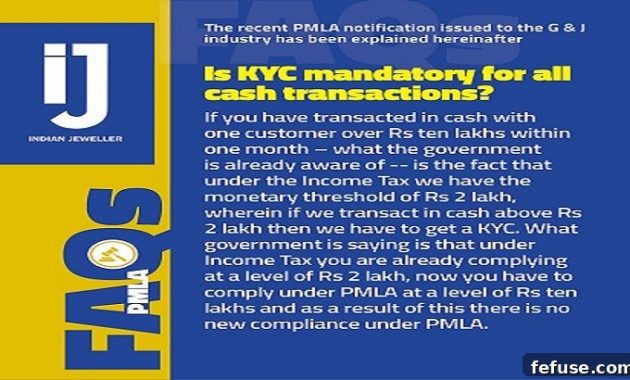
A key aspect of Rohan Shah’s explanation centered on differentiating the PMLA compliance requirements from existing Income Tax regulations, particularly concerning cash transactions. Many businesses were already familiar with the monetary threshold established under the Income Tax Act, which mandates KYC procedures for cash transactions exceeding Rs 2 Lakhs. This existing requirement meant that a significant portion of the G&J industry was already engaged in a degree of KYC due diligence for medium-to-large cash dealings.
The government’s position, as clarified, is not to introduce an entirely new layer of compliance in isolation but rather to delineate the PMLA’s specific applicability at a higher threshold. As Rohan Shah elucidated, “What government is saying is that under Income Tax you are already complying at a level of Rs 2 lakh, now you have to comply under PMLA at a level of Rs ten lakhs and as a result of this there is no new compliance under PMLA.” This statement is crucial. It underscores that for cash transactions between Rs 2 Lakhs and Rs 10 Lakhs, existing Income Tax KYC provisions continue to apply. However, for cash transactions exceeding Rs 10 Lakhs, the more stringent PMLA compliance procedures kick in. Essentially, businesses are expected to maintain their existing Income Tax compliance for lower thresholds while being prepared for PMLA requirements when cash transaction volumes cross the higher Rs 10 Lakh mark within a single customer interaction over a month.
This layered approach aims to capture larger cash movements more effectively under the ambit of anti-money laundering efforts without unduly burdening everyday transactions that are already covered by Income Tax regulations. It emphasizes a progressive increase in scrutiny based on transaction value, ensuring that due diligence is proportional to the potential risk of illicit financial activities.
Unresolved Queries and Areas Awaiting Further Clarification
While the January 8th clarifications brought significant relief, Rohan Shah also highlighted certain aspects that remain open-ended and require further governmental guidance to ensure complete clarity for the industry. These ambiguities, if left unaddressed, could still pose compliance challenges for G&J businesses.
1. The Enigma of Connected Transactions:
One of the primary areas awaiting a definitive explanation concerns “connected transactions.” The question revolves around whether multiple, seemingly separate cash transactions with a single customer that collectively total Rs 10 Lakhs or more within a specific period (e.g., one month) should be treated as a single PMLA-reportable event. This is a critical point because customers often engage in staggered purchases, or multiple smaller transactions might be made by the same individual over time. Without clear guidelines, businesses face the dilemma of how to aggregate such transactions. Should they track all purchases by a single customer over a month? What constitutes “connection” – merely the same buyer, or a clear intent to split a larger transaction? Clarity here is paramount to prevent unintentional non-compliance and to ensure a level playing field across the industry.
2. Defining “Customer” for PMLA Purposes:
Another crucial area requiring clarification is the precise definition of a “customer” under the PMLA framework, especially when juxtaposed with Income Tax definitions. Is a “customer” solely the individual directly purchasing the goods, or does the definition extend to encompass a “taxpayer” or an “associate of the Income Tax office”? This distinction is significant because, in the G&J sector, it is not uncommon for buyers to not be direct income tax payers, or for transactions to involve intermediaries. Understanding who precisely constitutes the “customer” for whom KYC must be performed is fundamental. Incorrect identification could lead to inadequate KYC procedures, exposing businesses to penalties. The industry needs to know whether the responsibility extends beyond the immediate transaction counterparty to ascertain the ultimate beneficial owner or the tax-paying entity behind the purchase.
The Central Board of Indirect Taxes and Customs (CBIC) has acknowledged the need for additional clarifications on these and potentially other related matters. This recognition from the regulatory body suggests that further guidance is anticipated, offering hope for a more comprehensive and unambiguous compliance framework in the near future. The GJEPC and other industry bodies will undoubtedly continue to engage with the government to expedite these much-needed clarifications.
Regulatory Oversight and the Imperative of Compliance
While the clarifications aim to streamline compliance, the implications of non-adherence remain severe. The regulatory landscape governing anti-money laundering (AML) and counter-terrorist financing (CFT) activities is robust, with stringent enforcement mechanisms in place. The Central Board of Indirect Taxes and Customs (CBIC) plays a pivotal role in ensuring that businesses comply with these mandates. Its oversight functions include monitoring, auditing, and issuing directives to ensure the effective implementation of PMLA provisions within sectors like Gems & Jewellery.
Should instances of non-compliance be identified, the enforcement arm of the government, the Enforcement Directorate (ED), is empowered to take decisive action. The ED is responsible for investigating offenses under the PMLA and can initiate proceedings that range from imposing substantial monetary penalties to the attachment of property and, in severe cases, criminal prosecution. The gravity of PMLA non-compliance cannot be overstated, making it absolutely imperative for all G&J businesses to understand and meticulously adhere to the stipulated regulations.
For cash transactions exceeding Rs 10 Lakhs, businesses must undertake thorough Know Your Customer (KYC) procedures. This involves collecting specific documents and information to establish the identity and bona fides of the buyer. The fundamental documents typically required include the buyer’s Aadhar card and PAN (Permanent Account Number). In cases where these primary documents are not available or applicable, any equivalent document proving the identity and address of the buyer must be submitted. This due diligence is not merely a formality; it forms the backbone of the PMLA’s objective to prevent the use of the financial system for illicit purposes.
Beyond initial KYC, there are clear reporting obligations. Businesses are required to submit reports detailing the nature of such cash transactions. These reports must be filed by the 15th of the subsequent month following the transaction. Furthermore, in situations involving ‘suspicious transactions’ – those that lack economic rationale, appear unusual, or raise red flags regarding potential money laundering or terrorist financing – a separate and more urgent reporting mechanism is triggered. Any suspicious transaction must be reported to the Financial Intelligence Unit (FIU-IND) within seven working days of its detection. The onus is on the businesses to develop internal mechanisms for identifying and reporting such transactions promptly and accurately, safeguarding both their operations and the integrity of the financial system.
The Road Ahead: Building a Transparent and Compliant G&J Industry
The clarifications provided by the government, elucidated by experts like Rohan Shah, mark an important step towards fostering a more transparent and compliant Gems and Jewellery industry in India. While initial concerns were significant, the refined understanding of PMLA’s application, particularly its focus on larger cash transactions, offers a more manageable framework for businesses.
The G&J sector, known for its intricate supply chains and reliance on diverse payment methods, stands to benefit from these clear directives. Increased regulatory adherence not only protects businesses from legal ramifications but also enhances their credibility on both domestic and international fronts. A compliant industry is a trusted industry, capable of attracting greater investment, fostering stronger trade relationships, and contributing robustly to national growth.
However, the journey towards full clarity and seamless compliance is ongoing. The need for further governmental pronouncements on “connected transactions” and a precise definition of “customer” remains pressing. Industry bodies like GJEPC will undoubtedly continue their vital role in advocating for their members and facilitating dialogue with regulatory authorities to ensure all ambiguities are resolved. Businesses, in turn, must remain vigilant, proactively educate themselves and their staff on the evolving regulations, and implement robust internal compliance systems.
The goal is a G&J industry that thrives on transparency, operates with integrity, and plays a leading role in India’s economic narrative, all while upholding the highest standards of financial probity. These PMLA clarifications are a critical part of that journey, guiding the sector towards a future of enhanced trust and sustainable growth.