
Retail Giants Unite: A Deep Dive into the US-China Tariff Debate and its Impact on American Consumers
The specter of an escalating trade war between the United States and China has prompted a strong reaction from America’s leading retail companies. A coalition of twenty-five prominent retailers, including industry titans such as Macy’s, J.C. Penney, Kohl’s, and Walmart, has collectively voiced their urgent appeal to President Donald Trump, urging him to reconsider the imposition of substantial tariffs on Chinese imports. Their primary concern revolves around the undeniable economic ripple effect: a projected surge in prices that would directly burden American consumers and potentially undermine the nation’s economic stability.
At the heart of the retailers’ argument lies the assertion that tariffs are, in essence, a regressive tax. In a meticulously crafted letter, the group highlighted a critical economic paradox: “In the U.S., those who can afford less pay more because the U.S. levies the highest tariffs on basic consumer goods.” This statement underscores a significant point often overlooked in the broader tariff discourse. The letter further elaborated with concrete examples, pointing out that “families shopping in our stores pay higher prices because America already levies import taxes as much as 32 and 67 percent on basic clothes and shoes.” The message was clear: introducing “any additional broad-based tariff [would] punish American working families with higher prices on household basics like clothing, shoes, electronics, and home goods,” impacting the daily lives and budgets of millions.
The coordinated effort to present this unified front was meticulously orchestrated by the Retail Industry Leaders Association (RILA), a powerful advocacy group representing the nation’s most successful retail companies. RILA’s involvement signifies the gravity of the situation for the sector, as retailers operate on thin margins and are highly sensitive to price fluctuations and consumer spending habits. Their appeal is not merely a request but a warning of potential economic hardship for their customer base and, by extension, their own businesses.
Echoing these profound concerns, the National Retail Federation (NRF), another influential trade organization, has similarly expressed its deep reservations regarding the proposed tariffs. The NRF critically characterized the tariffs as a “self-inflicted wound” on the robust American economy. Matthew Shay, President and CEO of the NRF, unequivocally stated, “A tariff is a tax, plain and simple. In this case, it’s an unnecessary tax on every American family.” Shay’s statement crystallized the retail industry’s apprehension, emphasizing that the administration’s “apparent desire to ignite a trade war” would ultimately result in “the net losers will be the very people the president wants to help,” creating an ironic and counterproductive outcome for American households.
President Trump’s Rationale: Addressing Trade Imbalance and IP Theft
The administration’s stance on tariffs, however, stems from a fundamentally different economic perspective. On March 22, President Trump formally announced his intention to direct the U.S. trade representative to impose 25 percent tariffs on approximately $50 billion worth of Chinese imports. This decisive action was framed as a direct retaliation for what the President frequently termed China’s “lax enforcement of intellectual property laws” – a long-standing point of contention in bilateral trade relations.
President Trump articulated a strong conviction that the United States had been subjected to unfair trade practices for decades. During his announcement, he highlighted the persistent and substantial trade deficit with China, stating, “We have a trade deficit, depending on the way you calculate, of $504 billion.” He acknowledged varying methodologies for calculation, noting, “Now, some people would say it’s really $375 billion. Many different ways of looking at it, but anyway you look at it, it is the largest deficit of any country in the history of our world. It’s out of control.” Beyond the sheer magnitude of the deficit, the President placed significant emphasis on the issue of intellectual property theft, asserting, “We have a tremendous intellectual property theft situation going on, which likewise is hundreds of billions of dollars.” This argument posits that China’s alleged theft of American technology and trade secrets not only harms U.S. businesses but also undermines innovation and future economic growth, necessitating a firm response.
China’s Swift Retaliation and Stance on Trade War
As anticipated, China responded swiftly and assertively to the U.S. tariff announcement. Beijing declared its own set of retaliatory tariffs, targeting an estimated $3 billion worth of U.S. goods. These measures were carefully selected to exert pressure on key American agricultural and industrial sectors, signalling China’s readiness to engage in a tit-for-tat tariff exchange. The announced tariffs included a significant 25 percent levy on U.S. pork imports and recycled aluminum, which are vital export categories for American producers. Furthermore, 15 percent tariffs were planned for American steel pipes, fruit, and wine, affecting a broad range of U.S. industries and potentially hitting specific regions and political constituencies.
The Chinese embassy in Washington, D.C., issued a stern statement that encapsulated China’s resolve. While affirming a preference for peaceful resolution, the statement left no doubt about China’s preparedness to defend its economic interests: “China does not want a trade war with anyone. But China is not afraid of and will not recoil from a trade war… If a trade war were initiated by the US, China would fight to the end to defend its own legitimate interests with all necessary measures.” This declaration underscored the high stakes involved and suggested a protracted and potentially damaging trade conflict if both sides remained entrenched in their positions. The global community watched with bated breath, recognizing the potential for significant disruption to international trade flows and global economic stability.
The Broader Economic Implications for the US and Global Economy
The implications of an escalating trade war extend far beyond the immediate increase in prices for consumer goods. For American consumers, the direct consequence of tariffs is a reduction in purchasing power. When import taxes are applied to goods manufactured in China – which constitute a vast array of products from everyday clothing to sophisticated electronics – the cost is typically absorbed by the importing companies and then passed on to the consumers. This means families will find their budgets stretched thinner, having to pay more for the same household essentials. This could lead to a decrease in overall consumer spending, a critical engine of the U.S. economy, potentially slowing economic growth and even leading to job losses within the retail sector as demand softens.
U.S. businesses also face a multitude of challenges. Manufacturers relying on components from China could see their input costs soar, making their final products less competitive both domestically and internationally. Supply chains, meticulously built over decades for efficiency and cost-effectiveness, would be disrupted, forcing companies to seek alternative, often more expensive, suppliers or relocate production, a process that is costly, time-consuming, and complex. This uncertainty and increased operational expense can stifle investment, deter innovation, and ultimately harm the profitability of American enterprises, large and small.
President Trump’s assertion, conveyed through a tweet, that trade wars are “good, and easy to win” encapsulates a particular economic philosophy that views tariffs as a powerful negotiating tool to rebalance trade relationships. This perspective often suggests that the U.S., as the world’s largest economy, possesses sufficient leverage to dictate terms and emerge victorious from such conflicts. However, many economists and trade experts hold a more cautious view, arguing that trade wars rarely yield clear winners. Instead, they often result in a net loss for all parties involved, creating economic instability, undermining international cooperation, and potentially leading to a fragmentation of the global trading system. The complexity of global supply chains means that tariffs on one country’s goods can have unintended consequences on businesses and consumers worldwide, cascading into broader economic turbulence.
Navigating the Future of US-China Trade Relations
The ongoing tariff dispute between the United States and China represents a pivotal moment in global trade relations, with profound implications for the future. The path forward remains uncertain, oscillating between potential de-escalation through negotiation and the risk of further escalation. Any resolution would likely require significant concessions from both sides, addressing core issues such as intellectual property rights, market access, and the trade deficit, while carefully managing the political and economic sensitivities involved.
The long-term impact of this dispute on international trade norms and relations cannot be overstated. Should tariffs become a more commonplace tool in geopolitical disagreements, it could undermine the principles of free trade that have largely governed global commerce for decades. This could lead to a more protectionist global economy, characterized by reduced trade volumes, higher barriers, and increased friction between nations. For businesses, this means navigating an increasingly complex and unpredictable international landscape. For consumers, it means continued uncertainty regarding product availability and pricing. The imperative for balanced approaches that consider the welfare of all stakeholders – from global manufacturers to individual American families – is paramount to fostering a stable and prosperous global economy.
In conclusion, the appeal from twenty-five leading retailers against U.S. tariffs on Chinese products underscores a deep concern within a critical sector of the American economy. Their warnings about increased prices for consumers, particularly on essential goods, highlight the immediate and tangible impact of these trade policies. While President Trump’s administration seeks to address long-standing grievances regarding trade deficits and intellectual property theft, China’s firm retaliatory stance confirms the potential for a prolonged and costly trade conflict. The stakes are undeniably high, with the ultimate consequences shaping not only the economic landscape of the U.S. and China but also the very fabric of global commerce for years to come.
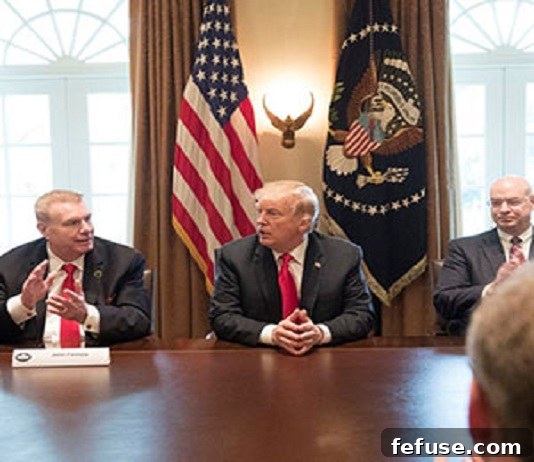
(Image courtesy of the White House)