
The coronation of a British monarch is a spectacle steeped in centuries of tradition, pageantry, and profound symbolism. For weeks, we have journeyed through the glittering history of coronation jewels, worn by queens regnant and consort alike, from the early days of Queen Victoria’s reign to the elegance of Queen Elizabeth the Queen Mother. Today, we conclude our illuminating series with an in-depth exploration of arguably one of the most iconic and universally remembered coronations: the majestic ceremony of Queen Elizabeth II in 1953.
This event was not merely a formal investiture; it was a deeply symbolic moment for a nation still recovering from the scars of World War II and entering a new Elizabethan era. It captivated a global audience, marking a pivotal transition and cementing Elizabeth II’s place on the world stage. From the intricate preparations of Westminster Abbey to the dazzling display of the Crown Jewels, every detail contributed to a day of unparalleled historical significance.
<
The Path to the Throne: Preparations for a Historic Coronation
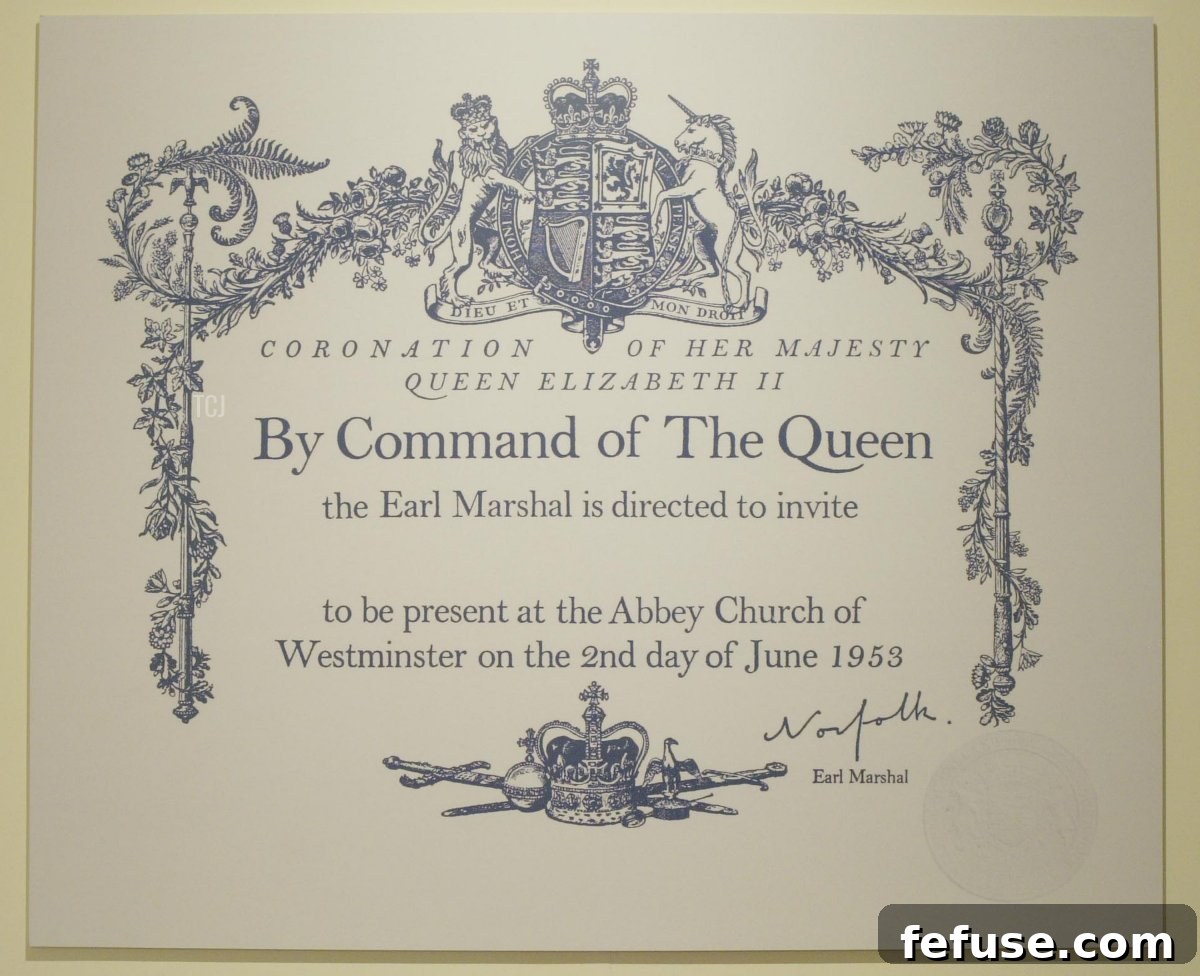
Princess Elizabeth ascended to the throne as Queen Elizabeth II following the untimely death of her father, King George VI, on February 6, 1952. While her reign began immediately, the coronation ceremony was scheduled for a little over a year later, on June 2, 1953. This fourteen-month interval allowed for meticulous and extensive planning, transforming a period of national mourning into one of eager anticipation and meticulous preparation for the grand occasion.
The scale of the preparations was immense, touching every aspect of British life and infrastructure. Westminster Abbey, the venerable site of English coronations for nearly a millennium, underwent significant physical transformations to accommodate the ceremony and its distinguished guests. Scaffolding was erected, temporary structures were built, and the ancient interior was carefully prepared to host the sacred ritual. One of the most groundbreaking decisions was to permit television cameras to capture the entire occasion. This marked a significant departure from previous coronations, allowing millions of people worldwide to witness the historic event in real-time, bringing the pageantry and solemnity directly into homes. This decision alone dramatically expanded the global audience and impact of the coronation. Beyond the Abbey, elaborate plans were made for the procession route through the streets of London, including security, public viewing areas, and the logistics of managing hundreds of thousands of spectators. Every detail, from the decorations adorning the city to the timing of military parades, was carefully choreographed to ensure a flawless and memorable day.
The Coronation Gown: A Symphony of Symbolism and Craftsmanship
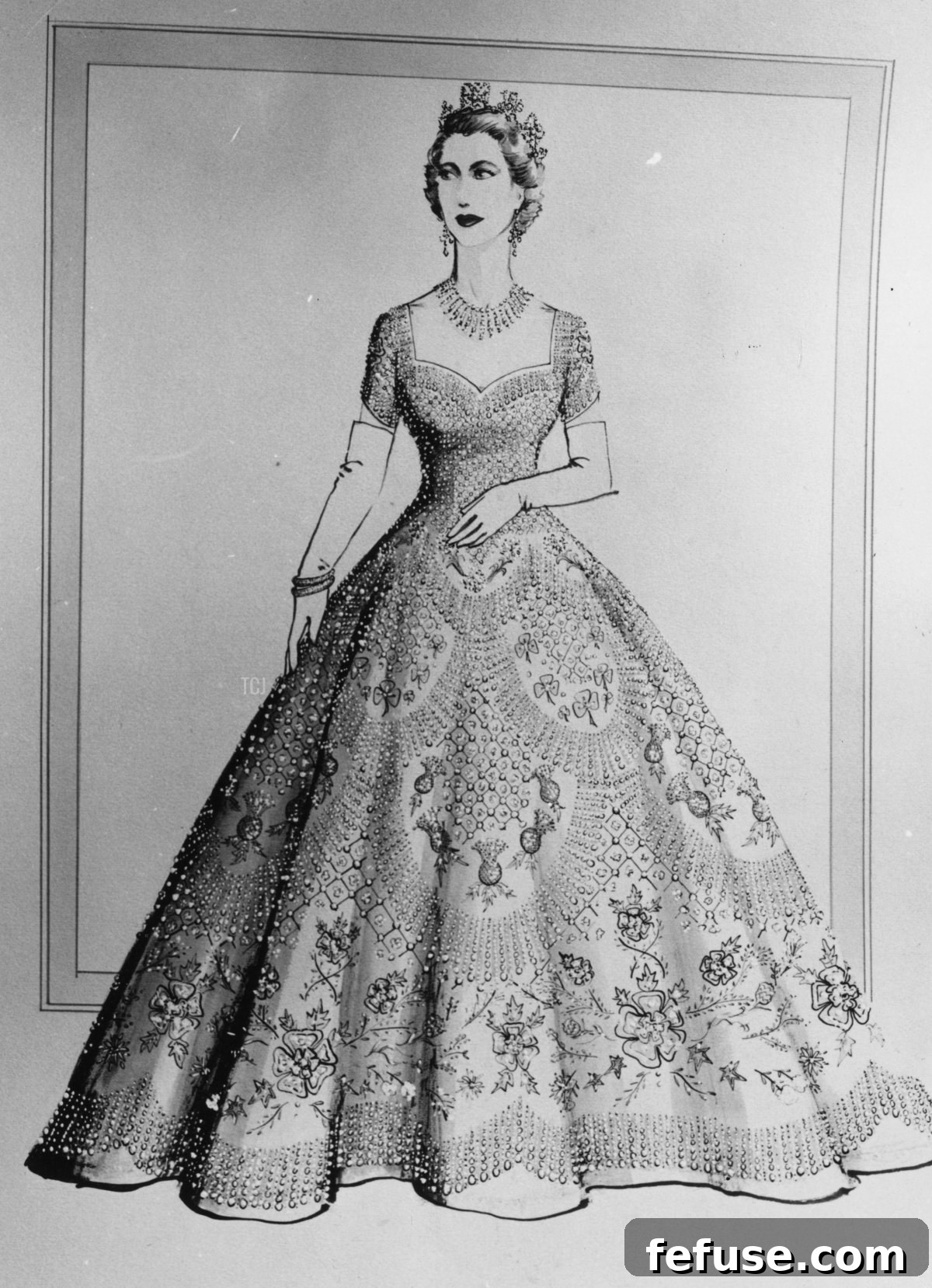
Among the myriad preparations, the Queen’s coronation attire demanded particular attention and artistic genius. For this pivotal ensemble, Her Majesty turned to the esteemed British couturier Norman Hartnell, the same designer who had created her elegant wedding gown just five years prior. The Queen’s request was for a similar, timeless silhouette to her 1947 wedding dress, reflecting both continuity and personal preference. Hartnell, a master of design, presented eight distinct sketches for her consideration, each a work of art in itself, blending royal tradition with contemporary elegance.
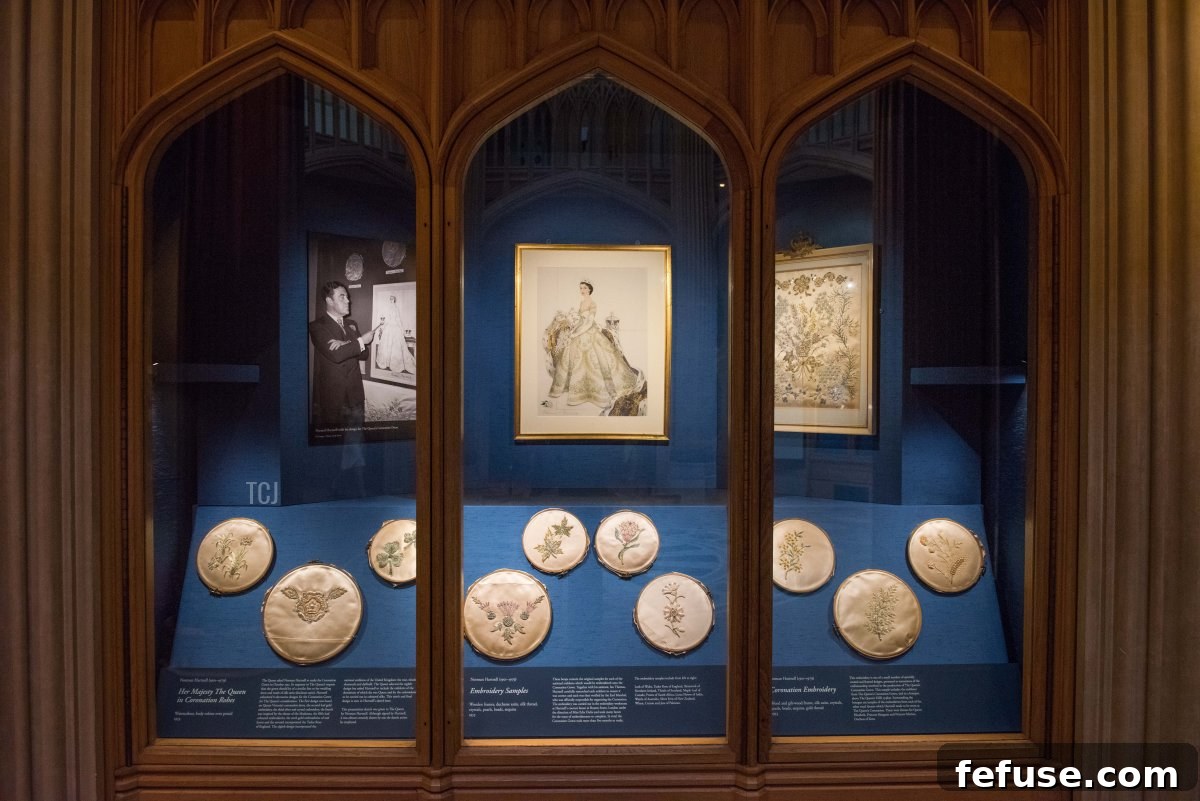
The eighth sketch captured the Queen’s imagination most profoundly. It featured an exquisite array of embroidered floral symbols, representing the diverse nations of the United Kingdom: the graceful rose of England, the hardy thistle of Scotland, the proud daffodil of Wales, and the resilient shamrock of Northern Ireland. While delighted with the core concept, the Queen requested a few thoughtful adjustments to imbue the gown with even deeper meaning. As noted by the Royal Collection, she “suggested the addition of embroideries in various colours rather than all in silver,” envisioning a more vibrant and rich tapestry of national symbols. Furthermore, and crucially, she “requested that in addition to the four national emblems, those of the Dominions of which she was now Queen should also be added.” This significant amendment transformed the dress into a powerful sartorial statement, symbolizing her role as the Head of the Commonwealth and her connection to a truly global family of nations. These historical embroidery samples, along with the magnificent finished gown, were proudly displayed as part of last year’s Platinum Jubilee exhibition at Windsor Castle, allowing a new generation to appreciate their artistry and historical weight.
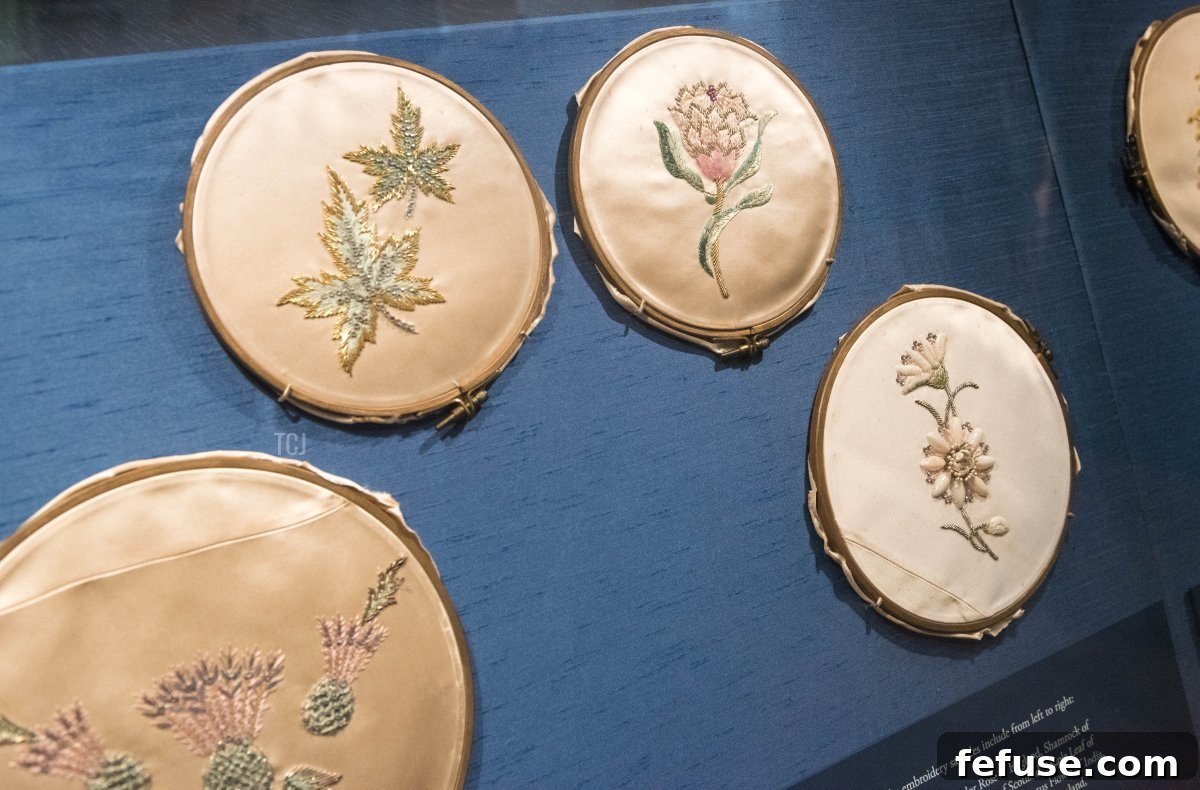
A closer inspection of the intricate embroidery reveals a magnificent collection of these national and Commonwealth symbols. Alongside the originally included English rose, Scottish thistle, and Northern Irish shamrock, the gown was adorned with the Welsh leek – a significant change from the initially proposed daffodil, reflecting a deeper historical connection. Further emblems represented the wider Commonwealth: the Canadian maple leaf, the Australian wattle, the New Zealand silver fern, the South African protea, and the Pakistani cotton and jute, acknowledging the textile heritage of the nation. Two exquisite lotus flower embroideries were also incorporated: one for Ceylon (now Sri Lanka), crafted in vibrant green silk with shimmering white sequins, and another for India, intricately made from mother-of-pearl, delicate seed pearls, and sparkling diamantes. Although India had become a republic and was no longer a dominion or realm at this point, its symbol was thoughtfully included to represent the Queen’s crucial and evolving role as Head of the Commonwealth. The inclusion of each emblem was not taken lightly; every design had to be thoroughly researched, verified, and officially confirmed by the Earl Marshal, ensuring historical accuracy and proper representation, turning the dress into a living map of the Commonwealth.
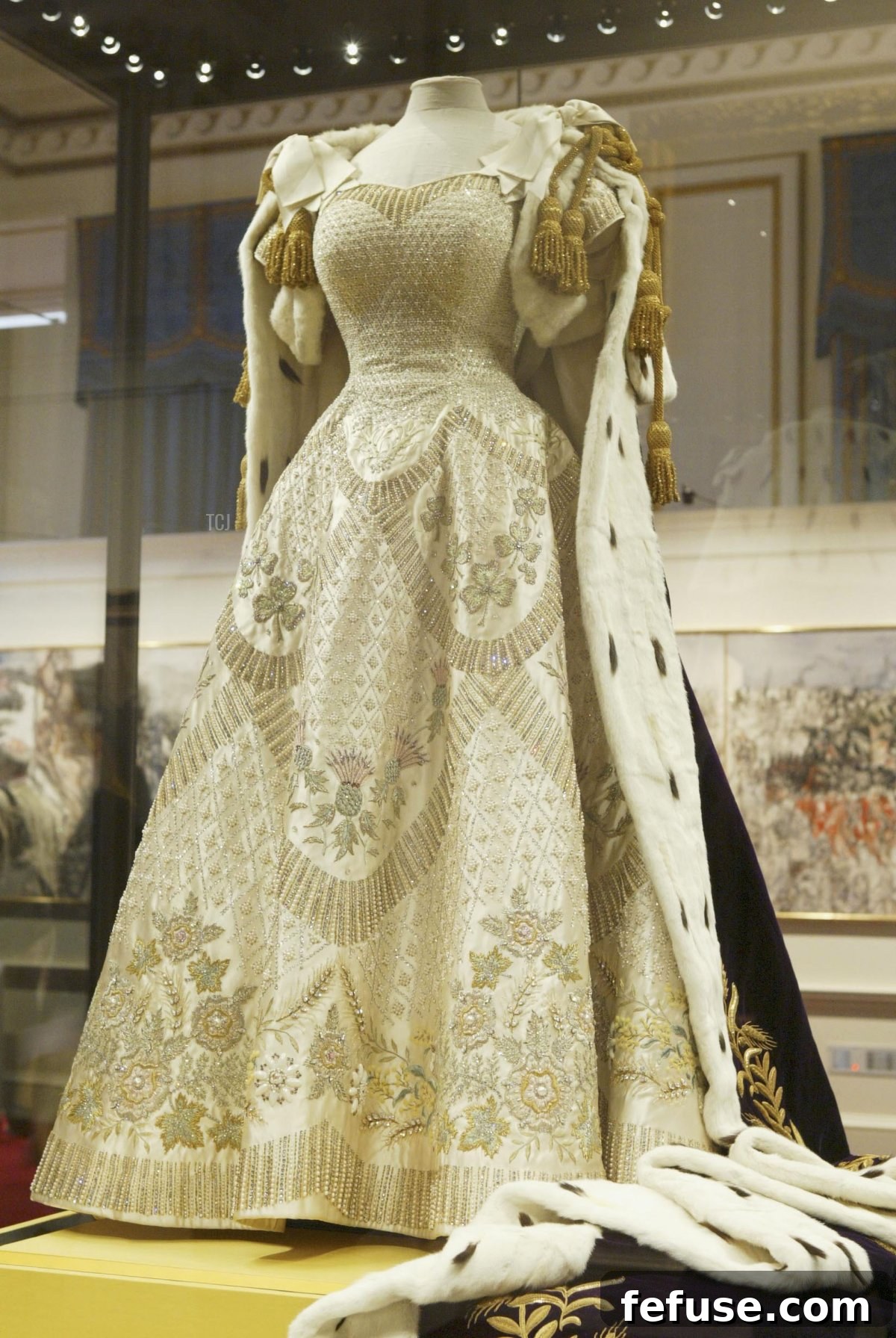
The creation of this historic gown was a monumental undertaking, blending traditional craft with modern artistry. The luxurious silk used for the dress was sourced from Lady Hart Dyke’s renowned silk farm at Lullingstone Castle in Kent, highlighting a commitment to British materials. This exquisite silk was then meticulously woven by a specialized company in Essex, ensuring the highest quality fabric. The intricate construction and embroidery of the gown took place at Hartnell’s prestigious London workshop. It was a painstaking process, requiring five months to complete, with countless hours dedicated to the elaborate embroidery work. A dedicated team of artisans, working under the expert direction of Edie Dulie, painstakingly hand-stitched each symbolic motif. Beyond the vibrant threads, additional embellishments such as shimmering gold bugle beads, sparkling diamantes, and lustrous pearls were also carefully sewn onto the gown during the embroidery process, adding to its unparalleled grandeur and making it truly worthy of a queen.
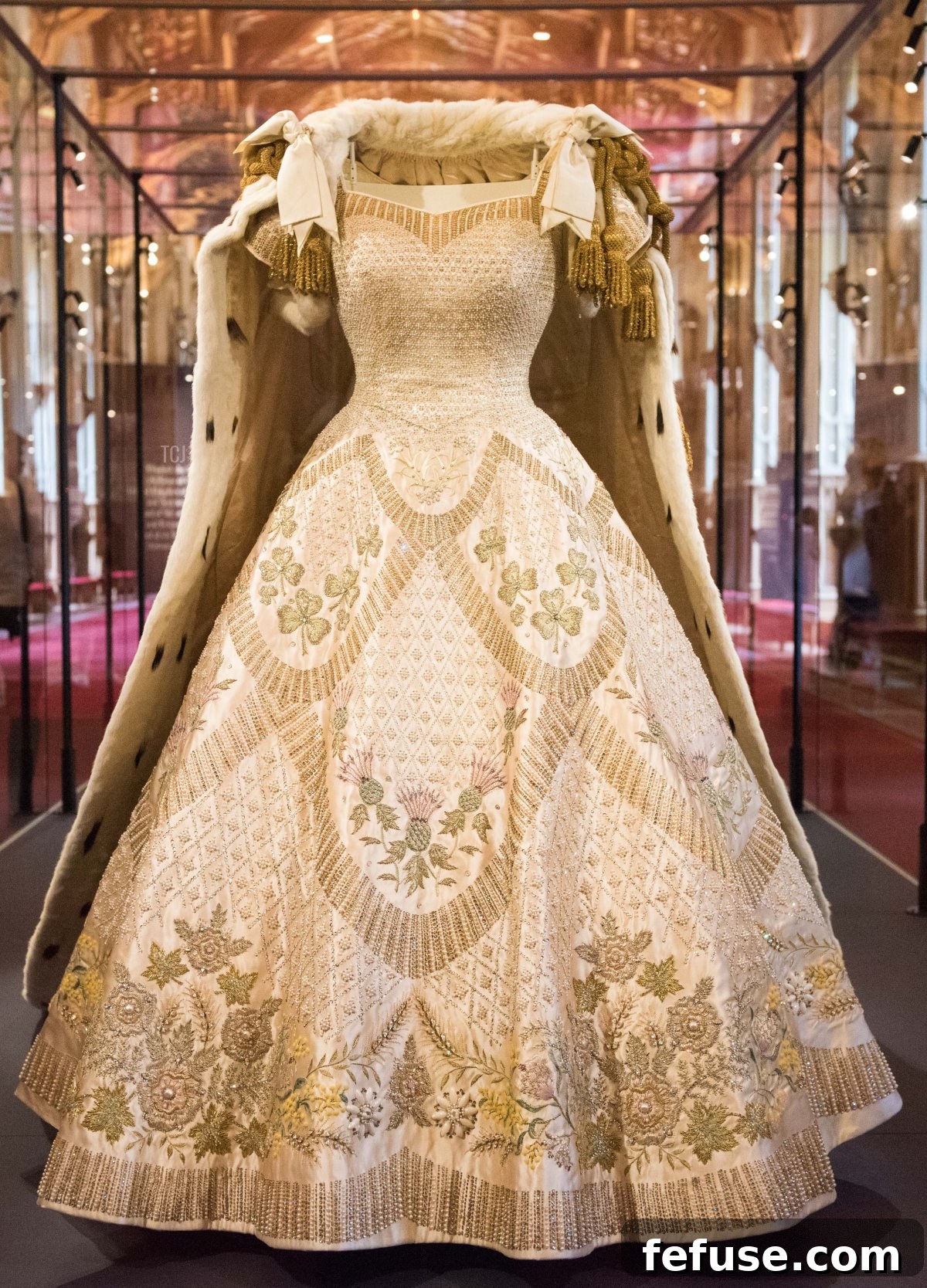
This magnificent coronation dress, a true masterpiece of royal sartorial history, remains a cherished part of the Royal Collection today. Its enduring beauty and symbolic significance ensure its place in British heritage. The image above captures its splendor in the summer of 2022, when it was proudly displayed at Windsor Castle as a centerpiece of the exhibitions celebrating the Queen’s historic Platinum Jubilee, allowing visitors to marvel at its intricate details and reflect on the momentous occasion it represented.
The Regal Robes: Symbols of Power and Tradition
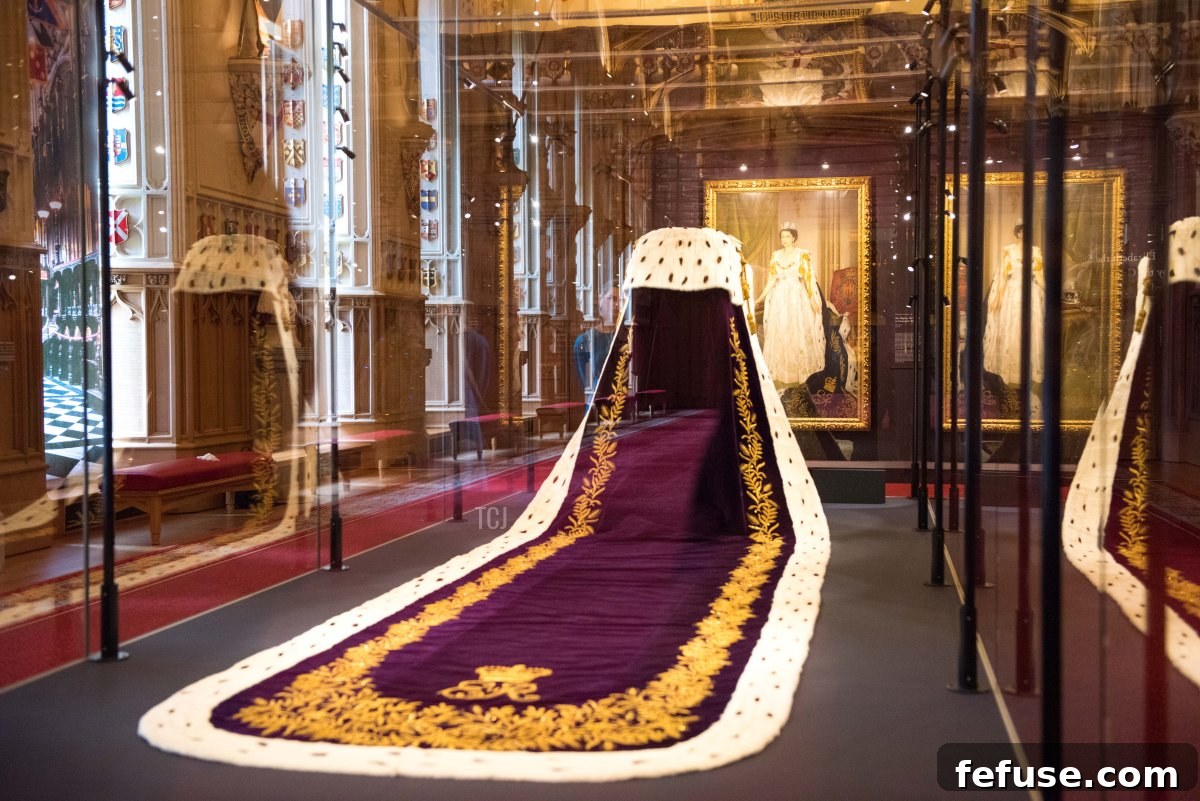
No coronation ensemble is complete without the ceremonial robes, which are steeped in centuries of tradition and royal symbolism. During the coronation ceremony, the monarch dons two distinct sets of ermine-lined velvet robes. The first is the Robe of State, worn upon arrival at Westminster Abbey, symbolizing the monarch’s official entry into the sacred space. Queen Elizabeth II’s Robe of State was crafted from rich crimson velvet, generously lined with precious ermine fur, specially sourced from Canada. This choice of materials and the color crimson traditionally signify royal power and dignity.
The second, and often more enduringly pictured, is the magnificent Robe of Estate, worn for the departure from the Abbey and subsequent procession. Pictured above, the late Queen’s Robe of Estate is made of opulent purple velvet, also sumptuously trimmed with ermine. Both robes are masterpieces of textile art, lavishly embroidered with intricate gold designs. These complex patterns and motifs were conceived and meticulously executed by highly skilled artists from the renowned Royal School of Needlework, ensuring that every stitch conveyed the majesty and historical weight of the occasion. In a poignant continuation of royal tradition, Queen Camilla will feature the Queen’s Robe of State in the upcoming coronation, following extensive conservation work undertaken by Ede and Ravenscroft, the very makers of the original 1953 robes, who also crafted the new robes required for the 2023 coronation. This continuity underscores the timeless nature of these royal garments and the enduring heritage they represent.
The Grand Arrival: Jewels of State and Tradition
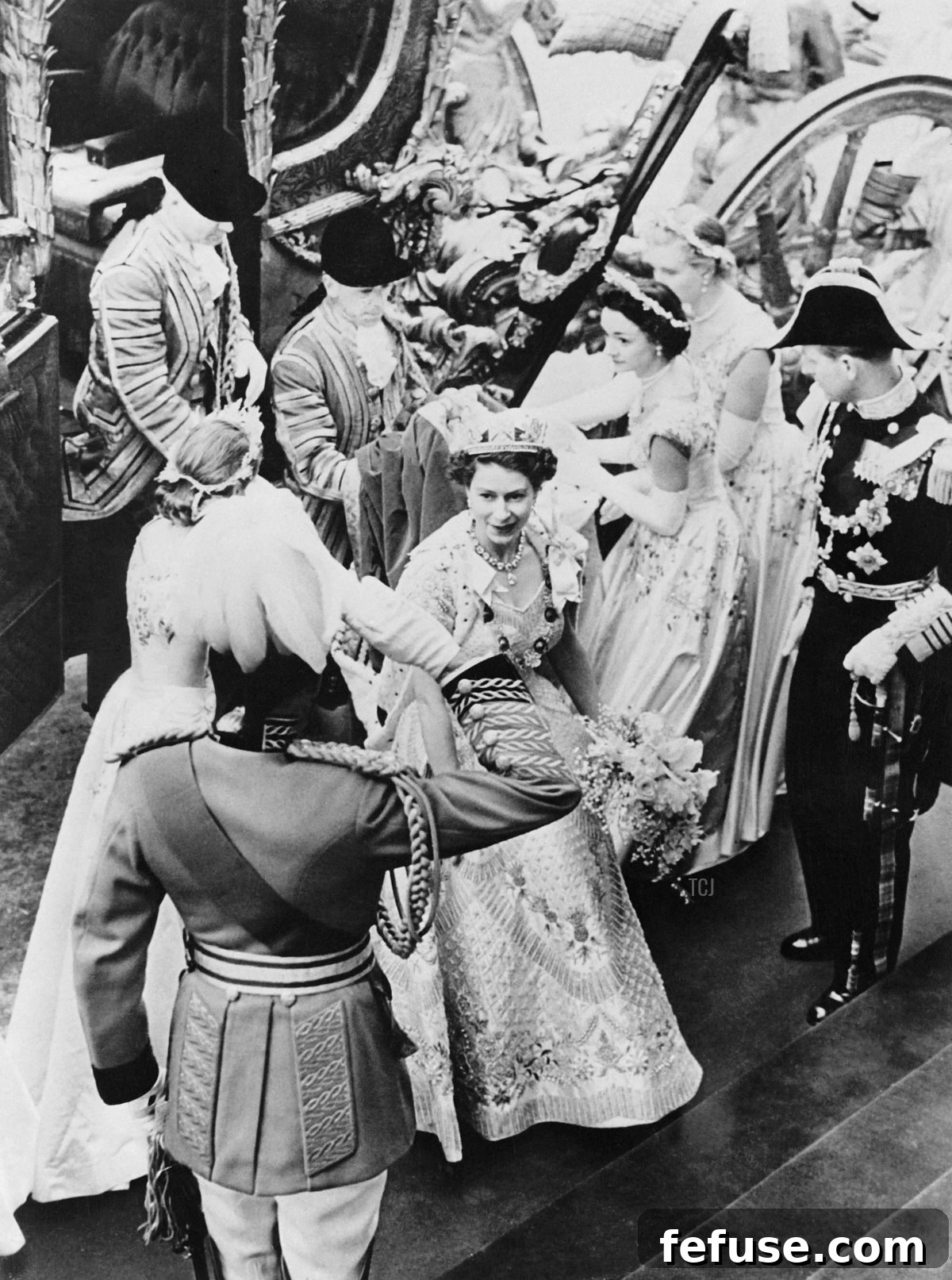
On the morning of Tuesday, June 2, 1953, the anticipation reached a fever pitch as Queen Elizabeth II made her grand arrival at Westminster Abbey. She was resplendent in her lavish coronation gown and the crimson velvet Robe of State, presenting a breathtaking vision of regal splendor. Her attire was further enhanced by a carefully selected array of magnificent jewels, each carrying its own rich history and symbolic weight. These pieces, worn for her arrival, underscored the profound heritage of the British monarchy. She wore the iconic Diamond Diadem, the historic Coronation Earrings and Necklace, and the esteemed Garter Collar and Badge. Let us now delve into the exquisite details of these magnificent jewels, starting from the crown of her ensemble.
The Diamond Diadem: A Royal Legacy
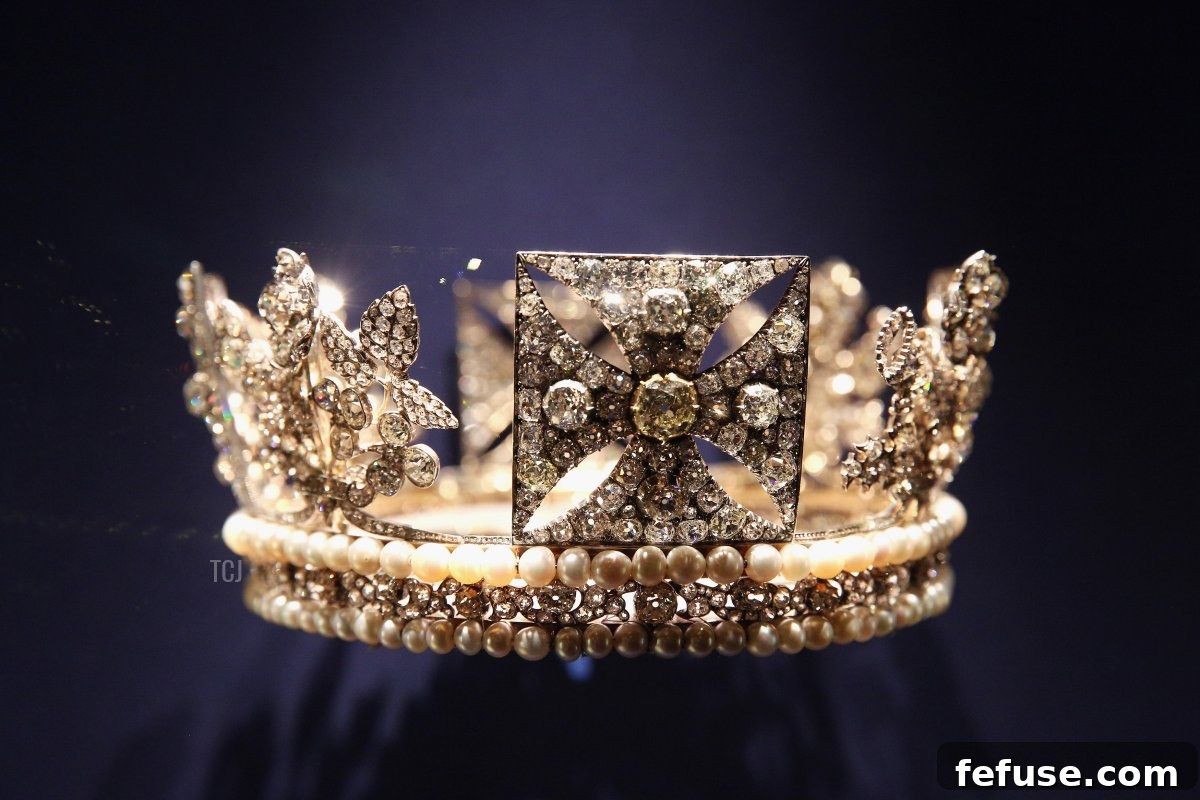
The Diamond Diadem, a truly breathtaking piece of British royal jewelry, holds a remarkable history, having been originally crafted for the lavish 1821 coronation of King George IV. The exquisite work on this elaborate diadem, meticulously designed with iconic national emblems—the roses of England, the shamrocks of Ireland, and the thistles of Scotland—was completed by the renowned jewelers Rundell, Bridge & Rundell in the year prior to the coronation. King George IV himself wore this diadem for his procession to Westminster Abbey, pairing it with a velvet cap instead of a simpler cap of maintenance. Queen Elizabeth II’s choice to wear the very same diadem for her own arrival at the Abbey was a powerful and elegant echo of that earlier 1821 coronation, connecting her reign to a rich past. Since George IV, the diadem has been exclusively worn by queens regnant and consort, including Queen Adelaide, Queen Victoria, Queen Alexandra, Queen Mary, Queen Elizabeth (the Queen Mother), and, of course, Queen Elizabeth II, cementing its status as a quintessential symbol of British royal femininity and continuity.
The Coronation Necklace and Earrings: A Dazzling and Complex History
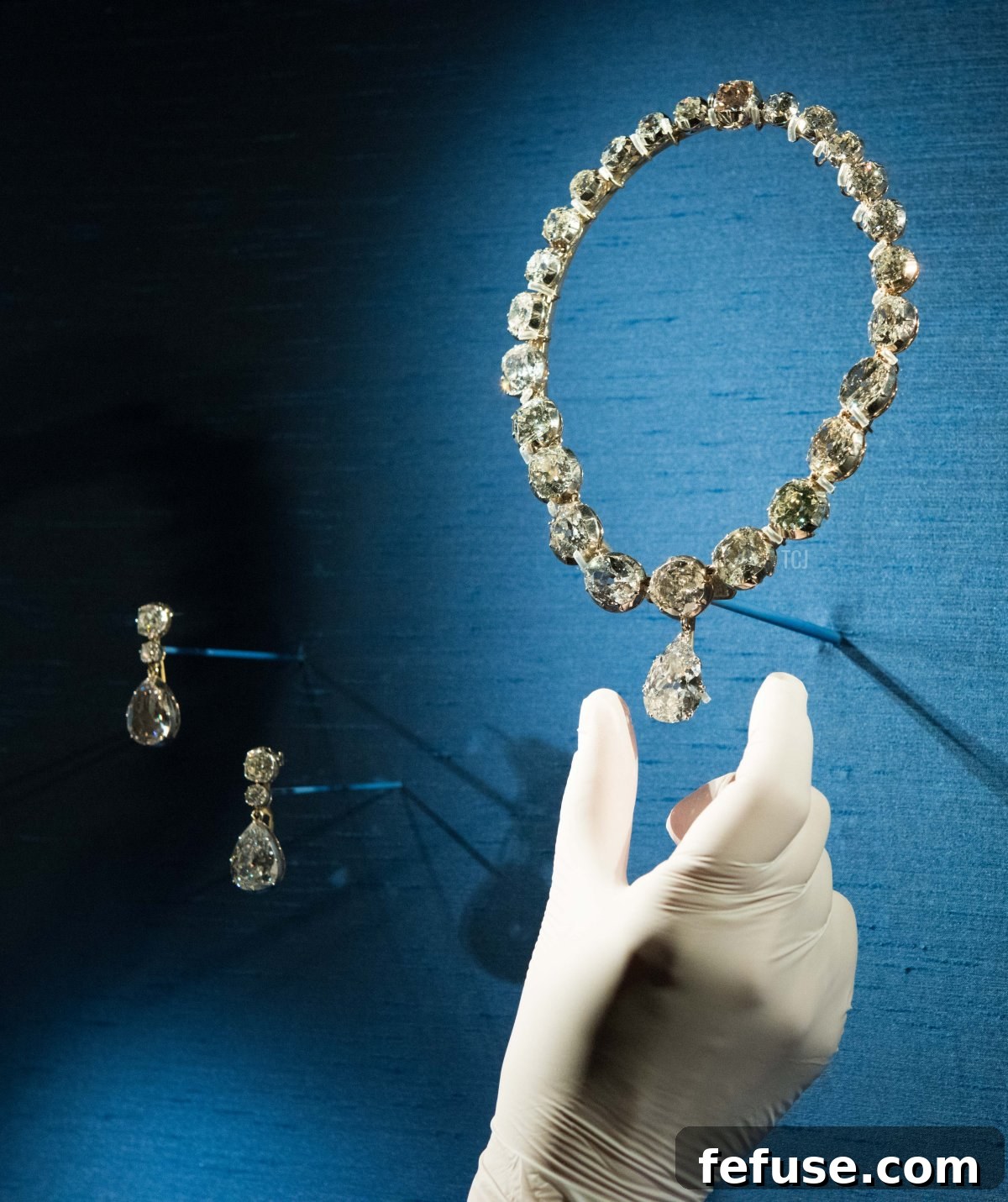
The Coronation Earrings and Necklace are another cornerstone of the British Crown Jewels, dating back to 1858. These magnificent pieces were specially created for Queen Victoria to replace items that were lost during the complex and protracted Hanoverian Claim, a historical dispute over royal assets. The diamonds that form the breathtaking necklace were meticulously repurposed from other treasured items within Queen Victoria’s extensive jewelry collection, ensuring that precious stones remained within the royal treasury. The centerpiece of the necklace, a truly spectacular diamond pendant, is the renowned Lahore Diamond. This historic gem was taken from the Lahore Treasury in what is now Pakistan by British colonizers in 1849, a poignant reminder of colonial acquisition and empire. Similarly, the striking pendants of the coronation earrings also bear a significant colonial history: they were originally part of the opulent armlet setting of the legendary Koh-i-Noor Diamond. Over the decades, these jewels have graced the necks and ears of multiple British queens consort and regnant during their own coronations, including Queen Alexandra, Queen Mary, and Queen Elizabeth the Queen Mother, who each wore various parts of the necklace and earrings for their respective coronation ceremonies, highlighting their enduring significance as symbols of royal power and continuity.
The Order of the Garter: Collar and Badge
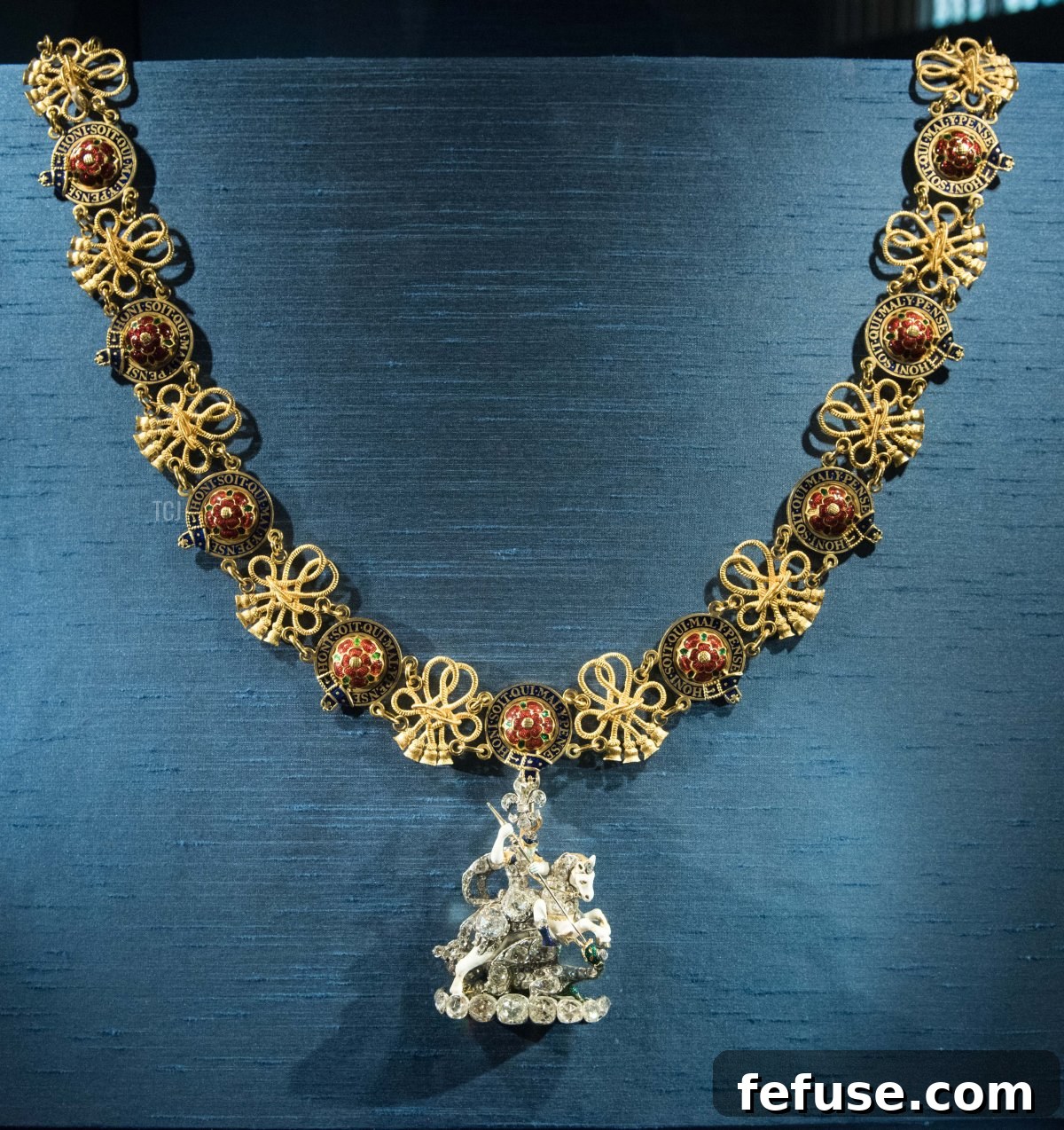
Adorning her resplendent gown, Queen Elizabeth II also wore the distinguished collar and badge of the Order of the Garter, Britain’s most senior and prestigious order of chivalry. This ancient order, founded by King Edward III in 1348, embodies a rich history of valor and loyalty, and its insignia are among the most revered in the British monarchy. The specific badge worn by Her Majesty for her coronation was a historically significant piece, meticulously crafted in 1828 by the celebrated jewelers Rundell, Bridge & Rundell for King George IV. Its presence on the Queen’s coronation ensemble emphasized her role as the Sovereign of the Order, a testament to her position at the apex of British society and its noble traditions.
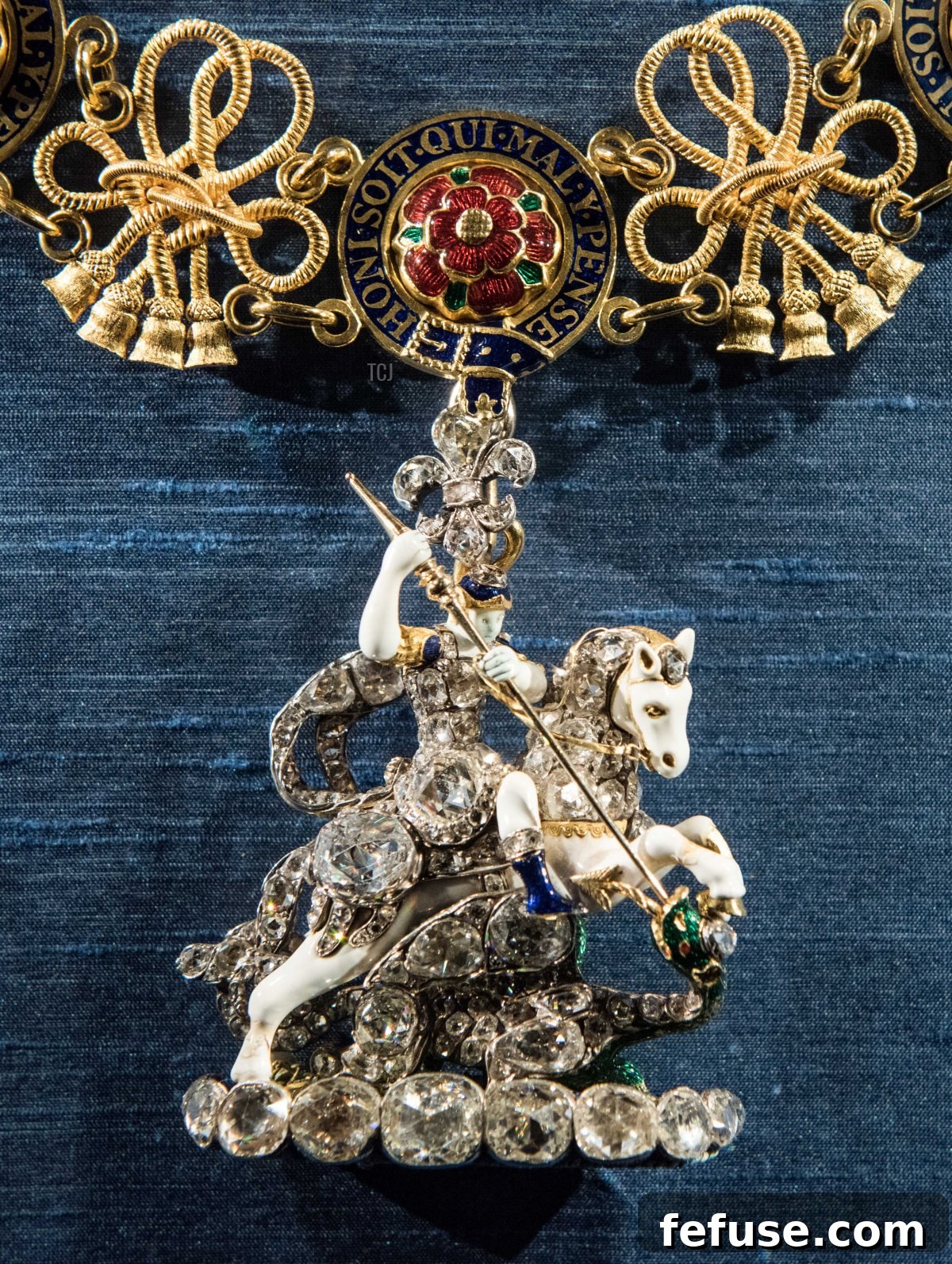
This particular Garter badge is famously known as the “Marlborough George,” a name that pays homage to its being a copy of a similar badge historically owned by the Duke of Marlborough. The Royal Collection provides a captivating description of this intricate piece: “the gold figure of St. George on a rearing horse slaying the dragon, the emblem of the Order, is mounted in enamel and diamonds.” This vivid depiction of St. George, the patron saint of England, triumphing over the dragon, is a powerful symbol of good overcoming evil and remains a central motif of the Most Noble Order of the Garter, symbolizing the virtues and ideals upheld by its members and, above all, by the Sovereign.
The Coronation Bouquet: A Floral Tribute to the United Kingdom
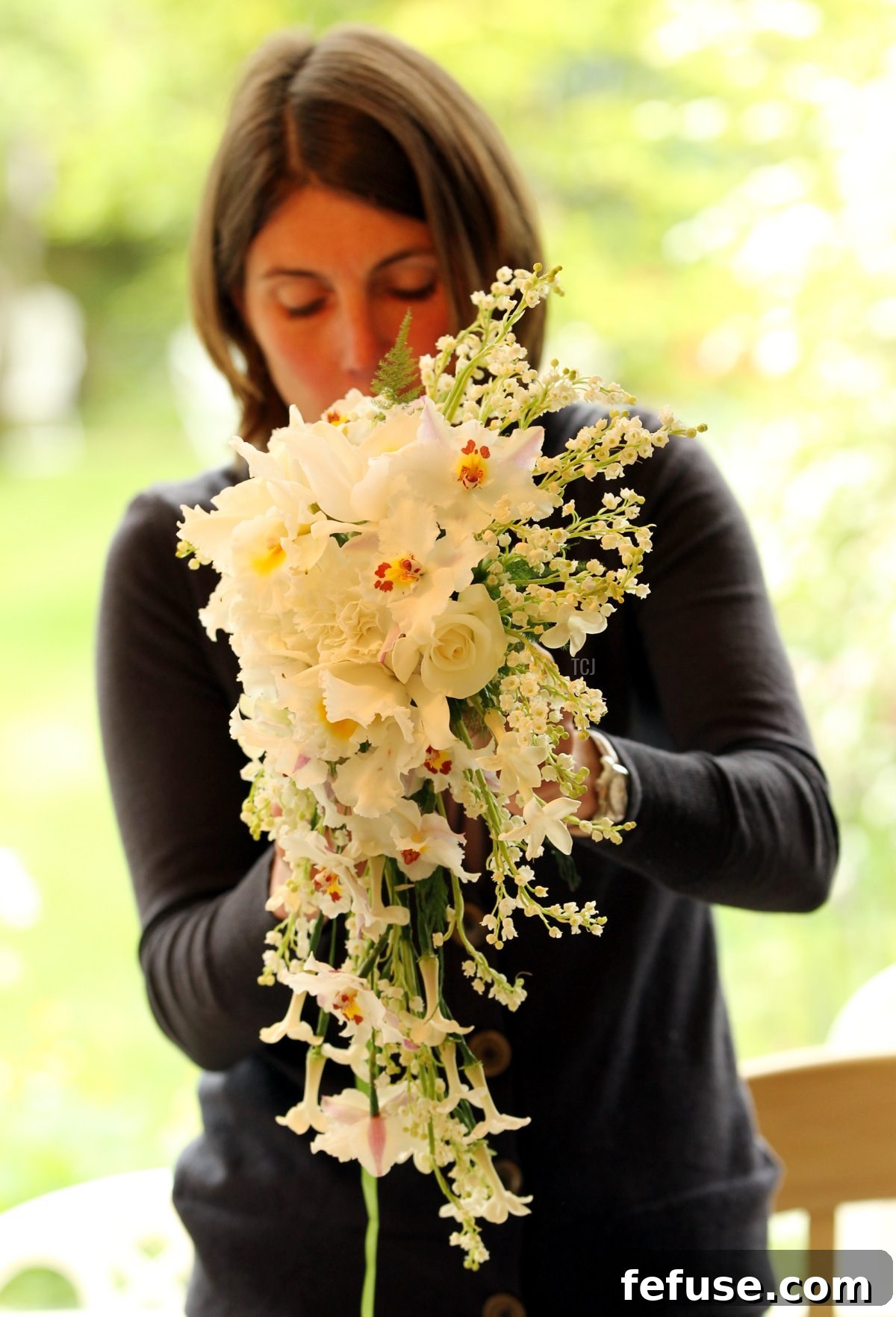
Adding a touch of natural beauty and profound symbolism to her majestic ensemble, the Queen carried a splendid bouquet of flowers upon her arrival at Westminster Abbey. This was no ordinary arrangement; it was a carefully curated collection of white flowers, each specially selected from various regions across the United Kingdom, representing the unity and diversity of her realms. The bouquet featured delicate lilies of the valley from Kent, pristine virgo roses from Hertfordshire, elegant orchids from Sussex, Kent, and Hertfordshire, rare slipper orchids from North Wales, fragrant carnations from Belfast, and exotic stephanotis from Scotland. Even the Isle of Man contributed, with its own carnations. The artistry behind this floral masterpiece belonged to Constance Fears, a highly skilled florist from Martin Longman in Fenchurch Street, who had previously crafted the Queen’s wedding bouquet in 1947. The completed bouquet was then formally presented to Her Majesty by representatives of the Worshipful Company of Gardeners at Buckingham Palace on the very morning of the coronation, signifying the importance of nature and fertility to the monarch’s reign.
The Queen was indeed carrying this significant bouquet as she left Buckingham Palace, and it rested gently in her lap during the grand procession to the Abbey. She held it as she gracefully stepped out of the Gold State Coach, a visual moment captured for posterity. However, a fascinating detail often overlooked is that she did not carry it during her solemn procession up the aisle of the Abbey itself. This raises an intriguing question that has long puzzled historians and royal enthusiasts: what became of the bouquet at this critical juncture? Was it discreetly handed off to one of her trusted maids of honor, or perhaps to Mary, Duchess of Devonshire, her Mistress of the Robes, for safekeeping? Or, in a gesture of profound respect and remembrance, was it perhaps placed on the Tomb of the Unknown Warrior within the Abbey, a tradition sometimes observed at royal weddings? The mystery persists, as even the official Westminster Abbey website simply notes that the bouquet “was not carried into the Abbey,” leaving its ultimate fate during the ceremony itself to historical speculation. This unanswered question only adds to the allure and intricate details of that unforgettable day.
The Solemn Entry into Westminster Abbey
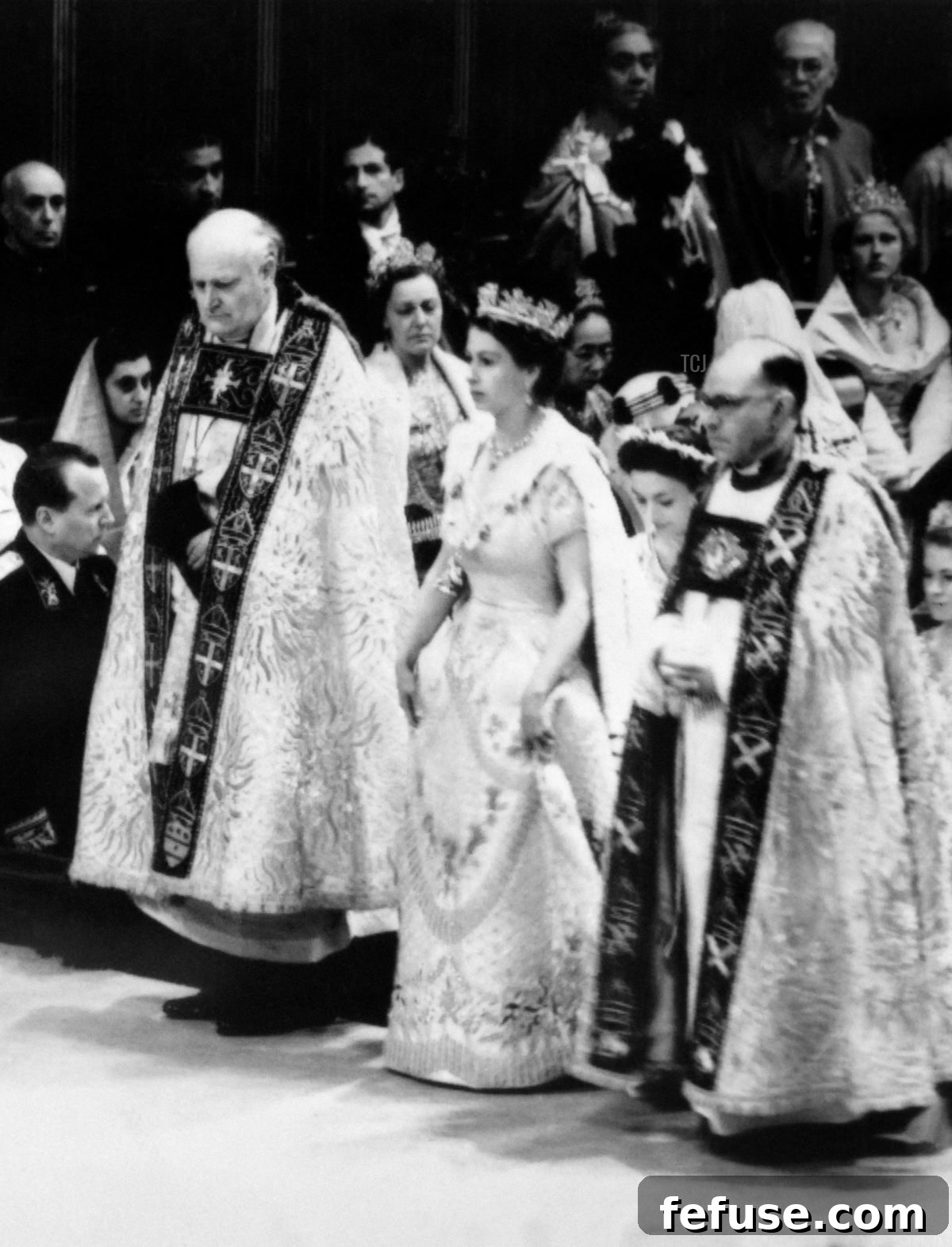
The moment Queen Elizabeth II stepped inside Westminster Abbey marked the transition from external pageantry to profound spiritual ceremony. Here, she is captured as she arrives in the central part of the Abbey, famously known as the “coronation theatre,” where the sacred rites would unfold. Flanking her were two significant ecclesiastical figures: the Right Reverend Michael Ramsay, the revered Bishop of Durham, and the Right Reverend Harold Bradfield, the esteemed Bishop of Bath and Wells. This solemn procession was accompanied by a powerful and ancient tradition. As the Queen moved towards the Coronation Chair, the King’s Scholars of Westminster School, a privilege they have held for centuries, enthusiastically cheered out the famous “Vivats” section of Sir Hubert Parry’s magnificent anthem, “I Was Glad.” This rousing acclamation – “Vivat Regina Elizabetha!” (Long Live Queen Elizabeth!) – filled the hallowed space, adding a vibrant human element to the divine ceremony and signaling the hearty welcome of the nation’s youth to their new sovereign.
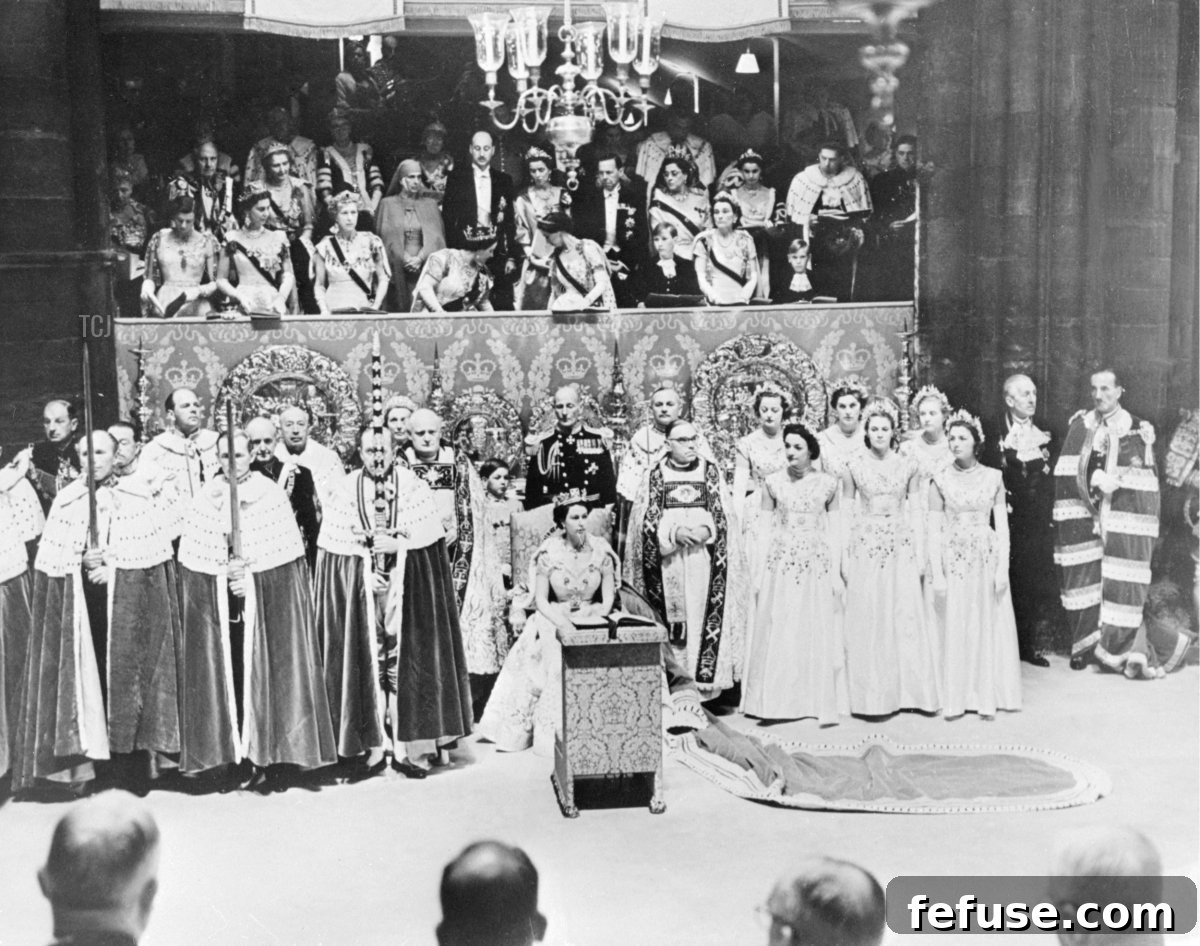
The Royal Spectators: Family in the Abbey
Upon her dignified arrival, Elizabeth took her designated place on the Chair of Estate, a significant moment preceding the anointing and crowning. From the Royal Box situated directly above her, an array of distinguished members of the royal family observed the historic proceedings. This photograph offers a fascinating glimpse into the composition of the royal gathering, many faces of whom are now instantly recognizable from historical records and modern documentaries. (Indeed, as a tantalizing spoiler, we will be delving further into the spectacular tiaras worn by the royal attendees in the Royal Boxes in our next article!) In the prominent front row, we can identify Princess Alexandra; her mother, Princess Marina, Duchess of Kent; Princess Mary, the Princess Royal and Countess of Harewood; Queen Elizabeth the Queen Mother, radiating grace; Princess Margaret, the Queen’s beloved sister; Prince William of Gloucester; Princess Alice, Duchess of Gloucester; and Prince Richard of Gloucester. Young Prince Charles, the future King Charles III, was not initially in the main viewing area. He spent the earlier part of the ceremony elsewhere in the Abbey, accompanied by his nanny, Helen Lightbody. He was later brought in for a significant portion of the ceremony, taking his seat between his grandmother, Queen Elizabeth the Queen Mother, and his aunt, Princess Margaret. Poignantly, his paternal grandmother, Princess Andrew of Greece and Denmark, clad in her distinctive nun’s habit, was seated almost directly behind him in the second row, a powerful symbol of the family’s international connections and diverse backgrounds.
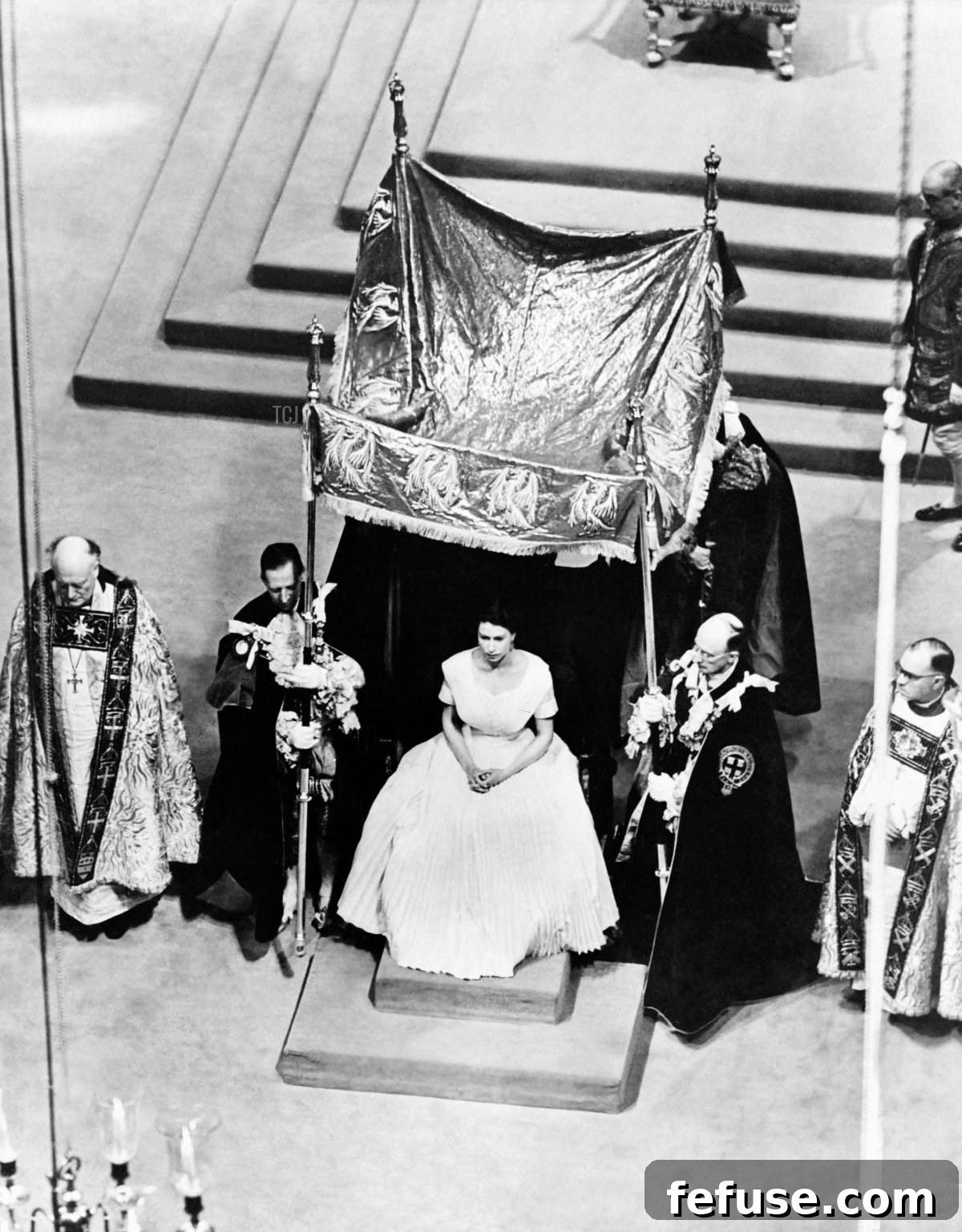
The Sacred Anointing: A Moment of Divine Grace
Following the solemn recitation of the Coronation Oath, a profound pledge to uphold the laws and traditions of the realm, and a reverent communion service, the ceremony moved to its most sacred and private moment: the anointing of Elizabeth by the Archbishop of Canterbury. This ancient ritual, symbolizing the divine blessing bestowed upon the monarch, is considered the spiritual heart of the coronation. For this deeply personal part of the ceremony, a simple yet elegant white gown, also designed by Norman Hartnell, was placed over her magnificent coronation dress. This unassuming garment underscored the spiritual humility of the moment. Crucially, a magnificent canopy of cloth of gold was held aloft by four Knights of the Garter, shielding this intensely private and sacred act from public view, including from the television cameras. This deliberate act preserved the sanctity and mystical essence of the anointing, emphasizing that the monarch’s power stemmed not solely from earthly appointment but from divine consecration.
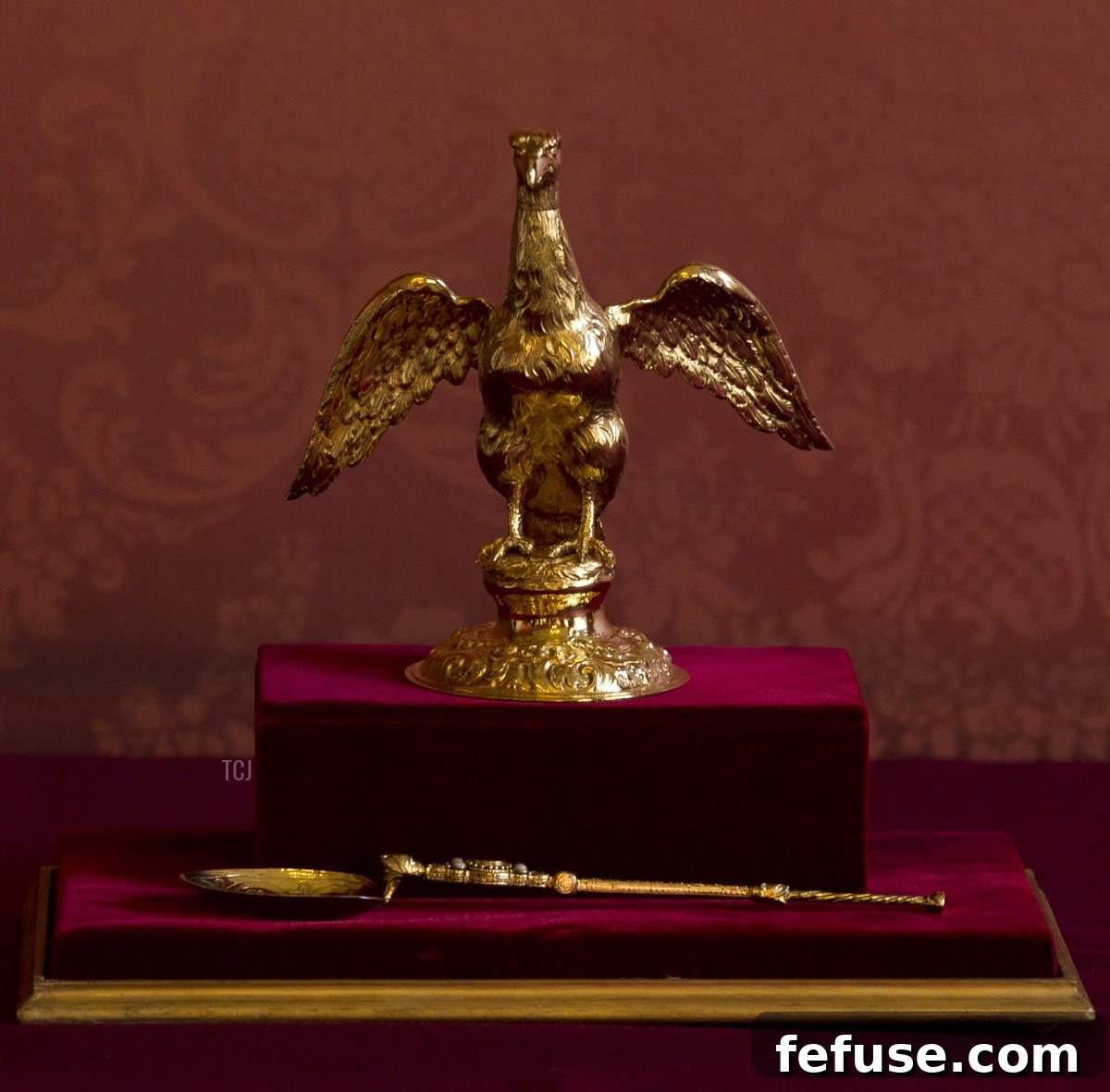
Ancient Instruments of Consecration: The Ampulla and Coronation Spoon
For the sacred act of anointing, the Archbishop of Canterbury utilized two exceptionally ancient and significant pieces of coronation regalia: the Ampulla and the Coronation Spoon. The Ampulla, a magnificent eagle-shaped vessel, was crafted in 1661 specifically for the coronation of King Charles II. It has since held the holy anointing oil for every subsequent monarch. However, the Coronation Spoon predates the Ampulla by centuries, its origins tracing back to the remarkable 12th century. This makes it one of the oldest surviving pieces of British royal regalia, a testament to its incredible resilience and historical importance. Remarkably, it is one of the very few pieces of coronation regalia that managed to survive the turbulent period of Cromwell’s Commonwealth and the ensuing interregnum, when much of the ancient royal treasures were destroyed or melted down. Its survival offers a tangible link to a distant past, symbolizing the unbroken line of the monarchy and the enduring spiritual traditions of the coronation.
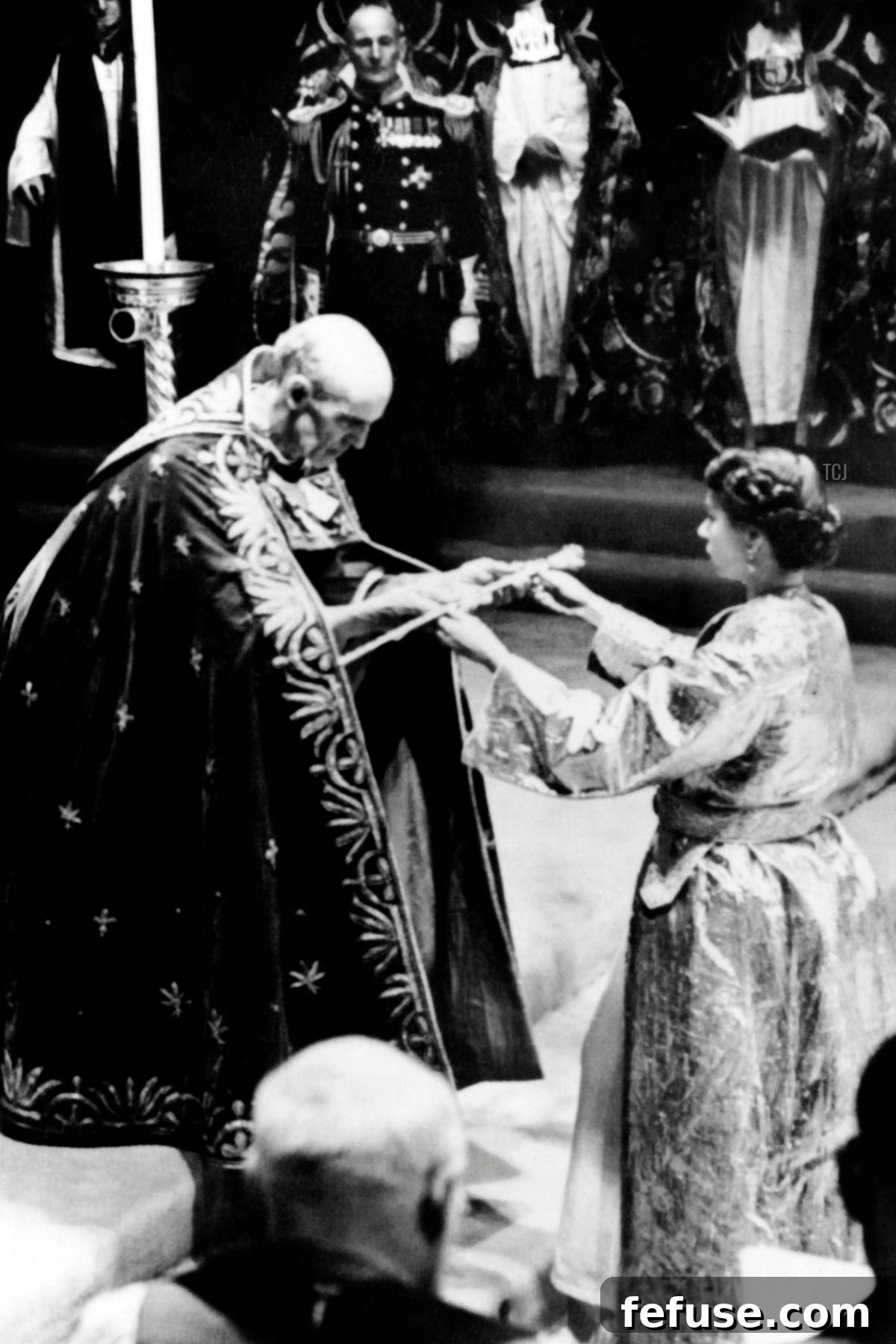
Investiture with the Regalia: Emblems of Sovereignty
Following the deeply spiritual anointing, Queen Elizabeth II was progressively invested with a series of additional, highly symbolic pieces of the coronation regalia. Each item presented to her held profound significance, representing different aspects of her authority, responsibility, and the divine nature of her rule. This included the Sword of Offering, symbolizing justice and mercy; the Armills, or bracelets of sincerity and wisdom; the Orb, representing the Christian world under the monarch’s rule; the Sovereign’s Ring, often called the “wedding ring of England”; the Sceptre with the Cross, symbolizing temporal power and justice tempered with mercy; and the Sceptre with the Dove, representing equity and divine guidance. Together, these artifacts transformed the anointed monarch into a fully invested sovereign, ready to receive the crown itself.
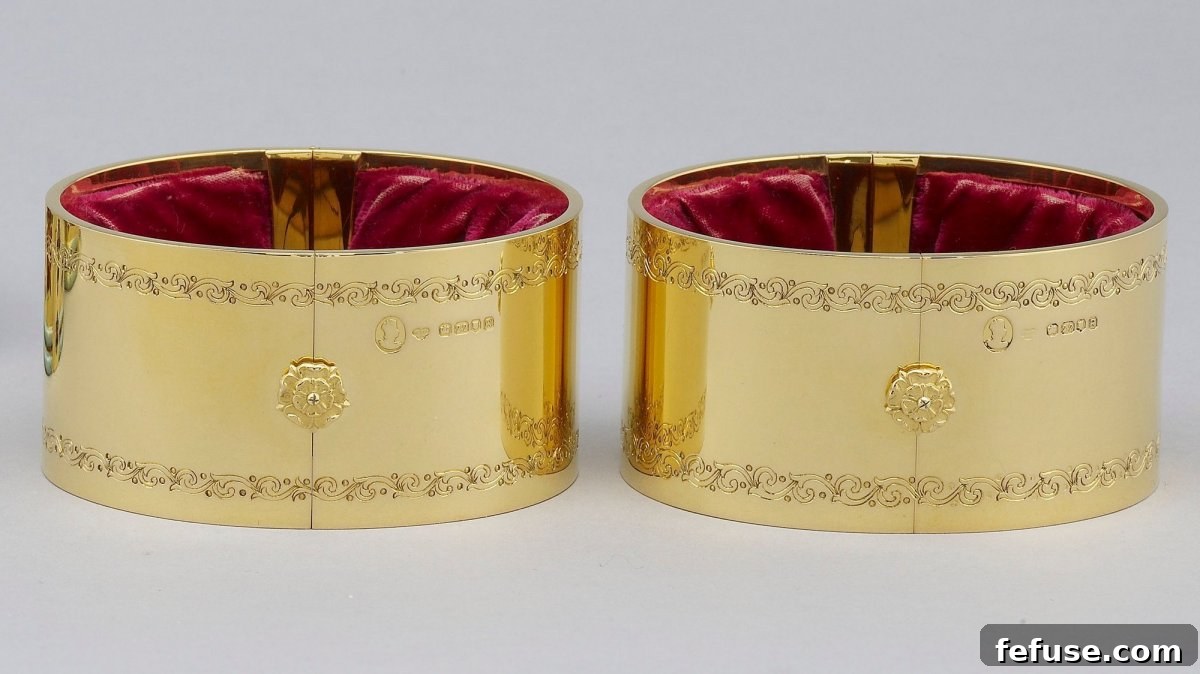
The Armills: Bracelets of Sincerity and Wisdom
Among the many pieces of regalia, two were actually worn by Queen Elizabeth II throughout the coronation ceremony, signifying her personal embrace of their meaning. The first of these were the Armills, often eloquently referred to as the “bracelets of sincerity and wisdom.” While the Crown Jewel collection historically includes a magnificent set of 17th-century armills—notably, the very ones King Charles III will wear at his upcoming coronation—Queen Elizabeth II wore a newly crafted pair of solid gold armills, made specifically for her unique occasion. These modern armills were the inspired brainchild of Prime Minister Robert Menzies of Australia, and they represented a profound gesture of unity and affection, being presented to the monarch as a collective gift from the Commonwealth of Nations. At that time, the Commonwealth comprised the United Kingdom, Australia, Canada, Ceylon (now Sri Lanka), India, New Zealand, Pakistan, and South Africa. This gift not only underscored the Queen’s role as the symbolic head of this diverse global family but also demonstrated the evolving relationship between Britain and its former colonies, now independent nations bound by shared history and allegiance to the Crown.
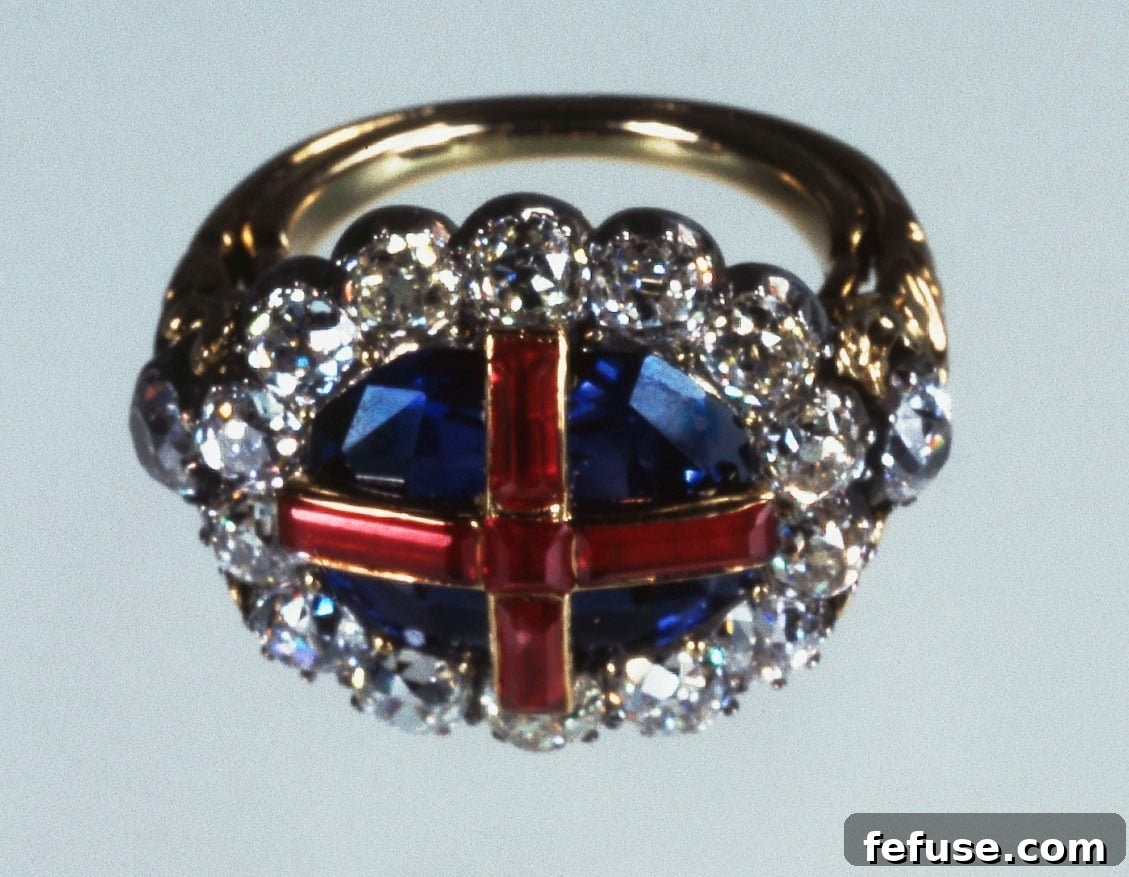
The Sovereign’s Ring: A Symbol of Marital Allegiance to the Nation
The second, deeply symbolic piece of regalia that Queen Elizabeth II wore was the Sovereign’s Ring. Crafted by the renowned jewelers Rundell, Bridge & Rundell in 1831 for King William IV, this exquisite ring is a dazzling testament to royal craftsmanship and national symbolism. It is set with a striking arrangement of diamonds, sapphires, and rubies, with the red and blue stones forming the shape of a cross upon the central diamond, a design that elegantly echoes the national flag of the United Kingdom. The coronation ring is often affectionately referred to as the “wedding ring of England,” a powerful metaphor highlighting the profound bond between the monarch and the nation. Historian Anna Keay beautifully illustrates this concept by recalling Queen Elizabeth I’s famous declaration: “When asked about her failure to take a husband, Elizabeth I pointed to her coronation ring and said she was married to the realm of England.” While Elizabeth II was, of course, happily married to Prince Philip, Duke of Edinburgh, the coronation ceremony itself is indeed a profound and spiritual “marriage” between the monarch and the nation, a sacred covenant of duty, loyalty, and unwavering commitment to the people and the realm. This ring, therefore, serves as a tangible representation of that eternal vow.
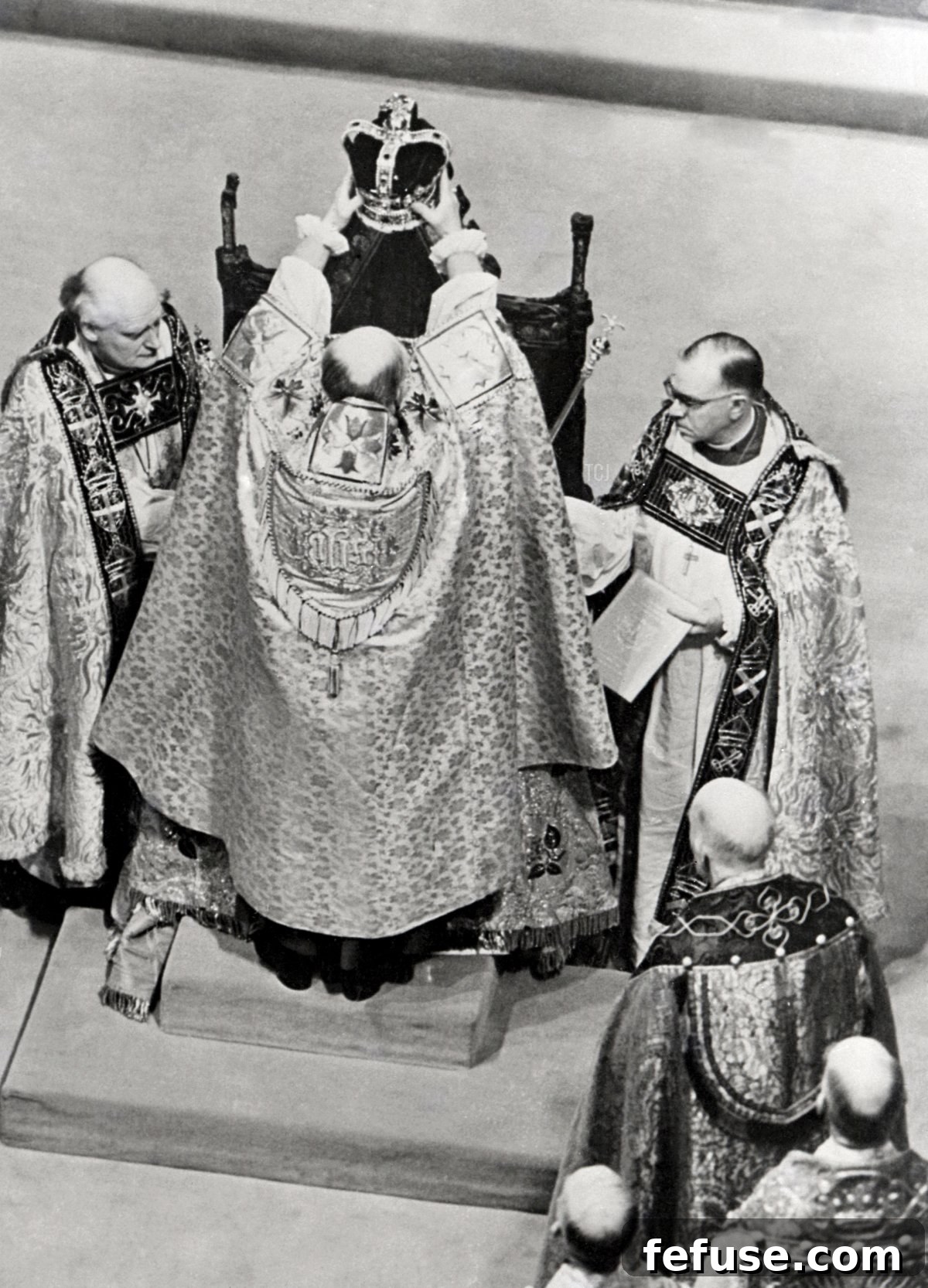
The Crowning: A Moment of Destiny
After the profound anointing and the investiture with the sacred regalia, the ceremony culminated in the most anticipated moment: the actual crowning of the sovereign. Seated majestically on the ancient Coronation Chair, a venerable piece of furniture that has witnessed the crowning of monarchs for centuries, Queen Elizabeth II was solemnly crowned by the Archbishop of Canterbury, the Right Reverend Geoffrey Fisher. This symbolic act, placing the physical embodiment of the Crown upon her head, officially recognized her as the supreme temporal and spiritual head of the United Kingdom and the Commonwealth, marking the pinnacle of the entire coronation ritual.
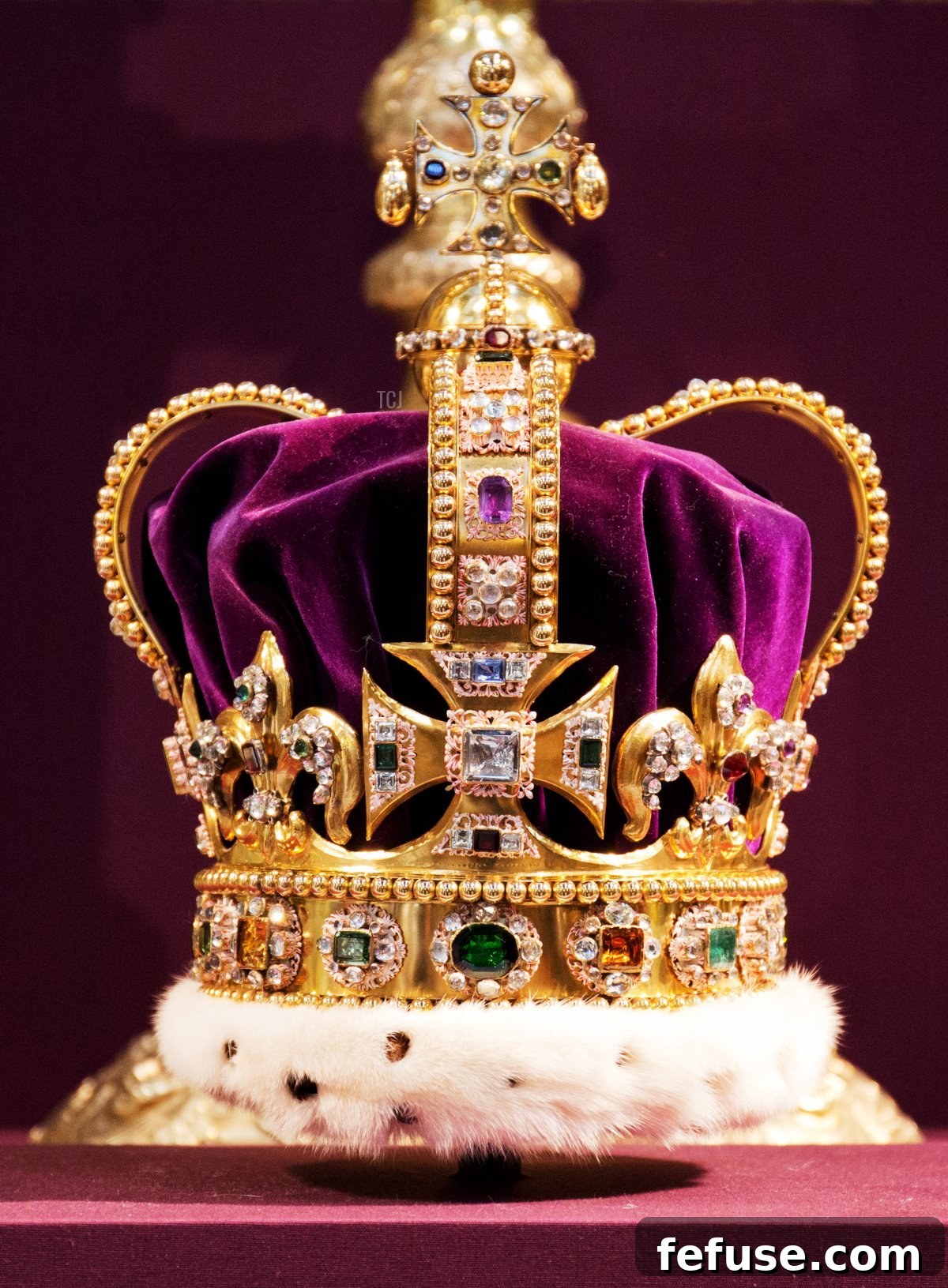
St. Edward’s Crown: The Sacred Crowning Jewel
The crown specifically used for this most pivotal part of the ceremony is none other than St. Edward’s Crown. This magnificent piece of regalia, crafted in 1661, is made of solid 22-carat gold and is famously adorned with hundreds of precious and semi-precious gemstones, giving it an unparalleled brilliance and weight. Its design was not arbitrary; it was deliberately inspired by the much older and lost crown of St. Edward the Confessor (1003-1066), one of the last Anglo-Saxon kings of England. That medieval crown, a relic of ancient monarchy, was tragically disposed of after the execution of King Charles I in 1649, during the turbulent period of the English Civil War and the Commonwealth. The current, newer St. Edward’s Crown has since been used to crown six British monarchs, a testament to its enduring significance and role in the coronation ritual. These monarchs include King Charles II, King James II, King William III, King George V, King George VI, and Queen Elizabeth II, linking their reigns through this powerful symbol of kingship and national heritage. It is the heaviest of the crowns, typically only worn for the moment of crowning itself.
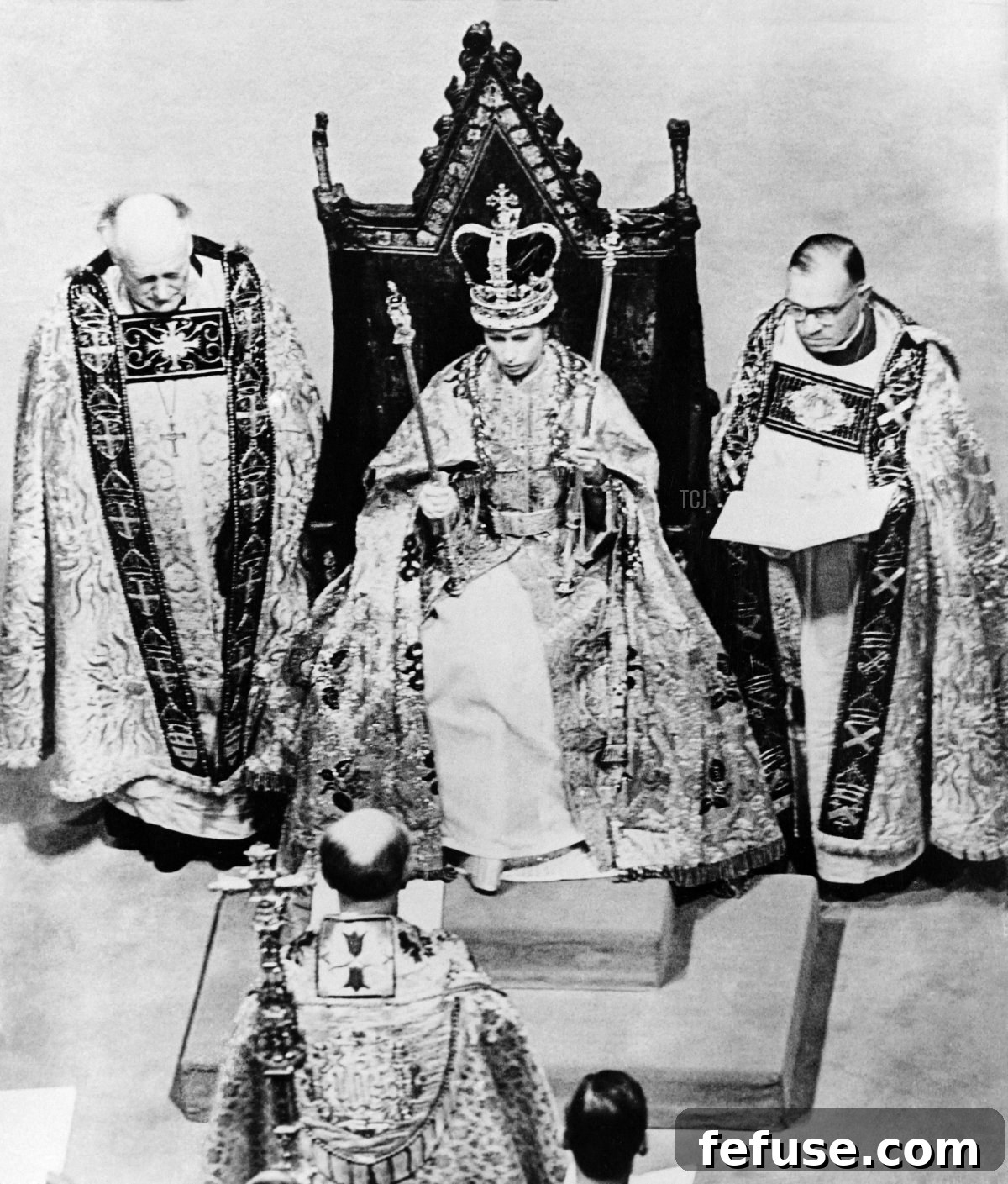
The Crowned Sovereign: Regalia in Hand
Captured in this iconic image is Queen Elizabeth II, now officially crowned, seated majestically on the revered Coronation Chair. She is adorned with the weighty and magnificent St. Edward’s Crown, its gemstones glittering under the Abbey’s lights. In her hands, she holds the two essential scepters, symbolic instruments of her newly assumed power and spiritual authority, signifying her full investiture as the sovereign. This moment, laden with historical significance and sacred symbolism, represents the culmination of centuries of tradition and the formal commencement of her reign as the crowned Head of State.
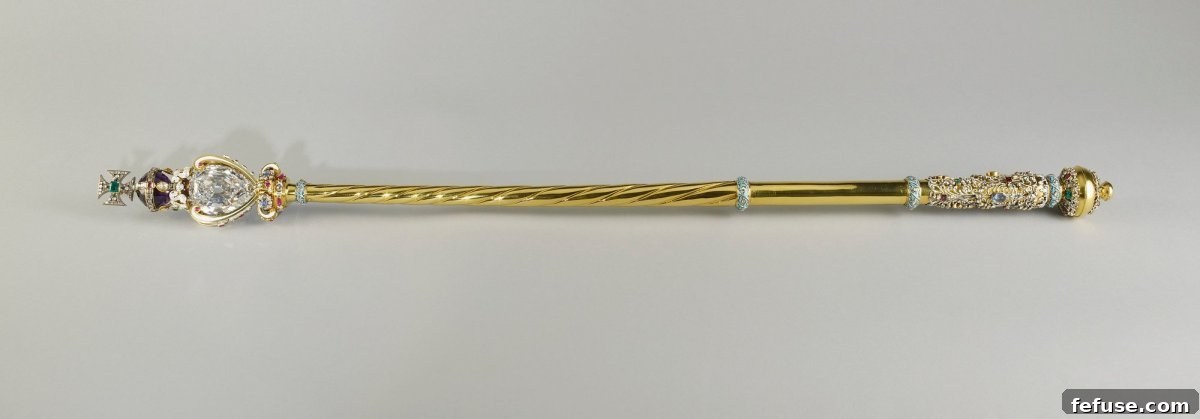
The Sovereign’s Sceptre with Cross: Bearing the Star of Africa
The scepter held in Queen Elizabeth II’s right hand is the Sovereign’s Sceptre with Cross, a potent symbol of the monarch’s temporal power under God. This impressive piece of regalia is made even more extraordinary by its most famous jewel: it is set with the magnificent 530.2-carat Cullinan I Diamond. Also known as the ‘Great Star of Africa,’ this diamond is the largest clear cut diamond in the world, having been cut from the colossal Cullinan Diamond discovered in 1905. Its inclusion in the scepter underscores the immense wealth and prestige of the British Crown, making this scepter one of the most valuable and visually striking objects in the entire collection of Crown Jewels.
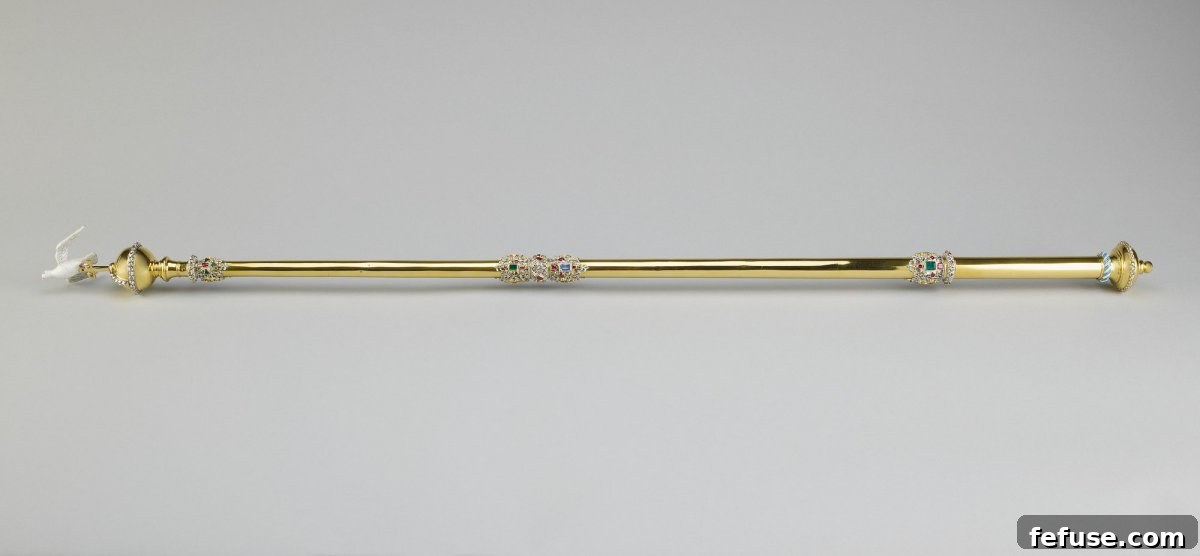
The Sovereign’s Sceptre with Dove: The Rod of Equity and Mercy
In her left hand, Queen Elizabeth II held the Sovereign’s Sceptre with Dove, also known as the Rod of Equity and Mercy. This scepter, crowned with an enamel dove representing the Holy Spirit, symbolizes the monarch’s spiritual role, her divine wisdom, and the virtues of justice and compassion she is expected to embody. Both the Sovereign’s Sceptre with Cross and the Sovereign’s Sceptre with Dove were meticulously crafted in 1661 for the coronation of King Charles II, following the restoration of the monarchy. Their parallel existence highlights the dual nature of the monarch’s power: temporal authority (represented by the cross) guided by divine wisdom and spiritual integrity (represented by the dove), a balance central to the philosophy of the British Crown.
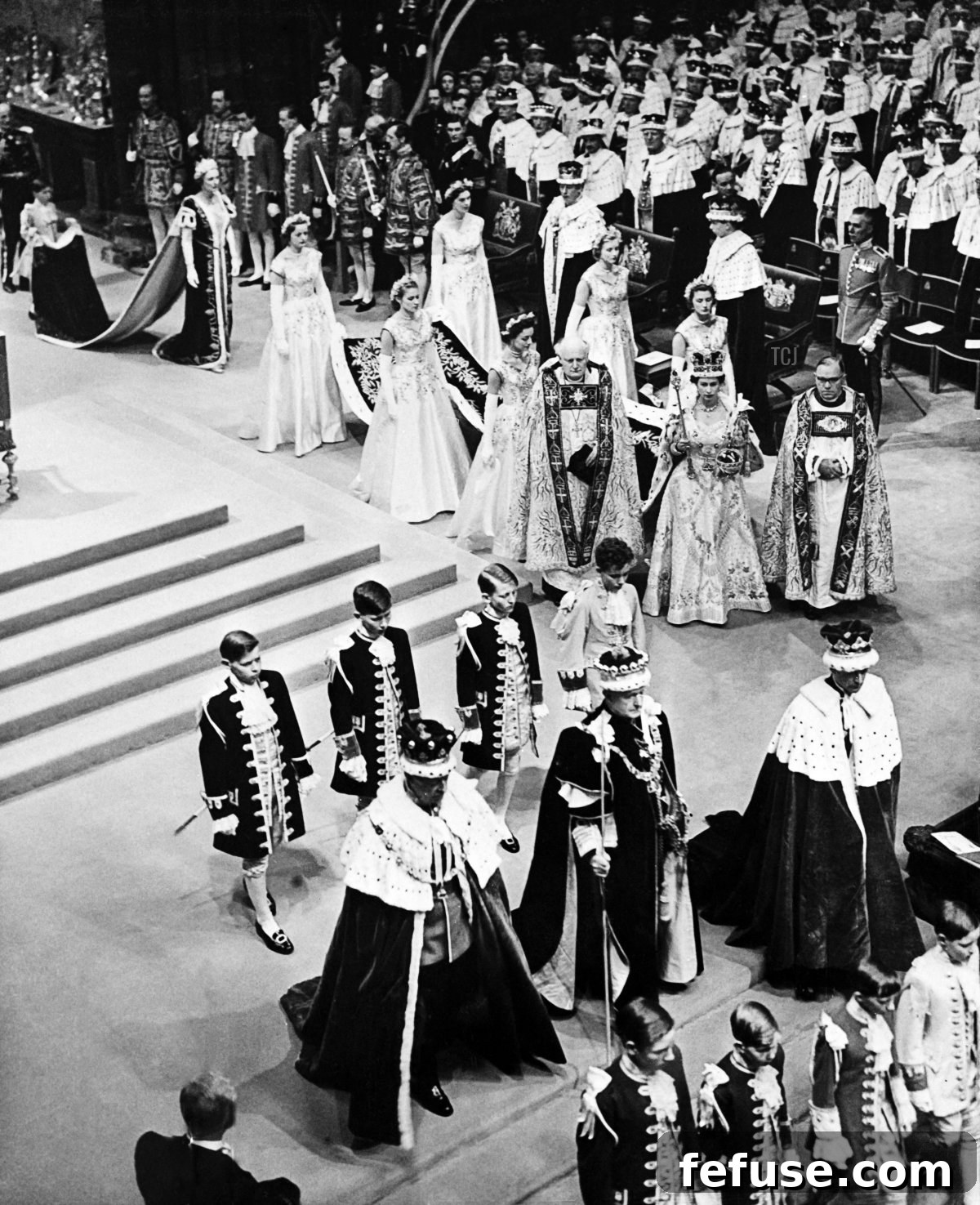
Departure from the Abbey: A New Crown and Orb
As Queen Elizabeth II emerged from Westminster Abbey after her profound coronation ceremony, marking the completion of her sacred investiture, there was a noticeable change in her regalia. While she still held the majestic Sovereign’s Sceptre with Cross in her right hand, a powerful symbol of her temporal authority, she was now wearing a different crown and carrying a distinct piece of regalia in her left hand. This change signifies the transition from the intensely sacred and solemn crowning ritual within the Abbey to the public display of sovereignty and celebration that would follow, as she presented herself as the crowned monarch to her people.
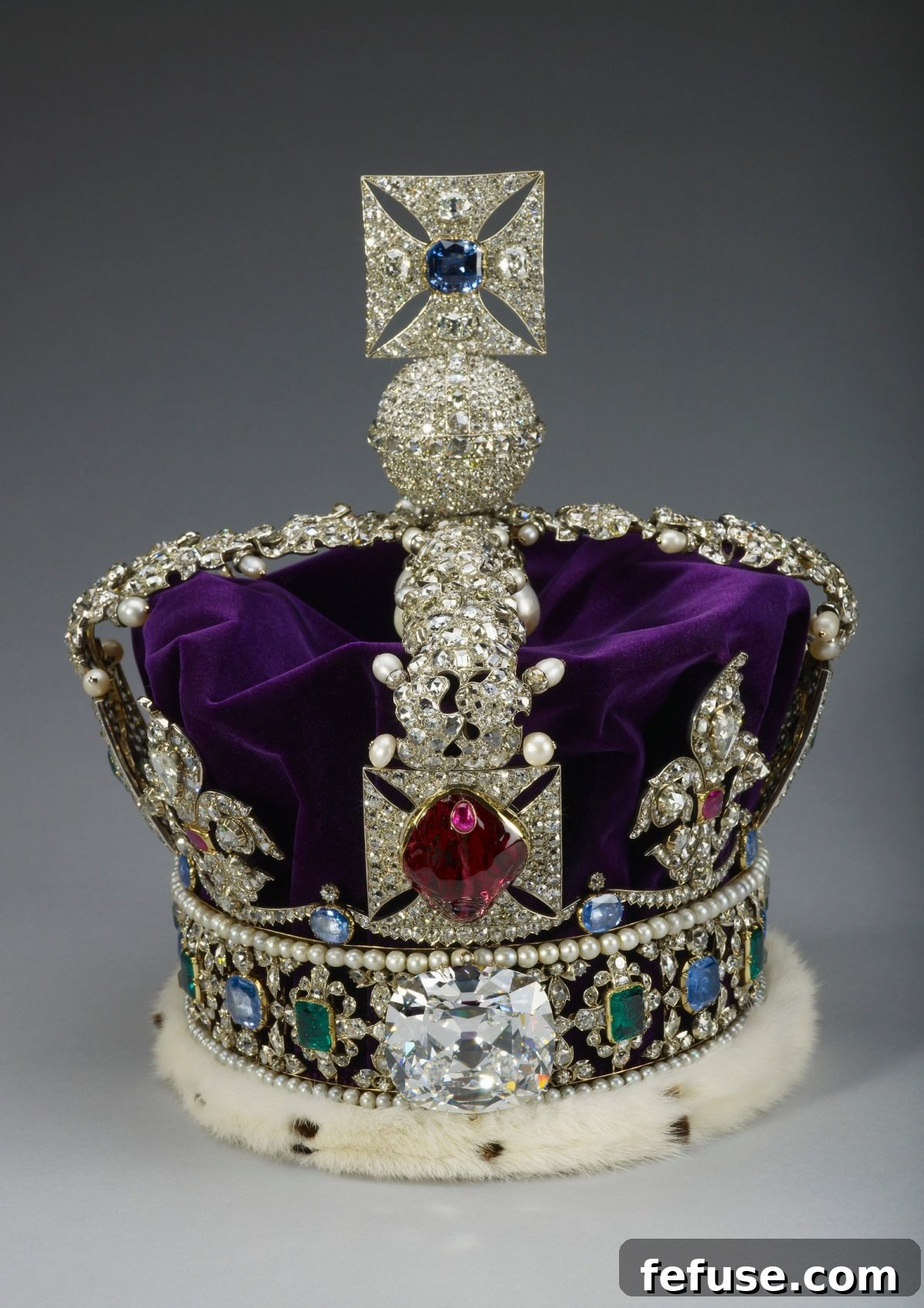
The Imperial State Crown: A Dazzling Symbol of Sovereignty
Before the monarch makes their grand exit from Westminster Abbey, a crucial exchange of crowns takes place. The ponderous St. Edward’s Crown, used only for the moment of crowning, is carefully swapped for the Imperial State Crown. This crown is significantly lighter and considerably more dazzling, making it suitable for wearing during the procession and other public engagements. The current Imperial State Crown, a magnificent piece of British royal history, was crafted in 1937 for King George VI, Queen Elizabeth II’s father. However, its design and, crucially, many of the extraordinary gems set within it, were inherited and meticulously reused from the Imperial State Crown made for Queen Victoria in 1838. This crown is renowned for its immense value and historical significance, featuring the 317.4-carat Cullinan II diamond (also known as the Second Star of Africa), St. Edward’s Sapphire, the Black Prince’s Ruby (actually a spinel), and the Stuart Sapphire. It is a crown that tells a story of empire, heritage, and enduring monarchical power, and its brilliance is a fitting sight for the jubilant crowds awaiting the newly crowned sovereign.
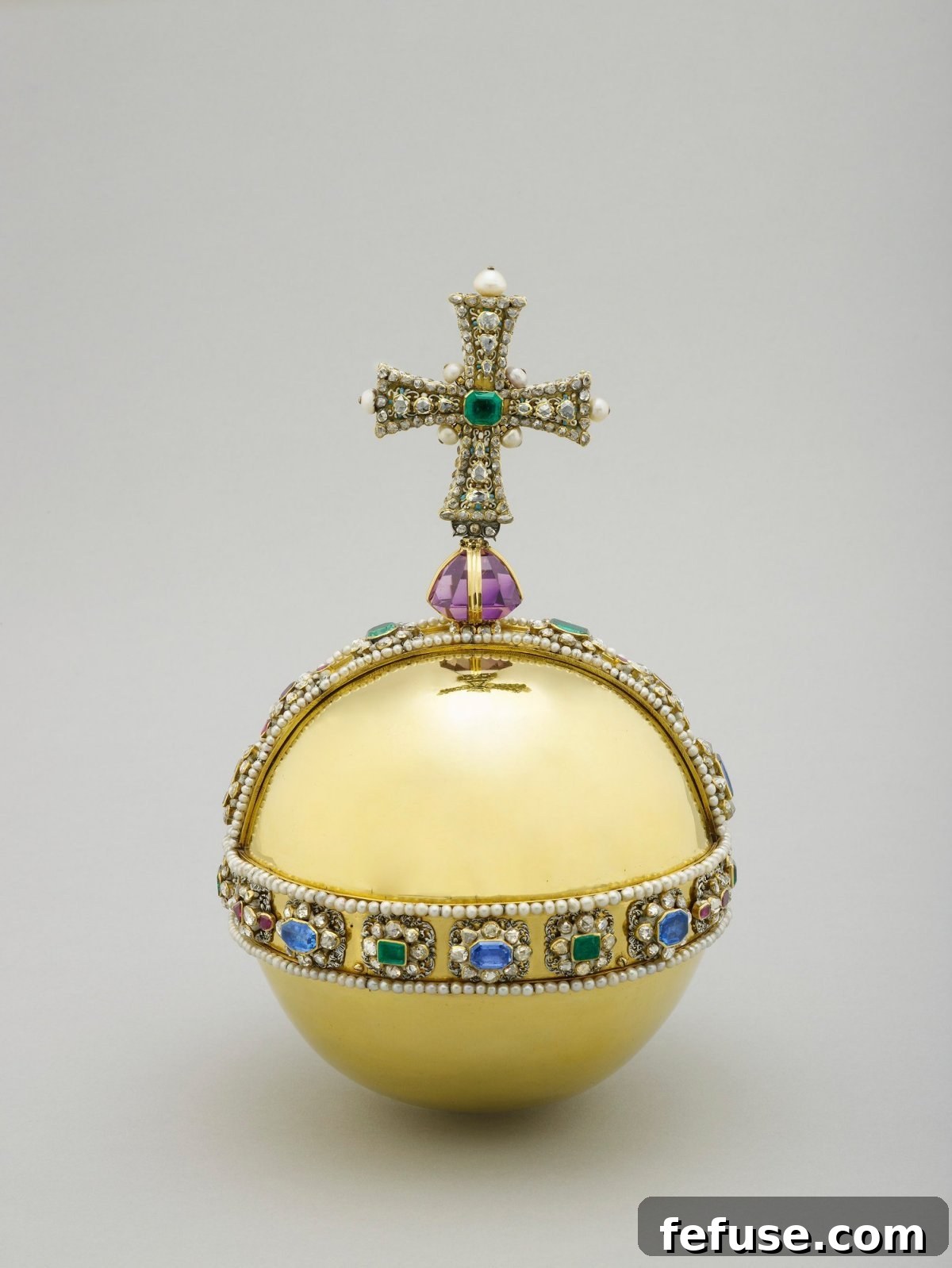
The Sovereign’s Orb: Symbol of Global Christian Sovereignty
In her left hand, as she departed the Abbey, the Queen held the Sovereign’s Orb. This striking golden orb, a hollow sphere adorned with a cross, is a powerful symbol of Christian sovereignty over the world. It is intricately set with a dazzling array of precious jewels, including pearls, diamonds, rubies, emeralds, sapphires, and crowned by a single, prominent amethyst. The orb was originally crafted in 1661 by Sir Robert Vyner for the coronation of Charles II, symbolizing the re-establishment of the monarchy after the Commonwealth period. The Royal Collection succinctly explains its profound meaning: “It symbolizes the Christian world with its cross mounted on a globe, and the bands of jewels dividing it up into three sections represent the three continents known in medieval times.” This ancient symbolism reinforces the monarch’s role as Defender of the Faith and head of a Christian nation, extending its spiritual reach across the globe as understood in historical contexts.
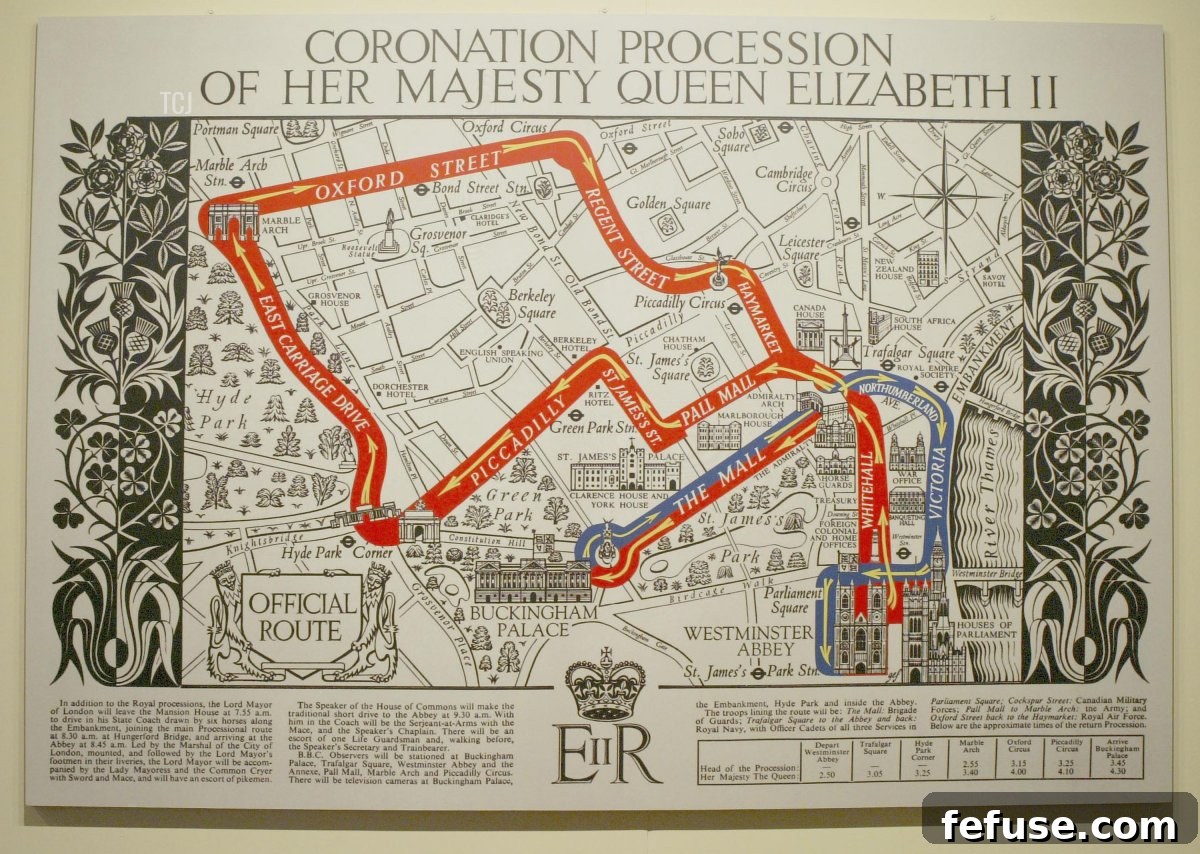
The Grand Procession: Return to Buckingham Palace
Clad in the lighter yet no less magnificent Imperial State Crown and holding the symbolic Sovereign’s Sceptre with Cross and the Sovereign’s Orb, Queen Elizabeth II walked out of Westminster Abbey to a crescendo of cheers. She then made her way to the Gold State Coach, a truly iconic symbol of British monarchy, for the grand procession back to Buckingham Palace. This procession was not merely a journey; it was a triumphant display of the newly crowned sovereign to her people. The route, meticulously planned and adorned, was lined with hundreds of thousands of jubilant spectators, eager to catch a glimpse of their new Queen. The Gold State Coach itself, a magnificent and historic vehicle, became a moving stage for the final act of the coronation day, carrying the monarch through the heart of her capital city in unparalleled splendor, marking a memorable and emotional moment for the entire nation and Commonwealth.
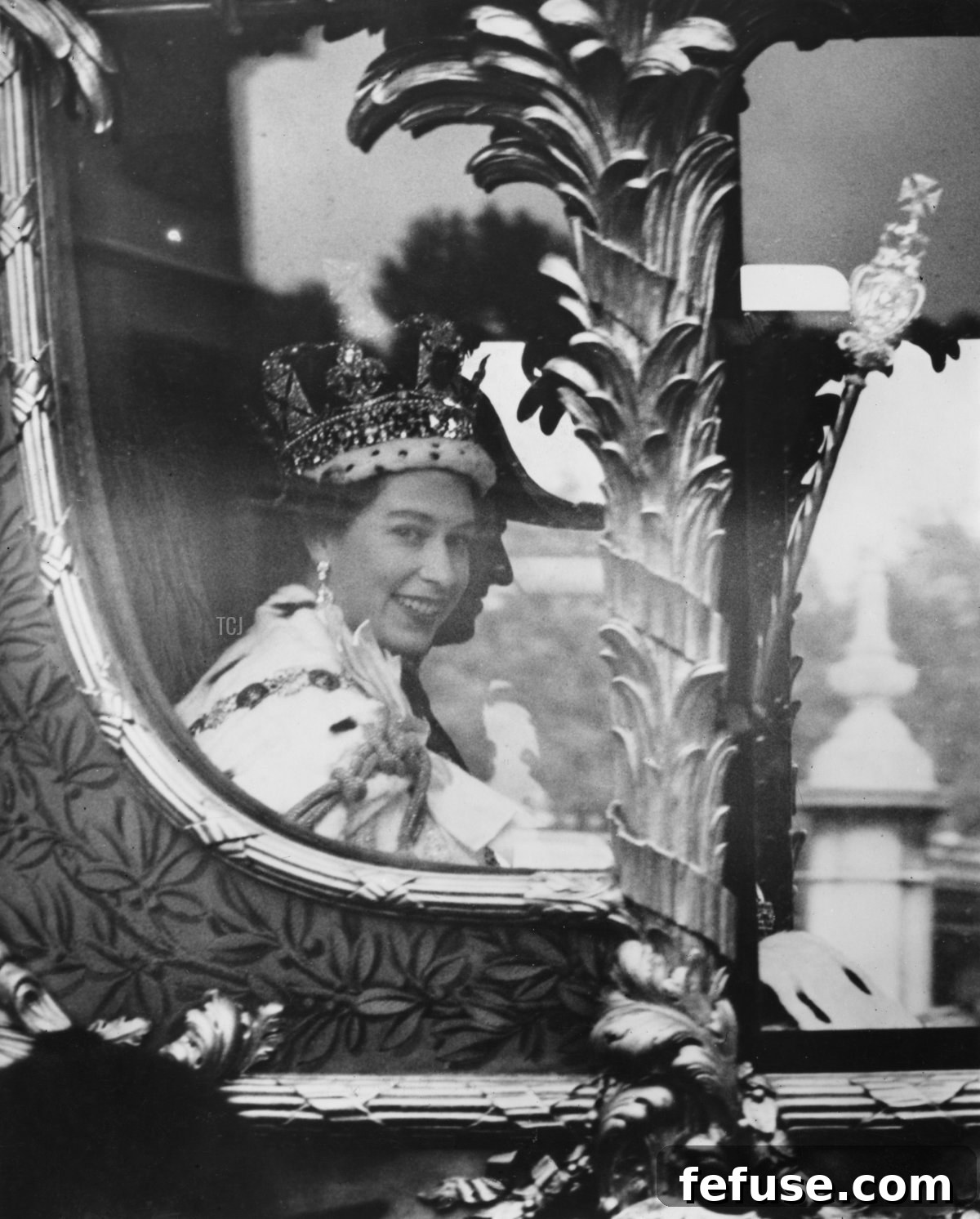
Amidst the overwhelming cheers and jubilant crowds, Queen Elizabeth II, radiating both joy and dignity, is captured here smiling through the window of the magnificent Gold State Coach. Beside her, her devoted husband, Prince Philip, Duke of Edinburgh, shares in this historic moment as they ride through the flag-draped streets of London. This image encapsulates the palpable excitement and profound sense of occasion that permeated the city after the completion of the solemn coronation ceremony. It was a moment of public triumph, where the monarch connected with her people, signaling the beginning of a long and celebrated reign.
The Buckingham Palace Balcony: A Public Affirmation
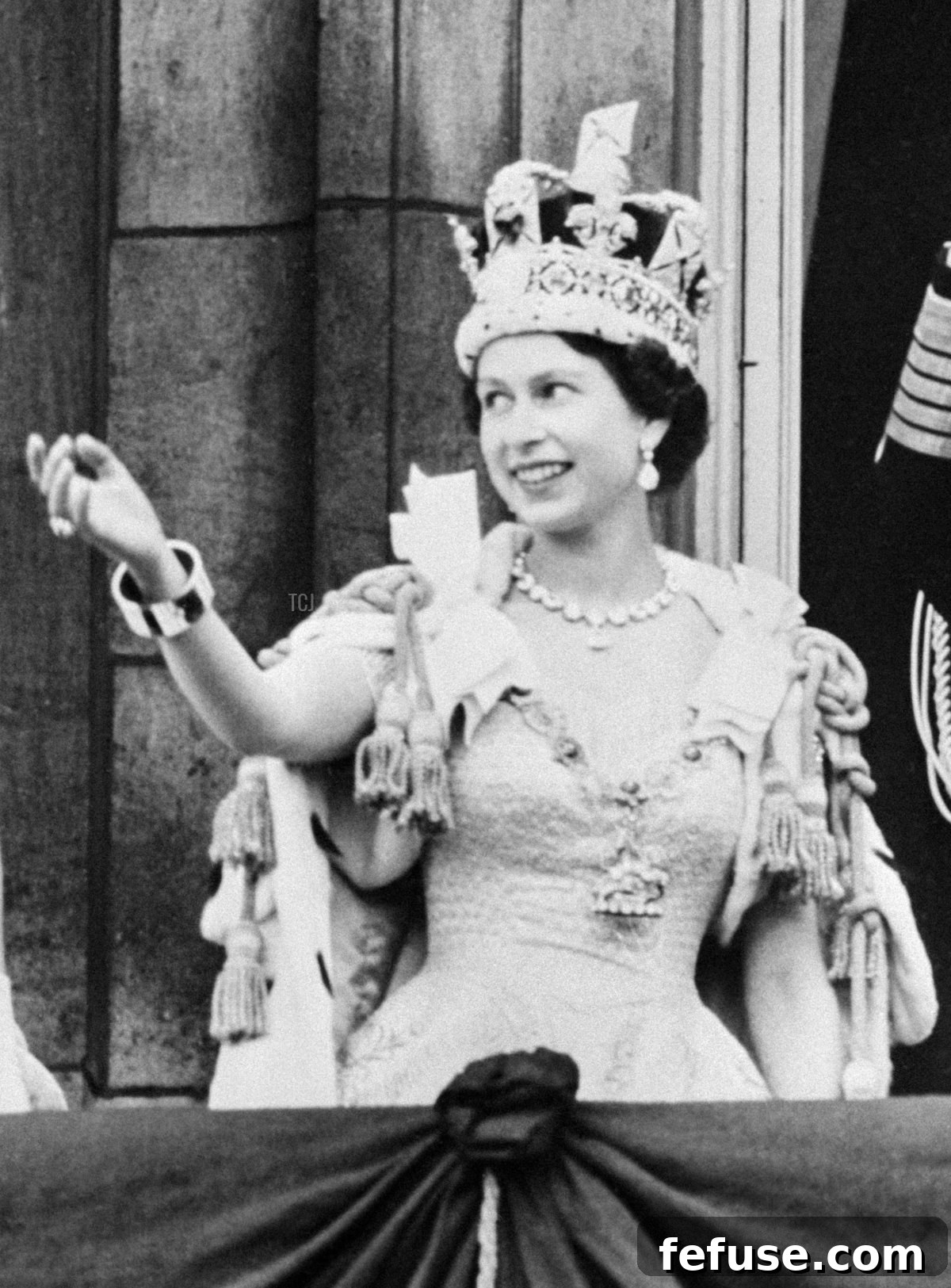
The joyous conclusion to the coronation day saw Queen Elizabeth II appear on the iconic balcony of Buckingham Palace, a moment eagerly anticipated by the vast crowds gathered below. For this public affirmation of her reign, she once again presented herself in full regal splendor. She proudly wore the magnificent Imperial State Crown, a glittering testament to her sovereignty. Accompanying it were the historic Coronation Earrings and Necklace, the prestigious Garter Collar and Badge, the symbolic Armills, and the revered Sovereign’s Ring. This ensemble of jewels and insignia, displayed before the adoring public, served as a powerful visual confirmation of her investiture and a joyous start to her reign, cementing the image of their new Queen in the hearts and minds of millions.
The Enduring Image: Coronation Portraits by Cecil Beaton
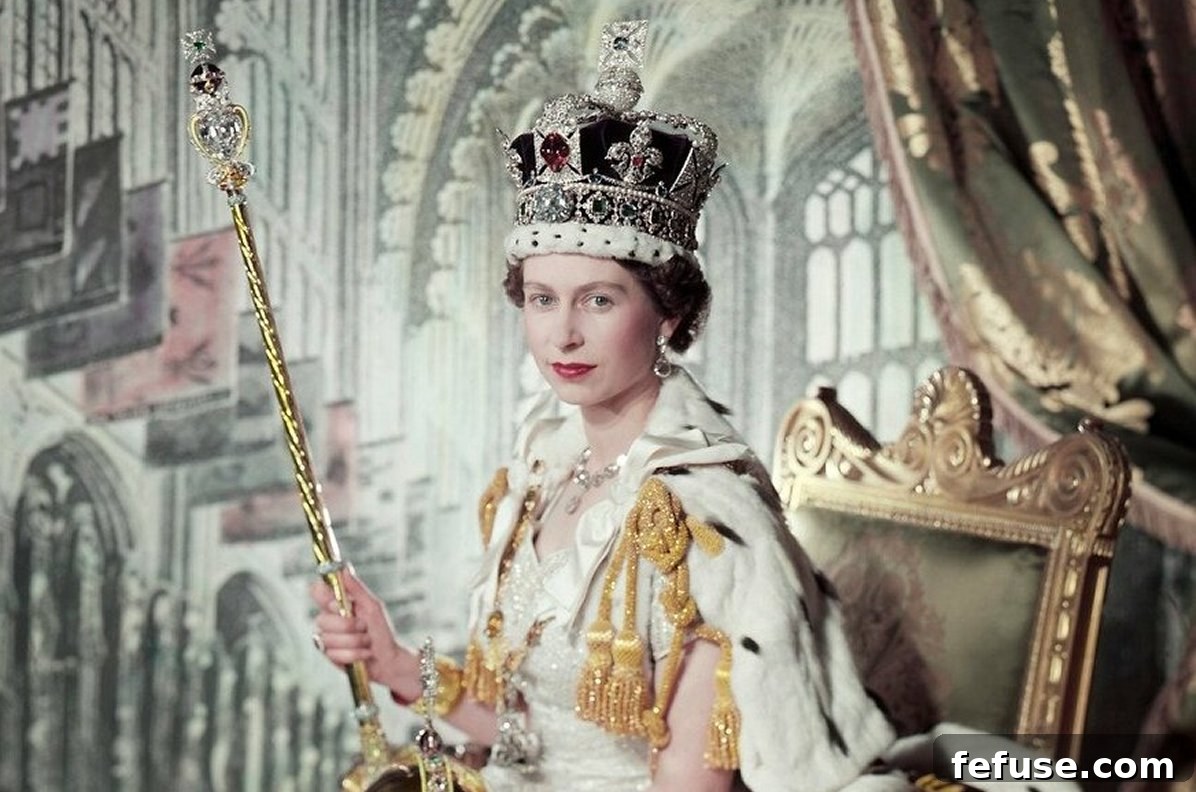
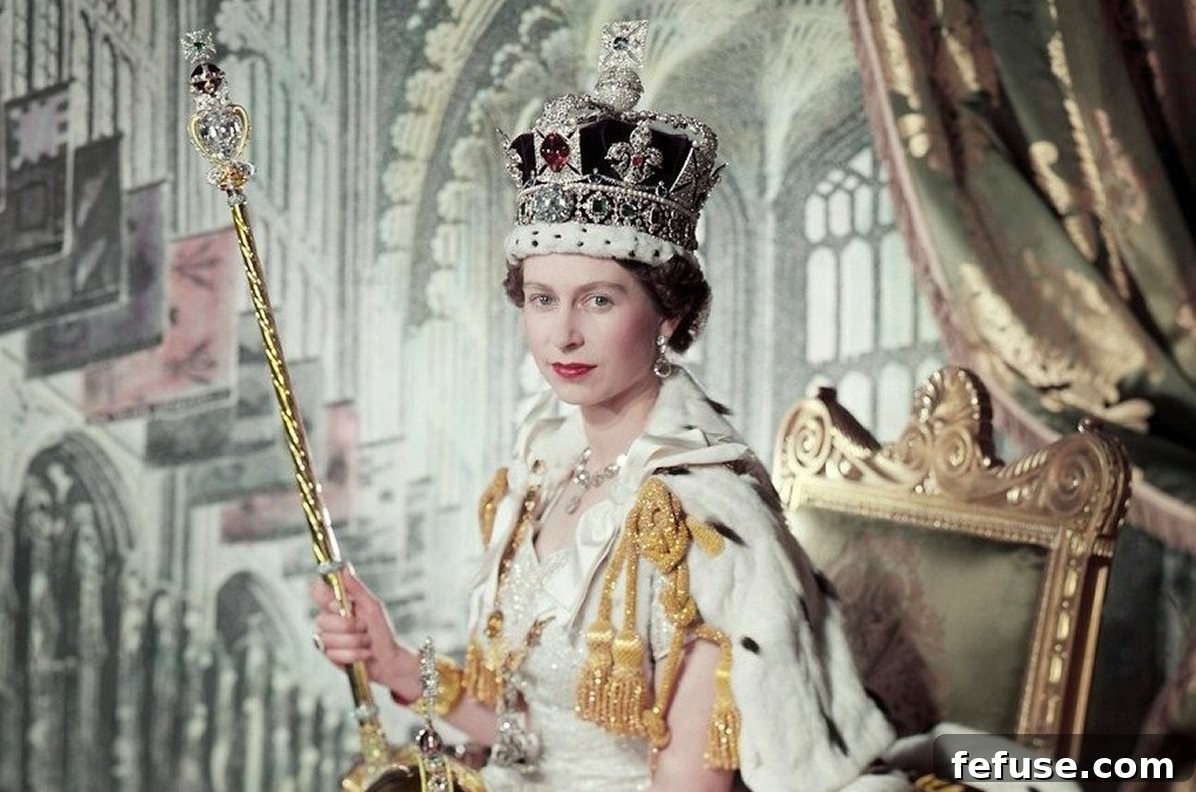
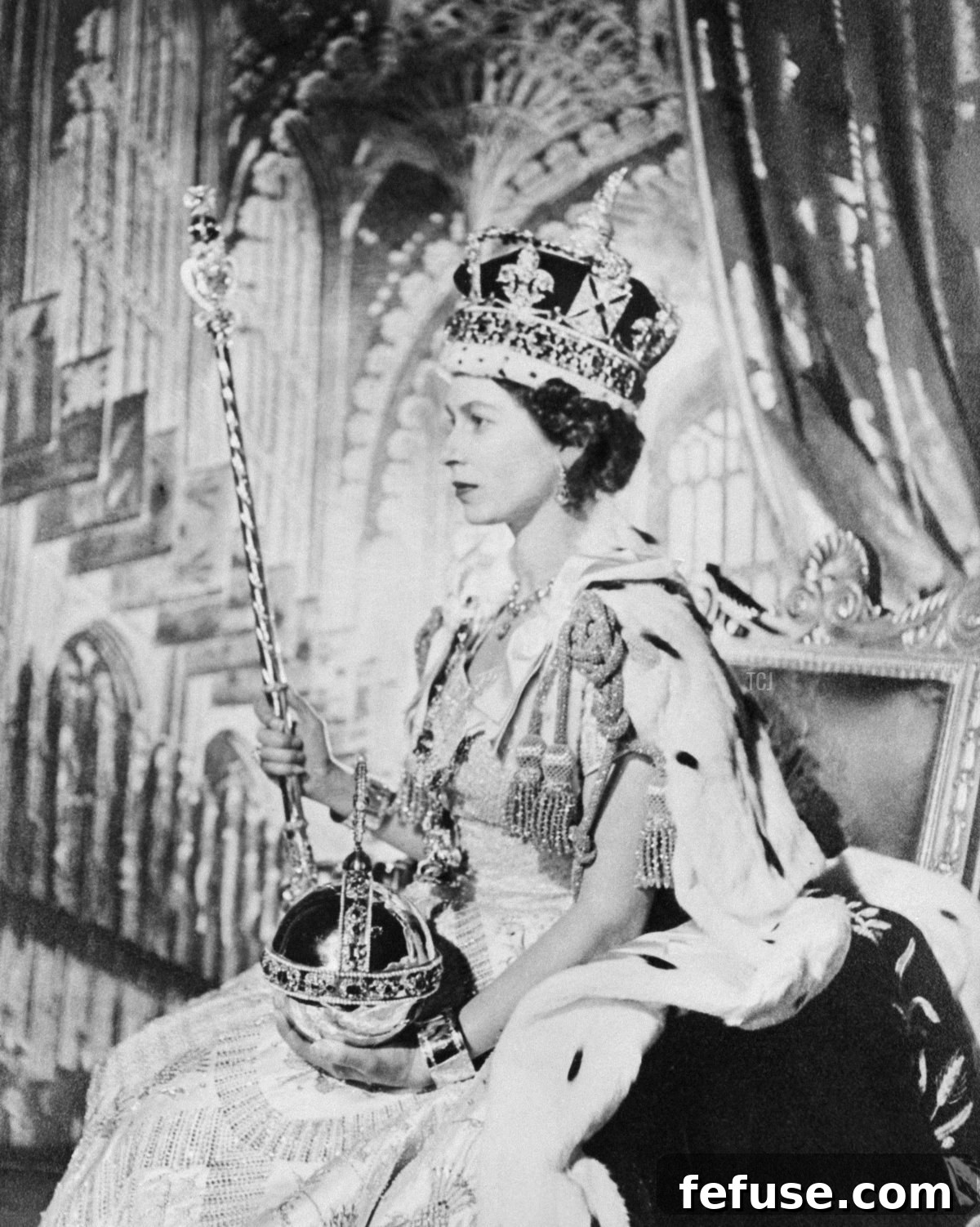
Following the public festivities, Queen Elizabeth II sat for her official coronation portraits, an essential tradition that captures the essence of the new reign for posterity. These renowned photographs were taken by the legendary Cecil Beaton at Buckingham Palace, an artist celebrated for his ability to merge theatricality with portraiture. In these iconic images, the Queen is once again seen adorned with the same magnificent jewels and regalia worn throughout the latter part of the day. The Imperial State Crown sits proudly upon her head, and she holds both the Sceptre with Cross and the Sovereign’s Orb. It is worth noting that the Westminster Abbey visible in the background is not the actual Abbey but a beautifully painted backdrop, a common artistic technique employed by Beaton to evoke the grandeur of the ceremony’s setting within the confines of a studio at the palace. These portraits have become enduring symbols of her coronation, instantly recognizable and deeply embedded in the public consciousness, forever capturing the regal majesty of Queen Elizabeth II on her historic day.
A Legacy of Splendor and Continuity
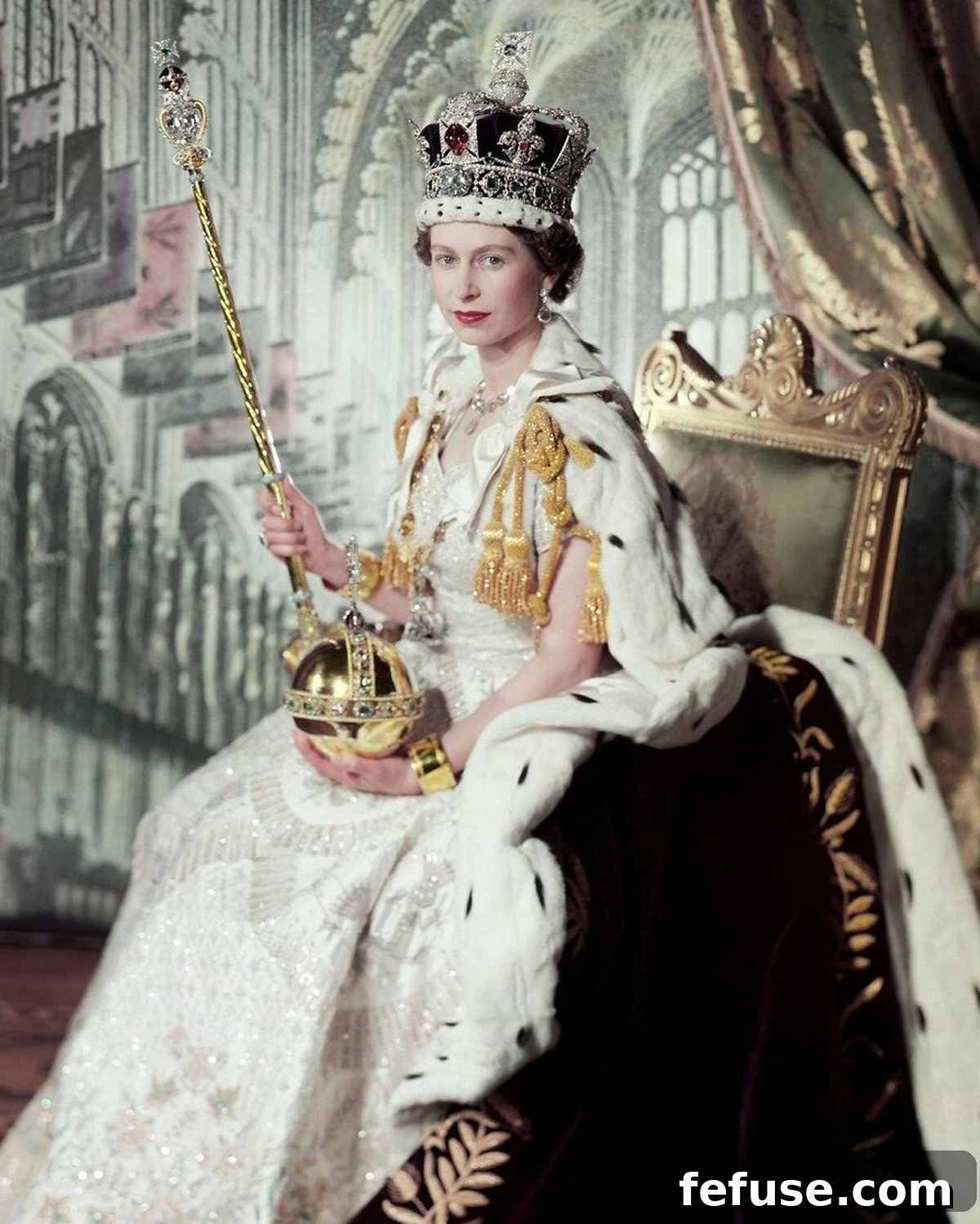
And here, we present an exquisite image from that memorable portrait session, rendered in vibrant color, allowing us to fully appreciate the intricate details and dazzling brilliance of the regalia. This portrait vividly captures the majesty of Queen Elizabeth II, resplendent in her Imperial State Crown, holding the scepter and orb, a true icon of her reign. As we conclude our exploration of her historic coronation, it is with a sense of wonder and anticipation for the future. In just a few days, the world will once again bear witness to a British coronation, and many of these very same pieces of jewelry and royal regalia will reappear, gracing the ceremony for the first time in an astounding 70 years. This upcoming event will not only honor the past but also forge new connections, carrying forward a rich tapestry of tradition that continues to define the British monarchy and captivate a global audience.