
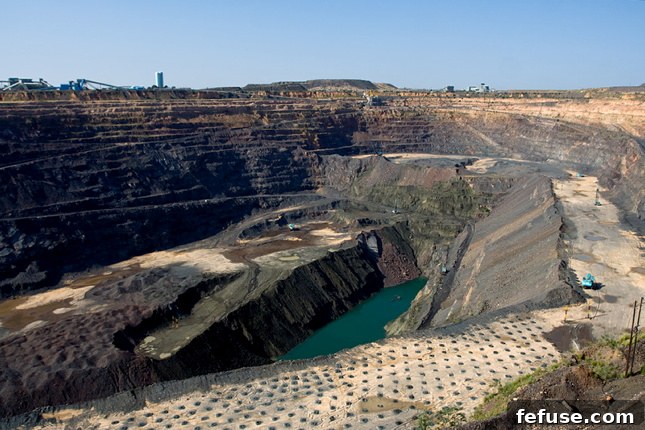
In a monumental leap towards the future of resource extraction, Debswana Diamond Company, a powerhouse joint venture between the Government of the Republic of Botswana and global diamond giant De Beers, has proudly announced the successful implementation of “the world’s first 5G-oriented smart diamond mine project.” This pioneering initiative, undertaken in close collaboration with leading Chinese technology corporation Huawei, marks a significant milestone in the digital transformation of the global mining industry. Launched at the iconic Jwaneng mine in Botswana, often hailed as the “Prince of Mines” due to its immense wealth and advanced operations, this project is already demonstrating transformative impacts on both operational efficiency and safety protocols, setting a new benchmark for intelligent mining worldwide.
Revolutionizing Mining: Debswana and Huawei Forge the Path with 5G at Jwaneng
The mining sector, inherently characterized by vast, complex operations and challenging environments, has long sought innovative solutions to enhance productivity, reduce costs, and, critically, ensure the well-being of its workforce. The advent of 5G technology presents an unparalleled opportunity to address these challenges head-on. Debswana, a company deeply rooted in Botswana’s economic fabric and responsible for a substantial portion of the nation’s GDP through diamond production, recognized this potential and partnered with Huawei, a global leader in telecommunications and enterprise solutions, to bring this vision to life at its flagship Jwaneng mine.
The core of this groundbreaking project lies in connecting over 260 pieces of vital mining equipment within the Jwaneng operation to a robust and highly efficient 5G network. This extensive connectivity facilitates an unprecedented level of real-time data transfer, creating a seamless digital ecosystem that was previously unimaginable. From colossal mining vehicles to intricate sensor networks, every component of the mining process is now integrated, enabling instantaneous communication and data exchange. This level of integration is not merely an upgrade; it represents a fundamental shift in how mining operations are managed and optimized, ushering in an era of intelligent, data-driven decision-making.
Unlocking Unprecedented Efficiency through Real-time Connectivity
One of the most immediate and profound benefits of the 5G-enabled smart mine is the dramatic enhancement in operational efficiency. The ability to transfer vast quantities of data in real-time empowers mining vehicles and other heavy machinery to operate with a new degree of precision and coordination. This means that excavators can communicate instantly with haul trucks, optimizing loading and transport routes to minimize idle time and fuel consumption. Predictive maintenance systems, fed by continuous data streams from equipment sensors, can anticipate potential failures before they occur, allowing for proactive repairs that drastically reduce unexpected downtime and costly disruptions to production schedules.
Furthermore, the real-time insights derived from this interconnected network enable superior resource allocation and management. Mine operators gain a holistic view of the entire operation, allowing them to adjust strategies on the fly to maximize yield and optimize the extraction process. This dynamic adaptability translates directly into increased productivity and, consequently, a significant reduction in long-term operating costs. By streamlining processes, minimizing waste, and maximizing the utilization of every asset, the 5G smart mine concept is poised to deliver substantial economic advantages, ensuring the continued viability and profitability of diamond mining operations in an increasingly competitive global market.
Elevating Safety Standards with Advanced Sensor Technology and Low Latency
Beyond efficiency, the imperative of safety in mining cannot be overstated. The Debswana-Huawei 5G project introduces a new paradigm for worker and equipment protection. The ultra-low latency and high bandwidth capabilities of the 5G network make the entire system extraordinarily sensitive and accurate. This enhanced responsiveness provides more reliable protection for both personnel and valuable mining assets. For instance, advanced collision avoidance systems can react instantaneously to potential hazards, preventing accidents before they happen. Real-time tracking of every vehicle and individual within the mine creates a comprehensive safety perimeter, allowing for immediate alerts and responses in emergency situations.
The implementation of remote-controlled machinery, facilitated by 5G’s near-instantaneous communication, enables operators to manage dangerous tasks from a safe distance, removing personnel from hazardous environments such as blast zones or unstable ground. Environmental sensors, integrated into the 5G network, continuously monitor air quality, ground stability, and other critical conditions, providing early warnings of potential dangers. This comprehensive approach to safety, powered by intelligent connectivity, not only safeguards lives but also enhances operational continuity by minimizing incidents and associated recovery efforts. The investment in 5G technology is, therefore, an investment in a safer, more humane future for the mining workforce.
Paving the Way for Autonomous Operations and Digital Transformation
The true revolutionary potential of the 5G network at Jwaneng extends far beyond current operational enhancements; it acts as the foundational infrastructure for cutting-edge technologies that will define the future of mining. Critically, 5G enables the seamless integration and deployment of autonomous driving capabilities for mining vehicles. With minimal latency and massive data transfer rates, self-driving trucks and drills can navigate the complex terrain of the mine with unprecedented precision and safety, operating around the clock without human fatigue. This not only boosts productivity but also transforms the nature of work, shifting human roles towards oversight, data analysis, and sophisticated remote operation.
Furthermore, the project lays the groundwork for a more profound and intelligent digital transformation of the mining industry as a whole. Artificial intelligence (AI) and machine learning algorithms can now process the vast streams of real-time data to identify patterns, predict outcomes, and optimize virtually every aspect of the mining process. Digital twins – virtual replicas of the physical mine – can be created and continuously updated with live data, allowing for simulated operations, scenario planning, and predictive maintenance in a safe, virtual environment. This level of digital sophistication promises to unlock efficiencies and innovations that were once the exclusive domain of science fiction, making the mining industry more agile, resilient, and sustainable.
Expansion Plans and Global Implications
The success and promising results at Jwaneng are merely the beginning. Debswana has ambitious plans to replicate this pioneering 5G-oriented smart mine model across its other significant operations in Botswana. The company intends to roll out the same advanced technological solutions at its Orapa, Damtshaa, and Letlhakane mines, further solidifying Botswana’s position at the forefront of technological innovation in the resource sector. This planned expansion underscores Debswana’s commitment to leveraging cutting-edge technology for sustainable growth and operational excellence across its entire portfolio.
The collaborative efforts of Huawei and Debswana were prominently showcased at the Mobile World Congress (MWC) Barcelona, one of the world’s largest trade shows for the mobile communications industry. Their exhibition served as a powerful testament to the tangible benefits of industrial 5G applications and highlighted the critical role of cross-industry partnerships in driving technological progress. This global visibility not only elevates the profile of Debswana and Botswana but also provides a blueprint for other mining companies around the world looking to embrace digital transformation. The lessons learned and technologies deployed at Jwaneng are set to inspire and accelerate similar initiatives across various heavy industries, demonstrating 5G’s immense potential beyond consumer applications.
A Future Forged in Connectivity and Innovation
The Debswana-Huawei 5G smart diamond mine project at Jwaneng represents more than just a technological upgrade; it signifies a strategic pivot towards a future where mining is inherently smarter, safer, and more sustainable. By harnessing the power of industrial 5G, Debswana is not only optimizing its current operations but also positioning itself as a pioneer in an industry ripe for disruption. This initiative will have far-reaching positive impacts, from enhancing the economic contribution of the mining sector to Botswana to setting new global standards for responsible resource extraction.
As the world continues to demand resources, the ability to extract them with greater efficiency, minimal environmental impact, and paramount safety will become increasingly crucial. The blueprint established at Jwaneng, through the visionary partnership of Debswana and Huawei, offers a compelling glimpse into this future. It demonstrates how advanced connectivity, combined with intelligent automation and real-time data analytics, can transform complex industrial environments, fostering innovation that benefits economies, protects people, and preserves the planet for generations to come. The era of the intelligent mine has truly arrived, led by the shining example of Botswana’s diamond industry.