
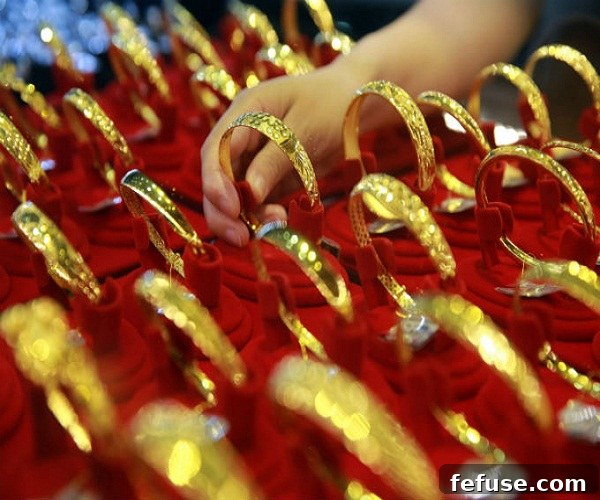
China’s Gold, Silver, and Jewelry Market Shines Bright Amidst Evolving Economic Landscape
The Chinese market for gold, silver, and jewelry demonstrated remarkable resilience and growth in the initial months of the year, signaling robust consumer confidence and a continued appetite for luxury goods. According to the National Bureau of Statistics of China (NBS), retail sales in this coveted category experienced a significant 7.5 percent increase during the first five months of the year compared to the same period in the previous year. This impressive performance underscores the enduring appeal of precious metals and finely crafted jewelry among Chinese consumers, further solidifying China’s position as a pivotal player in the global luxury market.
Delving deeper into the statistics, the NBS’s latest retail sales of consumer goods report highlighted that the momentum for gold, silver, and jewelry sales continued strongly into May. Retail sales for this specific category alone saw a substantial improvement of 5.9 percent in May, showcasing a consistent upward trend. These figures not only reflect a healthy recovery but also indicate a thriving segment within China’s broader consumer market, often acting as a barometer for discretionary spending and economic well-being.
While the precious metals and jewelry sector exhibited exceptional strength, the overall retail sales of consumer goods across China also registered positive growth. For the January to May period, overall retail sales were 9.5 percent higher than in the corresponding period a year ago. In May alone, the figure rose by 8.5 percent. The fact that gold, silver, and jewelry sales grew at a slightly lower, yet still robust, pace compared to the overall consumer goods market in May suggests a balanced growth across various consumer categories, with luxury items maintaining a strong foothold.
Understanding the Economic Context and Driving Forces
The positive performance of the jewelry market comes against a backdrop of broader economic shifts and forecasts. An outlook released in May 2018 by the intergovernmental economic group Organisation for Economic Co-operation and Development (OECD) predicted a softening of China’s overall growth in 2018 to 2019. This projected moderation was attributed to an anticipated easing of exports and a slowdown in investment, indicating a structural rebalancing within the Chinese economy from an export and investment-driven model towards greater reliance on domestic consumption.
However, the OECD report also highlighted a crucial counter-narrative: consumption had strengthened significantly at the beginning of the year. This resilience in consumer spending was primarily bolstered by two fundamental factors: rising real incomes and a consistently low unemployment rate. These conditions collectively empower Chinese households with increased disposable income and a greater sense of financial security, making them more willing and able to invest in discretionary purchases, including high-value items like gold, silver, and jewelry.
The Power of E-commerce and Digital Transformation
A particularly noteworthy driver behind the surge in consumption, as emphasized by the OECD, was the rapid expansion of e-commerce sales. China’s digital economy has been a global leader in innovation and adoption, and this dynamism has profoundly impacted the retail landscape. Online platforms offer unparalleled convenience, a vast array of choices, competitive pricing, and the ability to reach consumers even in lower-tier cities where traditional brick-and-mortar luxury boutiques might be less prevalent. The integration of live-streaming, social commerce, and personalized digital marketing strategies has transformed how consumers discover, evaluate, and purchase jewelry, making the market more accessible and engaging than ever before.
This digital acceleration has not only facilitated transactions but also democratized access to information and trends, enabling consumers across diverse demographics to explore and acquire precious items. For both domestic and international jewelry brands, a robust online presence has become indispensable, driving sales growth and fostering brand loyalty in a highly competitive environment. The ability to leverage big data for personalized recommendations and to offer seamless online-to-offline experiences further amplifies the appeal of e-commerce in the luxury sector.
Inflationary Trends and Consumer Confidence
The economic environment was further characterized by moderating producer price inflation and subdued consumer price inflation. According to the OECD, “Producer price inflation continued to moderate and consumer price inflation remains subdued.” This scenario is generally favorable for consumer spending. When consumer prices remain stable or increase modestly, the purchasing power of real incomes is preserved, encouraging households to spend rather than save excessively due to fears of rising costs. For luxury goods like jewelry, stable inflation ensures that prices remain relatively predictable, allowing consumers to plan their purchases with greater certainty and confidence.
Cultural Significance and Investment Appeal of Precious Metals in China
Beyond economic indicators, the intrinsic cultural value of gold and silver plays a profound role in China’s robust jewelry market. Gold, in particular, holds deep cultural significance, symbolizing prosperity, good fortune, and purity. It is an indispensable element in important life events such as weddings, births, and traditional festivals like the Lunar New Year. Gifting gold jewelry is a long-standing tradition, signifying blessings and well wishes, which consistently fuels demand throughout the year. The intricate craftsmanship and traditional designs often associated with Chinese gold jewelry further enhance its desirability, blending cultural heritage with contemporary aesthetics.
Moreover, precious metals, especially gold, are often viewed as a tangible asset and a hedge against economic uncertainties. In periods where other investment avenues might seem volatile or less secure, gold’s status as a safe-haven asset becomes more pronounced. Chinese consumers often allocate a portion of their savings to gold for both its aesthetic appeal and its perceived long-term value appreciation. This dual function as a luxury consumer item and an investment vehicle provides a stable foundation for the market, insulating it somewhat from broader economic fluctuations that might affect other discretionary spending categories.
Strategic Outlook for China’s Gold, Silver, and Jewelry Market
Looking ahead, the strong performance observed in the first five months of the year positions China’s gold, silver, and jewelry market for continued growth and innovation. The confluence of rising real incomes, a burgeoning middle class with aspirational spending habits, the unstoppable force of e-commerce, and the deep-seated cultural reverence for precious metals creates a powerful ecosystem for sustained demand. Brands, both international and domestic, are continually adapting their strategies to cater to evolving consumer preferences, focusing on personalized products, unique designs, and sustainable sourcing.
However, the market is not without its challenges. Intense competition, the need for constant innovation to capture ever-changing tastes, and potential economic headwinds will require agility and foresight from industry players. Yet, the underlying fundamentals of the Chinese market remain exceptionally strong. The emphasis on domestic consumption as a key driver of economic growth by the Chinese government further supports a favorable environment for luxury goods. The ongoing urbanization, coupled with rising disposable incomes in lower-tier cities, promises to unlock new growth frontiers for the jewelry sector.
Conclusion: A Glimmering Future for China’s Precious Market
In conclusion, the National Bureau of Statistics of China’s data paints a vivid picture of a vibrant and expanding market for gold, silver, and jewelry. The significant retail sales increases of 7.5 percent for the first five months and 5.9 percent in May alone demonstrate the sector’s robust health and the unwavering purchasing power of Chinese consumers. While the broader economic outlook presented by the OECD pointed to a potential moderation in overall growth, the strength of consumption, fueled by rising incomes, low unemployment, and the digital revolution, stands out as a powerful counterbalance.
The Chinese market continues to be a dynamic and complex landscape where cultural heritage meets modern trends, and traditional investment values converge with contemporary fashion. For global jewelers and precious metal suppliers, China remains an indispensable market, offering immense opportunities for those who can effectively navigate its unique consumer behaviors, embrace digital transformation, and resonate with its rich cultural ethos. The glimmering performance of its precious metals and jewelry sector serves as a testament to its enduring appeal and its crucial role in shaping the global luxury industry.