
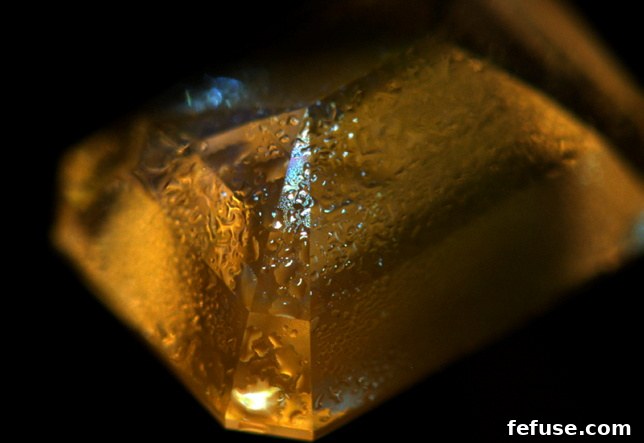
Unraveling the Mystery: Unexpected Orange Phosphorescence in a Lab-Grown CVD Diamond
The world of diamonds is constantly evolving, with the rise of lab-grown diamonds presenting both exciting opportunities and intriguing challenges for gemological science. As technology advances, so does our ability to create diamonds with remarkable precision, mirroring the beauty and chemical composition of their natural counterparts. However, these man-made marvels occasionally reveal unique characteristics that continue to fascinate researchers and redefine our understanding of diamond formation. A recent study conducted by the Gemological Science International (GSI) Lab in Mumbai brought one such anomaly to light: an unexpected and distinct orange phosphorescence observed in a specific lab-grown diamond, pointing towards the intricate role of internal crystal defects.
The Ascent of Lab-Grown Diamonds: A Modern Marvel
Lab-grown diamonds, also known as synthetic, cultivated, or engineered diamonds, are genuine diamonds created in highly controlled laboratory environments rather than being mined from the earth. They possess the identical chemical, physical, and optical properties of natural diamonds. Their increasing popularity stems from a combination of factors, including ethical sourcing, environmental considerations, and often, a more accessible price point. The two primary methods for producing these gems are High-Pressure/High-Temperature (HPHT) and Chemical Vapor Deposition (CVD). While both yield stunning results, the nuances of their growth processes can lead to distinct internal features that are vital for gemological identification.
Understanding the Chemical Vapor Deposition (CVD) Method
The Chemical Vapor Deposition (CVD) method is a sophisticated technique used to grow high-quality diamonds in a laboratory setting. This process involves placing a diamond “seed” (a thin slice of another diamond) in a vacuum chamber. Carbon-rich gases, such as methane, are then introduced into the chamber and heated to extremely high temperatures (around 700-1200 degrees Celsius). Microwaves are used to break down the molecular bonds of the gases, creating a plasma cloud of carbon atoms. These carbon atoms then fall onto the diamond seed, layer by layer, slowly building up a new, larger diamond crystal. The growth rate is carefully controlled, typically allowing for the production of several carats over a few weeks. CVD diamonds are renowned for their often high clarity and color, making them highly desirable in the jewelry market. However, their growth conditions can sometimes result in specific nitrogen-vacancy (NV) defects or other structural imperfections that influence their optical behaviors, such as fluorescence and phosphorescence.
A Unique Case Study: The Orange Phosphorescence Anomaly
The focal point of this intriguing discovery was a 1.547 carat, emerald cut H / VS1 lab-grown diamond, which had been produced using the CVD method. This particular stone was submitted to the prestigious Gemological Science International (GSI) Lab in Mumbai for routine post-growth treatment identification. While advanced gemological testing aims to confirm the diamond’s origin and detect any treatments, this specific stone presented an unexpected phenomenon. During standard observations, the diamond exhibited an unusual and vibrant orange phosphorescence, a characteristic that immediately captured the attention of the gemologists.
Phosphorescence, distinct from fluorescence, refers to the emission of light by a substance that continues after the exciting radiation (like UV light) has been removed. It’s akin to a “glow-in-the-dark” effect, where the diamond briefly holds and then releases absorbed energy. While some lab-grown diamonds do show phosphorescence, the strength, color, and behavior of this orange glow in the emerald-cut stone were considered highly unusual and warranted further investigation. This anomaly underscores the continuous need for rigorous scientific examination as diamond synthesis technologies advance.
Distinguishing Fluorescence and Phosphorescence in Diamonds
To fully appreciate the significance of this discovery, it’s crucial to understand the difference between fluorescence and phosphorescence in diamonds. Both are forms of luminescence, but they differ in their duration and mechanism:
- Fluorescence: This occurs when a diamond temporarily emits visible light while it is exposed to certain energy sources, most commonly shortwave or longwave ultraviolet (UV) light. As soon as the UV light source is removed, the diamond stops glowing. Common fluorescence colors in diamonds include blue (the most prevalent), yellow, green, and orange. For CVD diamonds specifically, observations with instruments like the DiamondView often reveal a diverse range of fluorescence colors, including orange, red, blue, and sometimes a mottled distribution of purple, red, and blue. This varying color distribution is a key indicator for identifying CVD growth.
- Phosphorescence: In contrast, phosphorescence is the emission of light that persists for a noticeable period after the exciting energy source has been removed. The absorbed energy is stored in the diamond’s atomic structure and then slowly released as light. This “afterglow” can last from a fraction of a second to several minutes, depending on the diamond and the specific defects present. While less common than fluorescence, phosphorescence, particularly in certain colors like green or blue, can be observed in both natural and lab-grown diamonds. However, a strong orange phosphorescence, as seen in the GSI study, is a particularly rare and noteworthy event.
The GSI lab note specifically highlighted that when observed with the advanced DiamondView instrument—which is designed to examine surface fluorescence by illuminating diamonds with shortwave ultra-violet light—the subject diamond initially revealed “a strong greenish yellow fluorescence when observed length wise.” Intriguingly, when the diamond was rotated, a strong orange fluorescence was observed. This dual observation of greenish-yellow and strong orange fluorescence, combined with the subsequent orange phosphorescence, presented a complex optical signature that hinted at underlying structural peculiarities within the diamond’s crystal lattice.
Delving into Diamond Defects and Internal Crystal Planes
The authors of the GSI lab note hypothesize that the distinctive change in fluorescence colors and the subsequent orange phosphorescence could be “due to the defects in the internal crystal plane.” This explanation points to a fundamental aspect of diamond growth and material science. Diamonds, whether natural or lab-grown, are crystalline structures. Ideally, these crystals would be perfectly uniform, but during the growth process—especially in a controlled, yet still complex, lab environment—imperfections can arise. These imperfections, or “defects,” can range from trace impurities like nitrogen or boron atoms substituting for carbon atoms, to structural dislocations and vacancies within the crystal lattice.
Internal crystal plane defects refer to disruptions or irregularities within the regular atomic arrangement of the diamond’s growth layers. These defects can act as traps for energy, influencing how the diamond interacts with light. For instance, specific types of nitrogen-vacancy (NV) centers, which are common in CVD diamonds, are well-known to contribute to certain fluorescence and phosphorescence behaviors. When the diamond is exposed to UV light, electrons are excited to higher energy levels. In the presence of defects, these excited electrons can get trapped in “metastable” states. When they eventually fall back to their ground state, they release energy as light, resulting in fluorescence or, if the release is delayed, phosphorescence.
The directional dependence of the observed fluorescence (greenish-yellow lengthwise, strong orange upon rotation) further supports the theory of internal crystal plane defects. It suggests that the defects are not uniformly distributed but are oriented along specific growth planes within the diamond. Different angles of observation allow the UV light to interact with different sets of defect structures, leading to variations in the emitted light. Such detailed observations are invaluable for scientists striving to understand and control the properties of synthetic diamonds.
The Indispensable Role of Gemological Testing and Identification
This remarkable case study underscores the paramount importance of comprehensive gemological testing and identification. In an increasingly sophisticated market where natural and lab-grown diamonds coexist, the ability to accurately identify a diamond’s origin and detect any post-growth treatments is critical for consumer confidence and market integrity. Gemological laboratories like GSI play a vital role by employing state-of-the-art instruments and highly trained gemologists to analyze every aspect of a diamond.
Advanced technologies such as the DiamondView are indispensable tools in this process. By illuminating diamonds with shortwave UV light and analyzing the resulting fluorescence patterns, gemologists can gather crucial evidence regarding a diamond’s growth history. The unique fluorescence and phosphorescence characteristics observed in this CVD diamond serve as valuable markers. They contribute to a growing database of identifiable features that help distinguish lab-grown diamonds from natural ones, and even differentiate between CVD and HPHT synthetic diamonds. Accurate identification ensures that consumers receive exactly what they pay for and helps maintain transparency in the diamond trade.
Future Implications and Ongoing Research
The discovery of unexpected phenomena like strong orange phosphorescence in a CVD diamond is more than just an interesting anomaly; it holds significant implications for future research and understanding. Each unique observation adds another piece to the complex puzzle of diamond growth mechanisms, both natural and synthetic. Researchers can use such findings to refine their models of crystal growth, defect formation, and their impact on optical properties.
This specific case could pave the way for developing new, highly specific identification techniques for certain types of lab-grown diamonds, especially those exhibiting unusual luminescence behaviors. As diamond synthesis technology continues to evolve, creating diamonds with increasingly subtle distinctions, such detailed gemological studies become even more crucial. They ensure that the scientific community and the industry remain at the forefront of understanding and authenticating these precious gems. Continuous exploration into the nuanced world of defects and their interaction with light will undoubtedly lead to further breakthroughs in gemology and materials science, enhancing our appreciation for the intricate beauty of diamonds.
Conclusion: The Ever-Evolving Science of Diamonds
The observation of an unexpected orange phosphorescence in a CVD lab-grown diamond, thoroughly documented by the GSI Lab in Mumbai, serves as a compelling reminder of the dynamic and continuously evolving nature of gemological science. This specific 1.547 carat, emerald cut H / VS1 stone, with its unique greenish-yellow and strong orange fluorescence under different angles, highlights how subtle defects within the internal crystal plane can dramatically influence a diamond’s optical characteristics. Such discoveries not only enrich our scientific understanding of lab-grown diamonds and the CVD method but also underscore the critical role of advanced gemological testing and instruments like the DiamondView in ensuring accuracy and maintaining confidence in the global diamond market. As technology progresses, so too will our insights into these brilliant wonders, making every new finding a precious gem in itself for the world of gemology.