
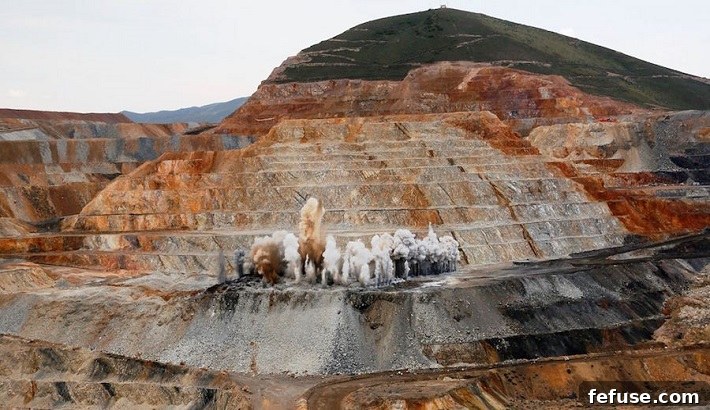
Newmont Mining Cuts 120 Jobs at Carlin, Nevada Amid Operational Revisions and Production Adjustments
Newmont Mining Corp, globally recognized as the world’s second-largest gold producer, has initiated a series of strategic adjustments at its extensive Carlin mining operation in Nevada. These changes, primarily driven by a revised outlook for one of its key mines and an unforeseen geological event at another, have unfortunately led to a reduction of 120 jobs within its workforce. This move underscores the dynamic and often challenging environment faced by major players in the precious metals sector, balancing operational efficiency with market demands and geological realities. The announcement, made public on a Thursday, confirmed a significant restructuring effort aimed at optimizing the long-term viability and profitability of one of Newmont’s most vital assets.
The Denver, Colorado-based mining giant formally communicated these workforce adjustments to its employees and union representatives on January 7. Following this initial notification, Newmont has been in the meticulous process of directly informing all affected individuals about their employment status. Omar Jabara, a spokesman for Newmont, confirmed these details, highlighting the company’s commitment to transparent communication during this period of transition. Such organizational changes are always challenging for both the company and its employees, reflecting difficult decisions made at the executive level to ensure the continued strength and sustainability of the business in a competitive global market.
Operational Revisions: Emigrant Mine and Gold Quarry Challenges
A primary catalyst for these job reductions and operational shifts stems from a critical reassessment of the Emigrant open-pit mine, a significant component of the Carlin complex. Newmont had previously disclosed in its third-quarter results announcement in October that it was taking a substantial write-down. This financial adjustment was a direct consequence of a fundamental change in the mine plan for Emigrant, which is projected to drastically shorten its operational lifespan. Originally, the Emigrant mine, which commenced operations in 2012, was anticipated to contribute to Newmont’s production portfolio for approximately 14 years. The decision to reduce this lifespan signifies a re-evaluation of its economic viability, influenced by factors that can range from declining ore grades to increasing extraction costs or fluctuations in the global gold price.
While specific details regarding the precise reasons for the Emigrant mine plan alteration were not immediately provided by Mr. Jabara, he acknowledged that such strategic shifts can be attributed to a confluence of economic and geological variables. These often include, but are not limited to, the prevailing market price of gold, which dictates revenue potential, and the intricate costs associated with processing the extracted ore. These costs can fluctuate significantly based on energy prices, labor, chemical reagents, and the complexity of the metallurgical processes required to recover gold. The inherent unpredictability of mineral deposits, coupled with volatile market conditions, frequently necessitates a dynamic approach to mine planning and operational execution in the highly capital-intensive mining industry.
Further complicating the operational landscape at Carlin was an incident at the Gold Quarry open-pit mine, another vital part of the sprawling Carlin operations. Parts of the Gold Quarry mine experienced a wall slide, a geological event that can pose significant safety risks and operational disruptions. Following this incident, operations in the affected sections of Gold Quarry were promptly suspended to facilitate extensive clean-up efforts and to ensure the safety of all personnel and equipment. Such slides are not uncommon in large-scale open-pit mining, often resulting from a combination of geological factors, ground water conditions, and the stresses inherent in deep excavation. The necessity of prioritizing safety and remedial work inevitably impacts production schedules and operational efficiency, contributing to the broader adjustments seen across the Carlin complex.
Impact on Production Guidance and Carlin’s Significance
These localized challenges and strategic adjustments at Carlin had a tangible ripple effect on Newmont’s overall production outlook. The company revised its total production guidance for its North American operations for the fiscal year 2018 downwards. A significant contributing factor to this revision was an observable 12-percent drop in gold production specifically at the Carlin complex during the quarter that concluded on September 30, compared to the same period in the previous year. This substantial decline underscores the profound impact that operational interruptions and revised mine plans at flagship assets like Carlin can have on a global producer’s overall output and financial projections. For a company of Newmont’s stature, maintaining consistent production levels is crucial for meeting market expectations and ensuring shareholder value.
The Carlin operation holds immense strategic importance for Newmont, serving as the largest of its four significant gold mining operations situated across the state of Nevada. This vast complex comprises no fewer than seven distinct mines, making it a cornerstone of Newmont’s global gold production portfolio. Nevada, often referred to as the “Silver State,” is also a prolific gold producer, consistently ranking among the top jurisdictions globally for gold output. Carlin’s sheer scale, its rich geological endowment, and its long history of production have cemented its status as a critical asset, not only for Newmont but also for the broader U.S. gold mining industry. Any significant operational changes or reductions in output from Carlin reverberate throughout the sector and hold economic implications for the region.
The Broader Context of Nevada’s Gold Mining Landscape
Nevada’s unique geological characteristics have made it an epicenter for gold mining for well over a century. The state is home to some of the world’s largest and most productive gold deposits, including the renowned Carlin Trend, which has yielded billions of dollars worth of gold. Companies like Newmont, Barrick Gold, and others have established deep roots in the region, contributing significantly to the state’s economy through direct employment, taxes, and indirect economic activities. Newmont itself is a major employer in Nevada, with approximately 5,000 individuals, including both direct employees and contractors, working across its various operations. These jobs are often high-paying and provide critical support to numerous rural communities across the state.
However, even in resource-rich regions like Nevada, the gold mining industry operates within a complex web of economic, environmental, and logistical challenges. Fluctuating commodity prices, increasing regulatory burdens, the escalating costs of exploration and extraction, and the need for continuous technological innovation all contribute to a demanding operational environment. Decisions like reducing a mine’s lifespan or suspending operations due to geological instability are not taken lightly; they represent careful calculations based on long-term economic viability and risk assessment. The industry is continuously evolving, requiring companies to be agile and adaptive to maintain profitability and ensure responsible resource stewardship.
Economic Implications and Market Reaction
The write-down announced in October, stemming from the revised mine plan for Emigrant, will undoubtedly impact Newmont’s financial statements. A write-down is an accounting adjustment that reduces the book value of an asset, reflecting a decrease in its expected future profitability or useful life. While it doesn’t represent an immediate cash outflow, it can affect earnings and shareholder equity, signaling a re-evaluation of the asset’s intrinsic worth. Investors often scrutinize such announcements for insights into a company’s operational health and future earnings potential. Managing investor expectations and providing clear communication around these financial adjustments is a key aspect of corporate governance for publicly traded companies.
Despite the news of job cuts and operational challenges, Newmont shares demonstrated a degree of resilience on the New York Stock Exchange. The company’s stock closed up 1.3 percent at $34.82, outperforming the broader market, which saw the Dow Jones Industrial Average gain a more modest 0.5 percent. This positive market reaction might seem counterintuitive at first glance. However, it could be interpreted in several ways by savvy investors. Firstly, the market might view these decisive actions – including job cuts and mine plan adjustments – as necessary steps taken by management to ensure long-term cost efficiency and profitability. Investors often reward companies that demonstrate proactive management in addressing operational inefficiencies, even if it involves difficult decisions. Secondly, the news might have already been partially priced into the stock, or the broader market sentiment towards gold producers might have been positive on that particular day, overriding specific company news. This market performance suggests a nuanced understanding by investors of the long-term strategic moves Newmont is making.
Future Outlook for Newmont’s Carlin Operations
Looking ahead, Newmont’s spokesman, Omar Jabara, provided a degree of reassurance by stating that the company does not anticipate any further layoffs at the Carlin operation beyond the previously announced 120 positions. This suggests that the current restructuring efforts are comprehensive enough to address the identified operational adjustments and that the company is aiming for stability in its workforce moving forward. While difficult, these types of strategic workforce realignments are sometimes necessary to streamline operations, reduce overheads, and ensure that resources are optimally allocated to the most productive and economically viable areas of the mining complex.
Carlin remains an indispensable part of Newmont’s global strategy. The company will likely focus on maximizing value from its remaining operational areas within the complex, implementing advanced technologies to improve efficiency, and continuing its rigorous exploration programs to replenish reserves. The gold mining industry is characterized by continuous investment in both capital and human resources to maintain production levels and discover new deposits. Newmont’s ability to navigate these challenges at Carlin, while maintaining its position as a leading global gold producer, will be a testament to its operational expertise and strategic foresight in a demanding and ever-evolving market environment.
Conclusion
The recent announcement of 120 job cuts and significant operational adjustments at Newmont Mining Corp’s Carlin complex in Nevada highlights the persistent challenges faced by the global gold mining industry. From adapting to geological realities like wall slides at Gold Quarry to making difficult economic decisions regarding the lifespan of mines like Emigrant, Newmont is actively navigating a complex operational landscape. These strategic revisions, while impacting the workforce and 2018 production guidance, are ultimately geared towards ensuring the long-term sustainability and profitability of one of the world’s most prominent gold producers. The market’s relatively positive reaction to Newmont’s stock suggests an acknowledgment of these proactive measures, indicating investor confidence in the company’s ability to adapt and maintain its leadership position in the precious metals sector. Newmont’s ongoing commitment to its Nevada operations, despite these adjustments, underscores the enduring importance of regions like Carlin to the global supply of gold.
NewsSource: mining.com