
India Gold & Jewellery Summit: Charting a Course for a Modern and Transparent Gold Market
The 2nd India Gold & Jewellery Summit recently concluded, marking a pivotal moment for stakeholders aiming to drive significant transformation within the nation’s illustrious gold and jewellery sector. The closing day of this impactful summit, a comprehensive two-day event, meticulously delved into an array of strategic tools and innovative mechanisms essential for fostering change. Discussions, while spanning diverse critical themes such as the imperative of skill development, the intricacies of taxation and enforcement, and the burgeoning concept of bullion banking, consistently gravitated towards two central pillars: the indispensable role of government policy and the proactive contributions expected from the industry itself in navigating these spheres.
A clear consensus emerged throughout the summit, echoing a widely held and increasingly vocal sentiment among the jeweller community: the future growth trajectory of India’s gold industry hinges on a dual strategy. This involves robust modernization, primarily driven by technological upgrades, coupled with an unwavering commitment to transparency, achieved through diligent compliance and self-regulation. These two principles are poised to serve as the fundamental fulcrum, propelling the sector towards unprecedented levels of efficiency, trust, and global competitiveness. The strategic dialogues undertaken at the summit aim to lay a concrete foundation for India’s gold market to not only thrive domestically but also to achieve a dominant position on the international stage.
NITI Aayog’s Vision: Transforming India’s Gold Market
The second day of the Summit commenced with an incisive and highly anticipated presentation by Mr. Yaduvendra Mathur, Additional Secretary, NITI Aayog. His address provided crucial context to the organization’s recently published, influential report titled ‘Transforming India’s Gold Market.’ Mr. Mathur elucidated the report’s foundational role in shaping the government’s overarching gold policy, underscoring its comprehensive approach. He highlighted that the report was meticulously formulated after extensive engagement with a broad spectrum of industry stakeholders, ensuring a holistic perspective. A key aspect of its methodology involved acknowledging the dual nature of gold in India – serving both as a cherished investment instrument for households and as a vital raw commodity for jewellers and manufacturers. This nuanced understanding informed the entirety of its suggestions, aiming for policies that balance economic stability with industrial growth.
Furthermore, Mr. Mathur emphasized the industry’s significant positive contributions to India’s foreign trade balance and its substantial role in employment generation, factors that were meticulously considered in the report’s recommendations. He passionately encouraged all attendees to download and thoroughly peruse the report, stressing the importance of understanding its 84 distinct recommendations. He reiterated that the report’s core objective was to harmonize two critical national goals: on one hand, to significantly enhance exports and create more employment opportunities within the sector, and on the other, to safeguard national economic interests, particularly with regard to addressing the Current Account Deficit (CAD) exacerbated by gold imports. He clarified that the NITI Aayog report functions as a strategic guide for policy formulation, rather than a definitive policy document in itself. Drawing parallels with earlier perspectives and plans developed by NITI Aayog and its predecessor, the Planning Commission, for other vital sectors, Mr. Mathur stated that the ultimate decision regarding the timeframe and specific steps for implementing these recommendations rests with the government, allowing for adaptive and responsive policy execution. This forward-looking document is designed to be a living framework, guiding the evolution of India’s gold policy for years to come.
Complementing this foresight, officials from the National Council of Applied Economic Research (NCAER) presented on their forthcoming Cluster Mapping study of the gem and jewellery industry. Dr. Poonam Munjal, Senior Fellow at NCAER, on behalf of her organization, meticulously outlined the diverse data sources that had been instrumental in sketching the initial contours of this pivotal study. She also detailed the guiding perspectives that would underpin the actual fieldwork, which was anticipated to commence in the immediate future. This study promises to offer invaluable insights into the geographical distribution, operational dynamics, and developmental needs of jewellery manufacturing clusters across India, thereby informing targeted interventions and policy support aimed at boosting efficiency and innovation at the grassroots level.
Empowering the Workforce: Employment Generation & Skill Development in the Gold Industry
A subsequent and highly engaging session featured a distinguished panel of experts who convened to discuss ‘Employment Generation & Skill Development in Gold Industry.’ The panel comprised prominent figures: Mr. Gaurav Kapoor from the National Skill Development Council (NSDC), Mr. Sanjay Kothari, Chairman of the Gem & Jewellery Skill Council of India (GJSCI), Mr. Rajiv Chawla, Chairman of the Integrated Association of Micro, Small & Medium Enterprises of India (IA MSME), Mr. Nitin Khandelwal, Chairman of the All India Gem and Jewellery Domestic Council (GJC), Mr. Prakash Pincha, Member of the Jewellery Panel Committee (JPC) within the Gem & Jewellery Export Promotion Council (GJEPC), and Mr. Ankur Goyal, President Works, MMTC-PAMP. This diverse group highlighted the multi-faceted approach required to nurture and expand the talent pool within the sector, recognizing skilled labor as the backbone of the industry.
Both Mr. Kapoor and Mr. Chawla delivered comprehensive presentations, shedding light on the vital work being undertaken by their respective organizations, particularly the programs directly relevant to the gold jewellery industry. Mr. Kapoor underscored the profound impact of the NSDC’s Recognition of Prior Learning (RPL) programs. These initiatives are designed to formally certify the skills of experienced artisans who have honed their craft through on-the-job training, often spanning generations without formal documentation. He proudly shared findings from a recent study revealing the tangible improvements in the lives of certified artisans: a remarkable 47% reported receiving better wages, and an even greater 63% expressed a heightened sense of recognition and validation for their skills as a direct result of obtaining formal certification. This demonstrates the critical role of formal recognition in elevating the status and economic well-being of traditional artisans, fostering pride and professional growth.
Concurrently, Mr. Chawla brought to the forefront the array of incentive schemes and crucial assistance available to Micro, Small & Medium Enterprises (MSMEs) operating within the jewellery sector. These support mechanisms are pivotal for facilitating essential technological upgrades, enabling participation in prestigious national and international exhibitions, and bolstering various promotional activities crucial for market expansion. He strongly urged jewellers across India to draw inspiration from the exemplary success story of Mars Jewels. This pioneering SME, with invaluable assistance from the IA MSME platform, successfully established India’s very first ZED (Zero Effect, Zero Defect) jewellery manufacturing unit. This achievement not only sets a benchmark for quality and efficiency in production but also showcases the transformative potential of strategic support for MSMEs in adopting best practices and achieving global standards.
The panel discussion culminated in a broad consensus regarding the urgent need to significantly upgrade the skills and enhance the livelihoods of India’s traditional artisans, often affectionately referred to as ‘karigars.’ The overarching sentiment was clear: creating conditions for their prosperity is not merely a social obligation but an economic imperative if India is to solidify its position as a global leader in the jewellery industry. Mr. Kothari articulated that the immediate priority must be the development of contemporary courses designed to equip artisans with cutting-edge skills, aligning their expertise with modern market demands and design sensibilities. Echoing this sentiment, Mr. Khandelwal stressed the profound importance of caring for these skilled karigars, emphasizing that such an investment would directly translate into meeting the escalating demand from discerning global consumers for high-quality, authentic Indian jewellery products, thereby enhancing India’s brand value.
GST, Taxation, and Enforcement: Paving the Way for Gold as a Transparent Asset Class
The subsequent sessions and presentations shifted focus to the critical area of ‘GST, Taxation and Enforcement – Making Gold a Transparent Asset Class.’ This segment was crucial for addressing long-standing issues of transparency and accountability within the gold market, aiming to integrate gold more seamlessly into the formal economy and enhance its credibility as a legitimate financial asset. The discussions highlighted the government’s unwavering commitment to streamlining regulatory processes while ensuring robust compliance.
Distinguished government officials provided insights into the regulatory landscape. Mr. Rashmi Ranjan Das, Joint Secretary, Tax Research Unit (TRU), Ministry of Finance (MOF), Mr. O.P. Dadich, Additional Director General, Directorate of Revenue Intelligence (DRI), and Mr. B.N. Sharma of the National Anti-Profiteering Authority each elucidated the vital roles played by their respective departments. Their discussions highlighted the rigorous enforcement and meticulous monitoring of financial and other transactions, crucial for ensuring stringent compliance with tax laws, including the Goods and Services Tax (GST), and other related legislations such as the Prevention of Money Laundering Act (PMLA). These measures are fundamental to curbing illicit activities, fostering a more legitimate and accountable market environment for gold, and building greater trust among consumers and investors.
Following these informative presentations, a robust panel discussion further explored the complexities of gold taxation and transparency. The panel featured Mr. Pankaj Singh from the DRI, Mr. Niranjan from the GST department, Mr. Bhargava Vaidya, an esteemed consultant, Mr. Surendra Mehta, National Secretary of the Indian Bullion and Jewellers Association (IBJA), Mr. Pranay Narvekar, CEO of MyKYC Bank, Mr. Bhavin Mehta of DeeCee Associates, and Mr. Nishant Shah of Economic Laws Practice (ELP). This diverse group of experts engaged in a comprehensive dialogue covering a vast spectrum of issues, from policy interpretation to practical implementation challenges.
Key topics included the various concerns voiced by jewellers regarding the practical implementation and nuances of GST, particularly its impact on their business operations and pricing structures. A spirited debate also centered on the fundamental question of whether the jewellery industry should be categorized primarily as a ‘luxury industry’ or an essential part of cultural heritage and investment, a classification that significantly impacts taxation policies and public perception. The discussion also underscored the critical need for Standard Operating Procedures (SOPs) to standardize processes across the industry, which would not only aid in more effective regulation but also be crucial if gold jewellery is to be successfully developed and recognized as a formal, transparent asset class. Furthermore, panellists addressed the significant burden of additional paperwork and compliance requirements, particularly their disproportionate impact on small and medium-sized companies, advocating for streamlined processes to support broader industry participation without compromising regulatory oversight.
Bullion Banking: Leveraging India’s Wealth in Gold
The final crucial panel discussion of the summit focused on ‘Bullion Banking, A Tool to Leverage India’s Wealth in Gold.’ This session explored innovative financial mechanisms to unlock the vast potential of India’s substantial gold holdings, estimated to be one of the largest private hoards globally. Moderated by Mr. Rajesh Khosla of MMTC-PAMP, the panel brought together an eminent group of financial experts and industry leaders: Mr. Jeremy East, former Global Head of Precious Metals at Standard Chartered Bank; Mr. Manish Gavaskar, VP, Bullion Sales at RBL Bank; Mr. Mayank Khemka, MD of Khemka Group; Mr. Nirakar Chand, DIL; Mr. Shailesh Sangani, Convener, National Exhibitions, GJEPC; Mr. Arjun Raychaudhuri, MD & CEO of MMTC-PAMP; and Mr. Sudeesh Nambiath, Head of the India Gold Policy Center at IIMA. Their collective expertise provided a multi-dimensional perspective on this transformative concept, aiming to integrate gold into the formal financial system.
The panellists delved into an extensive discussion concerning the myriad pros and cons associated with the ambitious introduction of metal accounts into India’s conventional banking system. This initiative is currently being meticulously developed by a dedicated group of stakeholders within the industry, working on a comprehensive blueprint designed to ensure its seamless integration and operational efficiency. The conversation thoroughly explored several critical areas essential for the successful implementation of bullion banking. This included establishing universal standards for purity and quality to ensure market confidence, ensuring the development of robust infrastructure for the secure storage, efficient delivery, and seamless trading of physical gold. Furthermore, the panel examined the potential growth and implications of a gold leasing market, and the profound impact these reforms could have on facilitating trade, optimizing purchases, and streamlining the delivery of metal to overseas partners. The consensus highlighted bullion banking’s potential to integrate India’s vast private gold reserves into the formal financial system, making it a more productive asset, reducing reliance on imports, and ultimately strengthening the national economy by unlocking latent wealth.
A Concluding Chaupal: Direct Engagement with Industry Associations
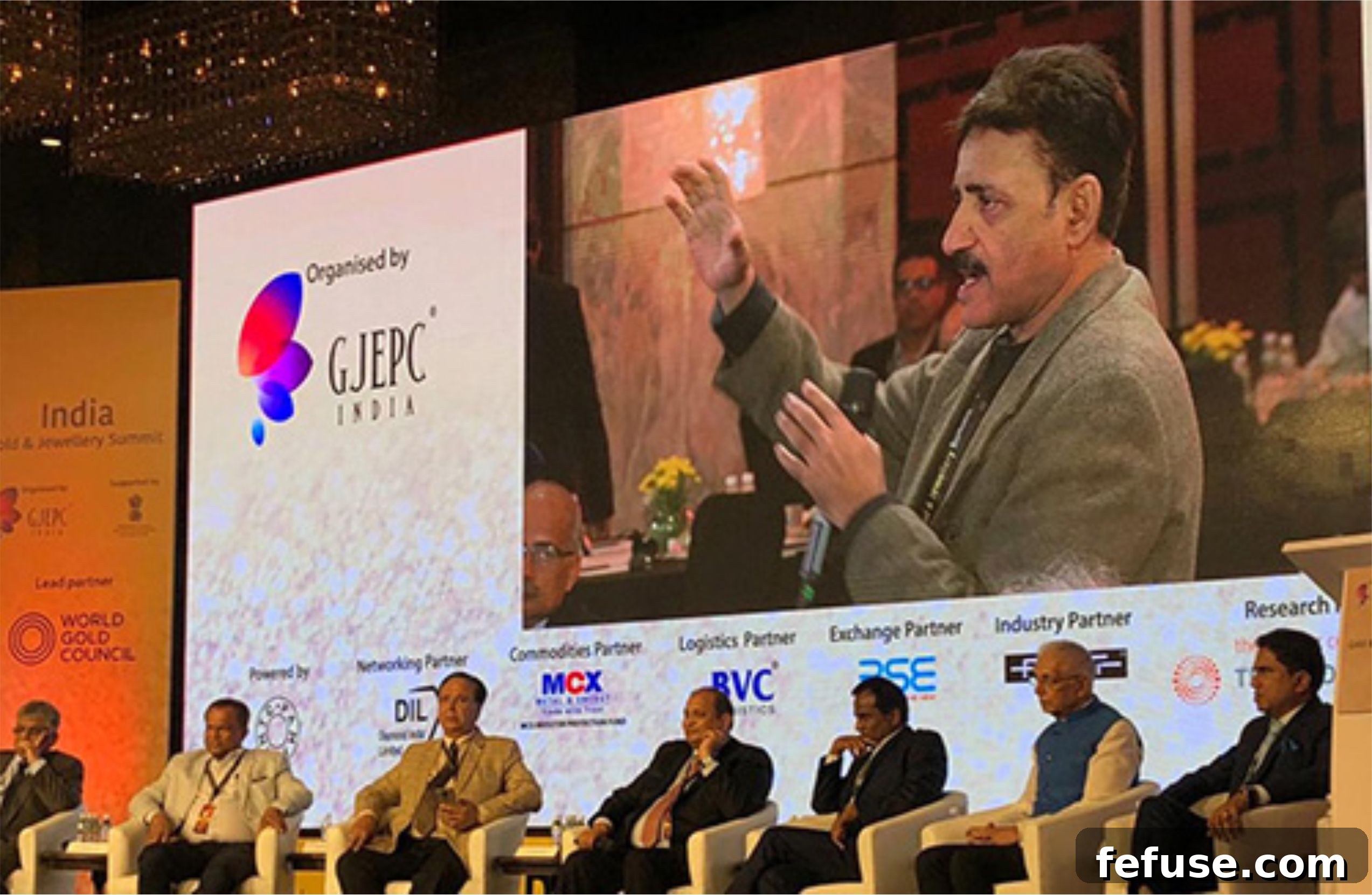
The Summit drew to a close with a highly interactive and significant concluding session, aptly termed ‘Chaupal,’ or Open House. This unique forum provided an invaluable opportunity for direct engagement between the leadership of the Gem & Jewellery Export Promotion Council (GJEPC) and a broad representation of the industry. GJEPC Chairman Mr. Pramod Agrawal, alongside other distinguished members of the Gold and Silver Jewellery Panel Committees and several Regional Chairmen of GJEPC, actively interacted with representatives from over 30 diverse trade associations. These associations hailed from various parts of the country, having converged at the Summit to contribute to the national discourse on the industry’s future and voice their ground-level perspectives.
During this dynamic Open House, the GJEPC leadership candidly responded to a multitude of questions, thoughtfully considered various suggestions, and deliberated on numerous proposals put forth by the association representatives. Where feasible and necessary, immediate action plans were formulated on the spot, demonstrating a proactive commitment to addressing grassroots concerns and fostering collaborative problem-solving. This Chaupal session underscored the Summit’s dedication to inclusive decision-making, ensuring that the voices and needs of jewellers from across India were heard and integrated into the broader vision for the industry’s future. It cemented the collaborative spirit required to implement the transformative changes discussed throughout the two-day event, laying a solid foundation for a more vibrant, transparent, and globally competitive Indian gold and jewellery sector. The direct interaction proved instrumental in bridging the gap between policy formulation at the national level and the practical realities faced by businesses on the ground, setting a clear path for future progress.
Pic caption: GJEPC Committee Members Address Open House at the conclusion of the India Gold & Jewellery Summit
News Source: gjepc.org