
In an increasingly complex and evolving global market, clarity and unwavering consumer confidence are paramount. Recognizing this critical need, the National Association of Jewellers (NAJ), in a monumental collaborative effort with eight of the diamond industry’s most influential organizations, has introduced a groundbreaking Diamond Terminology Guideline. This initiative brings together the expertise and collective wisdom of the Antwerp World Diamond Centre (AWDC), CIBJO (The World Jewellery Confederation), the Diamond Producers Association (DPA), the Gem & Jewellery Export Promotion Council (GJEPC), the Israel Diamond Institute (IDI), the International Diamond Manufacturers Association (IDMA), the World Diamond Council (WDC), and the World Federation of Diamond Bourses (WFDB). Together, these powerhouses have forged a unified framework designed to encourage the full, fair, and unequivocally effective use of precise and accessible definitions for diamonds, synthetic diamonds, and their imitations across all sector bodies, organizations, and traders worldwide.
This comprehensive ‘Diamond Terminology Guideline’ is not merely a suggestion; it serves as an indispensable reference document for every facet of the diamond and jewellery trade. Its primary purpose is to provide an unambiguous lexicon that ensures consistency and accuracy when referring to both natural diamonds and synthetic diamonds. In an era where technological advancements continue to blur lines, a common language is essential to uphold the integrity of the industry and protect consumers from potential misinformation. The proliferation of various diamond types and simulants necessitates a clear, standardized approach to nomenclature, ensuring that every stakeholder, from the seasoned dealer to the first-time buyer, understands exactly what is being bought, sold, or discussed. This clarity is the bedrock of ethical commerce and sustained market trust.
The strength and credibility of this guideline are firmly rooted in two internationally recognized and highly respected standards: the ISO 18323 Standard, officially titled “Jewellery – Consumer confidence in the diamond industry,” and the venerable CIBJO Diamond Blue Book. By aligning with these authoritative benchmarks, the guideline offers a robust, globally accepted framework that transcends regional variations and ensures a universally understood approach to diamond classification and disclosure. The ISO 18323 standard, for instance, is specifically designed to foster consumer trust by setting clear requirements for the description of diamonds, treated diamonds, and synthetic diamonds. It meticulously defines terms and mandates disclosure to ensure that consumers receive accurate and unambiguous information at the point of sale, thereby protecting them from deceptive practices and fostering informed decision-making. Similarly, the CIBJO Diamond Blue Book has long been considered the definitive guide for nomenclature, classification, and disclosure practices within the gem and jewellery industry. Its meticulously crafted rules and definitions have served as the benchmark for responsible trading for decades, making it an ideal foundational text for this new, consolidated guideline. The synergistic combination of these two standards creates a powerful, globally relevant foundation for the new terminology guideline, offering unparalleled authority and widespread applicability.
Let’s delve deeper into the core components of the ‘Diamond Terminology Guideline’ as released by these prominent industry groups, meticulously examining the definitions and recommended usage that will shape the future of diamond trading and communication, promoting transparency and fostering unwavering consumer confidence:
DEFINITIONS: Laying the Foundation for Clarity in the Diamond World
Understanding the fundamental differences between various stone types is the cornerstone of transparent communication. The guideline meticulously outlines these distinctions to prevent any potential ambiguity and ensure a shared understanding across the industry:
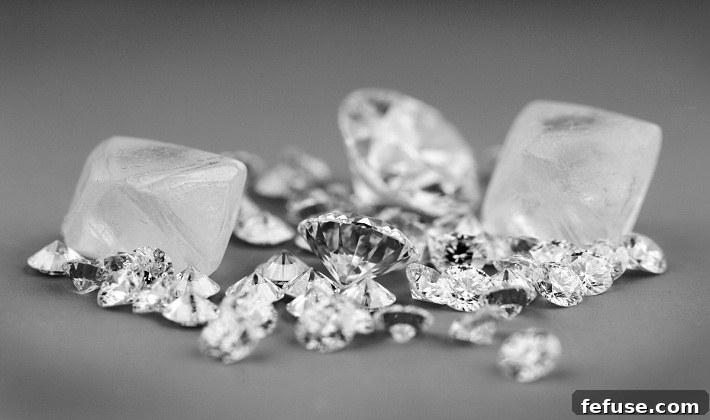
A **diamond** is inherently and exclusively a mineral created by nature. It is formed deep within the Earth’s mantle under immense pressure and temperature over billions of years, making each natural diamond a geological marvel and a unique testament to nature’s power. These precious stones possess unparalleled hardness, brilliance, and fire, characteristics that have captivated humanity for millennia. When the term “diamond” is used without any qualifier, it always, by definition, signifies a **natural diamond**. This precise distinction reserves the singular, unqualified term for stones of natural origin, emphasizing their unique geological heritage, finite supply, and inherent rarity. This designation respects the centuries-old understanding of what a diamond truly is.
A **synthetic diamond** is an artificial product. While it possesses essentially the same chemical composition, crystal structure, physical properties, and optical properties as a natural diamond, its critical distinguishing factor is its origin. Synthetic diamonds are manufactured in controlled laboratory environments using advanced technological processes such as High-Pressure/High-Temperature (HPHT) or Chemical Vapor Deposition (CVD). These methods meticulously replicate the extreme conditions under which natural diamonds form, resulting in materials that are physically and chemically identical to natural diamonds, yet are distinctly human-made. The emphasis here is on transparency regarding their laboratory genesis, ensuring consumers understand they are purchasing a product of human ingenuity rather than natural geological processes. While offering an alternative, their man-made nature demands clear disclosure to maintain market integrity.
An **imitation diamond**, also frequently referred to as a **diamond simulant**, is an artificial product specifically designed to mimic the aesthetic appearance of diamonds. Crucially, these simulants do not share the chemical composition, physical properties, or crystalline structure of either natural or synthetic diamonds. Examples include popular alternatives like cubic zirconia (CZ) and moissanite. While they may visually resemble diamonds to varying degrees, their inherent characteristics, durability, and value propositions are entirely different. This category ensures that products that merely look like diamonds, but are not carbon-based minerals with diamond properties, are clearly distinguished. This prevents confusion between true diamonds (natural or synthetic) and other materials that simply emulate their sparkle and form.
A **gemstone** is defined as a mineral of natural origin that is valued and utilized in jewellery for a combination of its inherent beauty, its rarity, and its intrinsic value. This broad category includes not only natural diamonds but also other precious and semi-precious stones such as rubies, sapphires, emeralds, amethysts, and many more. The definition highlights the natural geological provenance and the aesthetic and economic desirability that makes these minerals suitable for adornment and investment. Gemstones, by their very nature, are gifts from the Earth, each with its own unique story and appeal, distinct from man-made creations.
TERMINOLOGY: Navigating the Language of Disclosure for Transparency
The guideline provides prescriptive rules for terminology, particularly concerning synthetic diamonds, to eliminate confusion and foster honest representation, thereby building consumer trust:
When referring to **synthetic diamonds**, absolute clarity is paramount. The guideline strictly mandates the use of specific, authorized qualifiers to ensure consumers are fully informed about the product’s origin. One of the following terms must be used: **“synthetic”**, **“laboratory-grown”**, or **“laboratory-created”**. These terms are chosen for their unambiguous nature, clearly indicating the human-made origin of the stone without diminishing its intrinsic qualities or beauty. They directly communicate the method of creation, allowing for transparent differentiation in the marketplace.
- It is imperative to **avoid the use of abbreviations** such as “lab-grown” and “lab-created.” While these shortened forms are commonly used in informal discourse, they can lack the professional formality and full clarity required for official documentation, marketing, and sales. Such abbreviations, though seemingly harmless, might inadvertently obscure the full disclosure and diminish the weight of the “laboratory-grown” or “laboratory-created” message, potentially leading to misinterpretation or an underestimation of the disclosure’s significance by consumers. Full terms ensure complete comprehension.
- Furthermore, the guideline explicitly prohibits the use of terms like **“cultured diamonds”** and **“cultivated diamonds.”** The rationale behind this prohibition is clear and critical: the terms “cultured” and “cultivated” are traditionally and exclusively associated with organic or biogenic products, such as cultured pearls or cultivated plants. Applying these terms to inorganic materials like diamonds (even synthetic ones) is fundamentally misleading and creates an inaccurate perception of their production method, falsely implying a biological process rather than a technological one.
- Similarly, terms that imply natural origin are strictly forbidden for synthetic diamonds. **Do not use the following terms: “real,” “genuine,” “precious,” “authentic,” and “natural.”** These descriptors are reserved exclusively for natural minerals and gemstones. Their use in reference to synthetic diamonds would be highly deceptive, blurring the critical distinction between a product of geological formation and one of technological synthesis. Maintaining this linguistic separation is vital for consumer trust and the long-term health of both the natural and synthetic diamond markets, ensuring each category maintains its unique identity and value proposition.
RECOMMENDATION: Upholding the Integrity and Identity of Natural Diamonds
The guideline also provides critical recommendations for the terminology surrounding natural diamonds, reinforcing their inherent status and ensuring their distinct identity is preserved:
By definition, a **diamond** is natural. This fundamental principle underpins the entire guideline, acknowledging the historical and geological reality of what a diamond represents. Therefore, when referring to a natural diamond, the simplest and most accurate approach is to use the word **“diamond” without any additional qualifier.** This acknowledges the primacy of natural diamonds within the industry’s lexicon and consumer understanding. However, if there is a specific need to differentiate natural diamonds from synthetic diamonds in a given context – for example, in comparative marketing materials, detailed product descriptions, or situations where clarity is paramount due to the presence of both types – then the term **“natural diamonds”** should be employed. This serves as the term of equivalent meaning to “diamond” in situations where explicit distinction from synthetic counterparts is required, ensuring absolute clarity for the consumer without creating unnecessary jargon.
A particular area of potential confusion arises with treated natural diamonds. These are natural diamonds that have undergone processes to enhance their appearance, such as improving clarity or altering color. The guideline advises against the use of the following confusing expressions: **“natural treated diamonds”** and **“treated natural diamonds.”** These phrases can be cumbersome and imply a distinction that is not necessarily helpful, potentially leading to misunderstandings about the stone’s origin or the nature of the treatment. Instead, the guideline recommends a straightforward and unambiguous approach: simply use **“treated diamonds.”** This concise terminology clearly communicates that the natural diamond has undergone enhancements, such as clarity treatments (e.g., laser drilling, fracture filling) or color treatments (e.g., HPHT annealing, irradiation), without unnecessary linguistic complexity. The full disclosure of any treatments remains absolutely essential, typically provided through detailed grading reports and point-of-sale information, but the general term used should be simple, direct, and universally understood.
WHEN AND WHERE TO USE THE DIAMOND TERMINOLOGY GUIDELINE: A Universal Mandate for Transparency
The collective leadership of the National Association of Jewellers (NAJ), the Antwerp World Diamond Centre (AWDC), CIBJO, the Diamond Producers Association (DPA), the Gem & Jewellery Export Promotion Council (GJEPC), the Israel Diamond Institute (IDI), the International Diamond Manufacturers Association (IDMA), the World Diamond Council (WDC), and the World Federation of Diamond Bourses (WFDB) has issued a powerful and unequivocal recommendation: all traders, sector bodies, and other organizations involved in the diamond and jewellery supply chain are strongly urged to comply with this guideline. This mandate extends to every conceivable medium of communication and documentation, underscoring the universal applicability and importance of these rules.
Compliance is expected across **all documents, websites, and other means of communication** that serve to sell, buy, promote, or describe diamonds, synthetic diamonds, gemstones, gemological laboratory reports, diamond jewellery, and synthetic diamond jewellery. This includes, but is not limited to: product listings on e-commerce platforms, in-store signage, advertising campaigns, social media posts, press releases, educational materials, invoices, certificates of authenticity, grading reports from reputable gemological laboratories, and even verbal sales presentations. The intent is to establish a unified and transparent language that permeates every interaction within the industry, from the point of extraction or creation all the way to the final consumer. This comprehensive application ensures that consistency is maintained at every touchpoint, reinforcing credibility and fostering confidence.
The adoption of these guidelines is not merely about adherence to industry best practices; it is a proactive and essential step towards reinforcing ethical trading, fostering fair competition among various product categories, and, most importantly, enhancing and preserving consumer trust in a rapidly evolving market. By speaking a consistent and transparent language, the industry can confidently navigate the complexities of modern diamond commerce, ensuring that every purchase is made with full knowledge and confidence. This collective commitment to clear communication will safeguard the reputation of both natural and synthetic diamond products, providing a solid foundation for sustainable growth and enduring value for generations to come. It reaffirms the industry’s dedication to integrity, accountability, and the long-term well-being of all its stakeholders.