
Kiran Gems Retreats from Surat Diamond Bourse: A Critical Look at India’s Diamond Hub Dynamics
In a significant development that has sent ripples across the global diamond industry, Kiran Gems, a colossal privately-owned entity and the world’s largest rough diamond manufacturer, has initiated a swift return of its staff and operations from the newly inaugurated Surat Diamond Bourse (SDB) back to Mumbai’s venerable Bharat Diamond Bourse (BDB). This move, occurring merely months after SDB’s much-anticipated opening, underscores the complex challenges and established advantages within India’s dominant diamond trading landscape.
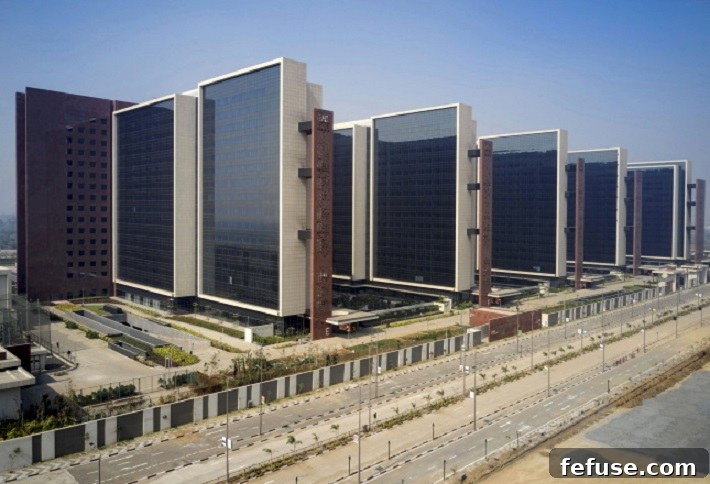
The relocation of a substantial portion of Kiran Gems’ workforce from Surat back to Mumbai represents a considerable blow to the Surat Diamond Bourse. Unveiled last November with much fanfare, the SDB, an imposing $388 million structure acclaimed as the world’s largest office building, was envisioned as a transformative force. Its primary goal was to consolidate India’s extensive diamond manufacturing and trading activities within a single, state-of-the-art hub in Surat, thereby challenging Mumbai’s long-standing supremacy. However, despite its grand scale and ambitious promises, SDB has struggled to attract major tenants, with Kiran Gems standing out as one of the few prominent names to initially commit. Their subsequent partial withdrawal raises pertinent questions about the viability and immediate future of this monumental project.
Kiran Gems: A Giant in the Global Diamond Supply Chain
To fully grasp the magnitude of this event, it is crucial to understand the stature of Kiran Gems. As a privately-owned enterprise, it commands an unparalleled position as the largest rough diamond manufacturer globally. Its operational footprint is immense, employing a staggering 48,000 diamond workers spread across eight modern factories, all strategically located in Surat, the undisputed heartland of diamond cutting and polishing. Annually, the company procures and processes over 5.7 million carats of rough diamonds, making it a critical player in the international diamond supply chain and a bellwether for the industry’s health and trends.
When Kiran Gems announced its decision to relocate its headquarters and approximately 1,200 employees to the Surat Diamond Bourse upon its opening, it was hailed as a powerful endorsement. This move was widely interpreted as a signal that SDB was indeed ready to fulfill its promise of becoming a comprehensive, integrated diamond trading and manufacturing ecosystem. The expectation was that other major players would soon follow suit, cementing Surat’s status as a formidable global diamond hub. However, the recent reversal of this decision, seeing many of these employees return to Mumbai, paints a different picture, suggesting that the initial transition was perhaps more challenging than anticipated.
The Economic Realities Behind the Return to Mumbai
While Kiran Gems has confirmed the movement of operations back to Mumbai, they have refrained from disclosing specific details. Nevertheless, insights from industry sources shed light on the core issues. An anonymous source within SDB, speaking to The Blunt Times, revealed a stark economic disparity: Kiran Gems was “barely making Rs. 20 for every Rs. 100 they earned in Mumbai.” This drastic drop in profitability, representing an 80% decline in earnings, is a powerful indicator of the operational inefficiencies or cost disadvantages encountered within the new Surat facility. Such a significant financial impact would inevitably necessitate a strategic re-evaluation, particularly for a company of Kiran Gems’ scale, where even minor percentage shifts can translate into millions in revenue or loss.
The reported profitability issues are likely multifaceted. Mumbai’s Bharat Diamond Bourse benefits from a deeply entrenched and mature ecosystem that has evolved over decades. This includes readily available access to specialized financial services, international connectivity, well-established logistics networks, ancillary support industries, and a robust talent pool experienced in high-level diamond trading. The SDB, despite its impressive infrastructure, is still in its nascent stages of developing such a comprehensive and seamless support system. Businesses relocating to a new hub often face initial hurdles related to establishing new supply chains, adapting to new logistical arrangements, and integrating with a less developed network of service providers. For a company like Kiran Gems, whose operations are intricately linked to global markets and require constant, efficient coordination, any disruption in this ecosystem can have severe financial consequences.
SDB’s Vision vs. Market Reality: Challenges of Establishing a New Hub
The vision behind the Surat Diamond Bourse was compelling: to create an integrated diamond city, bringing traders, manufacturers, and exporters under one roof, thereby streamlining operations and reducing logistical overheads, especially given Surat’s existing role as a manufacturing powerhouse. It aimed to reduce the need for rough diamonds to travel between Surat for cutting and polishing and then Mumbai for trading, finance, and export. However, the path to transforming a manufacturing center into a comprehensive trading hub is fraught with challenges.
One of the primary difficulties for SDB lies in attracting a critical mass of tenants beyond just manufacturing. Trading activities demand a sophisticated environment that includes not just office space but also access to international buyers, robust banking facilities specializing in diamond finance, customs clearances, secure vaulting, and a vibrant community of brokers, valuers, and insurers. Mumbai’s BDB has these elements in abundance, having cultivated them over decades. The SDB faces a “chicken and egg” dilemma: tenants are hesitant to move without a fully developed ecosystem, but the ecosystem cannot fully develop without a significant influx of tenants. The absence of other major players following Kiran Gems’ lead further compounds this challenge, creating a perception of uncertainty rather than a thriving new market.
Moreover, the human element plays a significant role. High-level diamond traders and executives often have established lives and networks in Mumbai, a major metropolitan city offering diverse amenities, international schools, and a cosmopolitan lifestyle. Convincing these key personnel to relocate to a developing hub like Surat, even with its state-of-the-art facilities, can be difficult. Connectivity, both in terms of international travel and local infrastructure (e.g., adequate housing, transport for employees), also needs time to mature and meet the demands of a top-tier global business center.
The Enduring Appeal of Mumbai’s Bharat Diamond Bourse
The Bharat Diamond Bourse (BDB) in Mumbai has, for decades, served as the nerve center of India’s diamond trade. Its enduring appeal lies in its unparalleled ecosystem. The BDB boasts thousands of offices, robust security, advanced communication networks, and, crucially, proximity to major banks, financial institutions, and international cargo facilities. Its location within Mumbai, a global financial capital, provides access to a wide array of support services – from specialized legal and auditing firms to international shipping and logistics providers – all operating within an established framework of trust and efficiency.
The BDB’s long history has also fostered deep-rooted relationships and a sense of community among diamond traders. Business is often conducted on the basis of personal connections and long-standing trust, factors that are difficult to replicate in a new environment overnight. For companies like Kiran Gems, relying heavily on a seamless flow of transactions and information, the reliability and established network of BDB offer tangible advantages that translate directly into operational efficiency and, ultimately, profitability.
What Lies Ahead for India’s Diamond Hubs?
Despite the significant setback, it is understood that Kiran Gems will maintain some level of presence at the Surat Diamond Bourse. This could indicate a strategic decision to keep a foot in both camps, perhaps for manufacturing coordination or as a long-term investment in Surat’s potential. It might also reflect an understanding that Surat, as the manufacturing engine, remains indispensable to their operations, even if the trading arm finds more immediate success in Mumbai.
The future of India’s diamond industry is unlikely to be a zero-sum game between Surat and Mumbai. Instead, a nuanced specialization might emerge. Surat could solidify its position as the world’s premier diamond manufacturing and processing hub, benefiting from its massive workforce and advanced factories. Mumbai, on the other hand, could retain its status as the primary international trading, finance, and export gateway, leveraging its established infrastructure and global connectivity. The challenge for SDB will be to bridge this gap, perhaps by initially focusing on attracting businesses that directly benefit from proximity to manufacturing, while slowly building out its trading ecosystem over time.
The Indian diamond industry, renowned for its resilience and adaptability, will undoubtedly navigate these shifts. The SDB project, while facing initial hurdles, represents a significant investment in modernizing and consolidating the industry. Its long-term success will hinge on its ability to evolve, address the practical concerns of major tenants like Kiran Gems, and offer a truly compelling value proposition that rivals the established advantages of the Bharat Diamond Bourse. This episode serves as a powerful reminder that while grand infrastructure projects can lay the groundwork, it is the intricate network of operational efficiency, market dynamics, and human capital that ultimately dictates the success of a global trading hub.