
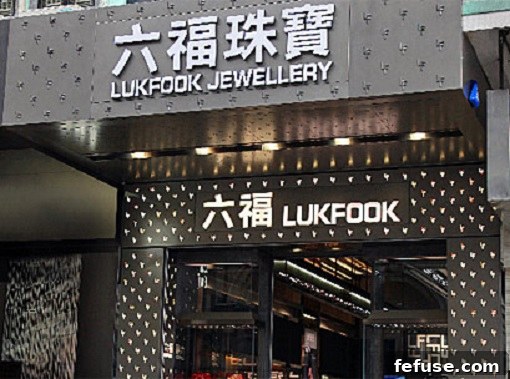
Luk Fook Holdings (International) Ltd, a prominent name in the global jewellery retail sector, is strategically repositioning its business to capitalize on the burgeoning prosperity of China’s middle-class consumers. The Hong Kong-headquartered retailer has announced ambitious expansion plans, targeting the opening of approximately 150 new shops across mainland China within the coming year. This aggressive strategy underscores the company’s unwavering confidence in the long-term potential of the Chinese market, despite recent global economic headwinds that have impacted its overall performance.
While the company reported an overall profit dip of 42 percent for the financial year ending March 31, 2020, its outlook for China remains remarkably optimistic. Luk Fook’s leadership believes that the anticipated substantial growth of the middle-class population in the mainland will serve as a powerful catalyst for future business expansion and profitability. In its latest earnings report, the company articulated its clear focus: “In view of the anticipated considerable growth of the middle-class population in the mainland, the group remains optimistic about the mid- to long-term business prospects, and will focus its expansion in the mainland market. The group looks forward to regaining business growth and bringing it to a new height in the near future.” This statement reflects a strategic pivot, prioritizing the vast domestic consumption power of China.
The challenging financial results from the past year were a direct consequence of a confluence of significant geopolitical and public health crises. Revenues during the year saw a notable decline of 29.2 percent, primarily attributed to the prolonged impact of the US-China trade war, which created an atmosphere of economic uncertainty and affected consumer confidence. Simultaneously, social unrest and incidents in Hong Kong severely disrupted local retail and tourism. Compounding these issues, the unprecedented global Covid-19 pandemic led to widespread lockdowns, travel restrictions, and a dramatic downturn in consumer spending, particularly in the luxury segment. Hong Kong and Macau, heavily reliant on tourist arrivals, suffered immensely from a substantial decline in visitors and a significant dwindling of local consumer sentiment. Furthermore, Luk Fook’s overseas shops also faced considerable operational and market challenges as global economies grappled with the pandemic’s fallout.
A detailed breakdown of the revenue performance illustrates the regional disparities in these impacts. According to Luk Fook’s financial disclosures, revenues generated from the Hong Kong, Macau, and overseas markets collectively experienced a sharp decrease of 36.4 percent. In mainland China, while also affected, the decline was comparatively narrower, sinking by 17.4 percent. This resilience in the mainland market highlights its foundational strength and the diverse nature of its consumer base. Notably, the e-commerce business within China emerged as a bright spot, demonstrating impressive growth with revenues increasing by 13.9 percent. This surge in online sales during a period of widespread physical store closures and reduced foot traffic underscored the growing importance of digital channels and the adaptability of Chinese consumers to online shopping.
The immediate aftermath of the pandemic’s peak presented further challenges, especially for regions heavily dependent on cross-border movement. With stringent border restrictions still firmly in place, same-store sales in Hong Kong and Macau recorded a staggering 80 percent drop from April to May 2020. This period represented the nadir for these key markets, reflecting the severe impact on inbound tourism and local consumer reluctance to spend on discretionary items. In stark contrast, same-store sales in mainland China registered a considerably narrower decline. This was largely due to the quicker containment of the virus in many parts of China and the subsequent phased reopening of businesses, allowing shops to resume operations and benefit from recovering domestic demand more rapidly than their counterparts in Hong Kong and Macau.
However, signs of recovery began to emerge as the year progressed. Beginning in June 2020, Luk Fook observed a gradual improvement in retail sentiment within Hong Kong and Macau. This nascent recovery indicated a slow return to normalcy, with local consumers venturing out more and some easing of restrictions. The decline in same-store sales in the first three weeks of June narrowed significantly to approximately 60 percent, a marked improvement from the preceding months. Concurrently, overall shops in mainland China continued to show consistent improvements, reinforcing the positive trajectory of the Chinese market. This period of stabilization and gradual recovery provided Luk Fook with valuable insights into market dynamics and reinforced its strategic focus on the mainland.
As part of its broader operational adjustments, the group revealed plans to optimize its store network in response to changing market conditions. In the coming year, Luk Fook intends to close five stores in Hong Kong. This move is likely a strategic decision to consolidate operations and enhance efficiency in a market that has faced prolonged challenges. Conversely, the company plans to open two new shops in Macau, signaling a cautious but continued investment in the gaming hub, perhaps anticipating a future rebound in tourism and high-end consumer spending once international travel restrictions ease. These targeted adjustments reflect a dynamic approach to managing its physical retail footprint across different geographical segments.
At the heart of Luk Fook’s forward-looking strategy lies a comprehensive three-year corporate plan, which explicitly outlines its continued commitment to business expansion in mainland China. A significant component of this plan for 2021 involves the strategic conversion of approximately 35 existing self-operated shops into licensed shops. This franchising model is a common and effective way for retailers to accelerate expansion, reduce direct operational costs, and leverage local entrepreneurial expertise, especially in diverse and geographically expansive markets like China. It allows for faster penetration into new regions while sharing the investment burden and operational responsibilities with local partners.
Elaborating on its ambitious mainland China expansion, the retailer specified its targets: “The target for net addition of Lukfook shops in China in the coming year will be not less than 150, mainly focused on opening licensed shops in fourth- and fifth-tier cities, while the target for net addition for new brands’ stores in the mainland is 50 shops.” This detailed target reveals a nuanced understanding of the Chinese market. The emphasis on fourth- and fifth-tier cities is particularly strategic. These rapidly developing urban centers are home to a burgeoning middle class with increasing disposable incomes and a growing appetite for luxury goods, yet they often have less saturated retail landscapes compared to first- and second-tier cities. By focusing on licensed shops, Luk Fook can penetrate these markets efficiently, adapting to local tastes and preferences while maintaining brand consistency. Additionally, the plan to add 50 new stores under its “new brands” initiative indicates a diversification strategy, possibly catering to different consumer segments or offering specialized product lines to broaden its market appeal.
As of March 31, 2020, Luk Fook boasted an extensive global network comprising 2,120 shops. This impressive footprint spans numerous key international markets, including Hong Kong, Macau, mainland China, Singapore, Malaysia, Cambodia, the Philippines, the United States, Canada, and Australia. This global presence provides Luk Fook with diverse revenue streams and brand recognition, positioning it as a truly international jewellery retailer. However, the recent strategic shift clearly indicates a re-prioritization, with mainland China identified as the primary engine for future growth and profitability, reflecting the evolving landscape of global luxury consumption and economic power.
Beyond physical store expansion, the group is also aggressively pursuing a strategy to strengthen its digital presence and e-commerce capabilities in China. A substantial 15 percent growth target has been set for e-commerce sales in 2021, underscoring the company’s commitment to harnessing the power of online retail. Luk Fook understands that the modern consumer, especially the younger demographic, is increasingly shopping online for jewellery. To cater to this evolving consumer behavior, Luk Fook announced it will focus on promoting affordable luxury jewellery products to young consumers. This segment is characterized by discerning buyers who seek quality and design but are also price-conscious. By offering well-designed, accessible luxury items through robust online platforms, Luk Fook aims to capture a significant share of this dynamic and rapidly expanding market, further solidifying its competitive edge in the vast and complex Chinese retail landscape.
Luk Fook Holdings is demonstrating remarkable adaptability and strategic foresight in navigating a challenging global economic environment. By boldly focusing on the immense potential of China’s middle class, optimizing its physical retail footprint, and aggressively expanding its digital reach with a focus on affordable luxury for younger demographics, the company is laying a solid foundation for sustainable growth. The emphasis on licensed shops in lower-tier cities and a targeted e-commerce strategy exemplifies a pragmatic and innovative approach to securing its position as a leading jewellery retailer in the Asia-Pacific region and beyond, striving to not only regain but elevate its business growth in the coming years.