
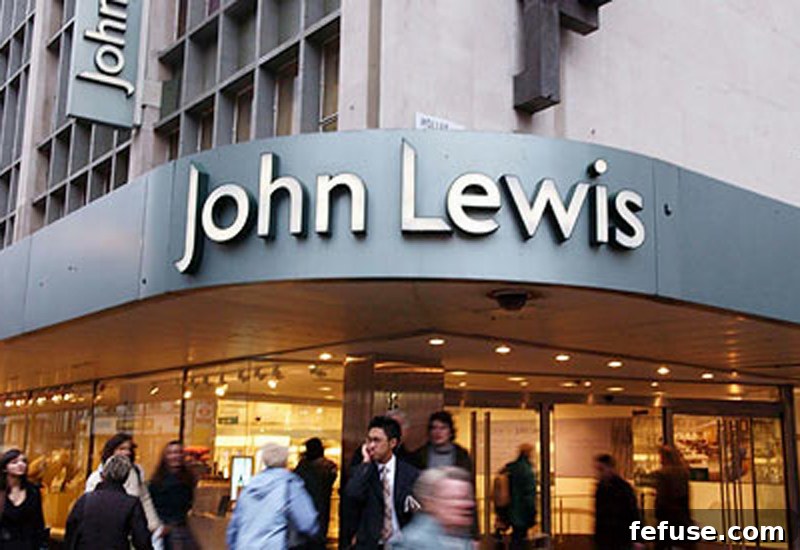
John Lewis Partnership Navigates Turbulent Waters: Over 50% Profit Drop in First Half of 2017
The John Lewis Partnership, a revered institution in the British retail landscape, has reported a sharp and significant downturn in its financial performance for the half-year ending 29 July 2017. These interim results reveal a more than 50% fall in profitability, shining a spotlight on the intensifying pressures faced by traditional retailers across the United Kingdom. This substantial profit reduction has spurred considerable discussion regarding the strategic adaptations necessary for the Partnership’s continued success and its implications for the wider retail sector.
Decoding the Numbers: A Steep Decline in Reported Profitability
At the heart of the Partnership’s announcement was a stark 53% decrease in pre-tax profit, which plummeted to just £26.6 million during the first six months of the year. This headline figure underscored a challenging period for the venerable retailer. However, a deeper analysis of the financial statement reveals a crucial distinction: a significant portion of this reported decline was attributed to exceptional, one-off costs. Specifically, £56.4 million was incurred for redundancy and broader restructuring efforts aimed at modernising and streamlining the business. When these strategic investment costs were excluded, the underlying pre-tax profit demonstrated a more modest, yet still concerning, almost 5% decrease, settling at £83 million.
This nuanced financial picture indicates that while the business was undergoing necessary transformation, operational profitability was simultaneously being squeezed. Rising costs across various facets of the business were eating into margins, even as the overall group sales managed a respectable increase of 2.3% over the period, reaching a robust £5.4 billion. The discrepancy between rising sales and falling profits highlights the intense cost pressures and competitive pricing environment prevalent in the UK retail market during this time. Understanding these figures is essential to grasp the dual challenge of navigating immediate market pressures while simultaneously investing for long-term resilience.
Divergent Performances: John Lewis Department Stores vs. Waitrose
Within the John Lewis Partnership, the financial performance of its two primary retail brands presented a contrasting picture. The John Lewis department stores, a beacon of quality and customer service, demonstrated remarkable resilience amidst the challenging conditions. This division saw its underlying profits increase by an encouraging 9.7%, reaching £39.7 million. This positive growth suggests that specific strategies within the department store segment, perhaps focusing on key product categories or an enhanced customer experience, were yielding favorable results and maintaining shopper loyalty.
In contrast, the premium supermarket chain, Waitrose, experienced a notable setback in its profitability. Despite contributing to the group’s overall sales increase, Waitrose’s profits fell by a significant 17.4%, settling at £101 million. This decline points to particular pressures within the highly competitive and price-sensitive grocery sector. In an environment marked by inflationary pressures and the continued rise of discount supermarkets, Waitrose likely faced difficulties in passing on increased supply chain costs to consumers without alienating its customer base, thus impacting its bottom line more severely than the department store operation.
The divergent fortunes of these two core businesses underscore the complex and varied challenges inherent in different retail segments, even under the same corporate umbrella. It highlights the need for tailored strategies to address the unique market dynamics, consumer behaviors, and competitive landscapes of each brand.
Chairman’s Perspective: Navigating a “Tough Market” and Margin Erosion
Sir Charlie Mayfield, then Chairman of the John Lewis Partnership, offered insightful commentary on the prevailing conditions, candidly acknowledging the difficulties. Speaking to the BBC, he stated, “Look, nobody should be surprised that this is a tough market for retailers. There’s any number of reasons for that.” This admission reflected a broader industry sentiment concerning the increasing complexity and severity of operating within the UK retail landscape.
Mayfield further elaborated on the core drivers behind the profit contraction, explaining, “The reason our profits are down is predominantly because of margin, and cost prices are rising. It’s a very competitive market, retail prices are not rising as fast.” This concise analysis pinpointed the fundamental squeeze on profitability: an inability to fully offset rising input costs with corresponding retail price increases. Factors such as the depreciation of the pound post-Brexit led to higher import costs for goods, directly impacting the Partnership’s cost base. Meanwhile, intense competition across both department store and grocery sectors constrained the company’s ability to raise prices without risking a loss of market share or customer trust.
Ultimately, the Partnership found itself grappling with a dual challenge: the necessity of absorbing substantial internal costs associated with its extensive business overhaul, coupled with an external environment characterized by weakened customer demand. The latter was primarily driven by the twin forces of inflationary pressures, which eroded household disposable income, and the persistent political uncertainty following the Brexit referendum, making consumers more cautious with their discretionary spending. These macro-economic headwind created a challenging operational backdrop for a business of the John Lewis Partnership’s scale and breadth.
Strategic Adaptation and Future-Proofing Initiatives
In a detailed statement, Sir Charlie Mayfield further elucidated the strategic context and ongoing initiatives within the Partnership. He reiterated the “solid performance in a difficult market” as evidenced by the 2.3% gross sales increase for both Waitrose and John Lewis. He also provided additional transparency on the financial results, noting that while Partnership profit before tax and exceptional items was down 4.6%, this figure was “flattered by property profits,” and after excluding these, the underlying decline was a more significant 17.2%. This detailed breakdown provided a clearer picture of the operational challenges.
A central theme of the chairman’s address was the profound impact of “inflationary pressures driven by exchange rates and political uncertainty,” factors that had been anticipated in earlier full-year statements. These pressures, he confirmed, had “dampened customer demand, especially in categories connected to the housing market,” which traditionally represents a significant revenue stream for department stores. Despite these broad economic headwinds, the Partnership celebrated “market share gains in Fashion,” a notable achievement that underscored effective category management and resonated with consumer trends.
Crucially, the company had made a deliberate strategic choice to “hold back on increasing prices across many areas.” While this decision aimed to protect customer loyalty and maintain competitive positioning, it inevitably contributed to the erosion of profit margins in the short term. Furthermore, the reported results were a direct reflection of an “acceleration of our strategy to ensure the Partnership’s success in the future.” This forward-looking agenda encompassed several key transformative initiatives:
- Waitrose Operational Evolution: Implementing significant changes in how Waitrose branches operate, including the creation of new flexible team structures with broader responsibilities. These changes were designed to enhance efficiency, adapt to evolving consumer shopping habits, and improve overall customer experience.
- John Lewis Business Adaptation: Initiating further modifications within the John Lewis department store business to better align it with future market demands, digital trends, and changing consumer expectations. This included optimizing store layouts, product assortments, and service offerings.
- Partnership-wide Functional Integration: Moving from a divisional to a unified Partnership-level function across critical areas such as Finance, Personnel, and IT. This consolidation aimed to foster greater synergy, eliminate redundancies, streamline processes, and ultimately drive cost efficiencies across the entire organization.
These ambitious, future-oriented efforts were directly responsible for the “exceptional costs of £56.4 million.” Sir Charlie Mayfield emphasized the careful and considered management of these strategic changes, particularly given the unique employee-ownership model of the Partnership. He affirmed, “Given the key role our Partners play, we are very focussed on managing the risk of these changes carefully,” highlighting the intrinsic value placed on its workforce amidst significant organizational transformation.
Encouraging Performance within John Lewis Department Stores
While the overall Partnership faced significant challenges, the performance of the John Lewis department stores segment offered several encouraging indicators of underlying strength and strategic effectiveness. The division reported gross sales of £2.07 billion, representing a 2.3% increase year-on-year. Furthermore, like-for-like sales, a crucial metric reflecting sales performance in existing stores, also registered a positive, albeit modest, increase of 0.1%, suggesting consistent performance rather than relying solely on new space.
Beyond the headline sales figures, John Lewis successfully expanded its market share and grew its customer base. This growth in reach and loyalty underscores the enduring appeal of the brand and the effectiveness of its customer-centric strategies, even in a fiercely competitive retail environment. The summer clearance period proved particularly robust, with sales surging by 4.5% compared to the previous year, driven by “a compelling customer offer” that resonated well with shoppers looking for value.
Within specific product categories, fashion sales stood out, climbing by an impressive 3.5%, with womenswear delivering particularly strong performances. This success in fashion, a highly trend-driven and competitive segment, highlights effective merchandising, product curation, and responsiveness to consumer tastes. Crucially, the digital aspect of the business continued its robust growth trajectory, with online sales accounting for a significant 37.3% of total merchandise sales, an increase from 34.5% in the prior year. This growing online penetration is vital for modern retailers and positions John Lewis strongly for the future of omnichannel shopping, blurring the lines between physical and digital retail experiences.
Outlook and Strategic Direction: Preparing for Future Headwinds and Opportunities
Looking ahead, the Partnership’s report indicated that sales growth had continued into the initial weeks of the second half of the year. This momentum provided a cautiously optimistic backdrop as the company prepared for the “all-important seasonal peak,” traditionally encompassing the Black Friday and Christmas trading periods. These crucial months typically account for a disproportionately large share of annual retail sales and profitability, making their successful navigation paramount for the Partnership’s full-year performance.
However, the management also issued a realistic and sober warning, anticipating that the “headwinds that have dampened consumer demand and put pressure on margins to continue into next year.” This forward-looking assessment suggests an acknowledgment that the underlying economic and competitive pressures, including Brexit uncertainty, inflationary trends, and a challenging consumer spending environment, were not merely transient but represented systemic shifts requiring sustained strategic effort and adaptation. The retail landscape was undergoing a fundamental transformation, and John Lewis Partnership was positioning itself for long-term viability rather than short-term gains.
Despite these anticipated challenges, Sir Charlie Mayfield concluded his statement with an emphatic declaration of confidence in the Partnership’s fundamental strategy: “We are confident that our relentless focus on the customer and differentiating our brand from our competitors will set us up for success in the second half, where the majority of our sales and profit are delivered.” This unwavering commitment to customer centricity, innovation, and the distinct value proposition of its brands remains the cornerstone of the John Lewis Partnership’s long-term resilience and competitive advantage in the ever-evolving UK retail landscape.
The Broader UK Retail Context: A Battle for Evolution and Survival
The financial results announced by the John Lewis Partnership in the first half of 2017 are not isolated incidents but rather a significant microcosm reflecting the wider, profound struggles gripping the UK retail sector during this period. Beyond the specific challenges unique to John Lewis and Waitrose, the industry as a whole was confronting a perfect storm of transformative forces. The relentless rise of e-commerce continued to fundamentally reshape consumer shopping habits, drawing a growing share of purchases away from traditional physical stores and intensifying price competition across the board.
Simultaneously, traditional brick-and-mortar retailers faced escalating operational overheads, including rising business rates, increasing wage costs, and other logistical expenses, which collectively exerted immense pressure on already thin profit margins. The overarching economic climate, heavily influenced by the aftermath of the Brexit vote and the subsequent weakening of the pound, led directly to increased import costs for a vast array of goods. This, combined with sluggish wage growth and persistent inflation, meant that consumers had less disposable income and consequently became more discerning and cautious with their purchases.
In this challenging environment, retailers like John Lewis, historically celebrated for their quality, service, and trusted brand, were compelled to navigate a delicate balance: upholding their premium appeal and distinct value proposition while simultaneously needing to offer competitive pricing in an increasingly cost-conscious market. The Partnership’s emphasis on “accelerating strategy” and incurring “restructuring costs” was not merely a choice but a proactive, albeit painful, necessity for ensuring long-term survival and future growth.
Investing heavily in operational efficiency, optimizing supply chain networks, enhancing the digital experience, and creating a seamless omnichannel customer journey became not just strategic options, but critical imperatives for adapting to this new retail reality. The John Lewis Partnership, with its unique employee-ownership model and deep-seated place in British culture, serves as a vital barometer for the health of the UK high street, and its ongoing ability to evolve and thrive amidst these turbulent conditions will be closely watched by the entire industry.