
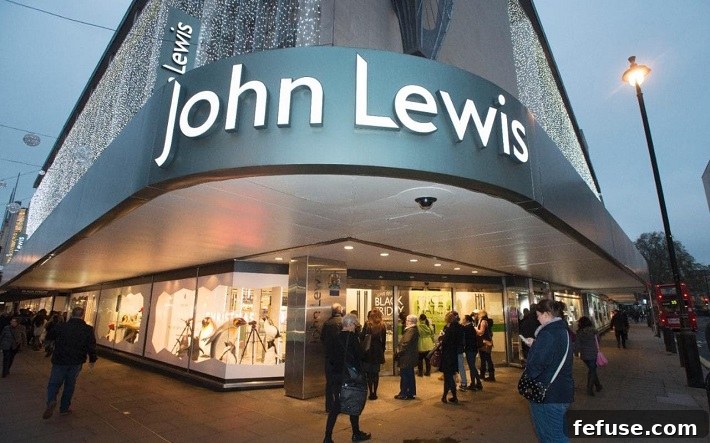
John Lewis Navigates Retail’s New Era: Eight More Stores Permanently Close Amid Sweeping Strategic Reshaping
The iconic John Lewis Partnership (JLP) has announced the permanent closure of an additional eight stores, a decision that will see these locations remain shut even as other non-essential retailers prepare to reopen their doors next month. This latest wave of closures underscores the profound transformation currently sweeping across the UK’s high street and marks another significant step in the department store chain’s ongoing efforts to adapt to evolving consumer habits.
This development brings the total number of operational John Lewis stores down to just 34. These latest closures follow an initial round of eight store shutdowns announced in July of last year, illustrating a consistent and strategic downscaling of the physical retail footprint as the partnership realigns its business model for future sustainability.
The Latest Locations Affected by John Lewis Store Closures
Earlier this year, the partnership indicated that up to eight more stores were under critical review, and it has now confirmed the specific locations slated for permanent closure. The impacted sites include a mix of formats, reflecting a broad assessment of the brand’s physical presence.
Four John Lewis ‘At Home’ shops are among those earmarked for closure. These smaller format stores, designed to offer a curated selection of homeware, furniture, and technology, are located in Ashford, Basingstoke, Chester, and Tunbridge Wells. In addition to these, four larger, full-service John Lewis department stores will also cease operations. These include long-standing branches in Aberdeen, Peterborough, Sheffield, and York. Each of these closures represents a significant loss for their respective local communities, both in terms of retail offering and employment opportunities.
Strategic Rationale: Adapting to a Changing Retail Landscape
In a statement detailing these difficult decisions, John Lewis Partnership elaborated on the strategic imperative driving these closures. “At the Partnership’s full-year results earlier this month, we said that we will reshape our business in response to how our customers increasingly want to shop in-store and online,” the company explained. This sentiment encapsulates the core challenge facing traditional retailers today: a rapid shift in consumer preference towards digital channels and a demand for more convenient, integrated shopping experiences.
The company further clarified the financial realities behind the move: “As part of this, we can unfortunately no longer profitably sustain a large John Lewis store in some locations where we do not have enough customers, which is resulting in the proposed closures. The eight shops were financially challenged prior to the pandemic.” This candid admission highlights that the COVID-19 pandemic merely accelerated pre-existing trends and exacerbated financial pressures on stores that were already struggling with declining footfall and profitability. The cost of maintaining large, often multi-story department stores has become increasingly unsustainable in an era where online sales dominate a growing share of the market.
A Vision for the Future: Smaller Formats and Enhanced Digital Integration
Despite the closures, John Lewis is not retreating from physical retail entirely. Instead, the partnership is committed to evolving its physical presence to better serve modern shoppers. As part of its strategic reshaping, JLP confirmed it will be “testing new formats of smaller, local neighbourhood shops.” This move signals a pivot towards more accessible, community-focused stores that could offer a more curated selection and a stronger emphasis on services and experiences rather than vast product ranges. Such formats could prove more resilient and relevant in an urban landscape increasingly dominated by convenience and localism.
The executive director for John Lewis, Pippa Wicks, further elaborated on this multi-faceted approach. “Alongside a growing online business and the expansion of next day click-and-collect, we will invest in our in-store services and experiences, as well as new, smaller neighbourhood formats and the introduction of John Lewis ranges in more Waitrose shops.” This comprehensive strategy aims to integrate the physical and digital shopping journeys seamlessly. Expanding click-and-collect options caters directly to the hybrid shopper who values the convenience of online browsing with the immediacy of local pickup. Furthermore, leveraging the strong customer base and store network of its sister brand, Waitrose, by introducing John Lewis ranges within these supermarkets, offers an innovative way to maintain brand presence and accessibility without the overheads of standalone department stores.
Impact on Partners and Communities: Navigating the Transition
The human cost of such significant strategic shifts is undeniable. The latest closures will affect approximately 1,465 dedicated staff members, known as ‘Partners’ within the unique John Lewis employee-owned structure. JLP has pledged to do everything in its power to find alternative roles for as many of these affected Partners as possible. This commitment is consistent with their approach during last year’s closures, where the company claims to have successfully redeployed around a third of the impacted workforce into other positions within the partnership.
Sharon White, chairman of the John Lewis Partnership, acknowledged the profound impact of these decisions, stating: “Today’s announcement is incredibly sad news for our affected Partners, for our customers, and for the communities we’ve served over many years.” Her words highlight the deep emotional ties and community value associated with John Lewis stores, which often serve as anchors in high street retail. White emphasized the necessity of adaptation: “The high street is going through its biggest change for a generation and we are changing with it. Customers will still be able to get the trusted service that we are known for – however and wherever they want to shop.” This message underscores a commitment to retaining the core values of service and quality, even as the channels through which these are delivered undergo radical transformation.
Wider Context: Financial Headwinds and Strategic Adjustments
These store closures are not isolated incidents but rather part of a broader pattern of strategic adjustments at the John Lewis Partnership, reflecting significant financial pressures that predate and have been exacerbated by the pandemic. In November, the company announced a further 1,500 job cuts at its head office, a stark indicator of the ongoing need to streamline operations and reduce overheads across the entire organization. These redundancies were designed to create a leaner, more agile leadership structure capable of navigating the complexities of modern retail.
Perhaps one of the most poignant symbols of the challenging financial climate was the confirmation in September that the annual partner bonus, typically awarded in March, would not be paid in 2021. This was the first time since 1953 that the highly anticipated bonus, a cornerstone of the partnership’s employee-owned model and a reflection of its financial health, had been suspended. This decision underscored the severity of the financial challenges faced by JLP and the imperative to prioritize reinvestment in the business’s long-term future over short-term payouts.
The Future of Department Stores and UK High Street Retail
The challenges confronting John Lewis are emblematic of a wider crisis facing traditional department stores globally. Once the grand temples of consumerism, offering everything under one roof, these giants have struggled to compete with the agility and convenience of online retailers, coupled with the rise of specialized boutiques and discount outlets. The pandemic acted as an unprecedented accelerant, pushing more consumers online and fundamentally altering shopping habits that may never fully revert to pre-pandemic norms.
Retailers like John Lewis are now locked in a race to reinvent themselves. This involves not just digital transformation but also a fundamental rethinking of the purpose of physical stores. The future high street will likely feature fewer, smaller stores, designed more for experience, service, and brand interaction rather than sheer volume of sales. Click-and-collect hubs, curated showrooms, and spaces for events or personal styling consultations are becoming increasingly important. The integration of online and offline, often termed “omnichannel retail,” is no longer a luxury but a necessity for survival.
John Lewis’s strategic moves – investing in its online platform, exploring new smaller formats, and leveraging the Waitrose network – are all part of this necessary evolution. While the closure of beloved stores is undeniably painful for Partners, customers, and communities, these difficult decisions are presented as crucial steps towards securing the long-term viability and relevance of the John Lewis brand in a rapidly changing retail landscape. The ultimate goal is to ensure that the trusted service and quality associated with John Lewis can continue to thrive, even if the physical spaces in which it operates look considerably different in the years to come.