
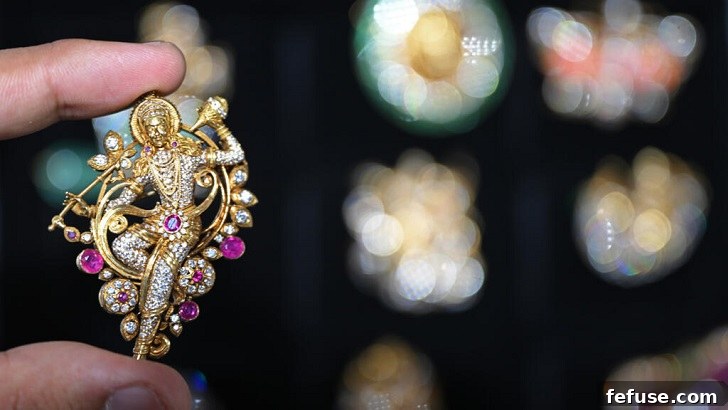
In a vivid illustration of India’s technological renaissance, a gold brooch meticulously crafted in the likeness of Lord Krishna captivated attendees at a recent New Delhi tech summit. This exquisite piece was not merely a testament to India’s unparalleled artisanal skill but also a striking symbol of its embrace of advanced technology. While the final product was lovingly handcrafted by skilled Indian artisans, its intricate design blueprint originated from artificial intelligence. This fusion perfectly encapsulates how India’s burgeoning startup ecosystem is seamlessly integrating ancient heritage industries with next-generation tools, paving the way for unprecedented innovation and global competitiveness.
Revolutionizing Jewellery Design Through AI Innovation
The luxury jewellery sector, steeped in tradition and manual craftsmanship, is experiencing a profound transformation thanks to AI. Among the vanguard of this shift is Idea Jewellery, a Hyderabad-based startup co-founded in 2023 by the visionary 23-year-old Siddharth Soni. Traditionally, the journey from a nascent concept to a finished, elaborate jewellery piece could span a formidable six to seven months. This laborious process involved numerous manual iterations, extensive consultations, and complex design adjustments. However, with Idea Jewellery’s innovative approach, this timeline has been dramatically condensed.
By harnessing the power of AI-generated design files, which are then used to create precision 3D-printed moulds, the production lifecycle is now reduced to approximately one week. This expedited process significantly cuts down on development costs and allows for quicker market responsiveness, with additional time factored in for essential hallmarking and meticulous finishing touches. The heart of Idea Jewellery’s platform lies in its customized version of Google’s sophisticated Gemini AI model. This advanced system empowers customers to articulate their design preferences through simple text prompts, specifying details such as metal type, desired gemstones, pricing range, and stylistic cues – from traditional to contemporary. The AI then rapidly generates a suite of visual samples and detailed 3D models, providing an unprecedented level of customization and choice. Artisans then take these AI-generated blueprints and imbue them with their unique human touch, refining and completing the pieces by hand, ensuring each creation retains its artisanal soul.
Soni’s pioneering venture stands on the shoulders of his family’s decades-old legacy in jewellery manufacturing. This generational bridge highlights a fascinating dynamic within the industry. While some older generations express legitimate concerns that AI might dilute the intrinsic artistic imagination and craftsmanship, they also acutely recognize the imperative to adapt. The global demand for bespoke, high-quality jewellery is constantly evolving, and technological integration is seen as crucial for survival and growth. Idea Jewellery is actively engaging with approximately 20 retailers, including a growing number of international buyers who are keen to source customized, high-quality Indian jewellery that marries traditional aesthetics with modern efficiency. This strategic outreach underscores the significant market potential for AI-assisted design in the global luxury goods sector.
India’s National Endeavour Towards Global AI Leadership
The widespread adoption of AI across India’s diverse sectors is not merely a collection of isolated startup successes; it reflects a broader, ambitious national agenda. India aims to solidify its position as a global Artificial Intelligence powerhouse. At the recent summit, Prime Minister Narendra Modi emphatically highlighted AI as a powerful testament to the nation’s youthful dynamism and boundless innovation capacity. The government’s proactive stance is evident in its ambitious projections, anticipating up to $200 billion in AI-related investment over the next two years. This substantial capital injection is earmarked for accelerating research, fostering AI startups, and developing robust AI infrastructure. Concurrently, comprehensive plans are underway to significantly expand data infrastructure and enhance energy capacity, which are critical prerequisites for supporting the large-scale computing demands of advanced AI models and applications across the country. This concerted effort positions India not just as a consumer but as a significant developer and exporter of AI solutions.
AI Beyond Opulence: Transforming Business and Agriculture
The transformative reach of AI in India extends far beyond the gleaming world of luxury design, permeating crucial sectors like business and agriculture, where its impact is fundamentally changing operational paradigms and improving livelihoods.
Empowering Businesses with Multilingual Voice AI
In the dynamic business landscape, startup Xtreme Gen AI, founded by Peush Bery, has developed a groundbreaking multilingual voice automation tool. This innovative solution is designed to proficiently handle both inbound and outbound calls for Indian businesses, offering a significant technological leap, particularly for smaller enterprises. Many small and medium-sized businesses (SMEs) in India often operate without the luxury of advanced technical resources or large customer service teams. Xtreme Gen AI’s system addresses this critical gap by operating seamlessly across multiple regional languages, a vital feature in India’s incredibly diverse and linguistically complex market. This linguistic versatility ensures that businesses can effectively communicate with a broader customer base, improving accessibility and customer satisfaction. While the growing accuracy and sophistication of voice AI could undeniably disrupt India’s massive call centre industry, Bery argues for a nuanced perspective. He contends that while certain roles may experience a decline, this technological shift will simultaneously generate entirely new opportunities in areas such as data management, AI training, and AI optimization, necessitating a strategic workforce transformation rather than outright displacement.
Cultivating the Future: AI in Agriculture
The agricultural sector, the backbone of India’s economy, is also undergoing a quiet revolution powered by AI. Soil Doctor, a pioneering startup, is applying AI-powered soil diagnostics across an impressive network of 500 farms spanning 10 different states. Collaborating closely with non-governmental organizations (NGOs), Soil Doctor is directly supporting rural communities, with a particular focus on empowering women and youth farmers. The startup provides data-driven fertilizer recommendations meticulously tailored to specific soil conditions, taking into account nutrient levels, pH balance, and crop requirements. The overarching goal is twofold: to significantly reduce farmers’ input costs by minimizing the wasteful overuse of fertilizers and pesticides, and concurrently to improve crop yields season after season. This precision agriculture approach not only boosts economic viability for farmers but also contributes to environmental sustainability by promoting more efficient resource utilization and reducing chemical runoff.
Navigating the Crossroads: Innovation, Employment, and Cultural Adaptation
Despite the palpable enthusiasm surrounding AI adoption, its integration is not without its share of challenges and resistance. Many skilled jewellery designers, traditional artisans, and other workers who have honed their crafts over decades express legitimate uneasiness regarding automation encroaching upon creative and technical tasks. The fear of job displacement is a common thread in global technological shifts, and India is no exception. However, a significant number of these experienced professionals are demonstrating remarkable adaptability, recognizing that embracing technological shifts is imperative for maintaining global competitiveness and relevance in a rapidly evolving world. They are actively engaging with new tools and processes, understanding that AI can be a powerful co-creator rather than merely a replacement.
For India, this ongoing debate about AI’s impact mirrors a broader global question: will artificial intelligence primarily replace traditional jobs, or will it be a catalyst for generating entirely new categories of employment that demand different skill sets? For the foreseeable future, startups across India’s diverse industries appear resolutely willing to embrace this profound transformation. They are skillfully blending centuries-old craftsmanship, time-honored agricultural practices, and traditional business models with the cutting-edge capabilities of algorithms, machine learning, and generative AI. This unique blend positions India at the forefront of a global movement where technology augments, rather than diminishes, human potential.
Ultimately, the glittering Krishna brooch, a harmonious blend of traditional artistry and AI-driven design, symbolizes far more than mere ornamental beauty. It stands as a powerful emblem of a transitional moment in India’s socio-economic trajectory. It signifies a period where the nation’s vibrant entrepreneurial spirit is diligently striving to harmonize its rich artistic heritage, its growing technological prowess, and its ambitious economic aspirations. This delicate balance promises a future where India not only preserves its invaluable cultural legacy but also actively shapes the global technological landscape.