
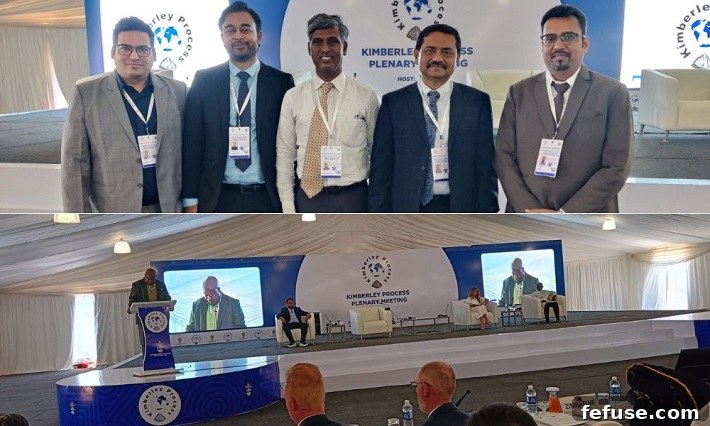
Safeguarding Ethical Diamonds: India’s Pivotal Role at the Kimberley Process Plenary in Victoria Falls
In a significant move reinforcing its unwavering commitment to a transparent and conflict-free global diamond trade, an esteemed Indian delegation is actively participating in the Kimberley Process (KP) Plenary meeting. This crucial annual gathering is being hosted in the breathtaking setting of Victoria Falls, Zimbabwe, from November 6th to 10th, 2023. The Kimberley Process Certification Scheme (KPCS) stands as a monumental international initiative, meticulously designed to prevent the proliferation of “conflict diamonds” – rough diamonds used to finance wars, illicit activities, and severe human rights abuses – from entering the legitimate global market.
The Kimberley Process Certification Scheme: A Foundation for Ethical Diamond Trade
The Kimberley Process emerged from a pressing need at the turn of the millennium, born out of a collective international resolve to address the devastating impact of blood diamonds on conflict-ridden regions, particularly in parts of Africa. Established in 2003, the KPCS is a unique tripartite agreement, bringing together governments, the diamond industry, and civil society organizations. Its primary objective is to stem the flow of conflict diamonds by imposing stringent requirements on its member states. These requirements ensure that rough diamond shipments are tamper-proof and accompanied by a KP certificate, guaranteeing that the diamonds are conflict-free. This robust certification scheme has, over two decades, played an instrumental role in restoring and maintaining consumer confidence in diamonds, transforming them from potential instruments of conflict into symbols of purity and enduring value, ethically sourced and responsibly traded.
The KPCS operates through a rigorous system of internal controls and checks within each participating country. Members commit to implementing national legislation and institutions to police the diamond trade, ensuring that only certified diamonds are imported and exported. This includes strict import and export procedures, criminal penalties for violations, and cooperation with other KP participants in data exchange and information sharing. The success of the KP hinges on the collective commitment of its members to uphold these standards, thereby creating a global supply chain where the provenance of rough diamonds can be traced and verified, providing a crucial safeguard against illicit trade and exploitation.
India’s Enduring Commitment to the Kimberley Process
A Founding Member and Global Leader in Responsible Diamond Trade
India’s involvement in the Kimberley Process is not merely that of a participant, but a foundational pillar. As one of the original architects and founding members of the KPCS, India has consistently demonstrated its profound dedication to upholding the principles of ethical and responsible diamond trade. Its strategic importance in the global diamond value chain is unparalleled, serving as the world’s largest cutting and polishing center for diamonds. Billions of dollars worth of rough diamonds are imported into India annually, meticulously transformed into exquisite polished gems that adorn consumers worldwide. This pivotal role naturally places India at the forefront of efforts to maintain the integrity of the diamond supply chain.
Beyond its economic stature, India has also taken on significant leadership roles within the KP. The nation has had the distinct honor of serving as the Kimberley Process Chair on two separate occasions – first in 2008 and again in 2019. During its chairmanships, India spearheaded critical initiatives aimed at strengthening the KPCS, enhancing its effectiveness, and adapting it to evolving global challenges. These periods of leadership allowed India to shape the direction of the KP, fostering greater cooperation among member states and driving forward reforms that reinforced the scheme’s core mission. India’s consistent advocacy for transparency, accountability, and the socio-economic upliftment of diamond-producing communities underscores its comprehensive approach to the global diamond trade.
Active Participation in KP Working Groups and Peer Review Mechanisms
India’s engagement with the Kimberley Process extends far beyond plenary meetings and chairmanships. The country remains actively involved in numerous KP activities and initiatives that form the backbone of the scheme’s operational effectiveness. This includes robust participation in the Peer Review Mechanism, a vital process where KP member states assess each other’s implementation of the KPCS requirements. India has both hosted peer review visits and sent its experts to conduct reviews in other nations, contributing valuable insights and promoting best practices across the globe. This collaborative self-assessment system is crucial for ensuring uniform adherence to KP standards and fostering continuous improvement among participants.
Furthermore, India plays a proactive role in various specialized Working Groups within the KP structure. These include the Working Group On Statistics, which is fundamental for monitoring the flow of rough diamonds globally and identifying potential anomalies; the Working Group On Monitoring, responsible for overseeing compliance and addressing concerns regarding implementation; and the Working Group of Diamond Experts, which provides technical expertise on diamond identification, classification, and valuation. By contributing its vast knowledge and experience to these critical groups, India helps to refine the KP’s operational guidelines, strengthen its analytical capabilities, and ensure its continued relevance in a dynamic global environment. The Gem & Jewellery Export Promotion Council (GJEPC) also plays a crucial supporting role, actively collaborating with the government to ensure industry compliance and advocacy.
The 2023 Kimberley Process Plenary: Charting the Future in Victoria Falls
The current KP Plenary meeting in Victoria Falls, Zimbabwe, represents a pivotal moment for the future trajectory of the Kimberley Process. This annual gathering is a crucial forum where KP members, observers, and representatives from civil society converge to review progress, address persistent challenges, and deliberate on the strategic direction of the scheme. Zimbabwe, serving as the KP Chair for 2023, has the immense responsibility of guiding these discussions, ensuring that the plenary fosters constructive dialogue and yields meaningful outcomes. The choice of Victoria Falls as the venue, a region deeply connected to natural resources, underscores the tangible impact of these discussions on communities and economies.
The agenda for the 2023 Plenary is particularly ambitious, focusing on key areas that are vital for the continued efficacy and relevance of the KPCS. Participants are meticulously reviewing the progress made in ensuring transparency and accountability within the global diamond trade over the past year. This includes assessing the effectiveness of existing measures, identifying gaps, and discussing corrective actions. However, perhaps the most critical and widely anticipated discussions revolve around the future direction and potential reforms of the KP. These reforms are essential for adapting the scheme to contemporary challenges and ensuring it remains a robust shield against illicit activities.
Foremost among these future-oriented discussions is the ongoing debate surrounding the expansion of the KP’s scope and, crucially, the redefinition of “conflict diamonds.” When the KP was established, the definition was narrowly focused on diamonds used by rebel groups to finance civil wars against legitimate governments. However, as the nature of conflicts and illicit financing has evolved, there has been a growing consensus among many stakeholders that this definition needs to be broadened. Discussions at the Plenary will likely explore incorporating concerns related to widespread systematic violence, severe human rights abuses, and even environmental degradation associated with diamond extraction, even if not directly linked to rebel groups. Reaching a consensus on this expanded definition is complex, involving diverse geopolitical interests and economic implications, but it is widely seen as a necessary step for the KP to remain pertinent and impactful in the 21st century diamond industry.
India’s Delegation: A Testament to National Resolve and Expert Contribution
India’s high-level delegation to the 2023 Plenary is a clear reflection of the nation’s steadfast commitment to these critical discussions. The delegation is adeptly led by Mr. R. Arulanandan, Director, Department of Commerce, Government of India, whose leadership signifies the serious governmental intent behind India’s participation. His presence at the helm ensures that India’s policy positions are articulated with clarity and authority on the international stage. He is accompanied by a formidable team of experts and industry representatives, emphasizing the collaborative approach taken by India in addressing global diamond trade challenges.
Key members of the delegation include Mr. Sabyasachi Ray, Executive Director of the Gem & Jewellery Export Promotion Council (GJEPC), alongside Mr. Rajat Wani, Assistant Director, GJEPC, Mr. Shashank Upadhyay, Sr. Manager, GJEPC, and Mr. Abhizar Bootwala, Sr. Manager, GJEPC. Their collective presence underscores the critical nexus between government policy and industry practice in India’s approach to the KP. These GJEPC representatives bring invaluable industry insights, technical expertise, and a deep understanding of the practical implications of KP decisions on the world’s largest diamond manufacturing sector. Additionally, Ms. Jilpa Sheth, an independent consultant, further bolsters the delegation’s analytical and strategic capabilities. This diverse and experienced team ensures that India’s voice in Victoria Falls is well-informed, pragmatic, and influential, striving for outcomes that benefit both the global diamond trade and the millions of livelihoods dependent on it.
Addressing Evolving Challenges and Future Directions of the KP
The Kimberley Process, while highly successful in its original mandate, faces a complex array of evolving challenges that demand continuous adaptation. Modern conflicts often take different forms than the civil wars of the 1990s, blurring the lines of direct rebel funding from diamonds. Issues such as state-sponsored violence, environmental abuses linked to mining, and broader human rights violations within the diamond supply chain are increasingly coming under scrutiny. The ongoing debate around expanding the definition of “conflict diamonds” is a direct response to these complexities, aiming to ensure the KP remains a relevant and effective mechanism for ethical sourcing in an ever-changing geopolitical landscape.
Furthermore, the illicit trade routes for diamonds continue to pose a significant challenge, requiring enhanced monitoring and enforcement mechanisms. Technological advancements offer promising avenues for strengthening the KP, from blockchain-based tracing systems that provide immutable records of a diamond’s journey from mine to market, to advanced analytical tools that can detect discrepancies in trade data. The KP must proactively embrace these innovations to bolster its verification capabilities and improve overall transparency. The continued relevance of the KP hinges on its ability to evolve, not just in its definitions, but also in its methodologies and its capacity to foster genuine collaboration among all stakeholders – governments, industry, and civil society – to overcome these multifaceted obstacles and secure a truly conflict-free future for diamonds.
The Broader Impact: Ensuring Consumer Trust and Sustainable Practices
The integrity of the Kimberley Process transcends mere compliance; it directly underpins consumer trust, which is the lifeblood of the diamond industry. In an era where consumers are increasingly conscious of the ethical provenance of their purchases, the KPCS provides an essential assurance that their diamonds have not contributed to conflict or human suffering. This trust is invaluable for brands and retailers, allowing them to confidently market their products as ethically sourced. A robust and adaptable KP not only safeguards the industry’s reputation but also stimulates responsible business practices across the entire supply chain, from artisanal miners to multinational corporations.
Beyond preventing conflict financing, a strong Kimberley Process contributes to broader goals of sustainability and corporate social responsibility. By promoting transparent and accountable trade practices, it encourages better governance in diamond-producing nations, supports legitimate economic development, and provides stable livelihoods for millions of people worldwide. The discussions at the Victoria Falls Plenary, particularly those concerning the expansion of the KP’s scope, are therefore not just about technical definitions; they are about reinforcing the industry’s commitment to social equity, environmental stewardship, and long-term sustainability. India, as a major player, is deeply invested in these outcomes, understanding that a thriving diamond industry is inextricably linked to ethical sourcing and responsible global citizenship.
In conclusion, India’s active and influential participation in the 2023 Kimberley Process Plenary in Victoria Falls underscores its unwavering dedication to fostering an ethical, transparent, and conflict-free global diamond trade. As a founding member and a global leader in diamond manufacturing, India plays a critical role in shaping the future of the KP. The discussions surrounding the expansion of the KP’s scope and the redefinition of conflict diamonds are crucial for the scheme’s continued relevance and effectiveness. By contributing its expertise and commitment, India continues to champion efforts that safeguard consumer trust, promote responsible sourcing, and ensure that diamonds remain a symbol of enduring beauty and ethical value, benefiting communities and economies across the globe.