
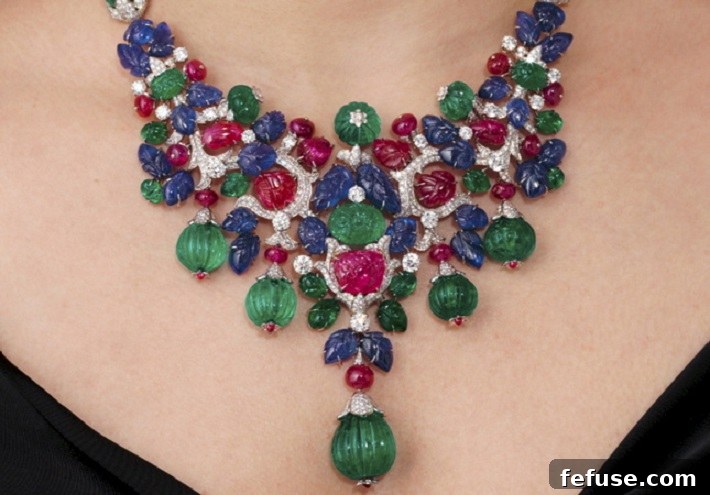
Cartier’s Legendary ‘India’ Tutti Frutti Necklace Smashes Records at Christie’s Hong Kong Auction
In a spectacular display of enduring allure and market demand for iconic luxury jewelry, a magnificent platinum and gold Cartier “India” Tutti Frutti necklace recently captivated bidders at Christie’s Hong Kong, ultimately selling for an astonishing $8.7 million. This monumental price significantly surpassed its high estimate of $4.9 million, solidifying its place as a true masterpiece in the annals of jewelry history and auction results. The sale was a resounding highlight of the “Magnificent Jewels” auction, which itself achieved a staggering total of $61 million. Demonstrating robust market confidence and intense collector interest, the auction notably realized a 127 percent hammer price against its pre-sale estimates, with more than half of the lots soaring above their initial high valuations.
The Phenomenal Sale and Market Impact
The fierce competition surrounding the Cartier “India” Tutti Frutti necklace was palpable, with bidders engaging in a captivating duel that lasted for over ten minutes. This extended bidding war underscored the exceptional rarity and desirability of the piece. Originally estimated to fetch between $3.6 million and $4.9 million, its final selling price of $8.7 million reflects not only the intrinsic value of its exquisite materials and craftsmanship but also its profound historical and artistic significance. Such an outcome sends a clear message about the strength of the luxury jewelry market, particularly for pieces with impeccable provenance, iconic design, and a connection to a renowned maison like Cartier. Christie’s, a leading global art and luxury business, successfully leveraged its international platform to attract a diverse pool of discerning collectors, further cementing Hong Kong’s position as a pivotal hub for high-end auctions.
Unveiling the ‘India’ Tutti Frutti Necklace: A Jewel of Unparalleled Design
At the heart of this record-breaking sale was a necklace of breathtaking beauty and intricate detail. The Cartier “India” Tutti Frutti necklace is a symphony of vibrant color and masterful craftsmanship, meticulously crafted from a harmonious blend of carved rubies, emeralds, and sapphires. These precious gemstones, often fashioned into leaf and berry motifs, are interspersed with scintillating round diamonds, ranging from 0.63 to 0.60 carats, boasting D to E color and VVS2 to VS1 clarity – indicators of exceptional quality. Further enhancing its opulent appeal, the necklace features delicate beads of sapphire, ruby, and emerald, adding depth and texture to its flowing design. As expected from a piece of such caliber, it bears the distinct signature of Cartier, accompanied by the maker’s mark and a unique number, assuring its authenticity and pedigree.
The Genesis of Tutti Frutti: A Fusion of East and West
The “Tutti Frutti” style is one of Cartier’s most recognizable and celebrated creations, a testament to the maison’s pioneering spirit and its ability to draw inspiration from diverse cultural aesthetics. The origins of this iconic style can be traced back to the early 20th century, particularly to Jacques Cartier’s travels to India in 1911 and subsequent visits by other Cartier family members. Fascinated by the vibrant colors, intricate carvings, and traditional designs of Mughal jewelry, particularly the lavish necklaces adorned with carved emeralds, rubies, and sapphires, Cartier’s designers were profoundly influenced. They began incorporating these elements into their own creations, merging Eastern exoticism with Western Art Deco elegance. Jeanne Toussaint, Cartier’s formidable creative director, further refined and popularized the “Tutti Frutti” aesthetic, making it synonymous with Cartier’s innovative spirit.
The term “Tutti Frutti,” Italian for “all fruits,” perfectly encapsulates the joyous burst of color and organic forms that characterize these pieces. Unlike traditional Western jewelry that often prioritized diamonds and single-colored gems, Tutti Frutti celebrated the kaleidoscopic beauty of colored stones, often carved into leaf, berry, or flower shapes. This audacious use of color and form was groundbreaking, offering a refreshing departure from the prevailing monochrome styles and perfectly aligning with the avant-garde spirit of the Art Deco era.
Cartier’s Enduring Legacy in High Jewelry
For over a century and a half, Cartier has remained at the pinnacle of high jewelry, renowned for its unparalleled craftsmanship, innovative designs, and a client list that includes royalty, aristocracy, and Hollywood legends. From the invention of the modern wristwatch to the creation of bespoke masterpieces, Cartier has consistently pushed the boundaries of jewelry design. The Tutti Frutti collection, in particular, showcases the brand’s commitment to artistic expression and its willingness to embrace global influences. Each piece is a miniature work of art, reflecting a meticulous attention to detail and a profound understanding of precious materials. The sale of the “India” necklace reinforces Cartier’s enduring legacy as a purveyor of the world’s most coveted and historically significant jewels.
Artistry and Craftsmanship: The Heart of the ‘India’ Necklace
The creation of a Cartier Tutti Frutti necklace is a testament to extraordinary artistry and technical prowess. The carved gemstones – rubies, emeralds, and sapphires – are not merely set but are often intricately sculpted by hand, a technique that requires immense skill and precision. This carving tradition, deeply rooted in Indian jewelry practices, was masterfully adapted by Cartier, giving each stone a unique character and dimension. The platinum and gold settings are meticulously designed to complement and enhance the vibrant palette of the gems, allowing the colors to truly sing. The fluidity of the necklace, its ability to drape elegantly around the neck, speaks to the exceptional engineering and design expertise of Cartier’s master jewelers. The interplay of geometric Art Deco lines with the organic, floral motifs creates a harmonious balance that is both sophisticated and playful.
The Allure of Mughal Inspiration and the ‘India’ Designation
The “India” designation in the necklace’s name is a direct homage to its primary source of inspiration. The Mughal Empire, which flourished in India from the 16th to the 19th centuries, produced some of the most spectacular and richly colored jewels in history. These pieces were characterized by their lavish use of carved gemstones, especially emeralds, rubies, and sapphires, often set en cabochon or intricately carved with floral motifs. Indian craftsmen were renowned for their skill in carving, producing beads and pendants that were both artistic and spiritually significant. Jacques Cartier’s travels to India opened his eyes to this unparalleled world of color and craftsmanship, and he began to acquire significant collections of carved Indian gems, which then became the building blocks for the Tutti Frutti collection. The “India” necklace epitomizes this cross-cultural exchange, blending the exoticism of the East with the refined luxury of Parisian haute joaillerie.
Christie’s Magnificent Jewels Auction: A Barometer of the Luxury Market
Christie’s “Magnificent Jewels” sale is a highly anticipated event on the international auction calendar, known for presenting some of the world’s rarest and most exquisite gemstones and signed jewels. The outstanding results of this particular sale – a $61 million total and a 127 percent hammer price against pre-sale estimates – underscore a robust and buoyant market for exceptional pieces. This strong performance indicates that collectors, both established and new, are actively seeking unique items that offer not only aesthetic pleasure but also potential investment value. The global demand, particularly from Asian buyers who are increasingly influential in the luxury market, continues to drive competitive bidding for items of such historical and artistic merit. Auction houses like Christie’s play a crucial role in validating values, establishing provenance, and bringing these extraordinary pieces to a global stage.
Factors Driving Exceptional Value: Why Millions for a Necklace?
The multi-million dollar price tag for the Cartier “India” Tutti Frutti necklace is a culmination of several critical factors. Firstly, its **rarity and uniqueness** are paramount; very few Tutti Frutti pieces of this scale and intricate design exist, making each one highly sought after. Secondly, its **historical significance** as an iconic representation of the Art Deco era and Cartier’s groundbreaking design philosophy contributes immensely to its value. Thirdly, the **brand prestige** of Cartier is unparalleled; items from such a revered maison consistently command higher prices. Fourthly, the **quality of the gemstones** – D to E color, VVS2 to VS1 clarity diamonds, and beautifully carved colored stones – ensures exceptional intrinsic value. Finally, **provenance** (though not detailed for this specific piece in the initial text, it is a general factor for high-value jewels) and the **overall condition** of the necklace, preserved immaculately over decades, further solidify its status as a collector’s dream. These elements combine to create an object that transcends mere adornment, becoming a tangible asset with a rich narrative and enduring appeal.
Conclusion: An Enduring Icon of Luxury and Artistry
The record-breaking sale of the Cartier “India” Tutti Frutti necklace at Christie’s Hong Kong is more than just an auction result; it is a celebration of artistry, innovation, and timeless beauty. It stands as a testament to Cartier’s visionary approach to jewelry design, its ability to fuse diverse cultural influences into singular masterpieces, and the enduring power of iconic luxury items to captivate collectors worldwide. This necklace is not merely a piece of jewelry; it is a wearable piece of history, a vibrant emblem of the Art Deco period, and a brilliant example of how a jewel can transcend its material components to become a coveted work of art. As such, its sale underscores the vibrant health of the global luxury market and solidifies the Cartier “Tutti Frutti” style as one of the most significant and collectible jewelry aesthetics ever created.