
Groundbreaking Discovery: Scientists Unveil Novel Method for Synthesizing Borophene on Gold, Paving Way for Next-Gen Electronics
In a significant leap forward for materials science, a collaborative team of scientists from Rice University, Argonne National Laboratory, and Northwestern University has developed an innovative and highly efficient method for synthesizing borophene, the atom-thin form of boron. This pioneering research introduces a unique “dissolve and resurface” technique that allows boron atoms to integrate with and then re-emerge from a gold surface, forming high-quality borophene. This breakthrough promises to accelerate the journey of this highly anticipated two-dimensional material from laboratories to practical applications, including wearable electronics, transparent devices, advanced plasmonic sensors, and next-generation energy storage solutions.
Borophene, often hailed as the boron equivalent of graphene, has captivated researchers due to its extraordinary properties. As a truly atom-flat, two-dimensional material, borophene exhibits exceptional metallic conductivity, remarkable flexibility, and a fascinating array of structural possibilities. Its unique electronic and mechanical characteristics position it as a potential game-changer in various technological domains. However, its synthesis has historically presented considerable challenges, making this new method a crucial step towards unlocking its full potential.
Understanding the Novel Synthesis Method: Dissolving and Resurfacing Boron
The core of this groundbreaking discovery lies in an ingenious synthesis technique that fundamentally departs from conventional methods used to create other 2D materials. Traditionally, two-dimensional materials are often grown using techniques like Chemical Vapor Deposition (CVD), where precursor gases settle onto a substrate and bond to form the desired material. In such processes, the atoms typically remain on the surface of the substrate, connecting with each other in a layer-by-layer fashion.
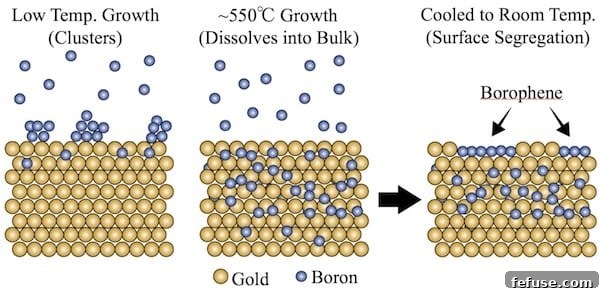
The method developed by the multi-institutional team, led by Boris Yakobson at Rice University, Nathan Guisinger at Argonne National Laboratory, and Mark Hersam at Northwestern University, takes a dramatically different approach. Their research, which began with theoretical predictions and was subsequently validated through meticulous experimental work, revealed a fascinating interaction between boron atoms and a gold surface under specific conditions. When boron atoms are heated in a high-vacuum furnace and then introduced to a gold substrate, they don’t simply settle on top; instead, they “dissolve” or sink into the molten gold bath itself.
Upon subsequent cooling of the materials, a remarkable phenomenon occurs: the dissolved boron atoms do not remain dispersed within the gold. Instead, they “resurface” from the gold substrate, spontaneously forming pristine islands of borophene on the surface. These metallic borophene islands are incredibly small, measuring approximately 1-nanometer square. Critically, these nanoscopic structures exhibit clear evidence of electron confinement, a property that holds immense promise for various quantum applications, paving the way for advancements in quantum computing and quantum sensing technologies.
Why Gold? The Strategic Choice of Substrate
The selection of gold as the substrate material is not arbitrary; it is central to the success and potential utility of this novel synthesis technique. As highlighted by Dr. Boris Yakobson, “Gold, with a lesser charge transfer and weaker bonding, may yield a layer that’s easier to lift off and put to use, although this has not yet been achieved.” This observation is profoundly significant for the practical application of 2D materials. For a 2D material like borophene to be integrated into electronic devices, it often needs to be transferred from its growth substrate to another, more suitable platform. A substrate that facilitates easier detachment without damaging the delicate atomic structure of the borophene is therefore highly advantageous.
The weaker bonding between boron and gold, compared to other potential substrates, implies that the borophene layer might be more readily separated. This characteristic is crucial for scalable manufacturing and the development of flexible or transparent devices where the 2D material needs to be integrated onto various non-traditional surfaces. Furthermore, the precise control over the dissolution and resurfacing process on gold offers a pathway to synthesize borophene with desired structural integrity and electronic properties, which are paramount for its high-performance applications.
Unlocking the Potential: Applications of Borophene
The successful and controlled synthesis of borophene opens up a plethora of exciting applications across multiple high-tech industries:
Wearable and Transparent Electronics
Borophene’s atomic thinness, inherent flexibility, and excellent conductivity make it an ideal candidate for next-generation wearable and transparent electronics. Imagine smart textiles that monitor health metrics, flexible displays that can be rolled up, or transparent circuits integrated into windows or eyeglasses. Its ability to conduct electricity efficiently while being incredibly lightweight and malleable is precisely what these futuristic applications demand.
Advanced Plasmonic Sensors
Plasmonics, the study of the interaction between light and free electrons in a metal, holds immense promise for ultra-sensitive sensing. Borophene, with its metallic nature and unique electronic structure, is expected to exhibit strong plasmonic resonances. This property could lead to the development of highly sensitive plasmonic sensors capable of detecting minute quantities of chemicals or biological molecules, revolutionizing fields from medical diagnostics to environmental monitoring.
High-Performance Energy Storage
The large surface area and excellent electrical conductivity of 2D materials like borophene are highly desirable for energy storage applications. Borophene could enhance the performance of lithium-ion batteries, supercapacitors, and fuel cells by offering improved charge storage capacity, faster charging and discharging rates, and extended cycle life. Its potential as an electrode material could pave the way for more efficient and durable energy devices.
Quantum Applications
The observed electron confinement within the 1-nanometer square borophene islands is particularly intriguing for quantum applications. Electron confinement, where electrons are restricted to a small region, can lead to distinct quantum mechanical properties. This could make borophene a valuable platform for developing components for quantum computing, quantum sensing, or other advanced quantum technologies that leverage these unique electronic behaviors.
Building on Past Successes and Future Challenges
This isn’t the first time the research team, particularly Dr. Yakobson, has explored the fascinating possibilities of borophene. In previous experiments, they demonstrated that borophene grown on a silver substrate exhibited a wavy, rippled structure. This controlled structural deformation also presented interesting avenues for applications, particularly in wearable electronics, where flexibility and strain engineering can be utilized to create novel functionalities.
Despite the significant progress, the journey of borophene is far from over. A crucial challenge that remains is the successful growth of borophene on an insulating substrate. As Dr. Yakobson articulates, “So far, the substrates with demonstrated success for borophene synthesis closely follow theoretical predictions. The challenge remains to grow it on an insulating substrate. That will permit many intriguing experimental tests, from basic transport to plasmons to superconductivity.”
Growing borophene on an insulating substrate is paramount for several reasons. In most electronic devices, conductive materials need to be isolated from each other to prevent short circuits and ensure proper device functionality. An insulating substrate would enable researchers to conduct fundamental studies on borophene’s intrinsic electrical transport properties without interference from a conductive substrate. Moreover, it would open the door to exploring other exotic phenomena such as plasmons (collective oscillations of electrons) and even superconductivity, which requires precise control over electron behavior in an isolated environment. Overcoming this challenge would be a monumental step towards integrating borophene into functional electronic and quantum devices.
Boron: A Strategic Resource for the Future
The element boron itself is a fascinating and industrially vital non-metal. While the groundbreaking research focuses on its two-dimensional form, borophene, it’s worth noting the natural abundance and traditional importance of boron. Boron is primarily found in large mineral deposits, with its main sources including colemanite, rasorite, ulexite, and tincal. These critical minerals are predominantly located in vast deposits across Central and Western Turkey, highlighting the geopolitical significance of this element. The continuous exploration into novel forms and applications of boron, such as borophene, further underscores its strategic importance in materials science and future technological advancements.
Conclusion
The innovative “dissolve and resurface” method for synthesizing borophene on gold represents a monumental advancement in the field of 2D materials. Developed by the collaborative efforts of scientists from Rice University, Argonne National Laboratory, and Northwestern University, this technique not only offers a more controlled and potentially scalable path to producing high-quality borophene but also deepens our understanding of fundamental material interactions. With its promising applications spanning wearable electronics, advanced sensors, energy storage, and quantum technologies, borophene is poised to revolutionize numerous sectors. While challenges such as growth on insulating substrates remain, this latest breakthrough brings the scientific community significantly closer to realizing the extraordinary potential of this atom-flat marvel, solidifying boron’s role at the forefront of advanced materials research.
NewsSource: mining