
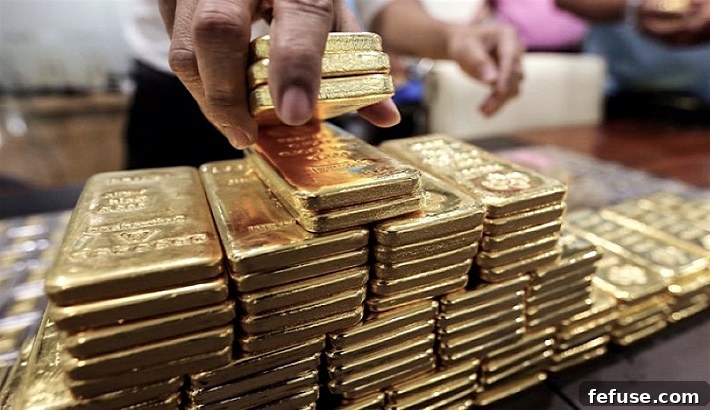
India’s Gold Imports: Navigating Economic Headwinds and Global Market Shifts
India, a nation deeply intertwined with gold through culture, tradition, and investment, consistently ranks among the world’s largest importers of the precious metal. The dynamics of its gold imports are not merely a reflection of consumer demand but a critical indicator influencing the country’s broader economic health, particularly its current account deficit (CAD) and the vitality of its extensive gems and jewellery industry. Recent data, spanning April-February 2018-19, reveals a notable shift in this landscape, with gold imports experiencing a significant dip in value terms, setting the stage for a comprehensive analysis of its causes, implications, and future trajectory.
A Significant Dip in Value: Decoding the Import Data
During the eleven-month period from April 2018 to February 2019, India’s gold imports witnessed a 5.5 per cent reduction in value, totaling approximately USD 29.5 billion. This figure stands in contrast to the USD 31.2 billion recorded during the corresponding period of the previous fiscal year (2017-18). This contraction in import value is a welcome development for policymakers, as it is widely anticipated to alleviate pressure on the nation’s current account deficit. The current account deficit, representing the difference between the inflow and outflow of foreign currency, is a key metric of economic stability, and excessive gold imports often contribute significantly to its widening.
The decline in import value, as highlighted by commerce ministry data, comes amidst a backdrop of fluctuating global gold prices. Trade experts frequently point to the softening prices of the yellow metal in international markets as a primary driver for this contraction. When global prices fall, the cost of importing the same volume of gold decreases, leading to a reduction in the overall import bill. This scenario can provide a much-needed reprieve for economies heavily reliant on commodity imports, like India, helping to conserve foreign exchange reserves.
Monthly Volatility: A Glimpse into Market Dynamics
While the overall trend for the April-February period shows a decline, a closer examination of monthly data reveals a more nuanced and at times volatile picture. Gold imports had experienced negative growth for three consecutive months leading up to December 2018, indicating a prolonged period of reduced inbound shipments. However, January of the following year saw a remarkable rebound, with imports surging by 38.16 per cent to reach USD 2.31 billion. This sudden uptick could be attributed to various factors, including a temporary dip in global prices, strategic inventory building by the jewellery industry ahead of peak demand seasons, or perhaps a temporary easing of import restrictions.
Yet, this resurgence proved short-lived. February saw another contraction, with imports decreasing by 10.8 per cent to USD 2.58 billion. Such month-on-month volatility underscores the sensitivity of India’s gold market to a confluence of factors, including international price movements, domestic demand patterns, festival calendars, and regulatory changes. These short-term fluctuations make it challenging to predict long-term trends but highlight the dynamic nature of the precious metal’s trade within the Indian subcontinent.
India’s Unwavering Demand: The Jewellery Industry’s Lifeline
India’s status as one of the world’s largest gold importers is primarily driven by its vast and culturally significant jewellery industry. Gold holds immense cultural, religious, and social importance in India, playing a pivotal role in weddings, festivals, and as a traditional store of wealth. This ingrained cultural affinity translates into robust and continuous demand for gold, which largely feeds the country’s extensive jewellery manufacturing sector. From intricate artisanal pieces to mass-produced designs, Indian jewellery relies heavily on imported gold as its primary raw material. Consequently, any significant fluctuation in gold imports has direct ramifications for thousands of jewellers, artisans, and retailers across the country, affecting employment, production volumes, and overall business sentiment.
The Critical Link to India’s Current Account Deficit (CAD)
The current account deficit (CAD) represents a country’s trade balance (exports minus imports of goods and services) plus net income from abroad and net transfer payments. A widening CAD indicates that a country is importing more goods and services than it is exporting, leading to a net outflow of foreign currency. For India, gold imports have historically been a significant contributor to its trade deficit and, by extension, its CAD. In the second quarter of the fiscal year, India’s CAD widened substantially to 2.9 per cent of the GDP, a considerable increase from 1.1 per cent in the year-ago period. This expansion was predominantly attributed to a large trade deficit, underscoring the urgency for measures to curb non-essential imports, including gold.
Therefore, the recent dip in gold import value, although modest, offers a glimmer of hope for CAD management. A sustained reduction in the gold import bill can directly contribute to narrowing the trade deficit, thereby easing pressure on the current account. This positive correlation between reduced gold imports and a more manageable CAD is a critical economic objective for the Indian government, which consistently seeks to maintain macroeconomic stability.
Beyond Value: Understanding Volume Trends
It is crucial to distinguish between the value and volume of gold imports when analyzing market trends. While the value of imports decreased in the April-February 2018-19 period, a look at the preceding full fiscal year provides an interesting contrast. In volume terms, India’s total gold imports actually increased by a substantial 22.43 per cent to 955.16 tonnes during 2017-18, up from 780.14 tonnes in 2016-17. This apparent paradox – a decrease in value for a partial period versus an increase in volume for a full preceding year – can be explained by the fluctuating global prices of gold. If global gold prices were lower in 2017-18, India could have imported a higher volume of gold for a proportionally lower increase in value, or vice-versa. The most recent dip in value (April-Feb 2018-19) strongly suggests that while import volumes might not have drastically changed compared to the previous year, the unit price of gold internationally has softened, leading to a lower overall expenditure in dollar terms for the same or slightly lower volumes.
Government Interventions: Strategies to Regulate Gold Flow
Recognizing the impact of substantial gold imports on its economy, the Indian government has implemented several strategic measures aimed at restricting and regulating the inflow of the precious metal. These interventions are designed to achieve multiple objectives: control the current account deficit, curb illicit trade, and promote the domestic gold processing and manufacturing industry.
One significant measure involved restricting duty-free gold imports from South Korea. This policy adjustment was made under the provisions of the India-Korea free trade agreement, which previously allowed for certain duty exemptions. By limiting these concessions, the government aimed to reduce the overall volume of gold entering the country without the standard import duties.
Furthermore, a ‘self-use’ condition was imposed on entities authorized to import the precious metal directly from overseas bullion suppliers, specifically Premier Trading Houses and Star Trading Houses. This condition mandates that the imported gold must be used for their own manufacturing or trading activities, preventing them from acting purely as intermediaries for other importers or diverting the gold into less transparent channels. This measure aims to bring greater accountability and transparency to the gold import ecosystem.
Perhaps the most widely known and consistently applied measure is the imposition of a 10 per cent import duty on gold. This duty, which has seen various revisions over the years, significantly increases the landed cost of gold in India. While it serves as a revenue generator for the government and a deterrent for excessive imports, it also presents challenges for the legitimate jewellery industry, which often lobbies for its reduction.
The Jewellery Industry’s Demands: Balancing Growth and Policy
The domestic jewellery industry, a cornerstone of India’s manufacturing and export prowess, has consistently voiced its concerns and demands regarding gold import policies. The industry advocates for a cut in the existing 10 per cent import duty on gold. Their argument stems from the belief that high duties increase the cost of raw material, thereby eroding their competitiveness in the international market and potentially encouraging unofficial channels for gold procurement.
In addition to duty reductions, the industry also seeks a relaxation of norms related to gold imports. They argue that easier access to the yellow metal is crucial for maintaining production levels, expanding capacity, and ultimately boosting jewellery exports. The availability of reasonably priced and easily accessible raw material is fundamental for an export-oriented industry to thrive and compete with global players. When sourcing becomes complex or expensive, it can lead to reduced production, job losses, and a decline in export performance.
The Interplay with Gems and Jewellery Exports
The performance of India’s gems and jewellery exports provides another critical dimension to this economic narrative. During the same 11-month period of the current fiscal, these exports also experienced a dip, contracting by 6.3 per cent to USD 28.5 billion. This decline in exports, coupled with the reduction in gold import value, suggests a broader slowdown in the sector. It could be indicative of a weakening global demand for jewellery, increased competition from other manufacturing hubs, or the adverse impact of domestic policies, such as the high import duty, making Indian-made jewellery less competitive on the world stage.
The health of the gems and jewellery export sector is directly linked to the availability and cost of its primary raw material – gold. If gold becomes too expensive due to high duties or difficult to procure due to stringent regulations, it directly impacts the industry’s ability to produce competitively priced and high-quality products for export. Therefore, achieving a balance between managing gold imports for macroeconomic stability and supporting the growth of the vital gems and jewellery export industry remains a perpetual challenge for policymakers.
Future Outlook and Economic Implications
The recent trends in India’s gold imports offer a mixed bag of challenges and opportunities. While the dip in import value provides a welcome respite for the current account deficit, the underlying reasons and broader economic context warrant careful consideration. Softening global prices, coupled with government interventions, have played a role in moderating the import bill. However, the persistent demands from the jewellery industry for duty cuts and relaxed norms highlight the need for a nuanced policy approach that balances economic prudence with industry growth.
Looking ahead, the trajectory of India’s gold imports will continue to be influenced by global gold prices, domestic demand dynamics, government policies, and the evolving competitiveness of its jewellery sector. A sustained effort to enhance local value addition, coupled with policies that foster a conducive environment for exports, will be crucial for navigating these complex economic currents. The ability to manage its gold trade effectively will remain a key determinant of India’s overall economic stability and its standing in the global precious metals market.