
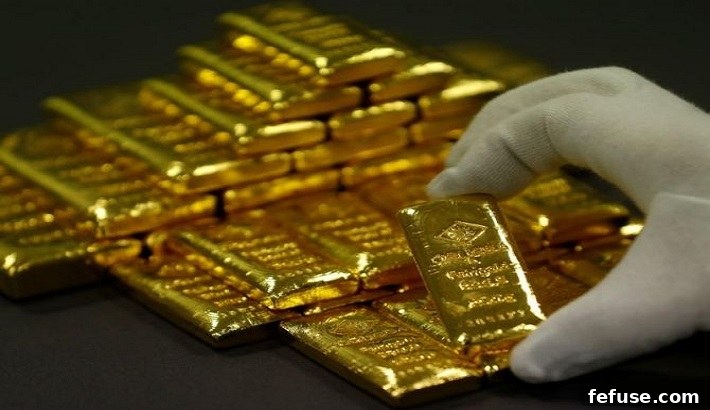
Gold Prices Dip as Global Economic Optimism Soars: What This Means for Investors
In a notable shift for the precious metals market, gold prices experienced a decline to a more than one-week low on Monday. This movement came as stronger-than-expected economic data from China and a robust commencement to the U.S. corporate earnings season collectively alleviated prevalent concerns regarding a global economic slowdown. This resurgence in positive sentiment naturally diminished the traditional appeal of bullion as a safe-haven asset.
Spot gold recorded a marginal decrease of 0.2 percent, settling at $1,288.08 per ounce as of 0330 GMT. Earlier in the trading session, the yellow metal had briefly touched $1,286.44, marking its lowest point since April 5. Concurrently, U.S. gold futures mirrored this trend, falling 0.3 percent to $1,291 an ounce. This immediate reaction underscored the market’s sensitivity to macroeconomic indicators and investor risk appetite.
Market analysts were quick to interpret these movements. Margaret Yang, a seasoned market analyst with CMC Markets in Singapore, elucidated the primary driver behind the price depreciation: “Gold prices have fallen because of improving macro-economic data which is favouring risk-taking.” This succinctly captures the essence of gold’s inverse relationship with global economic confidence. When the economic outlook brightens, investors tend to reallocate capital from safe-haven assets like gold towards riskier, higher-yielding investments such as equities.
Key Catalysts Driving Investor Confidence
Several positive developments converged to foster this improved market sentiment, effectively eroding gold’s allure. Yang highlighted a trifecta of influential factors:
Firstly, China’s economic performance delivered a powerful boost. The country reported better-than-expected figures for both credit growth and export performance. Chinese customs data, released on Friday, revealed a striking 14.2 percent year-on-year increase in exports for March, representing the strongest growth observed in five months. This surge in exports signals renewed vitality in the world’s second-largest economy and a potential easing of global trade tensions, which are crucial for global economic stability.
Secondly, the United States witnessed a positive kick-off to its corporate earnings season. A strong start to earnings reports from major U.S. companies typically instills confidence in the health of corporate America and, by extension, the broader U.S. economy. This robust performance encourages investment in equities, drawing funds away from less speculative assets.
Lastly, burgeoning hopes of a resolution to the protracted U.S.-China trade dispute contributed significantly to the bullish mood. Persistent trade tensions have been a significant source of global economic uncertainty, prompting investors to seek safety in assets like gold. Any indication of progress towards a comprehensive agreement acts as a powerful catalyst for risk-on sentiment.
Global Markets React to Renewed Optimism
The ripple effects of these positive developments were palpable across global financial markets. Asian shares commenced the week on a firm footing, reflecting the optimism emanating from China’s data and trade talks. Furthermore, the safe-haven yen, traditionally sought during periods of uncertainty, hovered near its lowest level for the year, underscoring the diminished demand for defensive assets. This coordinated market response indicates a widespread embrace of risk among investors.
Adding further weight to the positive sentiment surrounding trade, U.S. Treasury Secretary Steven Mnuchin made an encouraging statement on Saturday. He indicated that a potential U.S.-China trade agreement would go “way beyond” previous efforts aimed at opening China’s markets to U.S. companies. Mnuchin also expressed optimism, hoping that the two economic superpowers were “close to the final round” of negotiations. Such high-level pronouncements provide concrete reasons for markets to anticipate a resolution, reducing one of the most significant geopolitical risks that have overshadowed global trade and economic growth for an extended period.
Gold’s Role as a Safe-Haven in Flux
Gold’s unique position in the financial landscape as a hedge against economic and political uncertainty means it inherently suffers when risk sentiment revives. When geopolitical tensions escalate, inflation concerns emerge, or economic growth forecasts dim, investors typically flock to gold, driving its price upwards. Conversely, when the global economy appears stable, and political risks subside, the demand for gold as a protective asset wanes, often leading to price corrections.
The current market environment exemplifies this dynamic. The combination of strong economic data, promising earnings, and progress on trade talks collectively paints a picture of improving global stability. This scenario inherently reduces the perceived need for gold’s safe-haven attributes, making other, more growth-oriented assets appear more attractive to investors seeking returns in a buoyant market.
Monetary Policy and the Opportunity Cost of Gold
Another critical factor influencing gold’s valuation is the trajectory of interest rates and central bank monetary policy. Alfonso Esparza, a senior market analyst at OANDA, provided insight into this aspect: “The U.S. Federal Reserve hit the brakes hard in the first quarter but as data has improved rate cut chances are lower.” This statement refers to the Fed’s more dovish stance earlier in the year, which initially supported gold prices by suggesting lower future interest rates.
However, as economic data continues to strengthen, the likelihood of the Fed maintaining its accommodative stance or even considering rate cuts diminishes. Higher interest rates typically raise the opportunity cost of holding gold. Gold does not offer a yield or pay dividends, unlike bonds or interest-bearing savings accounts. When interest rates are low, the opportunity cost of holding gold is also low, making it a more appealing investment. Conversely, when interest rates rise, investors can earn higher returns from other assets, making gold less attractive by comparison.
Esparza further noted, “If retail sales (due later this week) outperform it would start building a case for an interest rate lift later this year despite the Fed’s dovish turn in January.” Strong retail sales figures would signal robust consumer spending and economic health, potentially prompting the Federal Reserve to reconsider its monetary policy outlook. A move towards hiking interest rates, or even just delaying anticipated rate cuts, would undoubtedly exert further downward pressure on gold prices by increasing the opportunity cost of holding the non-yielding asset.
A Nuanced Global Economic Picture: Challenges Remain
Despite the recent wave of optimism, it is crucial to maintain a balanced perspective on the global economic outlook. Officials in the joint communique of the International Monetary Fund’s (IMF) steering committee offered a sobering reminder that the global economy was still “not out of the woods.” Their assessment highlighted that trade disputes and tighter financial conditions continue to pose significant threats to the pace of global growth. This cautionary note serves as a reminder that while short-term data may appear positive, underlying structural issues and potential headwinds could still influence economic stability and, consequently, the demand for safe-haven assets.
This dual narrative – short-term optimism tempered by long-term concerns – creates a dynamic environment for gold. While current trends favor risk assets, any resurgence of trade tensions, unexpected economic downturns, or geopolitical instability could quickly reignite gold’s appeal. Investors should remain vigilant for shifts in these underlying factors.
Investor Positioning in COMEX Gold
Interestingly, amidst these market dynamics, recent data from the U.S. Commodity Futures Trading Commission (CFTC) indicated a contrasting trend among speculators. The CFTC reported on Friday that speculators actually increased their bullish wagers in COMEX gold in the week leading up to April 9. This suggests that while spot prices reacted to broader macroeconomic news, a segment of the market may be positioning for a potential rebound or hedging against unforeseen risks. Such positioning reflects a diversity of views within the market and underscores that not all investors are convinced of a sustained downturn for gold.
Performance of Other Precious Metals
The broader precious metals complex also experienced varied movements, though generally reflective of the overarching market sentiment. Silver, often dubbed “poor man’s gold” due to its similar safe-haven characteristics but higher industrial demand, remained largely unchanged at $14.95 an ounce. Its relatively stable performance might indicate a slight resilience or differing demand drivers compared to gold in the immediate term.
Spot platinum, another industrially significant precious metal, eased slightly by about 0.1 percent to $885.45 per ounce. Platinum’s prices are heavily influenced by the automotive industry, particularly diesel catalytic converters, and its modest dip could be tied to broader industrial demand expectations rather than pure investment sentiment.
Palladium, which has seen remarkable price rallies in recent years largely driven by its use in gasoline catalytic converters, lost 0.3 percent, settling at $1,368.03 per ounce. Like platinum, palladium’s price movements are strongly correlated with industrial demand and the health of the automotive sector. Its slight decline suggests a minor adjustment in response to the overarching market dynamics or specific industrial outlooks.
Conclusion: A Shifting Landscape for Gold Investors
The recent dip in gold prices highlights a market adjusting to a more optimistic global economic outlook. Stronger data from China, a robust start to U.S. earnings, and renewed hope for a U.S.-China trade deal have collectively bolstered investor confidence, reducing the immediate need for gold’s safe-haven properties. While the Federal Reserve’s monetary policy trajectory and upcoming economic data will continue to be crucial determinants, and the IMF still warns of lingering global economic threats, the current environment points towards a preference for riskier assets.
For gold investors, this period underscores the importance of monitoring not just immediate price movements but also the underlying macroeconomic narrative. Gold remains a vital component of a diversified portfolio, especially as a hedge against unforeseen uncertainties. However, its short-term performance will likely remain sensitive to shifts in global economic health, central bank policies, and geopolitical developments. As the global economy continues to navigate its recovery and growth path, gold’s role will evolve, presenting both challenges and opportunities for those looking to invest in precious metals.