
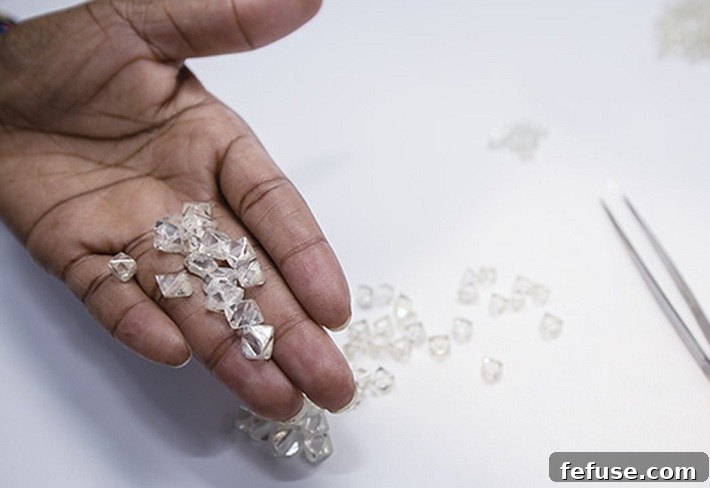
The sparkling world of diamonds has always captivated hearts, symbolizing love, commitment, and enduring beauty. However, with the remarkable advancements in technology, a new player has emerged: lab-grown diamonds. While offering an appealing alternative to their natural counterparts, the rapid rise of these man-made marvels has brought forth a critical challenge – ensuring consumers are fully aware and confident about what they are purchasing. The industry grapples with the imperative of transparent communication, a responsibility that directly impacts consumer trust and the integrity of the market. The core issue revolves around whether companies are adequately educating buyers, guaranteeing that every customer knows, unequivocally, if their treasured stone was unearthed from the earth or meticulously crafted in a laboratory.
The Growing Debate: Lab-Grown vs. Natural Diamonds and Consumer Clarity
Lab-grown diamonds, often referred to as synthetic, cultured, or man-made diamonds, are identical in chemical, physical, and optical properties to natural diamonds. The only fundamental difference lies in their origin: one is formed deep within the Earth over billions of years, while the other is created in a controlled laboratory environment within weeks. This scientific similarity, coupled with often more attractive price points and perceived ethical or environmental benefits, has fueled their surging popularity. Yet, this very resemblance also creates a fertile ground for confusion if proper disclosure is not maintained. Consumers, often making significant emotional and financial investments, deserve absolute clarity about the nature of their purchase. The distinction is not merely academic; it influences value perception, resale potential, and, most importantly, the buyer’s peace of mind.
When Transparency Fails: A Revealing Case Study from Good Morning America
The critical need for clear disclosure was starkly highlighted in a recent segment by Good Morning America, which brought to light a concerning incident of alleged misleading advertising. The story featured Molly Carlson, a consumer whose dream engagement ring turned into a puzzling revelation. Carlson had purchased her diamond ring from an unnamed jewelry store located in a local mall, believing she was acquiring a natural diamond – a classic symbol of eternal love. The narrative took an unexpected turn when, out of curiosity or perhaps a desire for a second opinion, Molly took her ring to another jewelry store. There, a salesperson delivered the surprising news: “Well, I can tell you, it’s not a natural diamond.”
The GMA reporter succinctly affirmed the discovery, stating, “Turns out, Molly’s dream diamond was actually a diamond created in a lab.” This revelation underscored the profound disconnect between the consumer’s expectation and the reality of their purchase. Molly’s fiancé, Scott Long, recounted the buying experience, emphasizing that the salesman at the initial point of sale had meticulously discussed various attributes like style, clarity, and color, yet conspicuously omitted any mention of the stone being lab-grown. This omission, whether intentional or not, directly contributed to Molly’s misunderstanding and highlights a significant gap in consumer education at the retail level. Such incidents erode trust, not only between the individual consumer and the specific retailer but also within the broader diamond industry, raising questions about the ethical practices and commitment to transparency across the board.
The Regulatory Backstop: FTC Guidelines and Consumer Protection
In response to the growing complexity of the diamond market, the Federal Trade Commission (FTC) has established clear guidelines to protect consumers from deceptive practices. As Good Morning America rightly pointed out in its segment, the FTC’s Jewellery Guides are explicit: retailers are legally obligated to “clearly and conspicuously” inform customers if a diamond is man-made. This directive is not a suggestion but a mandatory standard designed to prevent misleading advertising and ensure that buyers possess all necessary information to make informed purchasing decisions. The term “clearly and conspicuously” is crucial; it means the disclosure must be presented in an easily understandable manner, in a prominent location, and in a way that consumers cannot reasonably miss or misunderstand. It’s not enough to bury the information in fine print or on an obscure corner of a website.
Enforcement and Warning Letters: Sending a Clear Message
The FTC has demonstrated its commitment to enforcing these guidelines. Last year, the agency issued warning letters to eight online sellers specializing in lab-grown diamonds and diamond simulants. These letters served as a stern reminder that the FTC is actively monitoring the market for non-compliance. The primary concern cited in many of these warnings revolved around the use of ambiguous or potentially misleading language. For instance, some companies employed phrases like “diamond alternative” without adequately clarifying that these stones were, in fact, lab-grown and not natural diamonds, or that they were simulants (which are not diamonds at all). Such terminology, while not overtly false, can easily create confusion for consumers who may not understand the subtle but critical distinctions.
One of the firms that reportedly received such a warning letter defended its practices, asserting that its product descriptions were clear and that a dedicated section of its website thoroughly explained the production methods of its diamonds. While having explanatory content online is a positive step, the FTC’s emphasis on “clear and conspicuous” disclosure implies that the information must be readily accessible and explicitly stated at every critical touchpoint of the purchasing journey – from initial advertisements to product listings and sales interactions. A consumer should not have to actively search for the true nature of a diamond, especially when making a high-value purchase like an engagement ring.
Empowering the Consumer: Due Diligence in Diamond Acquisition
The responsibility for transparent disclosure primarily rests with retailers and the industry at large. However, consumers also play a vital role in safeguarding their interests by exercising due diligence. Renowned gemologist Antoinette Matlins, in her closing remarks on the GMA segment, offered invaluable advice: prospective diamond buyers should always inquire specifically whether a diamond is lab-grown or natural. More importantly, she stressed the necessity of obtaining this critical information in writing. This documented proof serves as an undeniable record of the transaction and the agreed-upon nature of the diamond, providing a layer of protection against future disputes or misunderstandings.
Key Questions and Documentation for Smart Diamond Buying:
- Direct Inquiry: Always ask the salesperson directly: “Is this a natural diamond, or is it a lab-grown diamond?” Avoid vague terms like “real” or “genuine” as both natural and lab-grown diamonds are “real” diamonds.
- Certification: Request a reputable third-party grading report or certification for the diamond. For natural diamonds, this typically comes from organizations like the Gemological Institute of America (GIA) or the European Gemological Laboratory (EGL). For lab-grown diamonds, certifications are often provided by institutions such as the International Gemological Institute (IGI) or GCAL, explicitly stating that the diamond is ‘laboratory-grown.’
- Sales Receipt Clarity: Ensure that the sales receipt clearly and explicitly states whether the diamond is “natural” or “lab-grown.” Ambiguous language should be questioned and clarified before finalizing the purchase.
- Laser Inscriptions: Many lab-grown diamonds are laser-inscribed on their girdle with “LAB GROWN” or a similar identifier, along with their report number. While not always visible to the naked eye, this inscription is an important identifier and should be noted on the certificate.
- Understand Price Differences: Be wary of prices that seem “too good to be true” for a natural diamond. Lab-grown diamonds typically cost 30-50% less than natural diamonds of comparable quality, so a significant discount might indicate a lab-grown stone, which should then be explicitly disclosed.
The Indistinguishable Sparkle: Why Disclosure is Paramount
The GMA segment concluded with a practical demonstration that powerfully underscored the necessity of explicit disclosure. One of the presenters was presented with two stones – one a natural diamond and the other lab-grown – and challenged to identify which was which. His choice fell on the lab-grown diamond, which he mistakenly believed to be the natural one. This moment perfectly illustrated just how challenging, if not impossible, it is for an uneducated consumer to discern the difference between a natural and a lab-grown diamond with the naked eye. Unlike diamond simulants, such as cubic zirconia or moissanite, which have different optical properties, lab-grown diamonds are chemically, structurally, and optically identical to natural diamonds. Specialized equipment and expert gemological analysis are required to distinguish between them, typically by detecting minute growth patterns or trace elements inherent to their respective formation processes.
This inherent indistinguishability highlights precisely why clear, conspicuous, and consistent disclosure is not merely a legal requirement but an ethical imperative. Without it, consumers are left vulnerable, relying solely on the word of a salesperson or marketing materials. The emotional weight and financial investment associated with diamond purchases demand absolute transparency, ensuring that every buyer understands exactly what they are acquiring, fostering confidence, and allowing them to make choices that align with their values and expectations.
The Future Landscape of Diamond Retail: A Call for Unified Transparency
The evolving diamond market presents both challenges and opportunities. As lab-grown diamonds continue to gain traction, the industry must adapt by embracing a culture of comprehensive transparency. This means not only adhering to current regulations but also proactively implementing best practices that elevate consumer confidence. Clear labeling, prominent displays distinguishing between natural and lab-grown options, detailed product descriptions online and in-store, and well-trained sales associates who can articulate the differences without ambiguity are essential components of this future. A robust, healthy diamond market is one where both natural and lab-grown diamonds can thrive, each appealing to different consumer preferences, but critically, where every purchase is made with full knowledge and understanding. The incidents of consumer confusion serve as a powerful reminder that while technology can create wonders, it is human integrity and ethical practices that build lasting trust in the realm of luxury goods.