
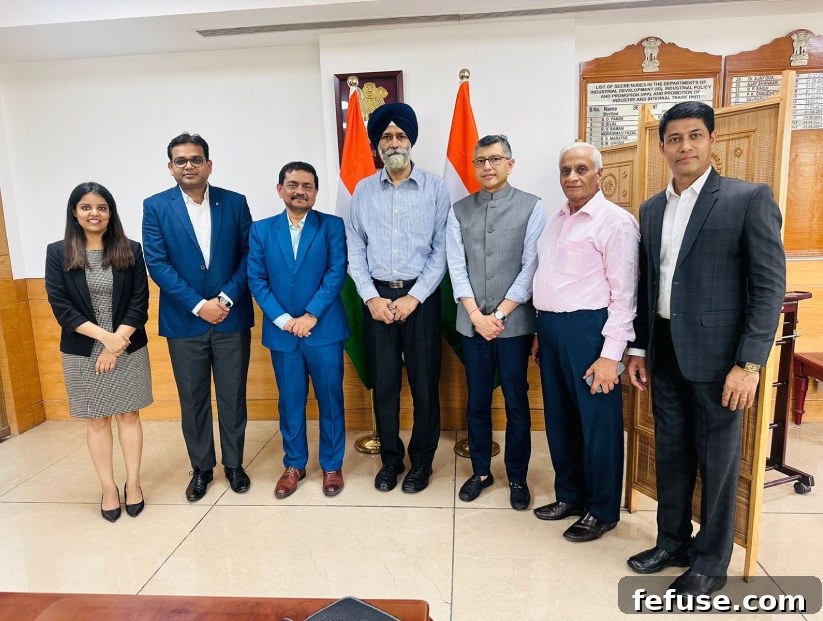
Unlocking Global Potential: GJEPC Spearheads GI Integration in HS Codes for Indian Exports
In a significant move poised to redefine India’s global trade landscape, the Gem & Jewellery Export Promotion Council (GJEPC) actively participated in a crucial stakeholder consultation meeting. Held on August 28, 2024, at Vanija Bhavan in New Delhi, the gathering focused on the strategic implementation of Geographical Indication (GI) specialised identifiers for existing Harmonized System (HS) codes pertaining to Indian GI products. This initiative promises to enhance the traceability, authenticity, and global recognition of India’s unique and heritage-rich offerings, providing a robust framework for their promotion in international markets.
The meeting, chaired by Dr. Himani Pande, IAS, Additional Secretary of the Department for Promotion of Industry & Internal Trade (DPIIT), underscored the Indian government’s commitment to fortifying its intellectual property protection mechanisms and streamlining export processes. It convened a diverse group of senior officials from the Central Board of Indirect Taxes and Customs (CBIC), alongside key stakeholders representing various commodity sectors. GJEPC, as a leading advocate for the gem and jewellery industry, played a pivotal role in articulating the profound benefits and addressing the potential challenges associated with integrating GI status into HS codes, particularly for high-value Indian exports. Mr. Siddhartha, COO, GJEPC, and Mr. Kaushik Ghosh, Assistant Director – Kolkata, GJEPC, represented the organisation, bringing invaluable industry insights to the discussions.
Understanding Geographical Indications (GI) and the Harmonized System (HS) Codes
What is a Geographical Indication? Protecting India’s Heritage and Authenticity
A Geographical Indication (GI) is a sign used on products that have a specific geographical origin and possess qualities or a reputation that are due to that origin. In essence, a GI serves as a certification that a product possesses certain qualities, is made according to traditional methods, or enjoys a certain reputation due to its specific geographic origin. For India, a nation renowned for its diverse cultural heritage and traditional craftsmanship, GIs are immensely vital. They not only protect indigenous knowledge and artistry from exploitation and counterfeiting but also empower local communities and artisans by providing legal protection and market recognition for their unique creations. Products like Darjeeling Tea, Basmati Rice, Mysore Silk, and Kanchipuram Silk are prime examples of Indian GIs that have garnered international acclaim. In the gem and jewellery sector, GIs can cover unique designs, traditional crafting techniques, or even specific origins of gemstones or metalwork, safeguarding the authenticity of “Made in India” luxury goods.
The Harmonized System (HS) Codes: A Global Language of Trade
The Harmonized System (HS) of tariff nomenclature is an internationally standardised system of names and numbers for classifying traded products. Developed and maintained by the World Customs Organization (WCO), it is used by over 200 countries and customs or economic unions worldwide. HS codes are fundamental to international trade, serving as a universal economic language and code for goods. They are crucial for customs authorities to identify products, assess duties and taxes, and collect trade statistics. While incredibly efficient for classifying “what” a product is, the current HS code structure often lacks the granularity to specifically identify the “geographical origin” or “GI status” of a product, leading to challenges in distinguishing authentic GI products from generic imitations in the global marketplace.
The Need for Synergy: Bridging GI and HS Codes for Enhanced Global Recognition
The disconnect between the specific, origin-based nature of GIs and the generic classification of HS codes presents a significant hurdle for countries like India, which possess a wealth of GI-protected products. Integrating GI-specific identifiers into HS codes is a strategic necessity. This integration would allow customs officials worldwide to precisely identify and differentiate genuine Indian GI products at the point of import or export. This targeted identification is crucial not only for better trade statistics but also for effective enforcement against counterfeiting, ensuring fair trade practices, and securing premium market positioning for authentic Indian goods.
The Pivotal Stakeholder Consultation: A Step Towards Enhanced Global Recognition
The Delhi Meeting: Context and Key Players Driving Forward-Thinking Trade Policies
The recent stakeholder consultation meeting in New Delhi represented a concerted effort by the Indian government to address contemporary challenges and opportunities in international trade. Chaired by Dr. Himani Pande from DPIIT, a department instrumental in formulating and implementing policies for industrial growth and foreign trade, the meeting was a testament to India’s proactive approach. The participation of senior officials from CBIC, the apex body for administering customs, GST, and central excise, underscored the operational significance of the discussions. Their involvement is crucial for translating policy decisions into actionable customs procedures. The diverse attendance from various commodity sectors ensured a holistic perspective, acknowledging that the implications of GI-specific HS codes would span across India’s entire export basket, from textiles and handicrafts to agricultural produce and, significantly, gems and jewellery.
GJEPC’s Strategic Advocacy: Protecting and Promoting Indian Craftsmanship
GJEPC’s presence and active advocacy at this high-level meeting were particularly impactful. As the apex body for the gem and jewellery trade in India, GJEPC is acutely aware of the challenges faced by manufacturers and exporters of uniquely Indian designs and products. Their representatives elucidated how the absence of GI identifiers in HS codes often makes it difficult to distinguish authentic Indian jewellery, crafted with traditional techniques or from specific regions, from mass-produced imitations. By integrating GI into HS codes, GJEPC highlighted how the industry could:
- Protect Traditional Designs: Safeguarding patterns, motifs, and crafting methods unique to Indian heritage.
- Prevent Counterfeiting: Establishing a clear global identification mechanism to deter the sale of fake products.
- Command Premium Pricing: Enabling genuine products to fetch their rightful value in international markets.
- Boost Brand India: Strengthening the global perception of Indian craftsmanship and quality.
The insights provided by Mr. Siddhartha, COO, and Mr. Kaushik Ghosh, Assistant Director, were instrumental in shaping the dialogue towards practical, industry-specific solutions.
Anticipated Benefits of GI-Specific HS Codes: A Multifaceted Impact
The successful implementation of GI-specific HS codes is expected to yield a multitude of benefits, revolutionising India’s trade practices and strengthening its position on the global stage:
- Enhanced Traceability and Authenticity: Consumers and buyers worldwide will be able to easily verify the authentic origin and quality of Indian GI products, fostering trust and transparency.
- Combating Counterfeiting and Misrepresentation: Customs authorities will possess a more potent tool to identify and seize counterfeit goods, protecting the integrity of India’s intellectual property and the reputation of its legitimate exporters.
- Streamlined Customs Processes: Clearer identification will lead to more efficient and faster customs clearance for authentic GI products, reducing trade barriers and operational costs.
- Premium Pricing and Market Access: With verifiable authenticity, Indian GI products can command premium prices in international markets, rewarding the skills of artisans and contributing to higher export revenues. This also opens new avenues for market access where authenticity is highly valued.
- Robust Data Collection for Policy Making: The government will gain access to granular data on the export volumes and values of specific GI products, enabling more targeted policy interventions, promotional strategies, and support systems for these crucial sectors.
- Global Brand Building for ‘Brand India’: This initiative significantly contributes to building a stronger “Brand India” image, showcasing the nation’s rich cultural heritage, unique craftsmanship, and commitment to quality on a global scale.
Advancing India’s Jewellery Sector: IJPM and Gati Shakti Initiative
The Vision of India Jewellery Park Mumbai (IJPM): A Hub of Excellence
Beyond the discussions on GI and HS codes, GJEPC senior officials also engaged in a crucial meeting with Mr. Amardeep Singh Bhatia, IAS, Secretary, DPIIT. A key topic of discussion was the ambitious India Jewellery Park Mumbai (IJPM) project. IJPM is envisioned as a state-of-the-art integrated jewellery manufacturing, trading, and exhibition hub designed to consolidate and elevate India’s position as a global leader in the gem and jewellery industry. This mega-project aims to provide world-class infrastructure, cutting-edge technology, and a conducive ecosystem for manufacturing, design innovation, skill development, and international trade facilitation. It promises to attract significant domestic and foreign investment, create thousands of jobs, and substantially boost India’s jewellery exports, transforming Mumbai into an unparalleled global jewellery destination.
Gati Shakti: The Catalyst for Infrastructure Development and Enhanced Logistics
Integral to the success of mega-projects like IJPM is robust logistical support and infrastructure. This is where the Gati Shakti initiative plays a transformative role. The PM Gati Shakti National Master Plan is an ambitious government scheme launched to create a comprehensive, multi-modal connectivity infrastructure across India. Its objective is to break down departmental silos and ensure integrated planning and coordinated implementation of infrastructure projects, including roads, railways, ports, airports, and logistics hubs. For IJPM, Gati Shakti is crucial:
- Improved Logistics Efficiency: Streamlined movement of raw materials, finished goods, and skilled personnel to and from the park.
- Reduced Costs: Lower transportation and warehousing expenses, making Indian jewellery more competitive globally.
- Faster Transit Times: Expedited delivery of products to international markets, enhancing reliability and customer satisfaction.
- Seamless Connectivity: Better integration with national and international supply chains, facilitating easier access to resources and markets.
Gati Shakti’s support is fundamental to realising the full potential of IJPM, aligning with the broader ‘Make in India’ and ‘Ease of Doing Business’ objectives.
High-Level Support: DPIIT’s Endorsement for India’s Trade Ambitions
The meeting with Mr. Amardeep Singh Bhatia, Secretary, DPIIT, yielded highly positive outcomes. Mr. Bhatia not only assured full cooperation and unwavering support from his office for the IJPM project but also explicitly acknowledged the significant advantages that upgraded HS codes for Indian GI products would bring. This high-level endorsement from DPIIT is a powerful affirmation of the government’s recognition of the strategic importance of these initiatives. It signals a strong commitment to fostering an environment conducive to export growth, intellectual property protection, and world-class infrastructure development, reinforcing the synergistic relationship between government policy and industry vision.
The Road Ahead: Fostering Sustainable Growth and Global Leadership
Challenges and Opportunities in a Dynamic Global Trade Environment
While the path to fully integrating GI identifiers into HS codes and establishing mega-projects like IJPM is fraught with implementation complexities, including technological upgrades, extensive training for customs officials, and achieving broader international harmonization, the long-term opportunities far outweigh these challenges. The discussions held during these meetings represent a crucial first step towards navigating these complexities through collaborative effort and innovative solutions. The emphasis on GI protection and robust infrastructure development positions India advantageously in a dynamic global trade environment that increasingly values authenticity, sustainability, and efficiency.
A Collaborative Future for India’s Global Trade Ambitions
The proactive engagement between government bodies such as DPIIT and CBIC, and industry representatives like GJEPC, exemplifies a collaborative model essential for driving national economic growth. This synergy ensures that policy frameworks are practical, responsive to industry needs, and aligned with India’s overarching vision of becoming a global manufacturing and export powerhouse. Continued dialogue, policy refinement, and steadfast implementation will be key to unlocking the full potential of these transformative initiatives.
Elevating India’s Position on the Global Stage
Collectively, the efforts to integrate GI into HS codes, develop world-class infrastructure through IJPM, and leverage the Gati Shakti initiative are set to significantly elevate India’s standing in international trade. They not only promise to boost exports of authentic, high-quality Indian products but also enhance the nation’s reputation as a reliable and innovative trading partner. This strategic alignment of intellectual property protection, infrastructure development, and trade promotion will pave the way for India to secure a prominent and respected position in the global economy, particularly within the competitive and prestigious gem and jewellery sector.
In conclusion, GJEPC’s instrumental role in advocating for GI integration in HS codes, coupled with high-level government support for pivotal projects like India Jewellery Park Mumbai under the Gati Shakti initiative, marks a transformative phase for India’s export sector. These concerted efforts are not merely about improving trade mechanics; they are about safeguarding India’s unique heritage, empowering its skilled artisans, and positioning the nation as an undisputed leader in the global market for authentic, high-quality goods. The future of Indian GI products and its dynamic gem and jewellery industry appears brighter and more globally connected than ever before.