
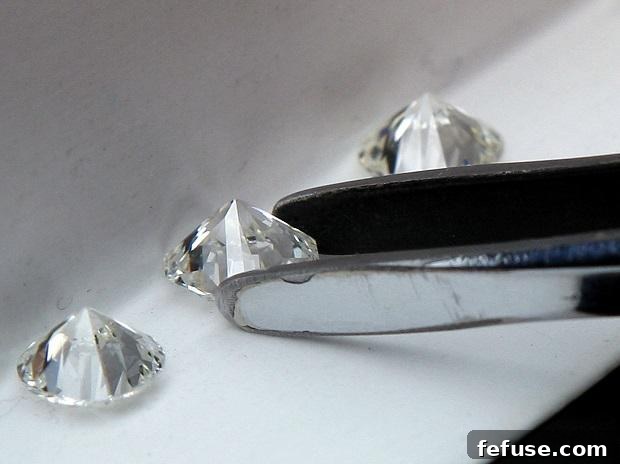
India’s Diamond Industry Shines: GST Rate Cut Unlocks Potential and Boosts Exports
The Indian diamond and jewellery industry, a cornerstone of the nation’s export economy, has received a significant boost following a landmark decision by the GST Council. A sharp reduction in the Goods and Services Tax (GST) rate on polished diamonds promises to free up crucial working capital, alleviate long-standing ambiguities in the tax structure, and effectively deter mis-declaration and tax evasion. This strategic move is poised to rejuvenate the sector, foster transparency, and enhance India’s competitive edge in the global diamond market.
A Closer Look at the GST Rate Reduction and Its Immediate Impact
Effective from Friday, a remarkable 94 percent of diamonds processed within India will now attract a mere 0.25 percent GST, a substantial drop from the previous three percent. This pivotal decision, made by the GST Council on Thursday, brings immense relief and cheer to thousands of diamond processors and jewellery exporters across the country. The remaining six percent of diamonds, primarily those processed in India and sold directly to end-consumers, will, however, continue to be taxed at the three percent rate.
This differential rate is a critical nuance, highlighting the government’s intention to support the industry’s manufacturing and export segments while maintaining a standard levy on domestic retail consumption. The reduction primarily benefits the intricate value chain that involves multiple stages of processing, from rough to polished, and subsequent export, streamlining operations and significantly reducing the financial burden on businesses.
Addressing Core Industry Challenges: Working Capital and Tax Compliance
For months, the Indian diamond industry grappled with an array of challenges stemming from the initial GST structure. One of the most pressing issues was the severe blockage of working capital. Praveen Shankar Pandya, former chairman of the Gems and Jewellery Export Promotion Council (GJEPC), an apex industry body under the Ministry of Commerce, articulated these concerns, stating, “We were trying to convince the government by citing the example of the diamond polishing business in Israel. We had made representations to the finance minister in October about the complex GST structure and the working capital blockage arising out of that.”
Pandya revealed the staggering financial strain on the industry, estimating that approximately Rs 4,500 crore (Rs 45 billion) of working capital was blocked until October due to the GST implementation in July. He projected this figure to have escalated to around Rs 7,500 crore (Rs 75 billion) by the time of the council’s decision. This immense financial squeeze had not only destabilized the intricate processing cycle but also severely impacted export capabilities, hindering growth and profitability for numerous businesses.
The ‘Angadia’ Conundrum and the Fight Against Tax Evasion
The previous GST structure, which imposed 0.25 percent on rough diamonds but a higher three percent on polished stones, inadvertently fueled an undesirable practice involving “angadias.” These unofficial courier services are traditionally used to transport rough diamonds from Mumbai, India’s largest trading hub, to Surat, the country’s largest processing center. Under the old regime, to circumvent the higher tax on polished diamonds, these valuable stones were sometimes transported back to Mumbai as “rough stones” by the same angadias after polishing in Surat. This mis-declaration of parcels led to widespread tax evasion, creating an uneven playing field and undermining the integrity of the tax system.
The revised GST rate is a direct measure to combat this loophole. By significantly narrowing the tax difference between rough and polished diamonds, the incentive for mis-declaration is drastically reduced. This move is expected to bring greater transparency and formalization to the diamond value chain, ensuring that all transactions are recorded and taxed appropriately, thereby fostering a fairer and more compliant business environment.
A Global Perspective: Enhancing India’s Competitive Edge
Historically, India has been a global powerhouse in diamond processing, handling an overwhelming majority of the world’s rough diamonds. However, unlike many other major diamond processing centers worldwide, India’s previous tax structure had been perceived as less “friendly.” Competitor nations often implement highly attractive tax policies, including ‘zero’ tax rates, specifically designed to encourage investment and generate employment within their diamond sectors. These favorable tax regimes allowed them to offer a more conducive environment for businesses, potentially diverting investment away from India.
Union Finance Minister Arun Jaitley, in June 2017, had stated that the objective of levying 0.25 percent GST on rough diamonds was to trace the movement of stones across the value chain. He reiterated this stance when justifying the need for GST on processed diamonds. The current decision to align the rates more closely brings India’s tax framework closer to global best practices, making it more competitive and appealing for both domestic and international investors. This alignment is crucial for maintaining India’s leadership in diamond processing and attracting further investment, which translates directly into job creation and economic growth.
Economic Repercussions and a Surge in Export Momentum
The positive impact of the GST rate cut is anticipated to be far-reaching, with immediate implications for India’s export performance. Data compiled by the GJEPC reveals encouraging trends even prior to the latest rate cut, suggesting a recovery was already underway. Net exports of gems and jewellery skyrocketed to $2.78 billion (Rs 180 billion) in November 2017, a substantial increase from $1.77 billion (Rs 120 billion) during the same month in the previous year.
This sudden spurt in demand, particularly from the United States – the world’s largest jewellery market – brought considerable cheer to Indian exporters. Retailers in the US reported increased consumer footfalls, indicating a robust recovery in global demand. While some of this growth could be attributed to a ‘base effect’ from a weaker previous year, the overall sentiment points towards a strong market rebound. The phenomenal growth recorded in November has effectively covered a significant portion of India’s earlier losses in gems and jewellery exports between April and October of the current financial year. During this seven-month period, the value of outbound shipments had fallen by 13.18 percent, from $21.73 billion (Rs 1,453.31 billion) in the previous year to $19.57 billion (Rs 1,261.72 billion).
A large diamond jewellery exporter emphasized the transformative potential of the rate adjustment, stating, “Many jewellers have started getting GST refunds now, against claims made in July 2017. Hence, the government’s claim for refund in 60 days is not real. Such a long period of working capital blockage had hampered trade. There are around 10 layers through which every diamond has to pass through during the entire value chain of processing. On every channel, a levy of three percent GST worked out a huge sum stuck in the form of tax. The changed rate of 0.25 percent therefore would certainly help boost exports in the coming months.” This sentiment underscores the direct link between reduced tax burden and enhanced export capabilities, allowing businesses to reinvest and scale operations.
Mehul Choksi, Managing Director of Gitanjali Gems, one of India’s largest exporters of branded diamond jewellery, expressed optimism about market recovery, especially in the US. “There has been a phenomenal growth in business recorded in the US. We expect 6-7 percent growth in sales this year over last year,” he remarked, further solidifying the expectations of a robust export season ahead.
Potential Concerns and the Path Ahead
While the industry largely celebrates this development, some concerns have been raised regarding potential unintended consequences. Surendra Mehta, National Secretary of the India Bullion and Jewellers Association (IBJA), voiced his apprehensions via a social media post, stating, “Different GST rate on diamond & precious stone will enable jeweller to split bill in 3 part for sale of jewellery i.e. gold/silver, diamond/precious stone and labour. Govt may lose thousand of crores on this. Also traceability of customer will be lost.”
Mehta’s observation highlights a potential loophole where jewellers might separate components of a jewellery sale – such as gold/silver, diamonds/precious stones, and labor charges – to apply different GST rates, possibly leading to revenue leakage for the government. Furthermore, such bill splitting could complicate efforts to maintain customer traceability, a critical aspect for regulatory compliance and consumer protection. Addressing these concerns will be vital as the new GST structure is implemented and monitored, ensuring that the benefits of simplified taxation are not undermined by new forms of evasion.
Conclusion: Paving the Way for a Brighter Future
The GST Council’s decision to slash the tax rate on polished diamonds marks a pivotal moment for India’s diamond and jewellery sector. By directly addressing the industry’s long-standing grievances regarding working capital blockage, tax ambiguity, and evasion incentives, the government has laid the groundwork for enhanced transparency and accelerated growth. This forward-thinking policy is expected to solidify India’s position as a global leader in diamond processing, attract further investment, stimulate employment, and significantly bolster exports in the coming months and years. While potential challenges, such as the risk of bill splitting, require careful monitoring, the overall sentiment within the industry is overwhelmingly positive, heralding a brighter and more competitive future for Indian diamonds on the world stage.
News Source : business-standard.com