
Navigating the Future: G7 Sanctions and India’s Diamond Industry Compliance
The global diamond industry, a fascinating intersection of natural beauty, intricate craftsmanship, and complex geopolitics, stands at a critical juncture. Representatives from the Group of Seven (G7) nations recently concluded a pivotal fact-finding mission to India, a visit designed to meticulously explore how the nation’s colossal diamond industry can seamlessly integrate with forthcoming sanctions targeting Russian-origin stones. This diplomatic engagement underscores the G7’s commitment to implementing measures that hold significant geopolitical weight, while simultaneously striving to minimize adverse ripple effects on a sector vital to India’s economy and the global luxury market. The overarching goal, as articulated by the Gem & Jewellery Export Promotion Council (GJEPC), which graciously hosted the high-level delegation, is to cause “minimal or no disruption to the sector.” This delicate balancing act reflects the nuanced challenges of global economic policy when confronted with intricate supply chains.
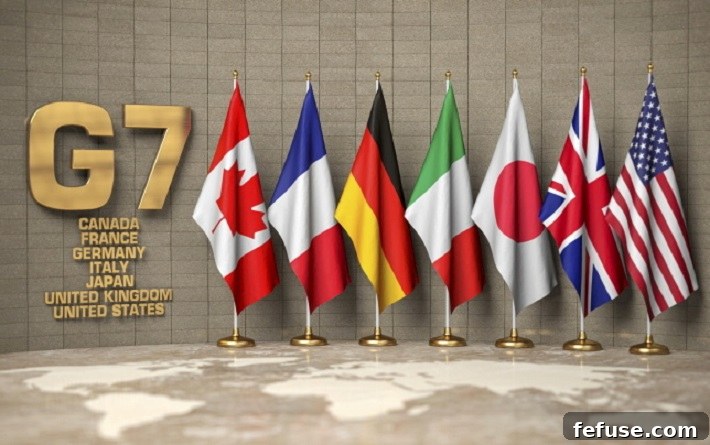
Comprising Canada, France, Germany, Italy, Japan, the United Kingdom, the United States, and with the European Union also playing a crucial role, the G7 bloc collectively accounts for a staggering 70 percent of global diamond sales. Their impending announcement of sanctions, anticipated in the coming weeks and slated to take effect on September 1st, represents a decisive move to exert economic pressure following recent geopolitical events. For India, the world’s undisputed leader in diamond cutting and polishing, compliance with these sanctions is not merely a regulatory obligation but a strategic imperative. The mission’s success hinges on developing robust, verifiable mechanisms that ensure the integrity of the diamond supply chain, providing assurance to consumers and stakeholders worldwide that their purchases do not inadvertently support sanctioned entities.
The Geopolitical Spark: Why G7 Targets Russian Diamonds
The decision by G7 nations to impose sanctions on Russian diamonds stems directly from ongoing geopolitical tensions. Russia, primarily through its state-owned mining giant Alrosa, is a major global producer of rough diamonds. By targeting this revenue stream, the G7 aims to reduce Russia’s financial capacity to fund its military operations, thereby leveraging economic tools to achieve broader foreign policy objectives. This strategy is not without its complexities, given Russia’s deeply integrated position within the global diamond supply chain. For decades, Russian rough diamonds have flowed into major cutting and polishing centers, most notably in India, where they are transformed into finished gems before being distributed to international markets. The proposed sanctions represent a significant reordering of this established trade dynamic, compelling the industry to re-evaluate sourcing strategies and enhance traceability protocols.
The ethical sourcing movement, which has gained considerable traction over the past two decades, also plays a foundational role in the G7’s initiative. Consumers increasingly demand transparency regarding the origin and journey of their diamonds, seeking assurance that their purchases are free from conflict, human rights abuses, and now, geopolitical controversy. The G7’s actions align with a broader global push for greater accountability and transparency across all luxury goods supply chains, positioning these sanctions not just as a political tool but also as a step towards a more ethically conscious marketplace. The challenge, therefore, lies in constructing a system that is both effective in its intent to sanction and practical in its implementation, without inadvertently penalizing legitimate businesses and millions of workers across the globe.
India’s Pivotal Role in the Global Diamond Supply Chain
India’s relationship with diamonds is ancient, deep, and multifaceted. The country has been at the heart of the global diamond trade for centuries, transitioning from a primary source of diamonds to the unrivaled leader in cutting and polishing. The cities of Mumbai and Surat are the twin pillars of this industry. Mumbai, often called the financial capital of India, serves as the primary trading hub, where rough diamonds are imported, and polished diamonds are exported. It houses numerous trading houses, financial institutions, and specialized customs clearance centers crucial for the smooth flow of goods. Surat, in the state of Gujarat, is the world’s largest diamond manufacturing center, responsible for polishing an estimated 90% of all diamonds globally. This unparalleled concentration of skill, infrastructure, and workforce underscores India’s indispensable role in transforming raw geological material into sparkling finished products.
Millions of livelihoods in India are directly or indirectly linked to the diamond industry, from skilled artisans and technicians in polishing units to traders, exporters, and logistics personnel. The industry is a significant contributor to India’s export earnings, making it a critical component of the national economy. Given this immense scale and the sector’s reliance on a consistent supply of rough diamonds, the impending G7 sanctions pose both a substantial challenge and an opportunity for innovation. India’s industry stakeholders, including the GJEPC, recognize the importance of maintaining access to key Western markets, which represent the primary consumer base for polished diamonds. Thus, ensuring compliance becomes paramount, not just for ethical reasons but for the continued economic viability and global standing of India’s diamond sector.
The Fact-Finding Mission: A Bridge to Compliance
The three-day G7 delegation visit, which concluded on a recent Friday (September 29), was meticulously planned to cover key facets of India’s diamond ecosystem. The delegates’ itinerary included crucial stops in both Mumbai and Surat, allowing them to gain a comprehensive understanding of the industry’s operations from various perspectives. Their engagements ranged from high-level governmental meetings to intimate interactions with grassroots traders, reflecting a thorough approach to gathering information crucial for developing effective sanctions policies. This hands-on investigation underscores the G7’s intent to craft sanctions that are not only impactful on the target but also practical for the implementing nations and industries.
Engaging Key Stakeholders Across the Value Chain
In Mumbai, the delegation engaged with small-scale diamond traders at the Mumbai Diamond Merchants’ Association, a vital representative body for a significant segment of the industry. This interaction was crucial for understanding the challenges faced by smaller businesses in complying with complex international regulations. They also visited the Precious Cargo Customs Clearance Centre, a critical facility that manages the secure and efficient transit of high-value goods like diamonds, offering insights into the logistical and administrative frameworks currently in place. These visits provided a ground-level view of the trade’s mechanics and the existing infrastructure for tracking and clearing diamonds.
The mission then moved to Surat, the heart of India’s diamond manufacturing. A significant highlight was their visit to the newly inaugurated Surat Diamond Bourse, a colossal trading and manufacturing hub that epitomizes the scale and ambition of the Indian diamond industry. Here, delegates met with representatives from large, medium, and micro diamond processing units, gaining insights into the varying capacities and readiness levels for adopting new compliance mechanisms. Further consultations included high-ranking Ministry of Commerce officials, reinforcing the governmental commitment to facilitating compliant trade. The delegation also visited the GIA laboratory in Mumbai, a world-renowned gemological institution, to understand the critical role of certification and grading in establishing provenance. Finally, engagement with jewelry manufacturers at the SEEPZ Special Economic Zone provided a perspective on how sanctions might impact the finished jewelry sector and its export capabilities. These diverse interactions were designed to provide a holistic picture of the Indian diamond value chain, from rough import to polished export.
The Path Ahead: Challenges and Innovations in Diamond Traceability
The implementation of G7 sanctions presents significant challenges, primarily centered around the issue of traceability. Diamonds, especially smaller ones, are often mixed from various sources during the cutting and polishing process, making it difficult to definitively prove their origin once they enter the manufacturing stream. The current system, largely reliant on Kimberley Process certification for conflict diamonds, may not be robust enough to track origin by country of mining in the way the new sanctions demand. This “mixing” dilemma is a major hurdle for the Indian industry, which processes diamonds from numerous global sources. Without clear, verifiable segregation or tracking mechanisms, ensuring compliance could become an onerous and potentially disruptive task.
To address these challenges, the industry will need to embrace innovative solutions. Technologies such as blockchain, which offers an immutable ledger for tracking diamonds from mine to market, are being explored as potential game-changers. Enhanced due diligence processes, digitalized supply chains, and robust certification protocols by independent laboratories like GIA (Gemological Institute of America) will become paramount. The GJEPC has already reaffirmed its unwavering commitment to addressing the G7’s concerns over compliance, indicating a proactive approach from the industry’s apex body. This commitment suggests a willingness to invest in new technologies and processes to uphold the integrity of the supply chain and safeguard India’s reputation as a reliable and compliant trading partner. The G7 delegation itself comprised a broad spectrum of international representatives, including members from the U.S. State Department, U.S. Department of Treasury, European Commission, Belgium’s Prime Minister’s office and Foreign Trade Department, and the Japan Embassy in India, highlighting the multifaceted diplomatic and economic coordination involved in this initiative.
Ensuring a Seamless Transition: GJEPC’s Commitment
The GJEPC, as the voice of the Indian gem and jewellery industry, plays a crucial role in facilitating this transition. Their statement about causing “minimal or no disruption” is a testament to their dedication to finding pragmatic solutions. This involves collaborating closely with international bodies, government agencies, and industry players to develop a feasible and effective compliance framework. It may entail educational programs for traders, investment in new tracking technologies, and advocating for a phased implementation that allows the industry sufficient time to adapt. The success of the sanctions will largely depend on the ability of major processing hubs like India to adopt and enforce the new rules without crippling their own economies or inadvertently creating illicit markets. The GJEPC’s proactive engagement with the G7 delegation is a strong indicator of India’s readiness to meet global expectations and secure its future in the international diamond trade.
Broader Implications: Reshaping the Global Diamond Landscape
The impending G7 sanctions on Russian diamonds are set to trigger significant shifts across the entire global diamond landscape. Beyond India, other diamond-producing nations in Africa, Canada, and Australia may see increased demand for their rough diamonds as buyers seek alternative, compliant sources. This could lead to shifts in traditional trade routes and a re-evaluation of long-term sourcing strategies by major manufacturers and retailers. Furthermore, the emphasis on traceability and ethical sourcing is likely to intensify, pushing the industry towards greater transparency and potentially accelerating the adoption of advanced tracking technologies. The long-term implications for Russia’s diamond industry, particularly Alrosa, could be substantial, potentially forcing them to seek new markets or adapt their sales strategies under stringent international scrutiny.
Ultimately, these sanctions are not just about penalizing a specific country; they are about shaping the future of global trade and the ethical considerations that underpin it. The diamond industry, already accustomed to evolving standards (e.g., the Kimberley Process), is once again being challenged to adapt and innovate. The outcome will depend heavily on sustained international cooperation, technological advancements in supply chain management, and the collective will of all stakeholders to uphold ethical and geopolitical responsibilities while maintaining economic viability.
Conclusion: Towards a Sustainable and Compliant Future
The G7 fact-finding mission to India marks a pivotal moment in the ongoing dialogue surrounding Russian diamond sanctions. While the challenges of ensuring full compliance across such a vast and intricate industry are undeniable, the commitment from both the G7 nations and the Indian diamond sector, particularly the GJEPC, to find workable solutions offers a hopeful outlook. The goal of “minimal or no disruption” is ambitious but essential for the livelihoods of millions and the stability of the global diamond trade. As the September 1st deadline approaches, all eyes will be on how India’s industry adapts, innovates, and reinforces its position as a responsible and compliant leader in the global diamond market, balancing economic realities with the imperative of ethical and geopolitical responsibility.