
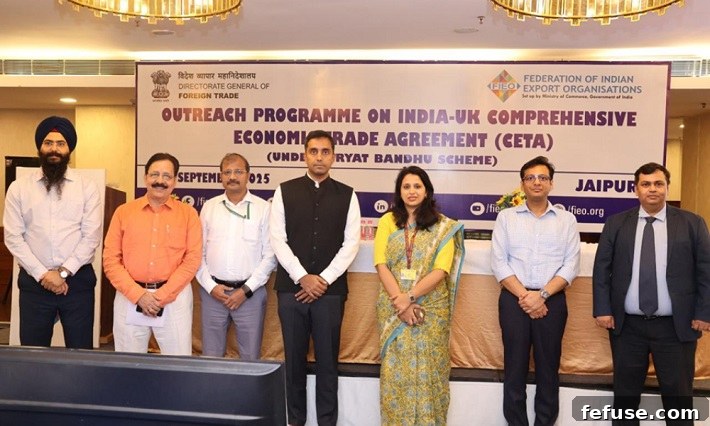
The vibrant city of Jaipur recently served as the crucial venue for an impactful outreach program, strategically organized to empower Indian exporters and illuminate the vast potential encapsulated within the UK-India Comprehensive Economic and Trade Agreement (UK-CETA). This significant initiative, held on September 4th, was a collaborative effort, spearheaded by the Jaipur office of the Joint Director General of Foreign Trade (Jt. DGFT). They partnered with key industry facilitators: the Federation of Indian Export Organisations (FIEO) and the Gem & Jewellery Export Promotion Council (GJEPC), under the guiding framework of the Niryat Bandhu Scheme. The primary objective was clear: to provide comprehensive guidance and practical insights to exporters, enabling them to fully harness the preferential trade terms offered by this landmark agreement and significantly expand their global market presence.
Unlocking UK Market Potential: The UK-India CETA Advantage
The outreach session delved deep into the burgeoning opportunities presented by the UK market, a vital economic partner for India. Exporters received crucial information regarding the pivotal feature of the UK-CETA: the promise of zero-duty access on 99% of tariff lines. This provision is not merely a technical detail; it represents a paradigm shift, opening significant growth avenues and competitive advantages across an extensive range of product categories for Indian businesses. This unparalleled market access is poised to revolutionize bilateral trade, fostering a new era of economic cooperation and prosperity.
The UK-India Comprehensive Economic and Trade Agreement (UK-CETA) is more than just a trade pact; it’s a strategic partnership designed to boost bilateral trade, foster investment, and strengthen the economic ties between two dynamic economies. By eliminating tariffs on nearly all goods, the agreement ensures that Indian products become more competitive in the UK market, making them more attractive to British consumers and businesses. This zero-duty access is particularly beneficial for sectors where India holds a strong manufacturing base and export potential, such as textiles, pharmaceuticals, automotive components, machinery, and agricultural products. For the gem and jewellery sector, a cornerstone of Jaipur’s economy, this means a significant reduction in costs, allowing exporters to offer their exquisite craftsmanship at more competitive prices, thereby increasing their market share and profitability.
Distinguished Leadership and Expert Insights
The event was graced by the esteemed presence of Ms. Vrunda Desai, Addl. DGFT, New Delhi Zone, who presided over the proceedings, underscoring the high-level commitment to export promotion. Her leadership set a comprehensive tone for the discussions, emphasizing strategic trade policies. The gathering also saw active participation from other prominent figures instrumental in facilitating India’s trade objectives:
- Mr. Moin Afaque, Jt. DGFT, Jaipur, who provided local insights and reinforced the government’s dedication to supporting regional exporters.
- Mr. Swadesh Deepak, Branch Manager, ECGC, Jaipur, offered invaluable perspectives on export credit insurance, risk mitigation, and financial support mechanisms crucial for businesses venturing into international markets. His insights helped exporters understand how to secure their transactions and navigate potential financial challenges.
- Mr. Nitin Khandelwal, Regional Director, GJEPC, brought sector-specific expertise, particularly relevant given Jaipur’s prominence as a hub for gems and jewellery. He detailed how the UK-CETA would specifically benefit this high-value sector, discussing market trends, design preferences, and compliance standards within the UK.
- Mr. Bhupinder Singh, Regional Manager, FIEO, represented the broader export community, highlighting the role of industry bodies in fostering a conducive environment for trade and providing practical support to Indian exporters across various sectors.
The Imperative of Exporter Preparedness and Government Proactiveness
A recurring theme among the distinguished speakers was the critical importance of preparedness among Indian exporters. To fully capitalise on the preferential trade terms offered by the UK-CETA, businesses must not only understand the agreement’s benefits but also equip themselves with the necessary knowledge and operational efficiencies. This includes thorough market research, adherence to international quality standards, efficient supply chain management, and robust compliance with rules of origin. Speakers elaborated on the need for exporters to understand the specific requirements of the UK market, including product certifications, labelling standards, and consumer preferences, ensuring their products meet the discerning demands of British consumers.
The dialogue also prominently underscored the Indian government’s proactive and multi-faceted efforts to raise awareness about such trade agreements. These initiatives are designed to build the capacity of Indian businesses, ensuring they are well-informed and well-equipped to compete effectively on the global stage. By investing in capacity-building programs and fostering a supportive trade environment, the government aims to strengthen India’s competitive positioning in international markets. This proactive approach includes facilitating access to market intelligence, providing training on export procedures, and offering platforms for direct engagement between exporters and trade experts, all aimed at simplifying the export process and maximizing opportunities.
Niryat Bandhu Scheme: A Catalyst for Export Growth
The outreach program, conducted under the banner of the Niryat Bandhu Scheme, exemplifies the government’s commitment to nurturing a strong export culture. The Niryat Bandhu Scheme, literally meaning “Friend of Exporters,” is a dedicated initiative focused on mentoring new and potential exporters and providing them with the necessary knowledge and skills to navigate the complexities of international trade. It serves as a vital bridge, connecting aspiring exporters with seasoned professionals and expert guidance. Through workshops, seminars, and interactive sessions like the one held in Jaipur, the scheme aims to demystify export procedures, highlight market opportunities, and instill confidence in businesses looking to expand globally. This comprehensive approach is essential for increasing India’s overall export volume and diversifying its product and market base.
Expanding India’s Global Trade Footprint and UK Market Opportunities
This initiative forms an integral part of a broader, concerted drive to equip Indian exporters with the essential knowledge and practical tools required to thrive in the competitive global marketplace. The ultimate goal is to significantly expand the country’s global trade footprint, making Indian products and services more accessible and desirable worldwide. Simultaneously, the UK-CETA is expected to unlock a myriad of new and lucrative opportunities specifically within the dynamic UK market. This expansion is not just about increasing export volumes; it’s about enhancing brand India, fostering innovation, and creating sustainable economic growth across various sectors.
The UK market, known for its high purchasing power and sophisticated consumer base, offers a premium destination for quality Indian goods. From traditional handicrafts and textiles to advanced engineering products and IT services, the potential for growth is immense. The removal of trade barriers through UK-CETA significantly reduces the cost of doing business, making Indian exports more attractive and competitive. This strategic partnership is anticipated to lead to substantial growth in bilateral trade, benefiting countless businesses and creating employment opportunities within India. The collaboration between government bodies and industry associations like DGFT, FIEO, and GJEPC is critical in ensuring that the benefits of such agreements trickle down to even the smallest exporters, enabling them to dream bigger and compete globally.
Conclusion: A New Era of India-UK Trade Partnership
The Jaipur outreach program stands as a testament to the collaborative spirit and strategic vision driving India’s export growth agenda. By bringing together government officials, industry leaders, and exporters, it created a vital platform for dialogue, education, and networking. The UK-India Comprehensive Economic and Trade Agreement represents a landmark achievement, promising to redefine the economic relationship between the two nations. With zero-duty access on 99% of tariff lines, Indian exporters are now poised to significantly enhance their presence in the UK market. The continued emphasis on exporter preparedness, coupled with the proactive support provided by schemes like Niryat Bandhu, will be instrumental in translating the theoretical benefits of UK-CETA into tangible economic gains. As India strives to achieve its ambitious export targets, such focused and well-executed initiatives will undoubtedly play a crucial role in strengthening its global trade footprint and fostering a prosperous future for its exporting community.