
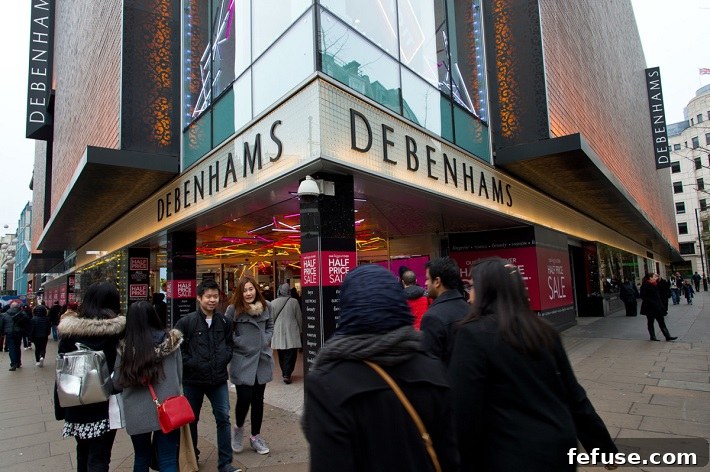
The venerable British department store chain, Debenhams, has confirmed that all of its remaining physical branches across the UK will permanently close their doors over the coming days, marking the poignant end of an era for a brand that has been a cornerstone of the British high street for 242 years. This monumental closure follows the acquisition of the business by online fashion retail giant Boohoo Group, a deal that signals Debenhams’ complete transformation into a digital-only entity.
For generations of shoppers, Debenhams was more than just a store; it was an institution, a go-to destination for everything from fashion and beauty to homeware and gifts. Its departure leaves a significant void and serves as a powerful symbol of the ongoing seismic shifts within the retail industry, particularly on the traditional high street.
Debenhams Bids Farewell to the High Street: A Historic Closure
The final days of Debenhams’ physical presence are now upon us, as the company prepares to complete the closure of its last 101 stores. This phased shutdown began on Saturday, May 8th, with 52 stores ceasing operations. The remaining 49 branches are scheduled to welcome customers for the very last time on either Wednesday, May 12th, or Saturday, May 15th, depending on their specific location. Each store has maintained rigorous COVID-secure measures right up until its appointed closure time, ensuring a safe final shopping experience for customers seeking to take advantage of the last-chance deals.
This systematic closure plan marks the definitive end of Debenhams’ physical retail journey, a journey that began in London in the late 18th century. The finality of these closures underscores the relentless pressures faced by traditional retailers in an increasingly digital world, a challenge that even historic brands like Debenhams could not overcome in their original format.
The Final Countdown: Store Closure Schedule
As the last operating days unfold, a palpable sense of nostalgia and urgency fills the air. The initial wave of 52 store closures on May 8th saw customers flocking to grab final bargains and bid farewell. The concluding phase, with stores closing on May 12th or May 15th, represents the ultimate curtain call for the brand’s physical footprint. Shoppers across the country are keenly aware that this is their very last opportunity to experience Debenhams in its traditional setting, adding a unique sentimentality to their final visits.
The End of a 242-Year Legacy: From Grandeur to Online-Only
The story of Debenhams began in 1778, when William Debenham established a drapers’ store on London’s Wigmore Street. Over more than two centuries, it grew into a formidable department store empire, synonymous with quality, variety, and the quintessential British shopping experience. For much of its history, Debenhams was a dominant force, expanding across the UK and into international markets, consistently adapting its offerings to reflect changing consumer tastes. It was a destination where generations purchased wedding dresses, school uniforms, festive gifts, and everyday essentials, cementing its place in the fabric of British society.
However, the past two decades have seen the retail landscape undergo radical transformation. The relentless rise of e-commerce, coupled with shifts in consumer spending habits and increased competition, chipped away at Debenhams’ foundations. Despite numerous attempts at restructuring, administrations, and store closures in recent years, the business ultimately succumbed to these pressures, exacerbated significantly by the global COVID-19 pandemic.
The Boohoo Acquisition: A New Chapter, Digitally Defined
In January 2021, Boohoo Group announced its acquisition of the Debenhams brand and its associated intellectual property for a sum of £55 million. Crucially, this acquisition explicitly excluded Debenhams’ physical stores, its existing inventory, or any of its operational infrastructure. Boohoo’s strategy is clear: to resurrect Debenhams as a purely online fashion and beauty retailer, leveraging its established brand recognition while shedding the expensive and complex overheads of a traditional department store chain.
This move is a testament to the power of brand equity in the digital age. Boohoo, itself a success story born from the e-commerce boom, aims to breathe new life into Debenhams by integrating it into its agile, online-centric business model. The ambition is to recapture a segment of Debenhams’ former customer base while also attracting new, digitally native shoppers to the revitalized online platform. This transition represents a stark example of how legacy brands are being reimagined and repurposed for a future dominated by digital commerce.
Unpacking the Decline: Factors Contributing to Debenhams’ Downfall
The demise of Debenhams as a physical retailer is a complex narrative, woven from multiple threads of economic, societal, and technological change. While often attributed solely to online competition, a confluence of factors contributed to its eventual downfall. Years of underinvestment in its physical estate, mounting debt, and a struggle to differentiate itself in an increasingly crowded market all played significant roles. The traditional department store model, with its vast overheads, extensive staff, and large property portfolios, became increasingly unsustainable in a retail environment demanding speed, agility, and competitive pricing.
Shifting Sands of Retail: E-commerce Dominance and Changing Consumer Behavior
The most prominent factor was undoubtedly the relentless rise of e-commerce. As consumers gravitated towards the convenience, choice, and often lower prices offered by online retailers, footfall in physical stores dwindled. Debenhams, while having an online presence, struggled to adapt its legacy infrastructure and business processes to compete effectively with agile, digital-first competitors. Changing consumer habits, including a preference for experiential shopping, ethical sourcing, and personalized services, also challenged the traditional department store model that Debenhams represented.
The Pandemic’s Accelerating Role
The COVID-19 pandemic served as the ultimate accelerant for Debenhams’ decline. Multiple national lockdowns forced non-essential retailers to close for extended periods, severing vital revenue streams and exacerbating existing financial vulnerabilities. Even after reopening, capacity restrictions and lingering consumer apprehension further suppressed sales. For a business already on the brink, the pandemic delivered a fatal blow, making continued physical operation untenable despite the best efforts of its management and employees.
The Grand Finale: Unmissable Deals as Doors Close
As Debenhams enters its final days of trading, customers are being urged to seize what is truly their last opportunity to shop within its physical stores. The closing down sale features staggering discounts of up to 80% across a wide range of products, including fashion, beauty, and home items. This unprecedented sale aims to clear remaining stock, offering incredible value to savvy shoppers looking for a final bargain.
A spokesperson for Debenhams articulated the bittersweet sentiment surrounding these last moments: “We are now heading into the final days of our closing down sale, and this is the very last chance for our customers to take advantage of some incredible deals. With up to 80% off across our remaining stores, customers are urged to shop now while stocks last. Over the next 10 days, Debenhams will close its doors on the high street for the final time in its 242-year history.” The message underscores the urgency and finality of this historic event, inviting customers to participate in the ultimate farewell.
A Heartfelt Message from Debenhams
The spokesperson also extended a poignant message of gratitude, reflecting on the long and illustrious journey of the brand: “Our sincere thanks go out to all of our colleagues and customers who have joined us on this journey. We hope to see you all one last time in stores before we say a final goodbye to the UK high street.” This sentiment highlights the profound human impact of the closures, acknowledging the dedication of its workforce and the loyalty of its customer base who have supported Debenhams for generations. It’s a touching recognition of the community that formed around the brand, even as it transitions into a new form.
Beyond Debenhams: The Evolving Landscape of UK Retail
The permanent closure of Debenhams’ physical stores is more than just the end of one retail giant; it’s a stark indicator of the fundamental restructuring occurring throughout the UK retail sector. Its departure signals a continued shift away from traditional, large-format department stores and towards more specialized, experiential, or purely online retail models. The high street, once dominated by such behemoths, is now being reimagined, with former retail spaces being repurposed for residential use, leisure, or smaller, independent businesses.
This transformation presents both challenges and opportunities. While thousands of retail jobs have been lost, the evolution also spurs innovation, forcing retailers to adapt or face obsolescence. The focus is increasingly on omnichannel strategies, where physical stores complement online operations, offering unique experiences that cannot be replicated digitally. The future of retail in the UK will likely feature a more diverse and dynamic landscape, driven by technology, sustainability, and highly personalized customer engagement.
What’s Next for the Debenhams Brand Under Boohoo?
Under the stewardship of Boohoo, the Debenhams brand is set to embark on an entirely new journey. Boohoo plans to launch a new, dedicated Debenhams.com website, aiming to capitalize on the enduring brand recognition and its heritage in fashion and beauty. The strategy will likely focus on leveraging Boohoo’s expertise in fast fashion and digital marketing to offer a curated selection of products, potentially targeting a younger, value-conscious demographic while also appealing to Debenhams’ traditional customer base through accessible online channels.
This rebirth as an online-only entity underscores Boohoo’s confidence in the brand’s intrinsic value, even without its physical presence. The challenge for Boohoo will be to retain Debenhams’ essence of quality and variety while integrating it into a lean, digital-first operation, proving that a brand can indeed shed its physical shell and thrive anew in the vast expanse of the internet.
Conclusion: A Symbol of Retail’s Ongoing Transformation
The final curtain call for Debenhams’ physical stores marks a truly historic moment in British retail. It is the end of an illustrious 242-year chapter for a brand that has served generations of customers and employed countless individuals. While the closure of its stores is undoubtedly a sad occasion for many, it also serves as a powerful testament to the relentless forces of change sweeping through the global retail landscape. Debenhams’ transformation into a purely online business under Boohoo’s ownership represents not just an ending, but also a bold experiment in how legacy brands can adapt and endure in the digital age. As the high street continues to evolve, Debenhams’ story will remain a pivotal reference point for understanding the challenges and opportunities that define the future of shopping.