
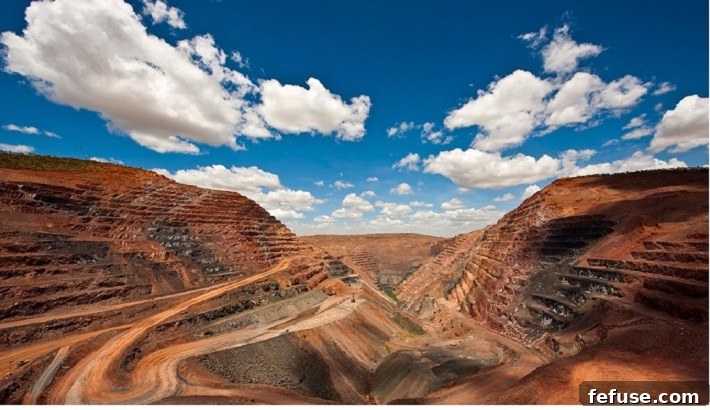
The Australian diamond mining landscape is on the brink of a monumental shift following Rio Tinto’s anticipated closure of the Argyle mine in 2021. This event is set to drastically reduce Australia’s rough diamond output by a staggering 99 percent, according to projections from GlobalData. The nation’s annual mining output is expected to plummet from its current level of 14.2 million carats to a mere 137,000 carats, marking the end of an era for one of the world’s most significant diamond producers.
For decades, the Argyle mine in Western Australia has been a global powerhouse, renowned not only for its vast production volume but, more famously, for being the primary source of the world’s rare pink, red, and violet diamonds. Its impending closure, attributed to the economic viability challenges and the gradual depletion of its ore body, signifies a profound turning point for the Australian resources sector and the global diamond market alike. This dramatic reduction underscores Australia’s almost complete reliance on Argyle for its diamond supply, especially since the suspension of the Ellendale mine in 2015, which followed the collapse of Kimberley Diamond Company.
The End of an Era: Argyle Mine’s Legacy and Impact
The Argyle diamond mine, located in the remote East Kimberley region of Western Australia, has been an extraordinary contributor to the global diamond supply since its operations began in 1983. Its unique lamproite pipe deposit yielded an incredible volume of diamonds, including the highly coveted and exceedingly rare pink diamonds, which commanded extraordinary prices and captured the world’s imagination. The mine’s closure isn’t merely a reduction in output; it represents the loss of a unique source of these precious gems, which will undoubtedly impact the high-end jewellery market and the overall availability of coloured diamonds.
The decision by Rio Tinto to close the mine was not sudden but the culmination of years of evaluation, as the ore body became progressively deeper and less economically viable to extract. While the closure of a mine is a natural part of the mining lifecycle, the sheer scale of Argyle’s production and its special place in the diamond industry makes this particular event exceptionally impactful. The 99 percent projected decline in Australia’s rough diamond output illustrates the profound void Argyle leaves behind, prompting urgent questions about the future of diamond mining in the country.
Australia’s Diamond Production: A Dramatic Downturn
The statistics provided by GlobalData paint a stark picture: a drop from 14.2 million carats to 137,000 carats. This isn’t just a minor fluctuation; it’s a near-total cessation of large-scale diamond production within Australia. For a nation that has consistently been a significant player in the global diamond market, this represents a significant economic and industrial challenge. The immediate impact will be felt across various sectors, from local employment in the Kimberley region to the broader Australian export economy, which will lose a valuable commodity stream.
Furthermore, the global rough diamond market will need to adjust to the absence of Argyle’s substantial supply, particularly its unique fancy coloured diamonds. While the overall volume of global diamond production might not be severely affected by 137,000 carats, the specialized segment of pink and red diamonds will face unprecedented scarcity, likely driving up prices for these already premium gems. This shift creates both challenges for buyers and potential opportunities for any future discoveries of similar deposits, although such occurrences are exceedingly rare.
The Hope for Revival: Focus on the Ellendale Mine
Amidst the somber news surrounding Argyle, there is a glimmer of hope rooted in the Ellendale mine. Situated in Western Australia, Ellendale was once a major global source of fancy yellow diamonds, known for their vibrant hue and unique sparkle. Its operations were suspended in 2015 following the financial difficulties of Kimberley Diamond Company, which led to its collapse. Since then, the Western Australian Government has proactively undertaken significant rehabilitation work at the site, demonstrating a clear commitment to its potential future.
According to GlobalData senior mining analyst Vinneth Bajaj, the Western Australian Government is actively seeking a new operator to re-start mining activities at Ellendale. This initiative is crucial for the potential revival of Australia’s diamond industry. Re-establishing Ellendale’s production could, at least partially, fill the void left by Argyle’s closure, especially for the market segment that values fancy yellow diamonds. The successful re-opening of Ellendale would not only bring back diamond production but also stimulate regional employment and economic activity.
Exploration Efforts and Promising Projects
The prospect of new diamond discoveries is keeping optimism alive within the Australian mining sector. Several mining companies are reportedly engaged in active exploration activities across Western Australia, striving to identify potential new deposits that could one day replace some of Argyle’s lost output. Companies such as Lucapa Diamond Company, Merlin Diamonds, Auteco Minerals, GeoCrystal, and Legend International are among those committed to unlocking Australia’s remaining diamond potential.
One particularly encouraging development comes from Lucapa Diamond Company. The company has reported positive results from its exploration efforts at the Brooking project, which is strategically located near the abandoned Ellendale site. This proximity suggests that Brooking might share similar geological characteristics with Ellendale, potentially yielding fancy yellow diamonds or other valuable diamond types. Such positive initial results are vital for attracting further investment and demonstrating that Australia still holds promising diamond prospects beneath its ancient landscape. These exploration activities are critical in the short to medium term to map out the future of diamond mining in the country.
Vinneth Bajaj commented on the immediate future, stating, “In the short term, there are no projects lined up that could replace even part of the output from the Argyle mine. However, there are positive signs that the Australian diamond industry could be revived.” This balanced perspective highlights the immediate challenge while maintaining a long-term outlook of cautious optimism. The intensive capital required for diamond exploration and mining, coupled with the inherent geological complexities, means that any new significant discovery and subsequent development would take considerable time.
Challenges and Opportunities for Australia’s Diamond Industry Revival
The path to reviving Australia’s diamond industry is fraught with challenges. The high upfront costs associated with diamond exploration, compounded by the often-elusive nature of significant kimberlite or lamproite pipes, demand substantial investment and a high tolerance for risk. Furthermore, navigating complex regulatory frameworks, ensuring environmental sustainability, and securing social license to operate within Indigenous communities are all critical aspects that new projects must address. Market volatility for rough diamonds also poses a risk, making long-term investment decisions more complex.
Despite these hurdles, Australia retains several compelling advantages. Its vast and geologically rich landmass remains underexplored for diamonds in many regions. The country boasts a well-established mining infrastructure, a skilled workforce, and a stable political environment, which are attractive factors for international mining companies. The global demand for high-quality, ethically sourced diamonds remains robust, particularly for unique coloured diamonds. If new deposits can be identified and economically developed, Australia could re-establish its position, perhaps with a focus on niche markets such as fancy yellows or other coloured varieties.
Long-Term Outlook for Australian Diamond Mining
The closure of the Argyle mine undeniably marks the end of a golden era for Australian diamond production in terms of sheer volume. However, it also opens a new chapter, one focused on intensive exploration and the potential for new, albeit possibly smaller or more specialized, discoveries. The Western Australian Government’s proactive stance on Ellendale, coupled with ongoing exploration by various companies, signals a collective determination to prevent the complete demise of a once-thriving industry. The future might see a diversified diamond industry in Australia, less reliant on a single mega-mine and more focused on uncovering unique, high-value deposits.
The coming years will be critical in determining whether the optimism surrounding Ellendale and other exploration projects translates into tangible results. Success in these ventures would not only bring economic benefits to Western Australia through job creation and revenue generation but also help maintain Australia’s global presence in the diamond supply chain. While the magnitude of Argyle’s output may never be fully replicated, the potential for Australia to remain a significant source of unique and valuable diamonds is a compelling narrative for the future.
News Source: idexonline