
Johnkoivulaite: Unveiling a New Mineral and Honoring a Gemological Legend
In a landmark discovery that underscores the relentless pursuit of knowledge in the fields of gemology and mineralogy, researchers from the Gemological Institute of America (GIA), in close collaboration with scientists from the prestigious California Institute of Technology (Caltech), have officially confirmed a new mineral species. This remarkable find, a 1.16 carat crystal, has been aptly named johnkoivulaite – a profound tribute to the esteemed microscopist and GIA researcher, John Koivula, whose contributions have profoundly shaped the industry. This groundbreaking confirmation by the International Mineralogical Association (IMA) marks a significant moment, highlighting the vital role of scientific collaboration and the dedication of individuals in expanding our understanding of the Earth’s hidden treasures.
The journey of johnkoivulaite began in the famed Mogok Valley of Myanmar, a region renowned globally for its exceptional gemstones. It was here that local gemologist Nay Myo first uncovered the crystal, recognizing its unique potential. The formal announcement of this newly named mineral, a moment anticipated by the scientific community, was made by GIA Senior Research Scientist Aaron Palke at the Geological Society of America (GSA) conference on September 25th in Phoenix, Arizona, bringing this exciting discovery to the forefront of geological discourse.
The Significance of Naming a Mineral After John Koivula
The decision to name this new mineral after John Koivula is a testament to his unparalleled impact on gemology. Tom Moses, executive vice president and chief laboratory and research officer at GIA, articulated this sentiment: “We are privileged to be able to name this mineral after John Koivula who has contributed so much to science and the gem and jewelry industry as a prominent gemologist and innovator in photomicrography.” This statement perfectly encapsulates the immense respect and admiration Koivula commands within the scientific and professional communities. His work, spanning over four decades, has not only advanced scientific understanding but also inspired countless individuals in the gem and jewelry sector.
Moses further emphasized the broader implications of such discoveries, stating, “Discoveries such as this remind us of the importance of our mission-based research and of the numerous important contributions John has made in his more than four decades of scientific work.” This highlights GIA’s unwavering commitment to foundational research, which often leads to breakthroughs that benefit the entire industry, from miners and gemologists to jewelers and consumers. Naming johnkoivulaite after Koivula ensures his legacy is forever etched into the very fabric of mineral science, a fitting honor for a man who has dedicated his life to uncovering the microscopic wonders within gemstones.
Johnkoivulaite: A Detailed Gemological Profile
Johnkoivulaite presents a fascinating case study in mineralogy, exhibiting a hexagonal crystal structure that closely resembles beryl and other members of the illustrious beryl group. This group includes well-known and highly prized gemstones such as emerald, aquamarine, morganite, and the rare pezzottaite, to which johnkoivulaite shows particular kinship. Its close structural relationship offers tantalizing clues about its formation conditions and geological environment, opening new avenues for research into mineral genesis.
Standard gemological testing revealed a distinct set of properties for johnkoivulaite. It boasts a refractive index (RI) of 1.608. While it exhibits birefringence, it is remarkably subtle, too small to be accurately measured by conventional methods, suggesting a high degree of optical isotropy despite its hexagonal structure. The specific gravity (SG) was recorded at 3.01, indicating its density. With a hardness rating of 7½ on the Mohs scale, johnkoivulaite is durable enough for use in jewelry, placing it among minerals like quartz and tourmaline in terms of wearability. Its fracture is conchoidal, a characteristic clean, shell-like break typical of many crystalline materials. Furthermore, it possesses a vitreous luster, giving it a glass-like sheen, and importantly, it shows no reaction to either long-wave or short-wave ultraviolet (UV) light, which aids in its identification and differentiation from other minerals.
The Unique Pleochroism of Johnkoivulaite
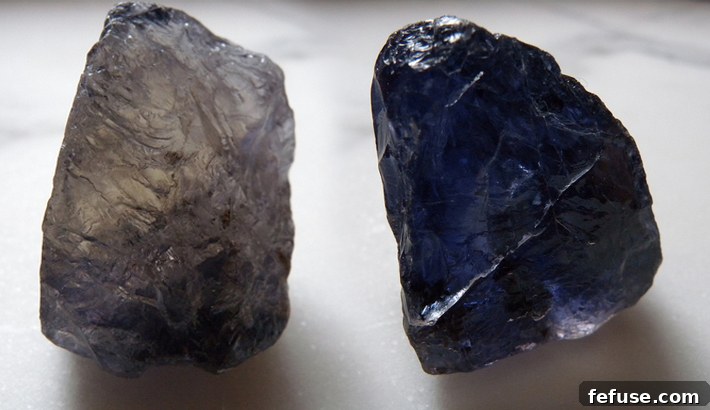
What truly sets johnkoivulaite apart and makes it an exceptionally unique mineral is its pronounced pleochroism. When observed under polarized light, the crystal displays a remarkable shift in color, transitioning from a deep, rich violet to a nearly colorless state. This striking optical phenomenon, where a mineral appears to be different colors when viewed from different angles, is a captivating characteristic that adds to its scientific intrigue and potential aesthetic appeal. Such strong pleochroism is a key diagnostic feature for gemologists and adds to the allure of this new discovery, potentially making it a prized specimen for collectors and researchers alike.
A specimen of this newly identified mineral has found its permanent home within the esteemed GIA museum collection, housed at the Institute’s world headquarters in Carlsbad, California. This placement ensures that johnkoivulaite will be preserved for future generations of scientists, students, and enthusiasts, serving as a tangible testament to ongoing advancements in mineralogical science and GIA’s pivotal role in these discoveries.
John Koivula: A Life Dedicated to Gemological Innovation
John Koivula’s career spans more than four decades, marked by an unwavering dedication to research and photomicrography. His profound expertise lies in the intricate world of gemstone inclusions – the tiny internal features that tell the unique story of a gem’s formation and origin. Koivula elevated photomicrography from a technical process to an art form, revealing the hidden beauty and scientific importance of these microscopic landscapes within gemstones.
In 1986, Koivula, alongside the legendary Edward J. Gübelin, co-authored the seminal work, Photoatlas of Inclusions in Gemstones. This groundbreaking publication revolutionized gemological education and research, providing an unprecedented visual guide to internal features that aid in identification, origin determination, and treatment detection. Its immense popularity led to two additional volumes, solidifying its status as an indispensable resource for gemologists worldwide. The Photoatlas didn’t just document inclusions; it taught readers how to interpret them, turning what might seem like imperfections into invaluable geological fingerprints.
Beyond the Photoatlas series, Koivula’s prolific writing career includes The Microworld of Diamonds, a deep dive into the fascinating internal characteristics of the world’s most coveted gemstone. He also co-authored Geologica with Robert Coenraads, further showcasing his broad intellectual curiosity and collaborative spirit in expanding the understanding of Earth sciences as they relate to gems. His clear, engaging writing style, combined with his exceptional photographic skill, has made complex gemological concepts accessible to a wide audience.
Accolades and Enduring Influence
John Koivula’s many contributions have garnered widespread acclaim and numerous prestigious awards, underscoring his towering influence in the gemological community:
- He received the American Gem Society’s (AGS) Robert M. Shipley Award, an honor recognizing outstanding service to the society and the gem and jewelry industry.
- The Accredited Gemologists Association (AGA) bestowed upon him the Antonio C. Bonanno Award for Excellence in Gemology, celebrating his exceptional achievements and leadership in the field.
- GIA honored him with the Richard T. Liddicoat Award for Distinguished Achievement, acknowledging his significant, long-term contributions to the Institute and gemology.
- His artistic and scientific prowess in photomicrography was recognized internationally when he won first place in Nikon’s highly competitive Small World Photomicrographic Competition in 1984, showcasing his mastery of capturing microscopic beauty.
- Further cementing his status as an industry titan, he was named one of JCK magazine’s 64 Most Influential People in the Jewelry Industry in the 20th Century, a testament to his profound and lasting impact.
These accolades reflect not only Koivula’s technical skill and scientific rigor but also his ability to communicate complex ideas compellingly, inspiring generations of gemologists to look deeper into the stones they study.
GIA’s Mission and the Future of Gemological Research
The discovery of johnkoivulaite serves as a powerful reminder of GIA’s unwavering commitment to its core mission: to ensure public trust in gems and jewelry through its research, education, and laboratory services. GIA’s extensive research initiatives are vital for advancing the scientific understanding of gemstones, identifying new materials, and developing sophisticated techniques for detection of treatments and synthetics. This ongoing work is fundamental to maintaining transparency and integrity within the global gem trade.
The collaboration between GIA and institutions like Caltech exemplifies the interdisciplinary nature of modern scientific inquiry. By pooling resources and expertise, researchers can tackle complex challenges and make discoveries that would be difficult for any single institution to achieve alone. This collaborative model is crucial for pushing the boundaries of knowledge in mineralogy, crystallography, and materials science.
Furthermore, discoveries of new minerals, like johnkoivulaite, contribute significantly to our broader understanding of geological processes. Each new mineral provides unique insights into the specific conditions – temperature, pressure, and chemical environment – under which it formed. This helps scientists to better comprehend Earth’s dynamic crust, mantle, and deep interior, shedding light on the planet’s evolutionary history. For the gemological community, identifying a new mineral means expanding the catalog of known gem materials, potentially introducing new sources of beauty and value to the market, and presenting new challenges and opportunities for identification and characterization.
Conclusion: A Lasting Legacy in Stone
The confirmation of johnkoivulaite as a new mineral species is more than just a scientific footnote; it is a vibrant narrative of discovery, collaboration, and profound respect. It immortalizes the name of John Koivula, a man whose visionary work in photomicrography and unwavering dedication to gemological research has illuminated the hidden worlds within gemstones. His legacy, now literally cast in stone, will continue to inspire aspiring gemologists and researchers to explore the intricate beauty and scientific wonders that lie beneath the surface.
This discovery reaffirms the Mogok Valley’s status as a treasure trove of geological marvels and highlights the invaluable role of local gemologists like Nay Myo in bringing these wonders to light. It also underscores GIA’s foundational role in scientific advancement, demonstrating how mission-driven research, coupled with strategic collaborations, continues to expand our knowledge of the natural world and uphold the integrity of the gem and jewelry industry. Johnkoivulaite stands as a brilliant new chapter in the ongoing story of mineralogy, a testament to human curiosity and the enduring allure of the Earth’s precious gifts.