
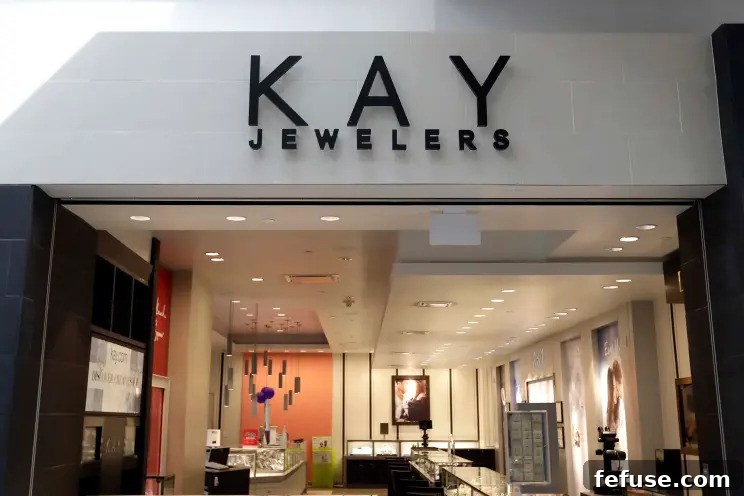
Signet Jewelers, the world’s largest retailer of diamond jewelry, recently unveiled its financial results for the fourth quarter and full fiscal year 2026. The report paints a picture of resilience and strategic navigation amidst a challenging economic landscape, demonstrating the company’s ability to maintain a steady course during a highly competitive holiday season while reflecting moderate growth over the full year.
Navigating a Competitive Holiday Season: Q4 FY26 Performance
For the quarter ending February 1, 2026, Signet Jewelers reported revenue of $2.35 billion, a figure that remained broadly unchanged when compared to the same period in the previous year. This stability in top-line revenue during the critical holiday trading period is noteworthy, particularly given the prevailing market conditions. The holiday season is traditionally a peak period for jewelry sales, but FY26 saw heightened promotional activity across the retail sector, signaling an intensely competitive environment where retailers vied for consumer dollars.
Despite the overall revenue holding steady, comparable store sales experienced a slight decline of 0.7%. This modest dip offers valuable insight into consumer behavior during the quarter, indicating a degree of cautious spending. Factors such as persistent inflationary pressures, fluctuating interest rates, and general economic uncertainties likely contributed to consumers being more discerning with their discretionary purchases. The aggressive promotional landscape also meant that achieving sales required more strategic discounting and marketing efforts, impacting overall sales dynamics.
The fourth quarter’s performance underscores Signet’s foundational strength, as it managed to hold its ground in revenue despite these significant headwinds. It highlights the effectiveness of its brand portfolio and customer engagement strategies in retaining market share even when consumers are exercising greater financial prudence.
Full-Year Resilience and Growth: FY26 Highlights
Looking at the broader annual picture, Signet Jewelers showcased commendable resilience. For the full fiscal year, the company recorded total revenue of $6.81 billion. More impressively, same-store sales for the year rose by a healthy 1.3%. This growth in same-store sales is a key indicator of underlying demand and the effectiveness of Signet’s retail strategies, demonstrating that core customer interest in jewelry remained robust despite ongoing macroeconomic pressures. These pressures, including geopolitical uncertainties and supply chain fluctuations, could have easily deterred discretionary spending, yet Signet managed to capture moderate growth.
The sustained performance throughout the year suggests that Signet’s diversified brand portfolio, which includes well-known names like Kay Jewelers, Zales, Jared, and Diamonds Direct, caters effectively to a wide range of customer preferences and price points. This strategic breadth allows the company to adapt to shifting consumer trends and economic conditions, bolstering its overall market position.
Strategic Product Assortment and Pricing Drive AUR Improvement
A notable achievement for Signet during the fiscal year was an improvement in its average unit retail (AUR). This positive trend was primarily driven by the company’s commitment to refined product assortments and strategic pricing initiatives. By carefully curating its offerings, Signet was able to present consumers with products that resonated with current tastes and provided enhanced value.
Refined product assortments signify a dedication to innovation and responsiveness to market demands. This could involve introducing new collections, enhancing existing lines with contemporary designs, or focusing on personalized and experiential jewelry options that appeal to modern consumers. Strategic pricing, on the other hand, involves optimizing price points across its vast inventory to balance competitiveness with profitability.
Interestingly, this improvement in AUR occurred even as discounting levels increased towards the end of the year. This seemingly contradictory trend can be explained by Signet’s ability to sell higher-value items or a more favorable mix of products, even while offering promotions on specific categories or during peak sale events to remain competitive during the intense holiday rush. It demonstrates a sophisticated approach to inventory management and sales tactics, ensuring that strategic promotions do not entirely erode the value proposition of its premium offerings.
Profitability Reflects Market Normalization
While revenue showed stability and full-year growth, profitability experienced a notable decline compared to the previous year. Fourth-quarter net income stood at $261.9 million, or $5.59 per diluted share. This figure was significantly lower than the stronger performance recorded in the prior year. Similarly, for the full year, net income reached $363.6 million.
This decline in profitability, however, is not necessarily a cause for alarm but rather a reflection of a more normalized earnings environment. The preceding period had benefited from an unusually high base, driven by unique market conditions such as pent-up demand during the post-pandemic recovery phase and elevated consumer spending on goods. As the market returned to more typical patterns, and with the increased promotional activity seen in FY26, a recalibration of profit margins was anticipated.
The competitive landscape, characterized by aggressive pricing and promotional strategies, inherently places pressure on gross margins. Coupled with potential increases in operational costs and investments in strategic initiatives, a moderation in net income aligns with broader industry trends as retailers adjust to evolving consumer behaviors and a more predictable economic climate after a period of unprecedented volatility.
Leadership Insights: Strengthening Brands and Customer Engagement
J.K. Symancyk, Signet Jewelers’ CEO, provided an optimistic outlook, noting that trading trends improved progressively throughout the fourth quarter, culminating in encouraging momentum during key holiday moments. This suggests that the company’s strategies gained traction as the season unfolded, effectively capturing consumer interest during peak purchasing times.
Symancyk reiterated the company’s unwavering focus on strengthening its core brands and deepening customer engagement, central pillars of its long-term growth roadmap. Strengthening core brands involves continuous investment in brand identity, marketing campaigns that resonate with target demographics, and maintaining the quality and allure associated with names like Kay, Zales, and Jared. Deepening customer engagement goes beyond transactional sales, encompassing personalized customer service, loyalty programs, and enhancing the omnichannel shopping experience—seamlessly integrating online and in-store interactions.
These strategic priorities are crucial for sustainable growth in the jewelry sector, where brand trust and emotional connection play a significant role in purchasing decisions. By fostering stronger relationships with its customers, Signet aims to build enduring loyalty and drive repeat business, securing its position as a preferred jeweler.
Operational Excellence Drives Strong Cash Flows
Joan Hilson, Signet’s COO and CFO, highlighted the company’s commitment to operational excellence, attributing strong cash flow generation to disciplined expense control and tighter inventory management. These operational efficiencies are vital in a competitive retail environment, allowing the company to optimize its cost structure and maximize liquidity.
Disciplined expense control involves rigorous monitoring and management of operational expenditures, identifying areas for cost savings without compromising service quality or strategic investments. Tighter inventory management means optimizing stock levels, reducing carrying costs, and minimizing the need for heavy markdowns, thereby protecting profit margins and improving overall operational efficiency. For a business with a vast and diverse inventory like Signet, effective inventory management is a complex but critical component of financial health.
The result of these efforts was impressive: free cash flow exceeded $500 million for the year. Generating such substantial free cash flow underscores Signet’s robust financial health and its ability to fund future investments, manage debt, and return capital to shareholders, reflecting a strong command over its working capital and operational processes.
Confidence Reflected in Dividend Increase
In a clear demonstration of confidence in its financial stability and future outlook, Signet Jewelers announced an increase in its quarterly dividend to $0.35 per share. A dividend increase is often interpreted by investors as a strong signal from management regarding the company’s sustained profitability and positive prospects. It reflects a belief that Signet’s cash flow generation is stable and sufficient to support increased shareholder returns, even as it continues to invest in its growth strategies.
This move reassures shareholders about the company’s long-term viability and its commitment to delivering value, reinforcing investor confidence during a period of economic uncertainty. It also highlights the effectiveness of the disciplined financial management practices praised by the COO and CFO.
Forward-Looking Strategy: “Grow Brand Love” and Operational Focus
Looking ahead, Signet Jewelers has outlined clear strategic priorities aimed at navigating the still-uncertain economic landscape and capitalizing on future opportunities. The retailer plans to prioritize margin improvement, operational efficiency, and continued investment in its “Grow Brand Love” strategy.
Margin improvement will be a key focus, likely through a combination of strategic pricing, optimizing product mix towards higher-margin items, and further enhancing supply chain efficiencies. Operational efficiency will continue to be a cornerstone, involving the streamlining of processes, leveraging technology for better inventory and store management, and optimizing the workforce to enhance productivity.
The “Grow Brand Love” strategy is an overarching framework designed to foster deeper connections with customers across its brand portfolio. This strategy likely encompasses initiatives centered on personalized customer experiences, innovative product development, impactful marketing campaigns, and enhancing the overall emotional resonance of jewelry purchases. It’s about creating lasting relationships and brand advocates, not just making sales.
As Signet navigates an economic environment that remains unpredictable, with factors like consumer confidence, inflation, and discretionary spending trends constantly evolving, its focus on these strategic pillars positions it for adaptive growth. By emphasizing customer loyalty, operational strength, and financial prudence, Signet Jewelers aims to solidify its market leadership and continue thriving in the dynamic world of retail jewelry.