
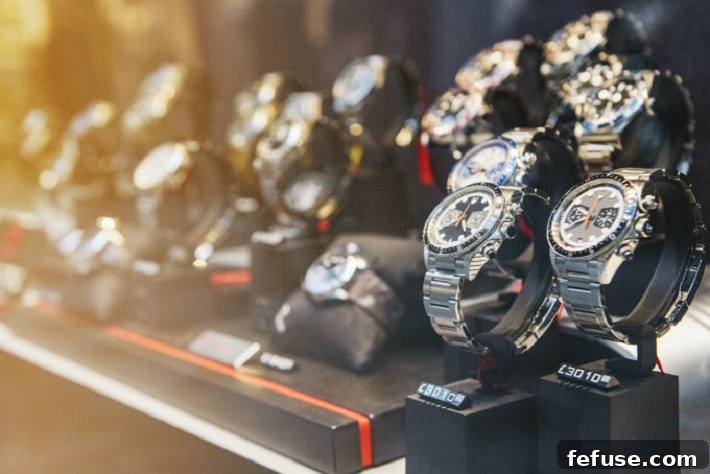
The esteemed Swiss watch industry, a global beacon of precision engineering and timeless luxury, faced an unprecedented and severe downturn in April, as evidenced by data released by the Federation of the Swiss Watch Industry FH. Exports plummeted by a staggering 81.3 percent year-on-year, a direct consequence of the widespread supply chain disruptions and plummeting consumer demand brought about by the rapidly escalating global pandemic. This dramatic contraction underscored the profound and immediate impact of the crisis on one of Switzerland’s most iconic and economically significant sectors, sending shockwaves throughout the luxury goods market worldwide.
The severity of the crisis was acutely felt across all major export markets, each recording substantial double-digit losses that reflected the pervasive nature of the global economic slowdown and retail closures. Hong Kong, a long-standing vital hub for luxury watch sales and a key gateway to the Asian market, experienced an 83.2 percent decline. The United States, consistently one of the largest and most influential markets for high-end timepieces, saw exports fall by an alarming 86.4 percent. Similarly, South Korea registered a 68.6 percent drop, while Japan, another significant market for luxury goods, contracted by 85.9 percent. Even Germany, a resilient European market, recorded an 82.1 percent decrease, highlighting the universal impact of the pandemic’s restrictions on consumer spending and international trade.
The widespread nature of this downturn was further emphasized by the fact that export performance remained remarkably consistent across all price segments, both in terms of value and volume. From entry-level luxury watches to haute horlogerie masterpieces, no segment of the market was insulated from the immediate economic fallout. This uniform impact indicated that the crisis was not merely a shift in consumer preference or a sector-specific issue, but rather a fundamental disruption to global commerce, consumer mobility, and discretionary spending. The unprecedented scale of travel restrictions, retail store closures, and pervasive economic uncertainty contributed to an environment where purchasing luxury items became a low priority for many consumers globally.
Amidst this landscape of severe contraction, one market stood out as a beacon of comparative resilience: China. In a stark contrast to the dramatic declines seen elsewhere, China exhibited a notably slower pace of decline, providing a glimmer of hope for the beleaguered industry. The Federation of the Swiss Watch Industry FH specifically highlighted China’s unique trajectory, stating, “China was the only country to buck the trend. Exports there fell by 16.1 per cent in April following an increase in March, illustrating the recovery in the Chinese market.” This exceptional performance underscored China’s advanced stage in recovering from the initial pandemic wave and its robust domestic market’s capacity to drive consumption, even as much of the world remained in various stages of lockdown and economic stagnation.
The relatively swift recovery observed in the Chinese market was a testament to several factors, including the country’s early and decisive actions to contain the virus, its rapid return to manufacturing and economic activity, and strong governmental stimulus measures designed to boost domestic consumption. For the Swiss watch industry, China’s performance was not just a statistical anomaly; it represented a strategic pivot point. As a direct result of this differentiated performance, China’s share of Swiss watch exports surged significantly, accounting for an impressive third of all exports last month. This substantial proportion cemented China’s status as an indispensable market for the long-term health and stability of the Swiss watch sector, particularly in times of global economic volatility.
The global pandemic forced luxury watch brands to re-evaluate their entire operational framework, from intricate supply chains to distribution networks and consumer engagement strategies. Traditional retail, often characterized by high-touch experiences in opulent boutiques, was severely compromised by lockdowns and social distancing measures. This compelled many brands, historically cautious about digital commerce, to accelerate their investment in e-commerce platforms and sophisticated online marketing strategies. The shift towards digital was not merely a temporary fix but an irreversible acceleration of an ongoing trend, positioning online channels as increasingly crucial components of future sales and brand building.
Beyond the immediate financial impact, the crisis also spurred deeper introspection within the industry regarding resilience and diversification. The intricate global supply chains, previously optimized for efficiency and cost-effectiveness, were revealed to be vulnerable to widespread disruptions. Discussions emerged about the need for more localized production, diversified sourcing of components, and robust contingency plans to mitigate future shocks. This push for greater supply chain resilience aims to ensure that the delicate balance of craftsmanship and precision, which defines Swiss watchmaking, can withstand unforeseen global events without compromising quality or timely delivery.
The profound impact on international travel further complicated matters, as travel retail typically constitutes a significant portion of luxury watch sales. With borders closed and tourism grinding to a halt, sales in duty-free zones and popular tourist destinations evaporated. This necessitated a renewed focus on engaging local consumer bases and fostering brand loyalty within domestic markets. Brands began to tailor marketing campaigns and exclusive offerings to cater specifically to local preferences, strengthening their presence within individual countries rather than relying heavily on transient international shoppers.
Looking ahead, the recovery of the Swiss watch industry is intrinsically linked to the broader global economic recovery, the successful deployment of vaccines, and the gradual restoration of consumer confidence. While the immediate shock of April 2020 was profound, the industry has historically demonstrated remarkable resilience and adaptability. However, the path to full recovery is expected to be gradual and uneven, varying significantly by market and dependent on prevailing health and economic conditions. The lessons learned from this period are likely to shape strategic decisions for years to come, emphasizing agility, digital innovation, and a nuanced understanding of diverse global markets.
Ultimately, the crisis served as a powerful reminder of the enduring allure and intrinsic value of Swiss watches. Despite the temporary disruption, the core appeal of exceptional craftsmanship, innovative design, and a rich heritage continues to resonate with collectors and enthusiasts worldwide. The industry is poised to emerge stronger, having undergone a necessary period of transformation and adaptation, ready to continue its legacy of producing some of the world’s most coveted and meticulously engineered timepieces for generations to come. The critical role of key markets like China, alongside a strategic reinvention of global engagement, will undoubtedly define the industry’s trajectory in the post-pandemic era, ensuring the timeless ticking of Swiss precision continues its journey.