
Global Jewelry Market Trends: Navigating Mixed Holiday Sales, Economic Shifts, and Policy Impacts
The global jewelry market presents a tapestry of contrasts, marked by both cautious sentiment and moments of extraordinary brilliance. As the holiday season—a crucial barometer for the industry’s health—draws to a close, initial reports reveal a complex landscape. While some of the largest industry players experienced softer sales, high-end independent jewelers often reported robust growth, signaling a segmentation in consumer behavior. Simultaneously, a strengthening U.S. economy offers a foundation for optimism, yet geopolitical shifts and supply chain dynamics introduce an element of unpredictability. This comprehensive analysis delves into the critical factors shaping the jewelry sector, from the nuanced performance of holiday retail and pivotal economic forecasts to the dazzling spectacle of high-value auctions and the profound ramifications of a major policy change in India.
Holiday Season Sales: A Segmented Performance Overview
The highly anticipated holiday selling period, often responsible for a significant portion of annual revenue, brought forth a varied set of results across different segments of the jewelry industry. This divergence underscores evolving consumer preferences and the resilience of luxury spending even amidst broader economic shifts.
Challenges for Large-Scale Jewelry Retailers
Several prominent jewelry operations, including leading online retailer Blue Nile, initially reported tepid sales numbers as the holiday season commenced. This trend was further evidenced by the financial disclosures of industry giant Signet Jewelers, the parent company of household brands like Kay, Zale, and Jared. Their latest quarterly financials indicated a 2% decline in sales, reflecting the ongoing challenges these mass-market retailers face in a rapidly transforming retail environment. Blue Nile, a pioneer in online diamond sales, also saw a 4.3% decrease in sales, suggesting that even digital-first models are not immune to market pressures and increased competition. The iconic luxury brand Tiffany & Co., despite its global prestige and brand recognition, managed only a modest 1% sales increase, a recovery from declines in the two preceding quarters, but still indicative of a market demanding strategic adaptation.
The softness wasn’t confined to Western markets. Hearts on Fire, a distinguished diamond brand owned by Hong Kong-based retail powerhouse Chow Tai Fook, experienced a 9% decline in worldwide sales during the fall quarter. Adding to the regional headwinds, Chow Tai Fook’s Hong Kong and China sales witnessed a significant 23.5% drop in the last quarter. These figures collectively paint a picture of cautious consumer spending among mainstream buyers and potential cooling in key Asian luxury markets, traditionally strong engines for the global jewelry trade.
The Resilience of High-End Independent Jewelers
In stark contrast to the mixed performance of larger chains, the luxury independent jewelry market showcased remarkable strength. A revealing survey conducted by Centurion Magazine, a respected publication for high-end jewelers, reported an encouraging trend: 60% of luxury jewelers experienced sales gains through the critical Black Friday and Cyber Monday shopping period. More impressively, nearly one-third (28%) of these independents reported increases exceeding 10%, highlighting a robust demand from affluent consumers. While 25% reported slight sales declines of 5% or less, the overall sentiment among this exclusive segment was overwhelmingly positive. This dichotomy suggests that discerning buyers, often less affected by economic fluctuations, continue to invest in unique, high-quality pieces, personalized service, and the intrinsic value offered by independent luxury boutiques. Furthermore, broader market indicators from “The Street,” a prominent stock market news site, observed a healthy 7.1% uptick in combined store and online holiday sales across various retail sectors, indicating an underlying consumer appetite that luxury independents were particularly adept at capturing.
Economic Forecasts and the Diamond Market: A Dual Perspective
Beyond the immediate retail performance, the long-term health and direction of the diamond industry are intricately linked to global economic projections and the delicate balance of supply and demand. Expert analyses offer both optimistic outlooks and strategic warnings.
Optimism Driven by Economic Recovery
A comprehensive report from ABN Amro, a leading lender to the diamond industry, projects a significant improvement in the U.S. economy throughout the upcoming year. This positive momentum in the world’s largest consumer market is expected to drive a substantial increase in diamond demand. The report also anticipates a slight but meaningful upturn in the Chinese economy, another pivotal market for luxury goods. These economic accelerations are forecast to reverse the trend of slow but steady erosion of polished diamond prices that has characterized the preceding 18 months. An invigorated consumer base in major economies typically translates into higher disposable income, increased consumer confidence, and a greater willingness to make significant luxury purchases, all directly benefiting the diamond sector and potentially stabilizing, if not elevating, polished diamond values.
Addressing the Potential for a Supply Glut
However, this optimistic outlook is tempered by a crucial caveat from a recent Bain & Company report. The analysis highlighted a growing imbalance within the diamond pipeline: producers have consistently been selling more rough diamonds than the downstream manufacturing and retail sectors can sustainably absorb. If this trend continues unchecked, it could lead to a significant supply glut in the coming year, potentially exerting renewed downward pressure on prices across the entire value chain. An oversupply of rough material eventually translates into an excess of polished diamonds, challenging the fundamental economic principles of supply and demand. This situation necessitates a more disciplined approach from diamond producers to align their output closely with actual market absorption capacity, thereby maintaining price stability and ensuring sustainable growth for all stakeholders, from miners to jewelers.
Luxury Diamond & Gemstone Auctions: Showcasing Unrivaled Rarity
While mainstream retail faced its challenges, the high-stakes world of luxury diamond and gemstone auctions continued to thrive, serving as a powerful testament to the enduring appeal and investment potential of truly rare and exceptional pieces. After an initial period of quiet, the fall auction season concluded with a series of spectacular sales, featuring multi-million-dollar fancy colored diamonds that captivated collectors and set new benchmarks.
Record-Breaking Sales by Global Auction Houses
The prestigious auction houses of Christie’s and Sotheby’s hosted events that drew global attention. At Christie’s Nov. 29 Hong Kong sale, a breathtaking GIA-graded 4.29 carat Fancy Vivid blue diamond achieved an astonishing price of $11.8 million, translating to an impressive $2.7 million per carat. Blue diamonds of such intense color saturation and significant size are exceptionally rare, making them among the most coveted assets for discerning collectors and investors. This magnificent sale was complemented by the acquisition of the historic 10.7 carat “Ratnaraj” ruby, which fetched $10.2 million, further underscoring the robust demand for top-tier colored gemstones with provenance.
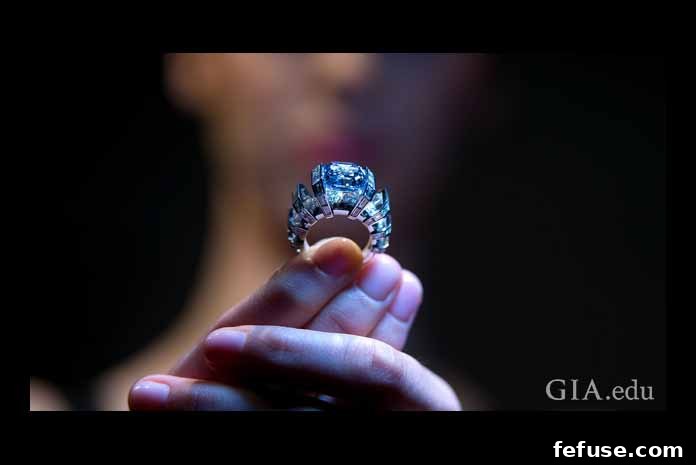
Sotheby’s Geneva sale also posted spectacular results, with the entire auction totaling more than $136 million. The undisputed star of the evening was the exquisite 8.01 carat “Sky Blue” diamond, also graded Fancy Vivid blue by GIA, which commanded a winning bid of just over $17 million, or approximately $2.1 million per carat. Another significant highlight was a 7.74 carat Fancy Deep blue diamond, which sold for a substantial $3.7 million, equating to around $1.7 million per carat. These sales consistently reinforce the extraordinary value attributed to blue diamonds, particularly those exhibiting the highest grades of color intensity.
Christie’s Nov. 15 Geneva auction proved equally impressive, with a remarkable 35 lots surpassing the $1 million mark. Among these, a stunning 9.14 carat Fancy Vivid pink pear-shaped diamond garnered significant attention, achieving a final price of $18.2 million, translating to an impressive $2 million per carat. Pink diamonds, especially those graded Fancy Vivid, are among the rarest and most sought-after diamonds globally, often appreciating significantly in value due to their extreme scarcity. The auction also featured a magnificent pair of GIA-graded D Flawless pear-shaped diamonds, weighing an astounding 52.55 carats and 50.47 carats respectively, which together sold for a combined $17.6 million. These flawless, colorless diamonds represent the pinnacle of traditional diamond beauty and continue to attract discerning collectors seeking perfection in their investments.

Global Trade Dynamics: India’s Demonetization and Its Far-Reaching Effects
Beyond market trends and the dazzling world of auctions, geopolitical and economic policy decisions can have profound and immediate impacts on the intricate global jewelry supply chain. A recent, abrupt policy change in India served as a powerful example of such an impact, creating significant ripples across its domestic markets and indirectly affecting international trade.
A Bold Policy and Its Immediate Market Disruption
In a drastic and unexpected move, Indian Prime Minister Narendra Modi announced an immediate ban on 500 and 1000 rupee notes (equivalent to approximately $7.35 and $14.70 USD at the time) for all cash transactions, effective by December 30. This monumental policy was introduced with the stated goals of cracking down on “unaccounted wealth,” combating the financing of terrorism, and suppressing other subversive activities. The decision sent immediate shockwaves through the country’s retail and wholesale markets, causing widespread chaos and confusion. The severity of the disruption stemmed from the fact that these particular denominations comprised an overwhelming 86% of the cash in circulation by value, effectively paralyzing a significant portion of India’s heavily cash-dependent economy.
The immediate fallout for the gem and jewelry sector was profound and far-reaching. The severe cash crunch forced the cancellation or postponement of several critical end-of-year trade fairs, which are vital platforms for networking, sales, and inventory replenishment within the industry. The largest affected event was the highly anticipated December 23-26 Jaipur Jewellery Show, a cornerstone for both the Indian and international gem trade, which had to be postponed indefinitely to an unstated date the following year. Furthermore, Gemfields, a leading colored stone miner known for its ethical sourcing, also canceled its scheduled Jaipur auction of emerald and beryl, which was slated for the same period. These cancellations resulted in significant financial losses for exhibitors and buyers, disrupted established sales pipelines, and introduced a considerable degree of uncertainty throughout the entire supply chain.
Economic and Regulatory Implications
The demonetization policy mandated that individuals holding the now-invalid bills deposit them into their bank accounts by the December 30 deadline, albeit with strict limits on bank withdrawals. This measure, while primarily designed to bring “black money” into the formal economic system, also significantly constrained liquidity for countless small and medium-sized businesses and individual citizens. Complementing this, the government’s Ministry of Finance simultaneously tightened reporting requirements for all cash transactions exceeding $3,000, aiming to enhance transparency and further combat illicit financial flows. These comprehensive regulatory shifts were part of a broader, ambitious push to formalize India’s economy and reduce its pervasive reliance on informal cash transactions.
While the ban’s direct impact on India’s vast, export-oriented diamond trade was relatively minor – as this sector largely operates through formal banking channels and international transactions – its effect on the domestic retail jewelry market was undeniably significant. Retail sales within India remain predominantly a cash-based business, particularly in smaller towns and for daily transactions. Economists swiftly predicted that this unprecedented action could reduce India’s overall economic growth by as much as 1% in the short term, reflecting the widespread disruption to consumer spending and commercial activity. The long-term implications, however, could be transformative, potentially accelerating a shift towards digital payment systems and fostering a more formalized, transparent economy, which might ultimately benefit the legitimate jewelry trade by leveling the playing field and reducing competition from the informal sector.
News Source: gia.edu