
Cutting-Edge Diamond Identification: Unmasking Glass-Filled CVD Synthetics in Polki Diamonds
In an era where advancements in gem synthesis and treatment are constantly evolving, the task of accurate diamond identification has become more critical and complex than ever before. Gemological laboratories worldwide are at the forefront of this challenge, employing sophisticated techniques to distinguish natural stones from their synthetic counterparts and treated specimens. A recent groundbreaking discovery by the Gem Testing Laboratory (GTL) in Jaipur, a pivotal project of the Gem & Jewellery Export Promotion Council (GJEPC), underscores this ongoing vigilance, setting a new benchmark in diamond authentication.
An Unprecedented Discovery in Traditional Indian Jewelry
The GTL Jaipur recently achieved a significant milestone, successfully identifying three polki-cut diamonds as glass-filled CVD synthetic diamonds. This identification is remarkable not only for its technical complexity but also because it represents what is believed to be the first documented case of a laboratory detecting this specific combination of synthesis and treatment within the traditional polki segment. Polki diamonds, renowned for their inherent charm and historical significance, are a cornerstone of traditional Indian kundan-meena jewelry, a heritage celebrated for its intricate craftsmanship and timeless appeal.
Reporting on this intricate process in the Summer 2019 issue of the GIA’s esteemed journal, Gems & Gemology, GTL Director Gagan Choudhary detailed the meticulous steps taken by the lab. The journey to this discovery began when the GTL team was alerted to the unusual characteristics of the submitted stones, particularly their distinct square profiles. This seemingly subtle detail prompted a deeper investigation into their origin and composition, leading to an extraordinary revelation that sent ripples through the gemological community.
Understanding Polki Diamonds: A Legacy of Natural Beauty and Vulnerability
To fully appreciate the significance of GTL’s finding, it’s essential to understand the nature of polki diamonds. These unique stones are a simple and ancient form of the “rose cut,” characterized by their flat base and domed, faceted crown. Traditionally, polki diamonds are fashioned from flat rough crystals, such as macles, or from chips derived during the cutting of larger crystals. This inherent method of formation often results in them containing natural cleavages or fissures that open onto the surface, making them inherently more delicate and susceptible to damage than conventionally cut diamonds.
For centuries, the natural imperfections and unique characteristics of polkis have been embraced as part of their allure. However, in recent decades, with advancements in treatment technologies and increasing market demand for enhanced clarity, a practice emerged to improve their appearance and durability. Over the past ten years, commercial-quality polkis have been routinely filled with high-refractive-index (RI) glass. This treatment effectively masks surface-reaching fractures, improving the stone’s perceived clarity and structural integrity, making them more suitable for widespread use in kundan-meena jewelry. This common practice, while enhancing aesthetic appeal, also adds a layer of complexity to their identification.
The Rise of Synthetic Diamonds: CVD Technology and its Impact
Parallel to the evolution of diamond treatments, the diamond industry has witnessed a dramatic surge in the production and market penetration of synthetic diamonds, particularly those grown using the Chemical Vapor Deposition (CVD) process. CVD technology allows for the creation of diamonds in a laboratory setting that possess the same chemical, physical, and optical properties as natural diamonds. These lab-grown diamonds offer consumers an alternative that is often more ethically sourced and environmentally friendly, contributing to their growing popularity.
One of the distinctive characteristics of CVD-grown diamonds is their typical crystal habit. They often grow in a square and tabular form, which dictates the optimal cutting yield for stones fashioned from these synthetic crystals. This specific growth pattern and the resulting square profile become a crucial diagnostic feature, especially when encountered in cuts like polkis, which traditionally exhibit more irregular or triangular shapes when derived from natural rough.
The Case Study: A Client’s Inquiry and GTL’s Meticulous Investigation
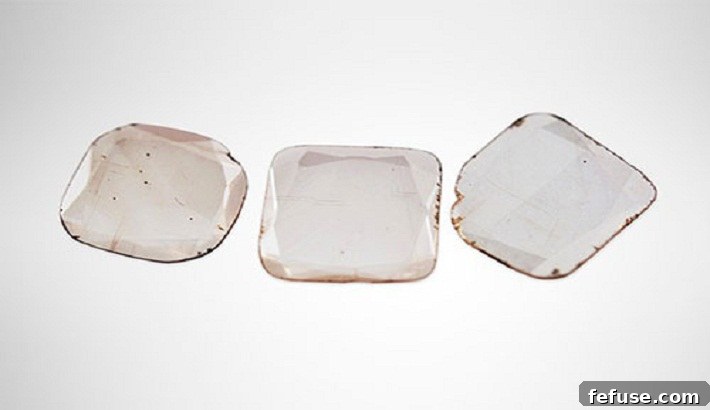
The pivotal moment for GTL began with the submission of three intriguing polki-cut diamonds by a client. These stones, described as light gray to brown, possessed distinctive square profiles and weighed between 0.27 and 0.29 carats, measuring 6.86–7.41 mm long and 0.36–0.41 mm thick. The client informed the lab that they believed the polkis were natural but sought confirmation regarding the presence of glass filling. This seemingly straightforward request initiated a complex and ultimately groundbreaking investigation.
Initial Suspicions and Microscopic Examination
Gagan Choudhary highlighted that the square profiles of the polkis immediately raised red flags for the GTL team, based on their extensive experience with both natural and synthetic diamonds. Initial examination under a high-power microscope quickly confirmed the client’s suspicion regarding treatment: glass filling was indeed present in all three stones. This was evidenced by tell-tale color flashes—typically vibrant blue, violet, and pink—along with characteristic crackling effects observed within the fissures and cleavage planes. Furthermore, the presence of cleavage planes intersecting each other at nearly 90 degrees provided clear visual evidence of octahedral cleavage, a hallmark feature in diamonds.
Advanced Gemological Analysis: Confirming the Unthinkable
To conclusively identify the nature of the filling, energy-dispersive X-ray fluorescence (EDXRF) analyses were conducted. These advanced spectroscopic tests unequivocally confirmed the presence of lead and bromine, common constituents of the high-RI glass used for clarity enhancement in diamonds. The polkis also exhibited a few dark brown grains, some of which were associated with stress cracks, though the specific nature of these grains was not the primary focus of this particular identification.
Building on their prior experience with polki diamonds, especially those with unusual square profiles, the GTL performed further, more sophisticated tests to definitively determine the origin of the stones – whether natural or synthetic. A comprehensive suite of advanced gemological procedures was employed, including:
- Viewing under crossed polarizers: To observe internal stress patterns.
- Use of infrared spectra: To detect characteristic absorption peaks.
- DiamondView imaging: A powerful tool that reveals growth patterns and internal structures unique to natural or synthetic diamonds through fluorescence.
The results from these advanced tests converged to an astonishing conclusion: the stones were not natural diamonds, as initially presumed, but were unequivocally identified as synthetic CVD diamonds. This finding, combined with the presence of glass filling, marked a truly unprecedented detection.
Implications for the Global Gem and Jewelry Trade
Choudhary noted that while the GTL had previously encountered numerous examples of glass-filled natural polki-cut diamonds, and separately, many CVD synthetic diamonds fashioned as polkis, this was the first time the lab had ever encountered glass-filled CVD synthetic diamond polkis. The market penetration of such composite stones remains largely unknown, but their emergence presents significant challenges for the gem and jewelry trade globally.
A New Challenge for Diamond Identification
The convergence of advanced synthetic diamond production with traditional clarity enhancement techniques creates a new frontier in gem identification. While glass filling itself is generally not challenging to identify for experienced gemologists, its presence in synthetic diamonds introduces a heightened risk of misidentification. As Choudhary warned, “encountering it in synthetic diamonds could lead to a misidentification as natural, especially among the trade.” This risk is particularly acute for those who may not possess the most advanced diagnostic equipment or specialized expertise required to differentiate between complex treatments and synthesis.
The Importance of Shape as a Diagnostic Feature
One of the most crucial insights emphasized by Choudhary revolves around the significance of the stone’s physical shape. He reiterated that natural diamond polkis are typically fashioned from flat rough or chips derived during the cutting of larger crystals, and as such, they usually display irregular or triangular profiles. In stark contrast, square-shaped polkis offer the best yield for crystals with inherently square profiles, such as natural cubic crystals or, more commonly, synthetic diamond crystals grown by the CVD process, which naturally exhibit a square and tabular habit.
Therefore, Choudhary strongly suggests that “doubts should be raised when the shape is encountered, especially when mixed in parcels of polki-cut natural diamond.” This piece of advice serves as a critical red flag for buyers, dealers, and jewelers, urging them to exercise heightened caution and demand thorough testing for any polki diamond presenting an atypical square outline. This simple morphological observation, when combined with expert gemological analysis, can prevent costly errors and safeguard market integrity.
Ensuring Consumer Confidence and Market Integrity
The GTL’s breakthrough identification highlights the ongoing necessity for advanced gemological research and robust testing protocols within the diamond industry. As synthesis techniques become more refined and treatments more sophisticated, the line between natural and lab-grown, or treated and untreated, can blur without expert intervention. Laboratories like GTL, backed by organizations such as GJEPC and supported by leading gemological institutions like GIA, play an indispensable role in maintaining transparency and consumer confidence.
For jewelers, it underscores the imperative of due diligence in sourcing and transparent disclosure to customers. For consumers, it emphasizes the importance of purchasing from reputable sources and insisting on certified stones, especially when investing in valuable jewelry. The continuous evolution of gem identification techniques is not merely an academic exercise; it is a vital safeguard that protects the integrity of the market and ensures the enduring trust in precious stones.
The Future of Diamond Authentication
This remarkable case serves as a powerful reminder that the gemological landscape is dynamic and ever-changing. It necessitates constant innovation in detection methods, ongoing education for industry professionals, and collaborative efforts between laboratories, traders, and regulatory bodies. The ability to identify complex combinations, such as glass-filled CVD synthetic diamonds, ensures that the industry remains transparent, ethical, and trustworthy, preserving the value and allure of both natural and lab-grown diamonds for generations to come.
Image Caption: A close-up view of the three distinct “polkis” exhibiting a pronounced square profile that were definitively identified by the GTL as glass-filled CVD synthetic diamonds, marking a critical advancement in gemological detection capabilities.
Photo Courtesy: Gagan Choudhary, GTL and GIA
Source: gjepc.org