
Queen Elizabeth II’s Intimate Glimpse into the Royal Crown Jewels: A Legacy Unveiled
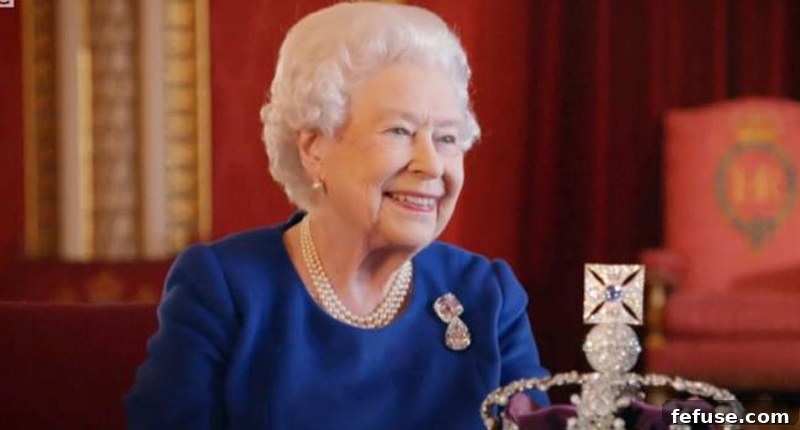
The allure of the British monarchy, particularly the reign of Queen Elizabeth II, has captivated audiences worldwide for decades. With the immense popularity of historical dramas like Netflix’s “The Crown,” public fascination with her life and the intricate traditions of the Royal Family has soared. A rare and profoundly insightful BBC documentary, “The Coronation with Her Majesty the Crown,” offered an unparalleled opportunity for viewers to witness the Queen’s candid persona as she revisited the pivotal moment of her coronation and delved into the mystique surrounding the United Kingdom’s priceless Crown Jewels.
Aired on a Sunday, this special documentary provided a unique window into history. Rather than merely recounting the details of her coronation 65 years prior, Queen Elizabeth II herself joined royal expert and interviewer Alastair Bruce. Together, they watched historical footage of the grand event, with Her Majesty offering her personal, often surprisingly pragmatic, commentary. The highlight of this extraordinary interview was the up-close inspection of the Crown Jewels, which were ceremoniously transported from their secure home at the Tower of London to Buckingham Palace for the Queen’s personal review and discussion. This intimate setting allowed for revelations that shed new light on these ancient symbols of power and the woman who wore them.
The Enduring Significance of the British Crown Jewels
The Crown Jewels are not merely a collection of magnificent gemstones and precious metals; they are the tangible embodiment of over a thousand years of British monarchical history, tradition, and sovereignty. Housed within the impenetrable walls of the Tower of London, this extraordinary collection comprises more than 140 items, collectively boasting over 23,000 precious stones. Each piece, known as the regalia, plays a crucial role in the coronation ceremony and other significant state occasions. From sceptres and orbs to rings and swords, these artefacts symbolize the monarch’s divine right, temporal power, and the continuity of the British throne. The most famous diamonds within this collection, the Cullinan I and Cullinan II, are masterfully cut from the legendary 3,106-carat Cullinan Diamond—the largest gem-quality rough diamond ever unearthed, a testament to nature’s incredible artistry and human craftsmanship.
Fact 1: The Dual Crowns of Coronation Day – A Symbol of Transition
One of the most intriguing insights shared during the documentary was the tradition of the monarch wearing not one, but two distinct crowns during the coronation ceremony. The primary and most sacred of these is St Edward’s Crown. Crafted in 1661 for the coronation of King Charles II, this solid gold masterpiece weighs a substantial five pounds and is adorned with 440 individual gemstones. Its sheer weight and profound historical significance mean it is typically worn only once in a monarch’s lifetime – specifically, at the very moment of their coronation. Queen Elizabeth II confirmed this tradition, revealing that she has not worn St Edward’s Crown since that momentous day in 1953.
Following the solemn ritual of anointing, investiture, and enthronement, a second, lighter crown is placed upon the monarch’s head: the Imperial State Crown. This magnificent piece, while less ponderous, is equally stunning and features many of the collection’s most famous jewels, including the Cullinan II diamond, St Edward’s Sapphire, and the Black Prince’s Ruby. The Imperial State Crown serves a more practical purpose, as it is worn by the monarch for most subsequent state openings of Parliament, symbolizing their ongoing authority and role in governance. The transition from the heavily symbolic St Edward’s Crown to the more regularly used Imperial State Crown marks a profound moment in the coronation ceremony, signifying the assumption of full royal duties.
Queen Elizabeth II: A Monarch’s Unpretentious View of Priceless Jewels
While most individuals would approach objects of such immense value and historical significance with extreme caution and reverence, Queen Elizabeth II displayed a refreshing lack of pretension during her interaction with the Crown Jewels. Her pragmatic and candid demeanor offered a truly unique perspective on the weight of history and the responsibility she carried.
Fact 2: A Practical Monarch’s Candid Commentary on the Crown
The documentary highlighted the Queen’s remarkable ease with these sacred items. She, the Archbishop of Canterbury, and the crown jeweler are the only individuals permitted to directly handle St Edward’s Crown. During her discussion with Alastair Bruce, when asked if the crown could be brought closer, Her Majesty unhesitatingly grasped the weighty object with both hands, stating matter-of-factly, “This is what I do when I wear it.” This simple action spoke volumes about her direct, no-nonsense approach to her role and its accoutrements.
Her observations were equally down-to-earth. Reflecting on St Edward’s Crown, she remarked, “Is it still as heavy? Yes it is. Weighs a ton. It’s very solid, isn’t it?” Her insights into the practicalities of wearing such an elaborate headpiece were both amusing and revealing. She noted, “Fortunately, my father and I have about the same sort of shaped head… once you put [the crown] on it stays.” Yet, she also acknowledged the challenges: “You can’t look down to read the speech; you have to take the speech up because if you did, your neck would break, it would fall off.” When Bruce mused that her principal memory of the coronation might be wearing the crown, she swiftly corrected him, emphasizing, “And how heavy and unbalanced it was.” Perhaps her most unsentimental yet honest appraisal was, “There are some disadvantages to crowns, but otherwise they’re quite important things.” These comments underscored her unique blend of duty, practicality, and an almost detached understanding of the symbols of her power.
The Astonishing Journey of the Cullinan Diamond
The Cullinan Diamond holds a legendary status not only within the Crown Jewels but also in the annals of gemology. Its discovery, journey, and subsequent transformation into the world’s most magnificent polished diamonds form a captivating chapter in royal history.
Fact 3: The Queen’s Curiosity and the Diamond’s Remarkable Origins
Discovered in South Africa in 1905, the colossal Cullinan Diamond embarked on a journey to Britain that was, quite astonishingly, “in the post.” This almost unbelievable detail highlights the understated methods often employed even for items of unparalleled value. In 1908, Joseph Asscher was entrusted with the formidable task of cutting this enormous rough diamond in Antwerp. Queen Elizabeth II expressed a genuine fascination with this process, stating, “I always wish I’d been there when they smashed it into pieces.” She then motioned to an enormous cushion-cut and an equally impressive pear-cut diamond pinned to her dress, adding, “These are the chips that were left.” These “chips” were, of course, the extraordinary Cullinan III and Cullinan IV, showcasing the sheer scale of the original stone.
The largest polished diamond from the original rough, the Cullinan I, weighing 530.2 carats, is famously mounted in the Sovereign’s Sceptre with Cross. Its companion, the 317.4-carat Cullinan II, graces the front of the Imperial State Crown. The Queen also recounted a popular anecdote about Asscher, stating that she heard he fainted after successfully cutting the massive stone, though she couldn’t definitively confirm its veracity. This story, whether fact or folklore, underscores the immense pressure and skill involved in working with such an irreplaceable treasure, and the Queen’s recollection of it further humanizes her connection to these historic gems.
Safeguarding a Nation’s Treasures: The Crown Jewels During World War II
The historical importance of the Crown Jewels extends beyond ceremonial use; they are considered vital national treasures, indispensable to the identity and continuity of the United Kingdom. This was never more evident than during the dark days of World War II when extraordinary measures were taken to protect them from potential Nazi seizure.
Fact 4: The Secret Wartime Hiding Place and Biscuit Tins
The documentary revealed a truly remarkable secret about the preservation of the Crown Jewels during World War II. A royal librarian recently unearthed evidence detailing their incredible hiding place: a secret room located an astonishing 60 feet beneath Windsor Castle. Access to this highly secure vault was only possible by descending a very long and precarious ladder, ensuring its extreme discretion. To facilitate potential rapid evacuation or further concealment, some of the most important jewels were meticulously removed from their ornate settings. These precious loose gems were then ingeniously stowed away in ordinary biscuit tins – a seemingly mundane container used to protect Britain’s most valuable heritage from the impending threat of war. This extraordinary measure highlights the profound lengths to which the Royal Family and the government went to safeguard these irreplaceable symbols of British sovereignty and resilience, demonstrating their unwavering commitment to preserving national identity even in the face of unimaginable danger.
The Queen’s Unique Perspective: The “Living” Pearls
Among the many fascinating insights, perhaps one of the most charming and personal revelations from Queen Elizabeth II was her almost mystical view on certain precious stones, particularly pearls.
Fact 5: Queen Elizabeth II’s Belief in the Sentience of Pearls
During her examination of St Edward’s Crown, the Queen showed particular delight in observing four ancient pearls that dangle from one of its elements. These pearls carry their own rich history, with two of them believed to have once belonged to the ill-fated Mary Queen of Scots, later acquired by Queen Elizabeth I after her cousin’s execution. Upon close inspection, the Queen offered a truly unique and endearing perspective on these gems. She remarked that the pearls, “don’t look very happy now… Most pearls like to be sort of living creatures so they’ve just been out, hanging out here for years, so they’re all sad. The trouble is that pearls are sort of live things and they need warming.” This observation reveals a deeply personal and almost empathetic connection the Queen felt towards these ancient objects. Her belief that pearls are “living things” that require human contact and warmth to retain their luster and “happiness” offers a rare glimpse into her personal reflections on the natural world and the very tangible history encapsulated within the Crown Jewels. It underscores that beyond their material value, these treasures held a profound, almost spiritual, significance for Her Majesty.
Conclusion: A Personal Connection to a Royal Legacy
The BBC documentary “The Coronation with Her Majesty the Crown” provided a truly unique and invaluable opportunity to see Queen Elizabeth II not just as a figurehead, but as a person with a profound, yet often pragmatic, connection to the symbols of her monumental reign. Her candid commentary on the weight and practicalities of the crowns, her fascination with the cutting of the Cullinan Diamond, the incredible story of the Crown Jewels’ wartime hiding, and her endearing belief in the “living” nature of pearls, all painted a vivid picture of a monarch intimately entwined with history. These revelations highlight the immense historical significance and breathtaking beauty of the Crown Jewels, while simultaneously humanizing the monarch who wore them. The documentary served as a powerful reminder that behind the pomp and ceremony of the British monarchy, there was a woman who approached her extraordinary duties with a remarkable blend of solemn responsibility, practical wisdom, and a touch of personal charm, leaving an indelible mark on both her nation and the priceless treasures she safeguarded.