
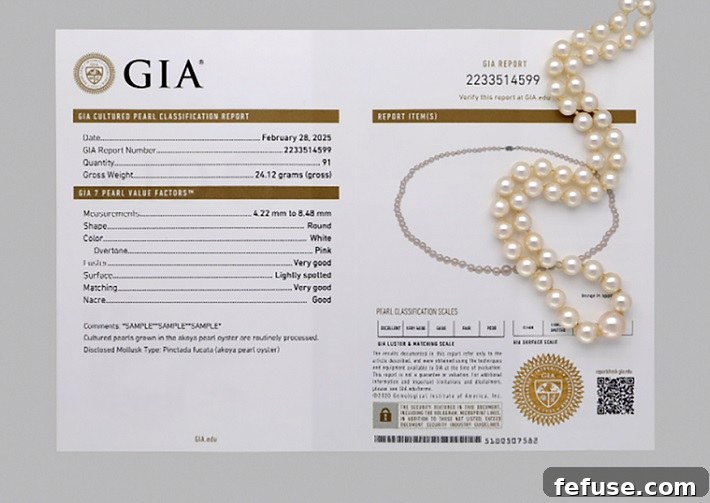
GIA Unveils Enhanced Nacre Grading Scale: A New Era for Pearl Evaluation
In a landmark move poised to significantly impact the global pearl industry, the Gemological Institute of America (GIA) has announced the implementation of an advanced, expanded nacre grading scale across all its comprehensive pearl classification reports. This pivotal enhancement represents a significant evolution within the GIA’s internationally recognized pearl evaluation framework, the GIA 7 Pearl Value Factors™. The primary objective of this refinement is to provide more granular, precise, and transparent insights into the critical quality of nacre, ultimately benefiting consumers, retailers, and collectors worldwide.
The Indispensable Role of Nacre in Pearl Beauty and Durability
Nacre, often referred to as the “mother-of-pearl,” is the organic-inorganic composite material that forms the iridescent outer layer of a pearl. It is secreted by the mollusk over time, layer upon layer, to create the pearl’s unique structure. This lustrous substance is absolutely fundamental to a pearl’s allure, directly influencing its breathtaking luster, captivating iridescence, and inherent durability. Composed primarily of microscopic aragonite crystals interleaved with a protein called conchiolin, nacre’s thickness, uniformity, and quality are paramount to a pearl’s overall value and longevity. Without sufficient, high-quality nacre, a pearl’s beauty can diminish, and its structural integrity can be compromised, leading to issues like dullness, peeling, or a chalky appearance.
Historically, the GIA’s approach to nacre assessment, while foundational, was relatively binary. Nacre was typically graded in GIA reports as either “Acceptable” or “Unacceptable.” The “Acceptable” designation broadly signified nacre that met commercial viability standards in terms of both its thickness and general condition. Conversely, “Unacceptable” indicated nacre that presented considerable risks to the pearl’s enduring beauty and structural integrity, often due to significant flaws such as excessive thinness, chalky appearance, or overt physical damage.
Responding to Industry Needs: A More Nuanced Approach
The pearl industry is dynamic and sophisticated, and its stakeholders consistently seek greater precision in gemological evaluations. In direct response to comprehensive feedback gathered from a wide array of international pearl industry stakeholders, including growers, dealers, manufacturers, and retailers, the GIA embarked on a mission to refine its nacre assessment methodology. The result is a dramatically improved, more detailed analytical system that evaluates nacre quality across a five-tier scale: Excellent, Very Good, Good, Fair, and Poor. This nuanced, multi-level system represents a significant leap forward, offering unparalleled transparency and a deeper alignment with how other critical pearl value factors — such as size, shape, color, luster, surface quality, and matching — are meticulously assessed.
This updated nacre scale is not merely an arbitrary change; it is the culmination of extensive, rigorous research conducted by GIA’s world-leading gemological scientists. This research involved an exhaustive study of a broad spectrum of pearl specimens, encompassing diverse origins, types, and formations. Thousands of pearls were examined to understand the full range of surface and sub-surface characteristics, allowing GIA to better capture the complex variability in nacre development and consistency observed during the natural and cultured pearl formation processes. The aim was to create a grading system that accurately reflects the subtle yet significant differences in nacre quality. Moving forward, it is anticipated that the majority of pearls evaluated under this comprehensive new system will receive a “Good” rating, effectively replacing the previous broader “Acceptable” designation and providing a more precise baseline for commercial quality.
Understanding the Five-Tier Nacre Grading Scale
The new five-tier system provides specific definitions that empower both trade professionals and consumers to understand the quality of nacre with greater clarity:
- Excellent: Pearls with nacre displaying exceptional thickness, outstanding uniformity, and flawless surface integrity, contributing optimally to luster and durability. These pearls represent the pinnacle of nacre quality.
- Very Good: Nacre is notably thick and uniform, exhibiting only minor, almost imperceptible irregularities. It provides excellent luster and robust durability.
- Good: Nacre is sufficiently thick and generally uniform, showing only slight variations that do not significantly detract from the pearl’s overall appearance or durability. This grade signifies a commercially acceptable and durable pearl.
- Fair: Nacre shows noticeable thinness or minor non-uniformity. While still present, it may exhibit some areas of slight chalkiness or minor imperfections that could subtly impact luster or durability over time.
- Poor: Nacre is conspicuously thin, highly irregular, or severely damaged. This grade indicates significant issues like extreme chalkiness, peeling, or clear evidence of the bead showing through, posing substantial risks to the pearl’s beauty and structural integrity.
Each pearl item — whether it’s a single loose pearl, an exquisite strand, or a finished jewelry piece — will be meticulously assessed based on several key parameters. These include visible nacre variations across the pearl’s surface, its post-harvest conditions (such as any signs of wear, abrasion, or treatments applied), and adherence to established industry benchmarks for appropriate nacre thickness relative to the pearl type and size. These elements collectively form the basis for determining the nacre quality noted in the official GIA report, providing a holistic and scientifically backed evaluation.
Leadership Perspective: GIA’s Commitment to Advancing Standards
“Nacre is absolutely fundamental to a pearl’s identity, profoundly impacting everything from its captivating luster and intriguing shape to its critical structural integrity,” affirmed Tom Moses, GIA Executive Vice President and Chief Laboratory and Research Officer. “By meticulously refining our nacre classification scale, we are not just introducing a new grading system; we are providing a significantly more accurate, comprehensive, and ultimately beneficial evaluation tool. This enhancement directly serves our valued clients and strengthens the entire broader pearl trade, fostering greater trust and confidence in every transaction.”
This enhancement unequivocally reinforces the GIA’s unwavering commitment to continuously advancing gemological standards and ensuring the utmost precision in all its evaluations. By doing so, GIA ensures that its pearl reports remain the most authoritative, reliable, and indispensable tools for discerning buyers, reputable sellers, and passionate collectors across the globe. The new nacre scale is more than just a technical upgrade; it’s a testament to GIA’s dedication to integrity, scientific rigor, and supporting a thriving, transparent pearl market.
Implications for the Global Pearl Market
The introduction of this expanded nacre grading scale carries far-reaching implications for every segment of the global pearl market. For **consumers**, it means unprecedented transparency. They will now receive more detailed information about the intrinsic quality of their pearl purchases, allowing them to make more informed decisions and enhancing their confidence in the value and authenticity of GIA-certified pearls. This clarity is crucial for an investment as personal and significant as fine pearl jewelry.
For **retailers and dealers**, the new system provides a standardized, universally understood language to communicate pearl quality to their customers. This improved nomenclature will facilitate smoother transactions, reduce ambiguity, and enable more accurate pricing strategies aligned with specific nacre quality. It also empowers them to better differentiate their inventory and highlight the superior qualities of their premium offerings.
**Pearl growers and producers** will also benefit from more precise feedback on the outcome of their cultivation efforts. This detailed grading can help them refine their farming techniques and improve the overall quality of their pearl harvests, contributing to sustainable growth within the industry. Ultimately, by elevating the standards of pearl evaluation, the GIA is fostering an environment of greater trust and professionalism, ensuring the enduring allure and value of pearls for generations to come.