
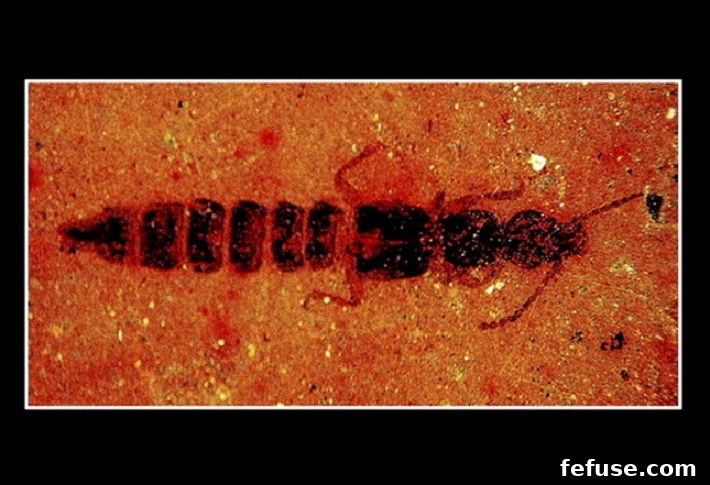
Ancient Rove Beetle Fossil Unearths 90 Million Years of Evolutionary History at Orapa Diamond Mine, Botswana
A groundbreaking discovery at the Orapa Diamond Mine in Botswana, the world’s largest diamond mine by area, has brought to light a remarkably well-preserved fossil of a 90-million-year-old beetle. This exceptional find, identified as Paleothius mckayi, a member of the Staphylinidae family, commonly known as rove beetles, offers an unprecedented window into the deep past, significantly illuminating the evolutionary journey of these prolific insects and ancient life forms.
This ancient specimen, dating back to the Cretaceous Period, provides compelling evidence that these specific types of beetles were not merely present but thriving during the age of dinosaurs. Researchers from the esteemed University of the Witwatersrand in Johannesburg, South Africa, emphasized the profound implications of this discovery, noting, “This discovery tells us that these types of beetles were not just present but thriving alongside dinosaurs, and they haven’t changed much over millions of years.” This remarkable evolutionary stasis highlights the extraordinary success and adaptability of the rove beetle lineage.
The Significance of Paleothius mckayi: A Rove Beetle’s Enduring Legacy
The Paleothius mckayi fossil represents a pivotal addition to the paleontological record. Rove beetles, comprising one of the largest families of organisms on Earth with over 63,000 described species, are vital components of global ecosystems. They play a crucial and often unsung role in maintaining ecological balance, primarily through their predatory habits, which help control various pest populations, and their active participation in the breakdown of organic matter, contributing to nutrient cycling in diverse habitats.
The discovery of such an ancient ancestor provides critical context for understanding the long-term ecological functions of these insects. The remarkable morphological similarity between the fossilized Paleothius mckayi and modern rove beetles underscores a highly successful body plan that has allowed them to persist across vast geological timescales with minimal significant changes. This evolutionary resilience is a testament to their adaptability, enabling them to navigate dramatic shifts in global climate and continental configurations over millions of years.
A First for Africa and the Southern Hemisphere
Beyond its ancient lineage, the Paleothius mckayi fossil holds another monumental distinction: it is the first record of a staphylinine rove beetle fossil found anywhere in Africa, and indeed, the entire Southern Hemisphere. This geographical uniqueness vastly expands our understanding of ancient insect distribution and paleobiogeography.
Prior to this find, most rove beetle fossils were predominantly discovered in the Northern Hemisphere. This absence left significant gaps in our knowledge regarding the presence and evolution of these insects in the ancient supercontinent of Gondwana and its subsequent fragmented landmasses. The Orapa discovery directly addresses this gap, providing concrete evidence of their widespread distribution during the Cretaceous and offering new avenues for research into the dispersal patterns and diversification events of these beetles across ancient continents.
Dr. Sandiso Mnguni, a postdoctoral fellow and lead researcher from the University of the Witwatersrand, eloquently stated, “This beetle is a clue into the long, intricate history of life on Earth, showing us how interconnected and unchanged some life forms have been over the ages and highlights the success of rove beetles in adapting to various environments without significant changes to their morphology.” His statement encapsulates the dual significance of the fossil: its role as a biological time capsule and its testament to the enduring success of an ancient life form.
Orapa Diamond Mine: A Surprising Cradle for Paleontological Riches
The setting of this discovery, the Orapa Diamond Mine, adds another layer of intrigue. Located in Botswana, Orapa is not only renowned as the largest diamond mine by area globally but also plays a pivotal role in the country’s economy. Since commencing commercial production in 1971, the mine has been a consistent powerhouse, yielding an impressive 8.7 million carats in 2021 alone. It is operated by Debswana, a highly successful joint venture between the government of Botswana and the world-leading diamond company, De Beers.
While diamond mines are primarily recognized for their geological deposits of kimberlite pipes—volcanic conduits that bring diamonds to the surface—they are not typically associated with paleontological excavations. However, the unique geological context of Orapa, with its deep excavations, occasionally exposes ancient sedimentary layers that can preserve fossils. This particular discovery underscores the unexpected potential for scientific breakthroughs even within industrial operations, highlighting the importance of multidisciplinary collaboration between geology, mining, and paleontology.
The very process of diamond extraction, which involves excavating vast quantities of earth, can inadvertently reveal layers of rock that have remained undisturbed for millions of years. This allows paleontologists like the team from the University of the Witwatersrand to access and study geological strata that might otherwise remain inaccessible, turning an industrial site into a scientific treasure trove.
Unlocking Earth’s Ancient Tapestry: Broader Implications and Future Endeavors
The revelation of Paleothius mckayi goes beyond the study of a single insect species; it contributes to a broader understanding of Earth’s complex and dynamic history. By studying such ancient survivors, scientists gain crucial insights into topics such as biodiversity, the mechanisms of evolutionary stasis, and the long-term impacts of environmental change on species survival.
The Cretaceous Period, during which this beetle lived, was a time of significant global transformation. Continents were drifting apart, new oceans were forming, and Earth’s climate was considerably warmer than today. Understanding how a species like the rove beetle thrived amidst such monumental shifts provides valuable context for contemporary ecological challenges, including those related to climate change and habitat loss.
Furthermore, this discovery serves as a powerful testament to the rich, unexplored paleontological heritage of Africa. For too long, the fossil record of the continent has been less extensively studied compared to other regions, particularly regarding insect and invertebrate life. This finding strongly encourages increased investment and focus on paleontological research in African nations, promising to fill critical gaps in our global understanding of ancient life.
The research team expressed optimism that this groundbreaking find at Orapa is merely the beginning. They anticipate that the unique geological setting and ongoing mining activities could pave the way for numerous future discoveries, potentially unearthing more ancient flora and fauna that have lain undisturbed for eons. Each subsequent find will undoubtedly enrich our understanding of Earth’s intricate past, the interconnectedness of life, and the astonishing resilience of ancient ecosystems.
In conclusion, the unearthing of the 90-million-year-old Paleothius mckayi fossil at the Orapa Diamond Mine stands as a monumental achievement in paleontology. It not only rewrites aspects of insect evolutionary history but also underscores the unexpected scientific value embedded within industrial sites. This tiny beetle, a survivor from the age of dinosaurs, offers immense lessons about adaptation, resilience, and the enduring mysteries that Earth continues to hold within its ancient layers, waiting to be discovered by future generations of scientists.