
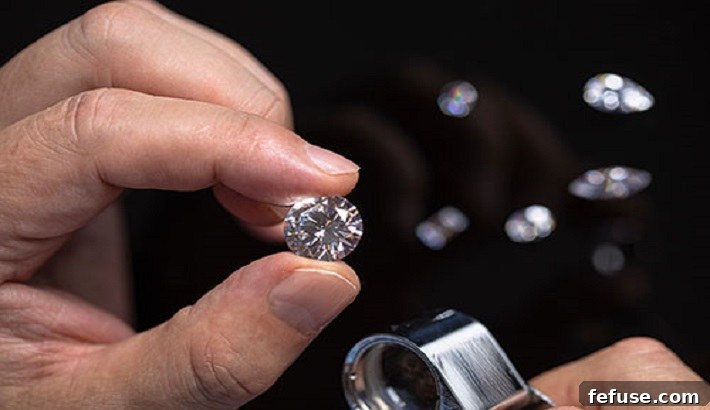
The global diamond industry stands on the cusp of a transformative change as the Bharat Diamond Bourse (BDB), the world’s preeminent diamond trading hub, prepares to make a landmark decision. Following its Annual General Meeting on December 28th, the BDB is poised to greenlight the trading of synthetic or lab-grown diamonds (LGDs) within its sprawling complex. This potential shift signals a significant evolution in the perception and integration of LGDs into the mainstream diamond market, reflecting changing industry dynamics and growing consumer acceptance.
This momentous resolution, if approved by the BDB’s managing committee, will empower the committee to establish comprehensive norms and protocols governing the trade of synthetic and lab-grown diamonds within its premises. The move is a carefully considered response to an evolving market landscape and addresses various aspects to ensure transparency, integrity, and fair practice. The proposed framework outlines stringent requirements designed to prevent commingling and maintain clear distinctions between natural and lab-grown diamonds.
Key among the proposed norms are several critical stipulations aimed at maintaining market integrity and ensuring absolute clarity:
- **Separate Application/Registration:** Members keen on venturing into the trade of synthetic diamonds will be required to submit a distinct application and undergo a separate registration process. This ensures that their intent to deal in LGDs is formally acknowledged and monitored.
- **Formation of Separate Entities:** Companies currently engaged in the trading of natural diamonds, and wishing to diversify into LGDs, will be mandated to establish two entirely separate legal entities. This clear corporate segregation is crucial for maintaining financial and operational distinctions.
- **Dedicated Office Premises:** Traders dealing in lab-grown diamonds must identify and exclusively demarcate an office space within the BDB complex solely for the purpose of trading synthetic or LGDs. This physical separation is a cornerstone of the BDB’s strategy to prevent any inadvertent mixing of products.
- **Robust Segregation Processes:** Offices dealing with LGDs will be required to implement a clear, distinct, and robust segregation process and technique. This includes strict operational procedures to handle and store lab-grown diamonds separately from natural ones at every stage.
- **Independent Inventory Management:** The implementation of a separate and distinct stock and inventory management system for LGDs is another vital norm. This ensures meticulous tracking and accountability for all lab-grown diamond stock, further preventing any potential confusion or misrepresentation.
Any deviation from these meticulously laid out protocols will be met with a strict Zero-Tolerance Policy. Violations could lead to severe penalties, including hefty fines, the cancellation of BDB memberships, and even permanent expulsion from the bourse. The full, detailed set of these critical protocols will be made available to all members once officially approved by the BDB. This underscores the BDB’s unwavering commitment to ethical trading practices and market transparency.
The potential decision marks a significant reversal from the BDB’s stance in 2015, when it had previously enacted a resolution to ban the trading of lab-grown diamonds within its premises. This earlier ban reflected the industry’s cautious approach at a time when awareness, detection technologies, and market understanding of LGDs were nascent. However, the intervening years have witnessed profound changes, compelling the BDB to revisit its policy.
Anoop Mehta, President of the Bharat Diamond Bourse, shed light on the compelling reasons behind this proposed policy shift. He explained that the BDB had been inundated with requests from its members who expressed a strong desire to diversify their businesses into the rapidly expanding lab-grown diamond category. “We requested the Natural Diamond Monitoring Committee (NDMC) to review the situation, as nearly five years had passed since our initial ban on LGD trading from the BDB,” Mehta stated. “Even at that time, we had clearly indicated that it was not a permanent resolution. The ban was implemented primarily because, at that specific juncture, there was insufficient awareness within the trade, among consumers, and even at the retail level regarding these new products.”
Mehta further elaborated on the dramatic transformation witnessed in recent years. “Today, a significant level of awareness has been successfully cultivated around the world, encompassing the entire diamond pipeline, from manufacturers to retailers and end-consumers,” he observed. “Furthermore, sophisticated detection machines, which were either unavailable or prohibitively expensive five years ago, are now readily accessible and affordable. The NDMC has diligently suggested a comprehensive set of rules and regulations specifically designed to prevent any contamination or misrepresentation. The core principle is that LGDs must be sold with full disclosure, not only by the seller but also ensuring that the subsequent buyer in the value chain is equally committed to upholding these disclosure norms. The prevailing belief within the value chain is that distinct and thriving markets exist for both natural and lab-grown diamonds, provided they are kept entirely separate, each finding its own niche.”
Colin Shah, Chairman of the Gem & Jewellery Export Promotion Council (GJEPC), shared his perspective, acknowledging the gravity of the decision. “The decision to permit LGD trading within the BDB will undoubtedly be a challenging one, but I am firmly convinced that it is the correct choice for ensuring the long-term sustainability and continued growth of the Indian diamond manufacturing industry,” Shah commented. He emphasized the need for a multi-pronged approach: “In addition to our stringent detection and disclosure protocols, we must establish robust retail Standard Operating Procedures (SOPs) to guarantee that customers are fully informed about the precise nature of the diamond they are purchasing. My vision is for the two distinct diamond pipelines – natural and lab-grown – to coexist harmoniously and thrive alongside each other, each catering to different market segments and consumer preferences.”
Shah reiterated his conviction regarding the opportune timing for this shift: “I genuinely believe that lab-grown diamonds represent an idea whose time has definitively arrived. The landscape has evolved considerably over the years; traders are now far more knowledgeable and aware of lab-grown diamonds. We possess incredibly robust detection technology, available at affordable rates, which empowers the industry to accurately identify and differentiate between diamond types. Moreover, we have successfully advocated with the Government to introduce greater granularity in HS (Harmonized System) codes specifically for synthetic and laboratory-grown diamonds, further clarifying their distinct classification. The trade today is equipped with both the awareness and the cutting-edge technology necessary to effectively separate and manage both product categories.”
Vipul Shah, Vice Chairman of the GJEPC, underscored the Council’s consistent support for the lab-grown diamond sector, provided ethical standards and full disclosures are meticulously maintained. “As GJEPC, we have always been supportive of the lab-grown business, as long as the critical aspects of disclosures and ethics were rigorously upheld,” Vipul Shah noted. He highlighted the remarkable growth trajectory of LGDs: “Just five years ago, the lab-grown segment constituted less than 1% of our total production in terms of value. Today, it has surged to almost 5%, registering an exceptionally sharp and undeniable growth. This segment has garnered significant acceptance among US retailers and is actively carving out its own unique niche and market, provided it is consistently sold as an LGD in a completely ethical and transparent manner.”
A confluence of significant developments over the past five years is widely believed to have been instrumental in influencing the BDB’s progressive new stance. These pivotal factors collectively painted a clear picture of an evolving market demanding policy adaptation:
- **Increasing LGD Activity by BDB Members:** A growing number of BDB members had already begun exploring or actively participating in the LGD trade, indicating an internal market pull for this category.
- **De Beers’ Endorsement with Lightbox:** The launch of De Beers’ Lightbox jewellery brand in 2018, which exclusively features fashion jewellery with lab-grown diamonds, served as a powerful endorsement from one of the industry’s most traditional and influential players. This effectively “anointed” LGDs as a legitimate product category.
- **Advanced Detection Technology:** The cost, speed, and universality of LGD detection technologies have dramatically improved, making it economically feasible for even smaller businesses to accurately identify diamonds. This mitigates the risk of undisclosed mixing.
- **Advent of Blockchain for Traceability:** The emergence and increasing adoption of blockchain technology offer unprecedented levels of transparency and traceability for diamonds throughout the entire supply chain, further bolstering confidence in both natural and lab-grown products.
- **Greater Consumer Acceptance:** Consumers, particularly younger demographics, have shown increasing openness and acceptance towards LGD jewellery, appreciating its ethical sourcing, environmental considerations, and often more accessible price points.
Vipul Shah further elaborated on the crucial role LGDs played during recent global disruptions. “During the challenging period of the pandemic, LGD cutting and polishing proved to be a blessing in disguise,” he added. “Lab-grown diamonds served as a vital substitute for natural diamonds, especially when the industry voluntarily implemented a ban on rough imports of natural diamonds to stabilize the market. This segment was instrumental in helping to maintain the livelihoods of countless workers across the industry. Even major mining companies have now accepted LGDs – a clear example being De Beers with its Lightbox brand. Manufacturers are increasingly compelled to switch to products like LGDs, as they offer viable profit margins, particularly when the profitability from natural diamonds becomes less predictable. Overall, it’s becoming evident that LGDs and natural diamonds are increasingly complementing each other within the broader jewellery market, rather than solely competing.”
Sanjay Shah, Convener of the Diamond Panel at GJEPC, reinforced the comprehensive progress made in establishing LGDs as a distinct and respected product category. “Through the collaborative and concerted efforts of all major bodies, both in India and globally, we have now reached a scenario where there is significantly greater awareness and widespread acceptability of LGDs as a legitimate alternative product,” Sanjay Shah stated. He highlighted the practical advancements: “There is now easy access to advanced detection technology, available at affordable rates, empowering the trade to make informed decisions. Furthermore, major laboratories worldwide are offering standardized certification services for lab-grown diamonds, adding another layer of trust and authenticity. LGDs are undeniably coming into their own and have successfully established a clearly segregated and transparent pipeline within the intricate structure of the global diamond industry.”
The Bharat Diamond Bourse’s impending decision is not merely a policy change; it represents a bold acknowledgment of the evolving diamond landscape. By integrating lab-grown diamonds under strict regulations, the BDB is poised to strengthen India’s position as a versatile and forward-thinking leader in the global diamond trade. This move promises to foster growth, enhance transparency, and cater to a wider spectrum of consumer demands, ensuring the long-term vitality and relevance of the Indian diamond industry.