
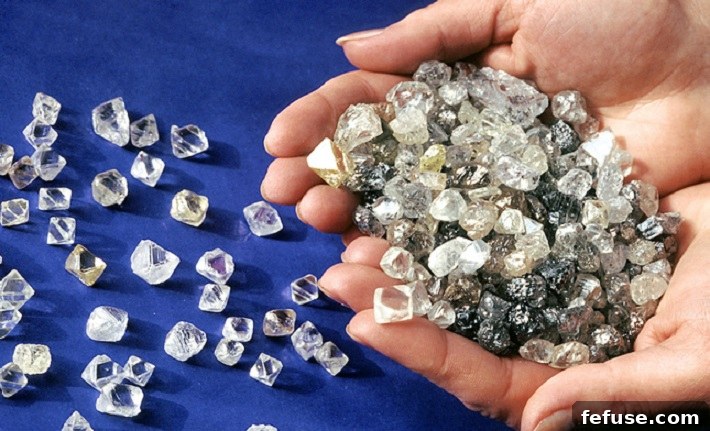
The intricate web of global trade and geopolitics has once again highlighted its complexities, particularly within the high-value rough diamond sector. Recent reports indicate a significant intervention by the United States, which has reportedly halted approximately $26 million in payments originating from Indian businesses. These transactions were ostensibly aimed at procuring rough diamonds from Russian suppliers, underscoring the ongoing tensions and enforcement challenges surrounding international sanctions against Moscow.
This development comes directly from the Office of Foreign Assets Control (OFAC), the primary US government agency responsible for administering and enforcing economic and trade sanctions. In recent months, OFAC is understood to have issued directives to various financial institutions, instructing them to block these fund transfers. A notable characteristic of these blocked payments is their origin: a substantial portion is believed to have been routed through subsidiaries of Indian companies operating within the United Arab Emirates (UAE), a prominent global trade and financial hub.
The situation is further complicated by the differing stances on Russian diamonds held by key nations. While the United States has unequivocally imposed sanctions on Russian rough diamonds as part of its broader economic pressure campaign against Russia, neither India nor the UAE has followed suit. This disparity creates a challenging environment for international trade, particularly for commodities like rough diamonds where supply chains are often complex and multi-jurisdictional. It is crucial to note that the US ban, while comprehensive for rough diamonds, does not extend to diamonds that have been cut and polished outside Russia, a crucial distinction for India, which serves as the world’s leading diamond processing center.
The broader international community has also grappled with establishing a unified front on this issue. Leaders of the G7 nations convened their summit in Hiroshima, Japan, in May, amidst widespread expectations that a clear mandate for fully sanctioning Russian diamonds would emerge. However, the summit concluded without such a definitive agreement, highlighting the intricate economic dependencies and the practical difficulties associated with implementing a universally enforceable ban on Russian diamonds. The challenges of tracing the origin of rough diamonds once they enter the processing pipeline, particularly in a globalized industry, have been a significant obstacle to achieving a consensus.
The underlying rationale for the US intervention is believed to stem from suspicions that these bank transfers were intended for entities in Russia that are currently under US sanctions. This enforcement action reflects the US government’s vigilant approach to preventing the circumvention of its sanction regimes. However, representatives from the Indian diamond industry vociferously dispute these allegations, asserting that the payments were legitimate and not in violation of international norms from their perspective. This divergence in interpretation forms the core of the current trade impasse.
In response to these unprecedented payment blockages, the Gem & Jewellery Export Promotion Council (GJEPC), a pivotal organization for India’s thriving diamond and jewelry sector, has initiated proactive lobbying efforts. The GJEPC is actively engaging with the Indian Ministry of Commerce and the Indian embassy in the UAE to seek a resolution to the matter. Their objective is to clarify the nature of these transactions and ensure that legitimate trade flows are not unduly hindered by the geopolitical climate. The council’s efforts underscore the significant economic stakes involved for India’s multi-billion dollar diamond industry, which is heavily reliant on a consistent supply of rough diamonds.
Vipul Shah, the esteemed chairman of the Gem and Jewellery Export Promotion Council (GJEPC), has provided further insight into the industry’s position. In an interview with Economic Times, Shah stated, “We are trying to explain to OFAC that the payments were made to non-sanctioned entities and even to some Russian entities well before the sanctions came into place. There is very little direct import of diamonds from Russia.” This statement is critical, as it emphasizes two key points: the alleged recipients were not sanctioned entities, or the transactions pre-dated the implementation of relevant sanctions. Furthermore, Shah’s clarification about the minimal direct import of diamonds from Russia highlights the often-indirect nature of their sourcing, frequently involving intermediaries in other jurisdictions.
From a financial perspective, the $26 million in blocked purchases represents a relatively modest proportion when viewed against the backdrop of India’s overall rough diamond import volume. According to GJEPC figures for the period spanning April to June, India’s average monthly rough diamond imports from all global sources amounted to a staggering $1.3 billion. While the immediate financial impact of the blocked funds might seem contained, the broader implications for trade finance, banking relationships, and the confidence of Indian businesses in international payment systems are significant. Such incidents can create a chilling effect, prompting businesses to seek alternative, potentially less transparent, payment mechanisms or to re-evaluate their supply chain strategies.
The ongoing dispute over these blocked payments serves as a stark reminder of the complexities of navigating global trade amidst evolving geopolitical landscapes. For India, the world’s undisputed leader in diamond cutting and polishing, maintaining access to a stable and diversified supply of rough diamonds is paramount for its economic well-being and the livelihoods of millions employed in the sector. The GJEPC’s diplomatic efforts are thus crucial in clarifying ambiguities and seeking pragmatic solutions that protect legitimate trade while respecting international sanction frameworks. This situation also prompts a broader discussion about the need for greater clarity in sanction enforcement, improved due diligence processes for financial institutions, and potentially, new mechanisms for transparent and verifiable diamond sourcing.
The challenge of distinguishing between legitimate trade and transactions that might inadvertently support sanctioned entities is immense. The global diamond market, with its inherent opacity and multi-layered supply chains, presents unique hurdles for regulators and industry players alike. The resolution of this specific $26 million blockage will likely set a precedent for future interactions and could influence how Indian diamond businesses structure their international transactions, potentially pushing them towards non-dollar denominated trade or alternative banking channels to mitigate perceived risks associated with US financial oversight. The delicate balance between enforcing sanctions and ensuring the smooth flow of essential international trade remains a key geopolitical and economic challenge for all parties involved.
Looking ahead, the resolution of this issue will depend heavily on the dialogue between the GJEPC, the Indian government, and OFAC. Clarity on what constitutes compliance, especially when countries have differing sanction policies, is essential for the long-term stability of the global diamond trade. This incident may also accelerate discussions around enhancing traceability technologies within the diamond industry, such as blockchain, to provide irrefutable proof of origin and transaction legitimacy. Such advancements could potentially alleviate future conflicts and foster greater trust across the supply chain. Ultimately, the future trajectory of India’s rough diamond imports from Russia, and indeed the broader international diamond trade, will be shaped by how these complex geopolitical and economic pressures are managed and resolved in the coming months.