
India’s Gold Rush: Why the RBI is Boosting Bullion Reserves Amid Global Shifts
In a significant move reflecting evolving global economic dynamics, the Reserve Bank of India (RBI) is poised to continue increasing its gold reserves throughout the year. This strategic accumulation mirrors similar actions taken by central banks in major economies like Russia and China, signaling a broader trend among nations to diversify their foreign-exchange holdings. As geopolitical tensions simmer and economic uncertainties persist worldwide, gold’s enduring appeal as a safe-haven asset is once again coming to the forefront, lending crucial support to global bullion demand.
The RBI’s growing interest in gold is not an isolated phenomenon but rather an integral part of a wider, calculated strategy adopted by numerous developing economies. According to Ross Strachan, an analyst at Capital Economics Ltd., these nations are actively seeking to reduce their reliance on the U.S. dollar within their foreign-exchange reserve portfolios – a process often referred to as ‘de-dollarization’. Strachan suggests that the RBI’s gold buying trend is sustainable and indicative of a long-term diversification strategy, likely to continue for several years, albeit in measured quantities.
Analysts are closely monitoring India’s gold acquisition pace. Howie Lee, an economist at Oversea-Chinese Banking Corp. (OCBC), projects that the RBI could acquire approximately 1.5 million ounces of gold in 2019, which translates to about 46.7 tons. This forecast is based on an extrapolation of the buying activity observed during the initial two months of the year, suggesting a consistent and deliberate approach to strengthening India’s gold reserves.
A Global Trend: Central Banks Embrace Gold as a Strategic Asset
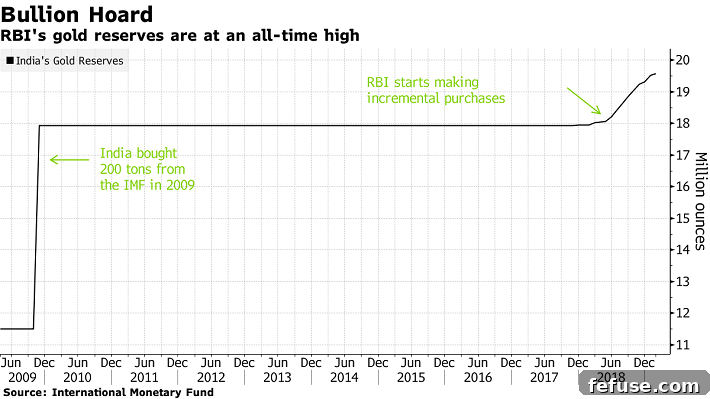
The momentum behind central bank gold purchases has been building steadily. The International Monetary Fund (IMF) data reveals that the RBI significantly augmented its gold stash by approximately 42 tons in the previous year. With additional purchases made in January and February of the current year, India’s gold reserves have reached an unprecedented high, nearing almost 609 tons. This figure firmly establishes India’s position among the top global holders of bullion, underscoring its commitment to reserve diversification.
India’s actions are part of a concerted global movement. Russia, for instance, has been a prominent buyer, adding a substantial 274 tons to its reserves in 2018 and continuing its acquisition spree this year. China’s central bank has also resumed its gold purchasing activities, initiating a renewed buying trend that commenced in December. These leading nations, alongside others such as Kazakhstan, Iran, and Turkey, are driving what Citigroup Inc. predicts could be a record year for official sector gold purchases, potentially reaching 700 tons globally in 2019.
The World Gold Council reported that governments worldwide added a remarkable 651.5 tons of bullion last year. This marked the second-highest total of purchases on record, a clear indicator of heightened geopolitical and economic uncertainty compelling central banks to re-evaluate their reserve compositions. The focus has decisively shifted towards investing in assets that offer both safety and liquidity, qualities inherently possessed by gold.
Why Gold Now? Geopolitical and Economic Headwinds Fuel Demand
The rationale behind this renewed interest in gold is multifaceted. Global financial markets have been navigating a complex landscape characterized by trade disputes, shifting monetary policies, and geopolitical flashpoints. In such an environment, fiat currencies and traditional reserve assets like government bonds can become susceptible to volatility. Gold, by contrast, has historically demonstrated its ability to act as a hedge against inflation and currency depreciation, offering a stable store of value.
Goldman Sachs Group Inc. anticipates further inflows into the gold market, potentially matching the robust levels seen in 2018, primarily driven by continued buying from China, Russia, and Kazakhstan. These sustained purchases are expected to be supportive of gold prices. While spot gold experienced a dip of about 5.6 percent since its peak in February amidst a rally in equities, the underlying demand from central banks suggests a strong floor for its value.
Howie Lee of OCBC observes a distinct pattern among central banks: “There seems to be some form of a pattern, not just the RBI, that central banks tend to increase gold reserves when the global macroeconomic environment is uncertain.” He further elaborates on the strategic implications, noting, “It’s no coincidence that one of the biggest buyers of gold in recent months was China, which is in the midst of trade tensions with the U.S. and may have been seeking to diversify its trillions of dollar reserves.” India, according to Lee, appears to be adopting a similar diversification tactic, responding to its own set of economic and geopolitical considerations.
One of the most significant disruptors to global stability has been the ongoing trade war between the U.S. and China. This economic confrontation has not only snarled supply chains and created significant market volatility but has also cast a shadow over the world economy. The repercussions are far-reaching, prompting nations to reconsider their economic vulnerabilities and seek greater autonomy in their financial reserves. Furthermore, the U.S. administration’s stance on trade, exemplified by Donald Trump’s March announcement to potentially end key trade preferences for India and Turkey, adds another layer of complexity. Such actions initiate a 60-day countdown before presidential authority can be exercised, compelling affected nations to fortify their economic positions.
India’s Strategic Imperative: Diversification and Economic Stability
While the RBI refrained from commenting on its gold purchasing strategy when approached, its annual report for 2017-2018, released in August, provided a clear indication of its intent. The report explicitly stated that the diversification of foreign currency assets continued throughout the year and, significantly, that the “gold portfolio has also been activated.” This statement confirms the central bank’s proactive and systematic approach to managing its reserves.
Factors Influencing the RBI’s Gold Strategy
Several domestic and international factors are converging to influence the RBI’s gold strategy. According to Shekhar Bhandari, the Mumbai-based business head of global transaction banking and precious metals at Kotak Mahindra Bank Ltd., the rising U.S. deficit coupled with the Federal Reserve’s signal to pause interest rate hikes could be pivotal. These developments potentially compel the RBI to further bolster its gold holdings, strategically positioning India’s financial assets.
Bhandari also highlights the interplay between India’s foreign-exchange reserves and its economic objectives. India’s foreign-exchange reserves have been improving steadily, bolstered by robust foreign fund inflows. In this scenario, purchasing U.S. Treasuries and gold serves a dual purpose: it helps to maintain the Indian rupee on the weaker side, which is beneficial for boosting exports, thereby supporting domestic economic growth and competitiveness in international markets.
The Indian rupee, which had a challenging 2018 as Asia’s worst-performing major currency, has shown signs of strengthening in recent months. This resurgence is primarily attributed to strong foreign inflows into both equity and debt markets, reflecting renewed investor confidence. However, the economic landscape remains subject to various risks. Investors continue to be wary of potential increases in global oil prices, which could impact India, a major oil importer. Swings in global risk appetite, influenced by international events, and the upcoming federal elections in the country also represent significant uncertainties that the RBI must navigate.
The Untapped Potential: Room for Further Gold Accumulation
Despite India’s significant gold holdings—currently the 10th largest by country—there remains substantial room for further diversification. Data from the World Gold Council (WGC) illustrates this point clearly: India’s gold holdings account for only 6.4 percent of its total reserves. This proportion stands in stark contrast to that of developed economies like Germany and the U.S., where gold comprises more than 70 percent of their respective national reserves. This disparity suggests that India has considerable scope to increase its gold allocation without over-concentrating its reserve portfolio.
Carsten Fritsch, a senior commodity analyst at Commerzbank AG in Frankfurt, views this comparison as a compelling argument for continued gold buying by the RBI. “This is an argument for further buying,” Fritsch states, emphasizing the strategic advantage of increasing gold reserves to align with global best practices in reserve management. While acknowledging the speculative nature of predicting exact figures, he suggests, “It is too speculative to say how much gold the RBI will buy this year. It could be more than last year, though.” This expert sentiment reinforces the expectation that India’s gold accumulation is a sustained, strategic endeavor rather than a fleeting response to short-term market fluctuations.
In conclusion, the Reserve Bank of India’s ongoing gold acquisition strategy is a meticulously planned move within a complex global economic framework. It reflects a prudent approach to reserve management, aimed at enhancing stability and resilience against a backdrop of de-dollarization trends, geopolitical uncertainties, and domestic economic imperatives. As India continues to rise as a global economic power, its strategic embrace of gold is likely to bolster its financial security, contribute to global gold demand, and shape the future landscape of international monetary reserves.